I always enjoy the trippy videos.
I hope you do, too.
Enjoy!
I always enjoy the trippy videos.
I hope you do, too.
Enjoy!

I can’t decide if episode nine of DC Universe’s original streaming series Doom Patrol is so good it hurts — or if it just fucking hurts.
Playing it pretty close and tight with its Grant Morrison/Richard Case-created “source material,” this is “Crazy” Jane’s story all the way — they don’t call it “Jane Patrol” for nothing — and Diane Guerrero puts on an acting clinic manifesting personalities seen and hitherto-unseen (hello Driver 8!) when Brendan Fraser’s Cliff Steele (with an assist from the “Negative Spirit” inside Matt Bomer/Matthew Zuk’s Larry Trainor) enters “the underground” of her subconscious to retrieve the Jane we know and love, who just last week collapsed within herself right at the moment her Karen persona was about to tie the knot. You thought this show was weird before? You really ain’t seen nothing yet.
Now, we’re used to Timothy Dalton’s “Chief” Niles Caluder and Alan…
View original post 510 more words

Is Chilling Adventures of Sabrina the most underlit show on Netflix?
Seriously, every scene on the show seems to take place in near darkness. I get that’s because the show itself is supposed to be dark and spooky and I appreciate the fact that the show is trying to maintain a proper atmosphere but still, as I watched the fourth episode of the 2nd season, I found myself shouting, “Will someone turn on a freaking light!?” Like a lot of things about this show, the constant darkness seems like one of those “it seemed like a good idea at the time” concepts.
That said, I also have to say that I liked this installment a bit more than the previous episode. Though it can probably be correctly stated that this was something of a filler episode, it still had enough surreal moments to remain entertaining. In fact, it reminded me a bit of last season’s superior Dreams In A Witch House. Like that episode, House of Horrors largely took place in the minds of the show’s characters. Whereas Dreams In A Witch House used the character’s nightmares as a way to provide a glimpse of their subconscious fears and desires, this episode used Tarot readings.
The episode begins with Hilda and Dr. Cee hanging out at Cerebrus Books. No mention is made of the fact that Dr. Cee apparently has an incubus inside of him, which seems like an odd thing to go unmentioned. Anyway, a fortune teller (played by Veronica Cartwright) shows up and asks if she can do readings in the back of the store. Hilda and Dr. Cee promptly agree because …. well, when do they ever say no to anyone?
For the next hour, various characters wandered into Cerebrus Books and got their fortune read. The fortune teller turning over her cards would lead to everyone having a surreal vision of the future. The visions rarely turned out well but, with one huge exception, the fortune teller was always quick to explain that the ominous vision was actually a good thing. For instance, Sabrina may have seen herself getting killed during Nick’s magic show but the fortune teller was quick to explain that the vision meant Sabrina should put her faith in Nick and not trust anyone else. Theo may have had a vision of turning into a boy and then having his body turn to wood but apparently, that meant Theo should trust others to help him out. Roz was thinking of having an operation to get her sight restored but her vision — in which a blind girl accused Roz of stealing her eyes — convinced Roz that she should remain blind. Harvey saw that going to Rhode Island would lead to him having a Satanic roommate. Hilda envisioned telling Father Blackwood the truth about the baby but then discovered that would just lead to Blackwood cheating on her. “Some secrets,” the fortune teller announces, “should stay secrets.”
Finally, Ambrose showed up and got his vision of the future. Four things disturbed him. First off, Luke was nowhere in the vision. Secondly, in the vision, Father Blackwood made him a member of the Judas Society and ordered him to murder the Spellmans. Third, in the vision, Ambrose did just that. And fourth, the fortune teller told Ambrose this was going to happen, regardless of what he did.
Rushing to Father Blackwood’s office, Ambrose asked for an assurance that Father Blackwood would never hurt the Spellmans. “Of course not!” Blackwood replied before informing Ambrose that Luke was dead and that Ambrose was now a member of the Judas Society….
After all this, it was revealed that the fortune teller had actually been Ms. Wardwell in disguise. I can’t say that I was particularly surprised by this reveal. Since Wardwell was, up until the show’s final five minutes, the only regular not to have made an appearance, it was obvious that the fortune teller would turn out to be her. I’m going to assume that her advice was intentionally bad and we should definitely be worried about Sabrina’s relationship with Nick.
Anyway, this episode was entertaining enough. Since Sabrina is really the only multidimensional character on the show, Chilling Adventures can be uneven when it doesn’t focus on her but this show managed to do a pretty good job with the other characters. We may not have learned anything new about any of them but some of their visions were enjoyably surreal and macabre. The scenes of Theo’s body turning to wood were well-handled and Roz’s vision was genuinely frightening. Even though you knew they weren’t real, the scenes of a murderous Ambrose stalking through the Spellman House were appropriately creepy.
Up next in the TSL’s Sabrina review-a-thon: Case returns with his reviews of Episodes Five and Six!
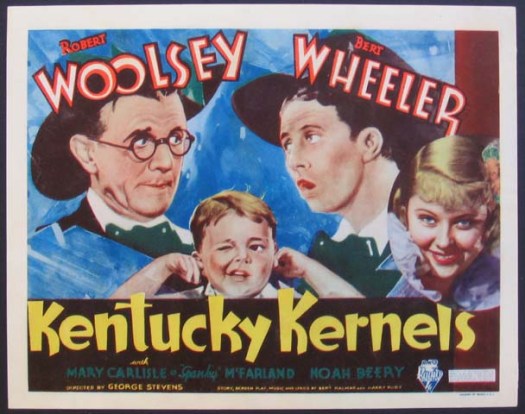
The comedy team of Bert Wheeler and Robert Woosley join forces with Our Gang’s Spanky McFarland in KENTUCKY KERNALS, directed by Hal Roach vet George Stevens. Sounds like the perfect recipe for a barrel of laughs, right? Well, while there are some laughs to be had, the (then) recent enforcement of the Production Code finds W&W much more subdued than in their earlier zany efforts, and playing second fiddle to both Spanky’s admittedly funny antics and the plot at hand, a takeoff on the famed Hatfield-McCoy feud.

Weirdly enough, the film starts off with a lovelorn man attempting suicide by jumping off a bridge. Fortunately for him, he lands in a fishing net owned by down-on-their luck vaudevillians Elmer (Woolsey) and Willie (Wheeler), living in a waterfront shack. The two convince him to adopt a child, and go to the orphanage, where they find cute little Spanky, who has a…
View original post 377 more words

by Virgil Finlay
Enjoy!

Artist Unknown


Here’s the thing — most “indie” comics creators, and even most “indie” comics readers, fancy themselves as “outsiders,” to one degree or another. Not only do we work on, or take pleasure from, an art form that is on the “margins,” but one that is on the very margins of those margins, divorced entirely from the industry that most people think of when they even do think of comics in the first place. When the small press and self-publishers are your “bag,” then you are, by both definition and default, “way out there.”
I think that sometimes we romanticize this “outsider” status, as well — I mean, we probably have to since none of us are in it for the money. We speak a secret language known only to us, one loaded with references and terminology those squares out there in the “straight world” could never understand. We’re interested in…
View original post 631 more words
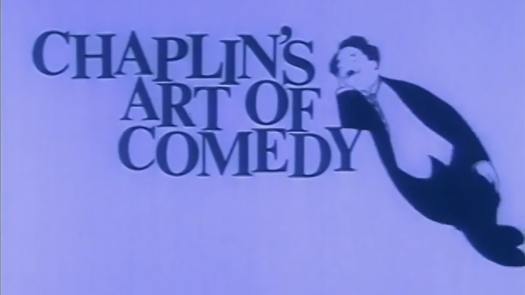
Today we celebrate the birthday of the immortal Charlie Chaplin , born on this date 130 years ago. Chaplin made his film debut 105 years ago this year, and the world hasn’t stopped laughing since! His silent comedies featuring the endurable character “The Little Tramp” (or as Chaplin called him, “The Little Fellow”) have stood the test of time, and his mix of humor and pathos elevated slapstick comedy to high art. The compilation film CHAPLIN’S ART OF COMEDY highlights Chaplin’s early efforts at Essanay Studios from 1914-15, and contains some of his best work.
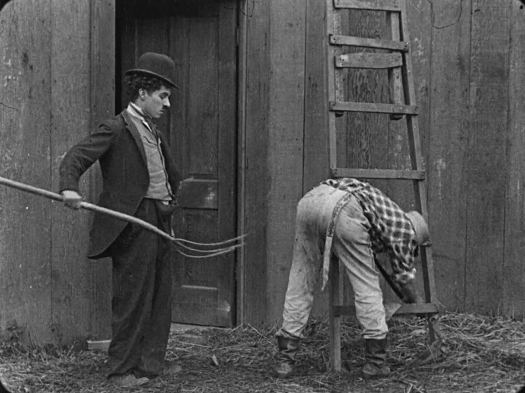
The success of Robert Youngson’s 1959 film THE GOLDEN AGE OF COMEDY (spotlighting silent luminaries like Laurel & Hardy, Ben Turpin, and others) had spawned a whole host of imitators over the next decade utilizing low-to-no cost silent footage and repackaging it into a new feature film. Some were good, others lackadaisically put together, most…
View original post 370 more words

 Through the Shattered Lens