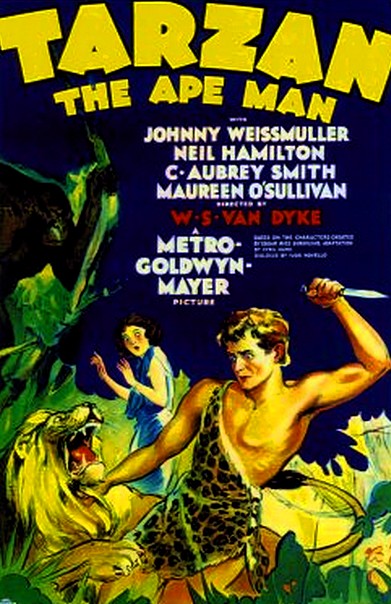
Edgar Rice Burroughs’ Lord of the Jungle first hit the screen way back in 1918 with Elmo Lincoln as Tarzan. Many actors since then have donned the loin cloth, but for me the definitive movie Tarzan remains Johnny Weissmuller , who swung from his first Hollywood vine in MGM’s TARZAN, THE APE MAN, and played the part for 16 years in 12 films.
Elderly John Parker and his young partner Harry Holt are in deepest Africa searching for the legendary “elephant’s graveyard”, which contains a fortune in ivory, but is considered sacred ground by the native tribes. Parker’s daughter Jane shows up, a spirited girl who’s no ball of fluff, but can hold her own. When Jane insists on accompanying the men on their journey, Parker scoffs, but Harry signs off because of course he’s immediately smitten with her.The jungle trek is fraught with perils, like a dangerous river crossing…
Tears For Fears frontman Roland Orzabal and keyboardist Ian Stanley were both practitioners of primal scream therapy, in which people confronted their fears and insecurities by shouting. This song was inspired by both the treatment and political protest.
The video, which was put in heavy rotation on MTV and become one of the defining videos and songs of the 1980s, features Orazbal and Curt Smith letting it all out on the cliffside at Durdle Door in Dorset. The video was one of the 300-something videos to have been directed by Nigel Dick, who has done videos for almost everyone.
Shout spend three weeks as the number one single in the US and has since become Tears for Fears signature song, along with Everybody Wants To Rule The World.
The 1947 film, Shoot to Kill (also known as Police Reporter), opens with both a bang and a crash.
The police are chasing a car down one dark and lonely road. When that car crashes, the police are shocked to discover who was inside of it. Two men and one woman, all well-dressed. The men are both dead but the woman is merely unconscious. The police identify one of the men as being the notorious gangster, Dixie Logan (Robert Kent). It makes sense that Logan would be fleeing the police but what about his two passengers, newly elected District Attorney Lawrence Dale (Edmund MacDonald) and Dale’s wife, Marian (Luana Walters)?
The police may not be able to get any answers but fortunately, there’s a reporter around! Mitch Mitchell (Russell Wade) is a crime reporter and, seeing as how he knew both Lawrence and Marian, he seems like the perfect person to get some answers. (In fact, it was Mitch who first suggested that Lawrence should hire Marian as his administrative assistant, therefore setting in motion the whirlwind romance that would end with them married.) Mitch goes to see Marian in her hospital room and he asks her what happened.
It’s flashback time! Yes, this is one of those films where almost the entire film is a flashback. That, in itself, is not surprising. Some of the best film noirs of all time were just extended flashbacks. (D.O.A, Double Indemnity, and Sunset Boulevard, to name just a few examples.) What sets Shoot to Kill apart is the fact that, occasionally, we even get characters having a second flashback while already in someone else’s flashback. We’re through the the film noir looking glass here, people.
Lawrence Dale, we’re told, was elected district attorney because he managed to secure the conviction of notorious gangster Dixie Logan, despite Logan’s insistence that he was no longer involved in the rackets. However, what we soon discover is that not only was Logan actually innocent but Dale specifically prosecuted him as a favor to some of Dale’s rival gangsters. That’s right, Lawrence Dale was on the take! It also turns out that Marian has some secrets of her own. When she first showed up at Dale’s office, she was doing more than just looking for a job. As for her marriage to Dale …. well, I really can’t tell you what the twist is here because it would spoil the entire film.
Shoot To Kill may clock in at just 64 minutes but it manages to pack a lot of twists and turns into just an hour. In fact, I’d argue that it probably tries to do a little bit too much. At times, the film is a bit difficult to follow and a few inconsistent performances don’t help matters. For instance, Russell Wade is likable as the crime reporter but he still doesn’t exactly have a dynamic screen presence. Much better cast are Luana Walters and Edmund MacDonald, who both do a good job as, respectively, a femme fatale and a sap. At the very least, history nerds like me will be amused by the fact that Edmund MacDonald was obviously made up to resemble Thomas E. Dewey, the former Manhattan District Attorney who twice lost the U.S. presidency.
The best thing about Shoot To Kill is the look of the movie. Filmed in grainy black-and-white and full of dark shadows, crooked camera angles, and men in fedoras lighting cigarettes in alleys, Shoot to Kill looks the way that a film noir is supposed to look.
Regardless of whether it was the filmmaker’s original intention, Shoot To Kill plays out like a low-budget, black-and-white fever dream. It’s definitely a flawed film but, for lovers of film noir, still worth a look.
In an interview with the now-defunct Kicking It Old School Blog, T’Pau’s Carol Decker explained the genesis of the song that would become Heart and Soul. It all began when her bandmate and then-boyfriend Ron Rogers purchased a new keyboard with a built-in synthesizer:
“He was just trying to get used to the gizmos in it and while messing around with the sequencer he started the ‘bum bum buh buh bum bum bum’ of the bass riff. T’PauI started to sing a melody over it, the wafty vocal and came up with ‘more than an ocean keeps us apart.’ … The lyrics were about when I went on holiday with my parents and Ronnie couldn’t come. I missed him so much, but then I morphed the story into a fictitious one of not being loved back (which I was) … The rap was the idea of Andy Piercy, our then producer. He said the gaps needed filling, so I started these syncopated sort of nonsense noises. I then turned those noises into words which took about a week to get right.”
The song reached #4 in both the U.S. and the UK Charts. In the UK, it became a hit after it was used in a clothing advertisement while, in America, its success was largely credited to the above music video, which was put into heavy rotation on MTV.
The song is best known for its vocal layering, with Decker’s melody lines coming in over the rap. Stylistically, the video’s is similarly layered, resulting in a perfect synthesis of audio and visual.
Heart and Soul is song that epitomizes an era. Personally, I have fond memories of fleeing from the Liberty City police while listening to it.
Everything’s better with a little heart and soul.
And yes, T’Pau was named after a Vulcan who appeared on an episode of Star Trek. Before Decker saw that episode of Star Trek, the band was called Talking America.
In the 1949 film, Undertow, Scott Brady plays Tony Reagan. Tony used to be a member of the Chicago mob but that’s all in the past now. He served his country in World War II and now, as he tells his old racket friend, Danny (John Russell), all Tony wants to do is settle down and run a hunting lodge in Reno.
However, before Tony can forever abandon Chicago for Nevada, he has to make peace with his future in-laws. He’s engaged to marry Sally Lee (Dorothy Hart). In fact, he’s so in love with her that not even meeting a single teacher named Ann McKnight (Peggy Dow) can distract Tony from his plans. The only problem is that Sally is the niece of a Chicago gangster named Big Jim Lee and, in the past, Big Jim and Tony haven’t always been the best of friends. In fact, the Chicago police are constantly harassing Tony because they’re convinced that he wants to start a gang war with Big Jim. Instead, Tony just wants to make peace with Big Jim before the wedding.
Tony goes to visit Big Jim and …. well, you can guess what’s going to happen, can’t you? If you’ve seen enough film noirs, you know that no one is every totally out of the rackets. No one believes an ex-mobster when they say that they’re no longer interested in making trouble. Even worse, any murder committed with automatically be blamed on anyone who says that they’re no longer a member of the rackets. That’s what happens to Tony. Not only does he discover that Big Jim has been shot dead but everyone thinks that he’s the one who did it. Fleeing through the shadowy streets of Chicago, Tony finds himself not only being pursued by the police but also by the murderers. Everyone wants to either capture or kill Tony.
In fact, the only person who seems to be on Tony’s side is Ann McKnight. Ann lets Tony hide out at her apartment while he tries to figure out what’s going on. Of course, Ann does have a nosy landlady who has no hesitation about letting herself into the apartment whenever she feels like it….
The plot of Undertow isn’t going to win any points for originality. It’s not going to take you long to figure out who is setting Tony up, if just because there really aren’t enough characters in the film for there to be much suspense about who is betraying who. But no matter! The film is still an atmospherically shot and briskly-paced thriller. Undertow was directed by William Castle, who is probably best known for directing campy B-movies like The Tingler and Strait-Jacket. There’s nothing campy about Castle’s direction of Undertow. The majority of the film was shot on location and Castle makes great use of Chicago. When Tony tries to lose the cops that are tailing him, it helps that he’s not running across a soundstage but instead down real city streets, ones that feels alive with tension and danger. There’s also a great chase that takes place in a long and dark corridor in an underground garage.
Scott Brady (who was the brother of tough-guy actor Lawrence Tierney) gives a sympathetic performance as Tony and he and Peggy Dow have a really likable chemistry in their scenes together. Dorothy Hart is also well-cast as the film’s femme fatale, while Bruce Bennett has a few good scenes as a detective who is an old friend of Tony’s. Fans of “classic” matinée idols will want to keep an eye out for Rock Hudson, making a brief appearance in his second film and credited as “Roc” Hudson.
Every Tuesday during the month of “Noirvember”, I’ll be spotlighting some dark genre gems. Enjoy wandering down the crooked path of film noir!
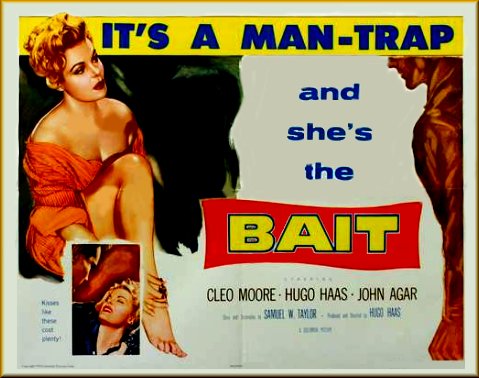
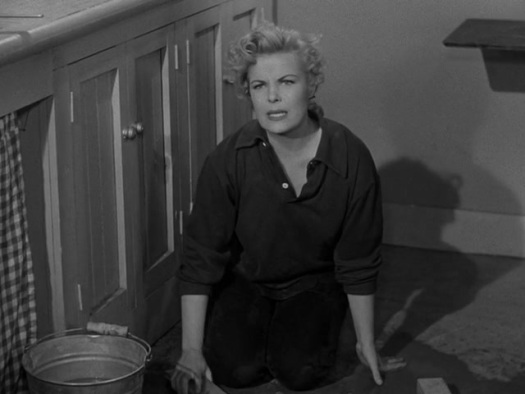
Welcome to the world of Hugo Haas, King of Low-Budget 50’s Film Noir. I’d heard about producer/director/writer/actor Haas’s films for years through Leonard Maltin’s annual Movie Guide, usually accompanied by a *1/2 to ** (or less!) rating. Of course, being a connoisseur of bad cinema, I was interested, but it wasn’t until recently I viewed my first Hugo Haas epic, 1954’s BAIT, starring Hugo’s screen muse Cleo Moore, who was featured in seven of the maestro’s movies.
BAIT starts with a unique introduction (and some nice camerawork from DP Eddie Fitzgerald), as an elegantly dressed Sir Cedric Hardwicke plays The Devil Himself delivering a monologue expounding on his evil machinations. Then we get into the story itself (written by Samuel W. Taylor, with “additional dialog”…
Inspired by a story that the Human League’s Phil Oakley read in a teen-girl’s magazine, Don’t You Want Me is a song not about love but instead a song about two people battling for control. While the song was originally conceived as being a male solo, Oakley made the last-minute decision to turn it into a duet, with Susan Ann Sulley taking on the role of the girl who once worked in a cocktail bar but always knew she was meant for a much better life.
After the song was recorded, Oakley disliked it because he felt that the song’s sound was too “poppy” and he was not happy when Virgin decided to release Don’t You Want Me as the fourth single off of The Human League’s third studio album, Dare! Despite Oakley’s misgivings, Don’t You Want Me went on to become the band’s biggest hit and one of its signature songs.
(As of 2014, Phil Oakley still didn’t think much of the song. In an interview with Classic Pop Magazine, Oakley said, “‘Don’t You Want Me‘ might have shifted gazillions, but either I’ve heard it too many times or the rest of Dare! is just so far ahead that it puts it in the shade. Still, it made the band.”)
The music video was shot at a time when MTV was still in its infancy and many people weren’t even sure what a music video was supposed to be. Filmed on a cold, rainy night in Slough, Berkshire, the video featured Phil Oakley as a director and Susan Ann Sulley as the actress who walks out on him during the filming of a murder-mystery. Director Steve Barron used 35mm film, giving the video a richly cinematic look that was unusual for the music videos of the time. Reportedly, Barron was influenced by Truffaut’s Day For Night, which is why the clapper board features the inscription, Le League Humain.
The video not only helped to make the song a hit but it also did the same for MTV itself. At a time when many were still wondering if people would actually watch MTV, the popularity of this video gave them a reason to do just that. The video proved that music videos didn’t have to just be bland performance clips. Instead, like any film, a music video could tell a story of its very own.
Don’t You Want Me was the 1981 Christmas number one in the UK, where it has sold over 1,560,000 copies, making it the 23rd most successful single in the history of the UK Singles Chart. In 2015, in an ITV poll, it was voted the 7th most popular number one single of all time.




 Through the Shattered Lens