4 Shots From 4 Films is just what it says it is, 4 shots from 4 of our favorite films. As opposed to the reviews and recaps that we usually post, 4 Shots From 4 Films is all about letting the visuals do the talking.
This October, I am going to be using our 4 Shots From 4 Films feature to pay tribute to some of my favorite horror directors, in alphabetical order! That’s right, we’re going from Argento to Zombie in one month!
Today’s director is Roy Ward Baker, one of the masters of Hammer and Amicus horror!
4 Shots From 4 Films
Quatermass and the Pit (1967, dir by Roy Ward Baker)
Today’s horror film is a true classic of its kind, the 1953 science fiction epic Robot Monster.
Now, I should admit that this is not the first time that I’ve shared Robot Monster in October. I share it every year and, every year, YouTube seems to pull the video down in November. That sucks because Robot Monster is one of those weird films that everyone should see. So, I’m going to share it again. And, hopefully, YouTube will let the video stay up for a while.
As for what Robot Monster is about…
What happens with the Earth is attacked by aliens? Well, first off, dinosaurs come back to life. All of humanity is killed, except for one annoying family. Finally, the fearsome Ro-Man is sent down to the planet to make sure that it’s ready for colonization. (Or something like that. To be honest, Ro-Man’s exact goal remains a bit vague.)
Why is Ro-Man so fearsome? Well, he lives in a cave for one thing. He also owns a bubble machine. And finally, perhaps most horrifically, he’s a gorilla wearing a diver’s helmet. However, Ro-Man is not just a one-dimensional bad guy. No, he actually gets to have a monologue about halfway through the film in which he considers the existential issues inherent in being a gorilla wearing a diver’s helmet.
Can humanity defeat Ro-Man? Will Ro-Man ever get his intergalactic supervisor to appreciate him? And finally, why are the dinosaurs there?
All of those questions, and more, are cheerfully left unanswered but that’s a large part of this odd, zero-budget film’s considerable charm. If you’ve never seen it before, you owe it to yourself to set aside an hour and two minutes in order to watch it.
(Lisa is not just devoting all of her time to horror movies this month! She is also trying to clean out her DVR. She has recorded over 170 movies this year and she needs to watch all of them before January 1st! Will she make it? Keep checking this site to find out! Lisa recorded The Wrong Bed: Naked Pursuit off of the Lifetime Movie Network on June 2nd.)
Now, this is just frustrating!
When you sit down to watch a movie called The Wrong Bed: Naked Pursuit, I think you’re justified in thinking that the majority of the movie is going to take place in a bed (perhaps even the wrong bed, which I guess would mean that it has a lumpy mattress or a lice-infected pillow something). I think you’re also justified in expecting that everyone’s going to be naked for the majority of the movie. As for the pursuit — well, pursuit can mean anything. Maybe the two naked people in the wrong bed are pursuing pleasure or enlightenment. Maybe they’re pursuing the ultimate high of sexually decadent ennui. Who knows?
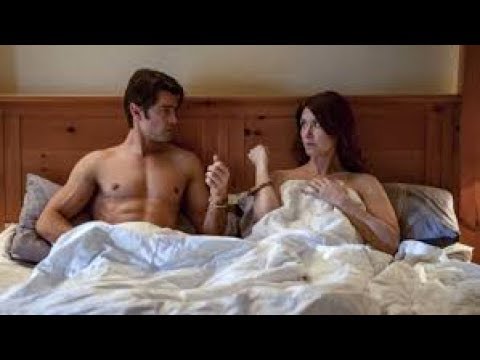
Well, The Wrong Bed: Naked Pursuit does open with Stella (Jewel Statie) and Owen (Corey Sevier) waking up naked in bed and handcuffed together. However, it’s not the wrong bed. It’s just a hotel bed and it looks like a pretty nice hotel, too! Both Owen and Stella are naked but that only lasts for about ten minutes. Eventually, they get out of bed and manage to get partially dressed. And while I appreciate the fact that the film is honest about the difficult of putting on a bra while handcuffed to another person (because, seriously, it’s not as easy as the movie’s usually make it look), that still doesn’t change the fact that the title specifically promised us a naked pursuit in the wrong bed.
Now, I should admit that the title is honest about the pursuit part. When Owen and Stella wake up, they have no memory of how they met or eventually ended up in bed together. However, they do know that someone is chasing them. They spend the entire movie running around Canada, trying not to get caught by the usual collection of men in suits and uniforms. Occasionally, Stella has flashes of memory. She sees herself strapped down to a gurney with a scientist named Larissa (Lisa Berry) preparing to give her a shot. She realizes that she and her best friend tried to earn some extra money by taking part in some sort of clinical study. However, something went wrong…
Stella and Owen try to retrace their steps. It turns out that they both got pretty wild the night before they woke up in the not-so wrong bed. They ever started a riot at a bowling alley. Even more importantly, they find the time to stop by Owen’s house. Owen, who says that he’s a fireman, lives in an impressively big house. That’s Lifetime, though. Everyone gets a mansion, regardless of what they do for a living.
Anyway, once I got over the misleading title, The Wrong Bed turned out to be a pretty entertaining little movie. It was directed by Monika Mitchell, who has done several Lifetime movies and who can always be depended on to keep the action moving quickly. Things got a little bit silly once Owen and Stella discovered why they were being pursued but no matter! Jewel Statie and Corey Sevier had chemistry and Sevier looked good without his shirt on.
To my knowledge, this is the last Toto Coelo video out there. I can’t imagine why this song didn’t do as well as I Eat Cannibals and Milk From The Coconut. Some of these lyrics are priceless:
‘Cause your castle is a nightmare
You’ve got batty friends who live there
Oh please, just squeeze
I go insane don’t tap my windowpane
……
Got to get my teeth in you
Necking is the thing to do
Even though they never know it
Positive or not
You and I coagulate
Vitalize a dying rate
Vladimir my dear
You know I’m after every drop
Get into a different vein
R.I.P is all the same
I was bitten now I’m trying
Transylvania
You’re the coffin I’m the key
We tune up in harmony
I’ll do anything for you
Except for mania
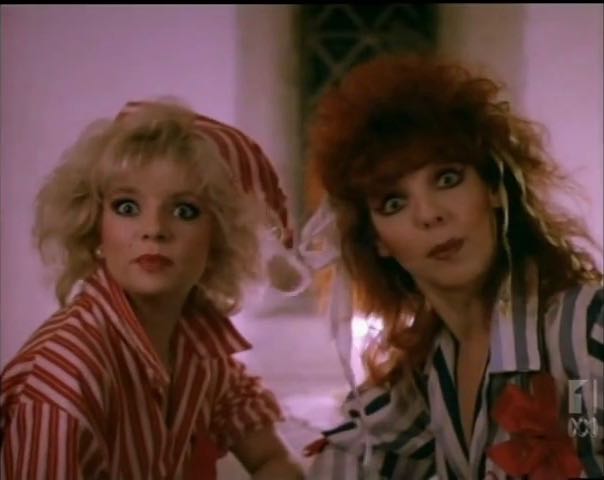
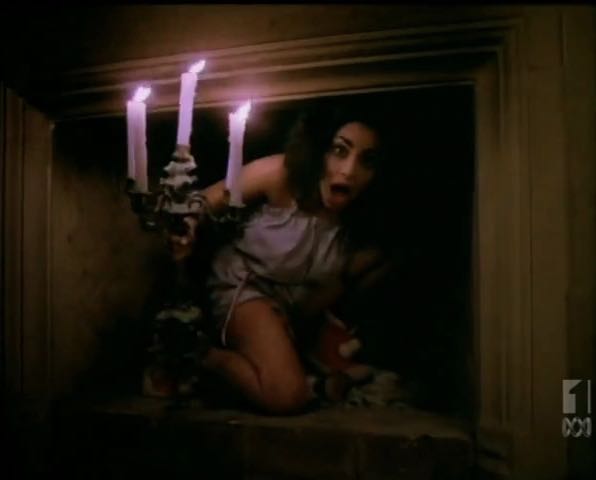
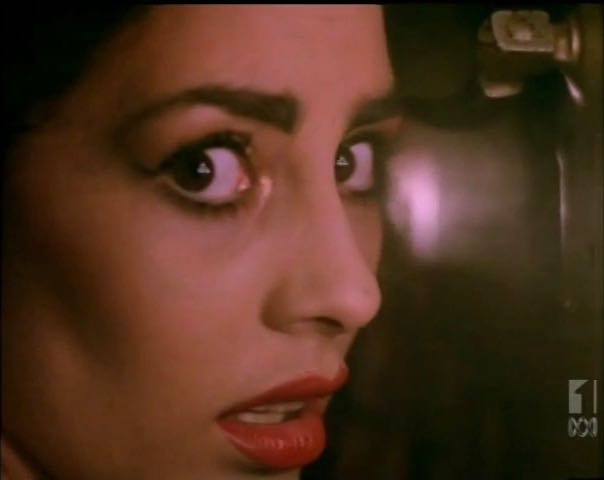
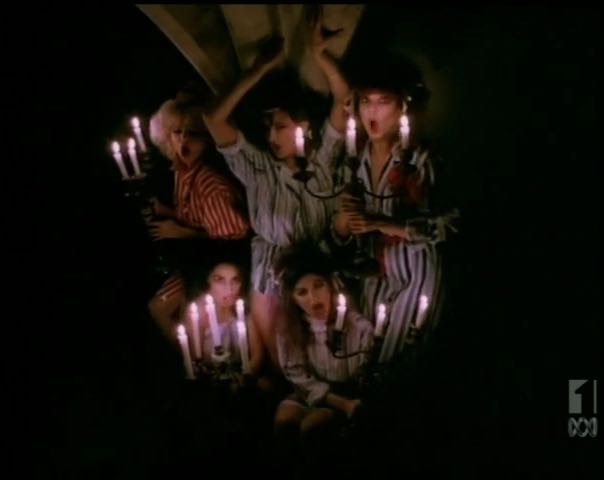
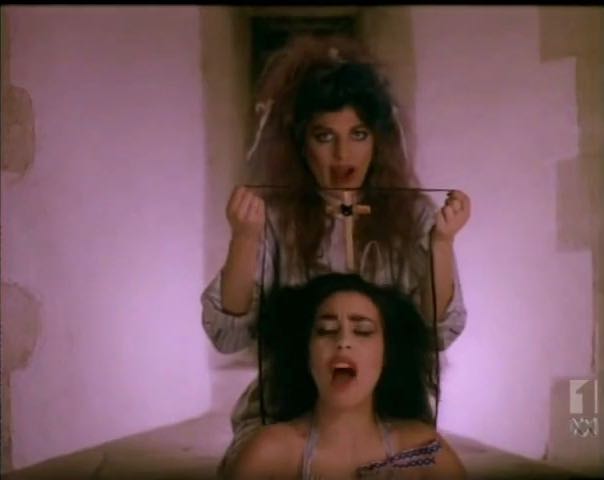
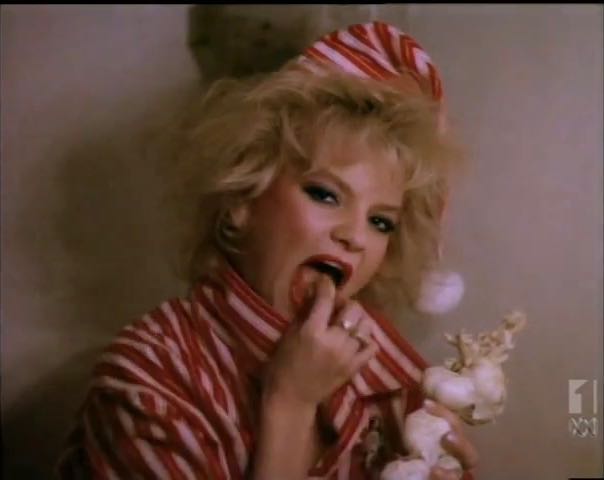
Then you have the video. I love this video. There’s something goofy in almost every shot.
They also make sure to pound it into your head that the song has something to do with sex. It’s a little difficult to miss that when you watch the video.
The dance isn’t the best part, but it’s pretty great. You can find numerous videos of people doing their own dance to the song:
They even performed this live for the German TV Show WWF Club:
Something tells me this song is what people think the Twilight films are until they’re unfortunate enough to sit through them.
Can you believe it? The first day of Horrorthon is nearly over! I’ve got tears in my mismatched eyes.
You may remember, from previous horrorthons, that I like to end each day in October by sharing a classic example of televised horror. Much as with the the horror movies that I share at the start of each day, it should be remembered that I’m a bit at the whim of YouTube here. If YouTube decides to yank down a video after I share it on this site, there’s nothing that I can do about it. That’s why I encourage everyone to watch these now! Don’t wait until 2024. Who knows if YouTube will even still be a thing in 2024?
Anyway, let’s start things off with The Curse of Degrassi!
This is a special episode of my favorite TV show of all, Degrassi! Originally airing on October 28th, 2008, The Curse of Degrassi features Degrassi’s main mean girl, Holy J Sinclair (Charlotte Arnold), getting possessed by the vengeful spirit of deceased school shooter, Rick Murray (Ephraim Ellis). Chaos follows! Fortunately, Spinner (Shane Kippel) is around to save the day. As any true Degrassi fan can tell you, only Spinner has a chance against the forces of the undead.
Enjoy!
(Before anyone asks, yes, I did share this same episode last October. What can I say? I really like Degrassi and forcing people to watch my favorite Canadian obsession is a bit of a tradition around here. We’re all about tradition here at the Shattered Lens.)
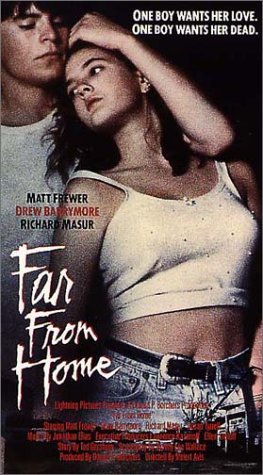
There are several lessons that can be learned from watching horror films. One that is often overlooked is the importance of staying out of trailer parks. Seriously, I have lost track of how many horror films have taken place within the confines of a trailer park. Once you see someone surrounded by RVs and mobile homes, you know that they’re probably doomed.
Take 1989’s Far From Home, for instance.
Far From Home is set in perhaps the sleaziest trailer park in America. This place sits in the middle of the Nevada desert and is run by chain-smoking Agnes Reed (Susan Tyrrell), who has a voice like a bullfrog, a daughter (Stephanie Walski) who is obsessed with watching TV and eating fishsticks, and a delinquent teenage son named Jimmy (Andras Jones).
The only law is provided by Sheriff Bill Childers (Dick Miller), who has a squad car but apparently no deputies. Childers is gruff but not that bad of a guy once you get to know him. However, he’s also played by Dick Miller and we all know better than to depend on Dick Miller to maintain the peace.
There’s a gas station nearby. A mellow Vietnam vet named Duckett (Richard Masur) owns it. Duckett is always willing to be helpful but he rarely has any gas. This is one of those small towns where the gas truck apparently only rolls in every two months or so. Still, Duckett’s a nice guy and he’s full of stories about how the government used to do atomic bomb tests in the surrounding desert.
(The scenes where Duckett drives around the desert feel somewhat out of place but they’re still enjoyable, due to Masur’s eccentric performance.)
Living in the trailer park, there’s a lot of odd people. Some of them are permanent residents while some of them are just temporarily stranded. 14 year-old Pinky (Anthony Rapp, who would go on to appear in Dazed and Confused and Rent) lives with his mother and is a permanent resident. His mother is rarely seen, though occasionally she can be glimpsed through a window, propped up in front of the TV. Pinky says that, when he was a kid, he and Jimmy were best friends. But now, Jimmy and Pinky are enemies.
And then there’s Amy (Jennifer Tilly) and Louise (Karen Austin), who are just waiting for enough gas to come in to be able to get Amy’s car to start running again. Louise is intelligent and responsible. Amy is flighty and undependable. As soon as one of them accidentally pulls the handle off the driver’s side door, you just know one of them is going to end up getting trapped in that car at a bad moment.
When Far From Home opens, two newcomers have moved into the trailer park. Writer, divorced father, and self-described “former angry young man” Charlie Cox (Matt Frewer) has just spent a month with his 13 year-old daughter, Joleen (Drew Barrymore, who was 14 when she made Far From Home). It hasn’t exactly been a great vacation and it doesn’t get any better when Charlie’s car runs out of gas. Joleen is about to turn fourteen and she doesn’t want to spend her birthday in a crummy trailer park with her incredibly dorky dad.
However, both Jimmy and Pinky are happy that Joleen will be spending at least a day or two at the trailer park. At first, Joleen crushes on Jimmy and then, after Jimmy reveals himself to be aggressive and unstable, she crushes on Pinky, who protects her from Jimmy. One of the two boys is so obsessed with Joleen that he is willing to commit murder to keep her from leaving the trailer park. But which one?
(It’s actually pretty obvious but you probably already guessed that.)
Far From Home is a film about which I have mixed feelings. On the one hand, the movie’s totally predictable. Characters do dumb things for no real reason beyond needing to move the plot forward. Charlie’s parenting abilities change drastically from scene to scene. A traumatized character goes from catatonic to recovered to catatonic again with no real explanation.
One of my main issues with the film is that there’s no real surprise about who the killer turns out to be. Even worse, once the killer’s identity is revealed, the killer suddenly turns into one of those psychos who can come up with a dozen one-liners while trying to kill someone. I mean, seriously, who does that? Are movie psychos required to take a year’s worth of improv clubs and do an apprenticeship with the Upright Citizens Brigade before they’re allowed to pick up a knife? If I was the type to commit murder (and I’m not but let’s just say that I was), I would be too busy trying to make sure everyone was dead to be witty. I’d save the jokes until I was safely on a beach somewhere, drinking pink lemonade and keeping an eye out for Ben Gardner’s boat. That’s just me, I guess.
And yet, there’s a part of me that really likes this stupid, stupid movie. It’s a surprisingly well-directed film, full of artfully composed shots. The trailer park really does take on a life of its own and the film also makes good use of a nearby abandoned apartment building. It’s a great location and, occasionally, it lends the film a dash of surrealism. (Of course, I guess you could legitimately ask who would build an apartment complex in the middle of the desert, especially one that’s still humming with radiation from the Atomic bomb tests, but let’s not.) Richard Masur, Dick Miller, and Susan Tyrrell all give good performances. For that matter, the same is true of Anthony Rapp and Andras Jones. Neither Rapp nor Jones are to blame for the fact that they were let down by a weak script.
Though I doubt either one of them would describe Far From Home as being their proudest cinematic achievement, Matt Frewer and Drew Barrymore are totally believable as father and daughter. In the end, that’s why I like this movie. Whenever I’ve watched Far From Home, I’ve always been able to relate to Joleen. When I was thirteen, I basically was Joleen.
Fortunately, though, I was never found myself stranded in a trailer park full of homicidal maniacs.
What type of actor does it take to bring to life one of the scariest monsters in horror film history?
A damn good one!
Seriously, Robert Englund is a truly underrated actor. Of course, we all know him best as the original Freddy Krueger. Whenever I watch the original Nightmare on Elm Street, I’m always surprised by just how scary Englund actually was in that role. Some of the sequels got a bit too gimmicky and Freddy sometimes seemed to spend more time coming up with one-liners than actually killing people but, in the original Nightmare on Elm Street, Freddy is truly terrifying. Wes Craven deserves a lot of credit for that, of course. But Robert Englund truly throws himself into that dark role, bringing Freddy to nightmarish life. Reportedly, Craven’s original choice for Freddy was the British actor David Warner. It’s nothing against Warner (who is a very fine actor who has played many memorable villains) or, for that matter, Jackie Earle Haley (who took over the role in the 2010 reboot) to say that, after watching the original A Nightmare on Elm Street, it’s impossible to imagine anyone other than Robert Englund in the role.
What is often forgotten is that Robert Englund was a fairly successful character actor before finding fame as Freddy. It’s not an uncommon occurrence that I’ll be watching an older movie from the 70s and suddenly, out of nowhere, Robert Englund will pop up in a small role. Interestingly enough, pre-Nightmare Englund seemed to specialize in playing nice guys. Sure, he played an occasional creep but, usually, it was far more likely that Englund would be cast as the hero’s best friend or sidekick.
Add to that, I have never heard anyone say a word against Robert Englund. I have never once heard about him being a jerk to his fans. I’ve never heard any stories about his being difficult on a set. Every story that I’ve heard about Robert Englund describes him as being friendly, gracious, and easy-going, almost the exact opposite of Freddy Krueger.
That’s certainly the impression that I got from reading Englund’s autobiography. Published in 2009, Hollywood Monster is quite literally one of the most likable Hollywood memoirs that I’ve ever read. This memoir is full of stories about both Englund’s early career and his time as a horror movie icon and yet, never does Englund seem to have a bad word to say about … well, anything. Instead, he writes about encouraging his friend Mark Hamill to audition for Luke Skywalker in Star Wars or how his co-stars all dealt with being victims in the latest Nightmare on Elm Street film. The book’s tone is cheerful even when talking about what it’s like to be typecast as everyone’s favorite dream killer. For a Hollywood monster, Robert Englund comes across as being disarmingly likable.
If this memoir was by any other actor, I would complain about the lack of cynicism and bitterness. But, in Englund’s case, it’s actually kind of sweet. It’s also rather impressive. Who would have guessed that such a nice guy could give everyone nightmares? That’s the power of good acting.
Anyway, Hollywood Monster is an entertaining and often very funny Hollywood memoir. It’s a fun read and one that I suggest for horror fans everywhere.
How far would you go if all you had to do was follow orders? That is the question posed by The Belko Experiment.
A violent and disturbingly plausible social satire/horror film, The Belko Experiment was released into theaters on March 17th. It was one of the best films of the first half of 2017 but, as so often happens whenever a genre film subverts the traditional narrative, The Belko Experiment is also one of the most overlooked films of 2017. It got mixed reviews, with most critics focusing on the fact that the script was written by James Gunn. (Though Gunn may be best known for directing Guardians of the Galaxy, his non-MCU work has always been distinguished by a subversive, often transgressive sensibility.) A few critics dismissed it as being just another lurid celebration of violence, showing once again that you can always count on certain mainstream critics to unfairly categorize any film that doesn’t neatly fit into their preconceptions. Yes, The Belko Experiment is violent. And yes, it is gory and sometimes hard to watch. However, to dismiss The Belko Experiment as merely being that latest entry in the torture porn genre is to totally miss the point.
Mike Milch (John Gallagher, Jr.) is one of the many employees of Belko Industries. He’s a nice enough guy. In fact, if I worked for Belko Industries, Mike would probably be one of my favorite co-workers. He’s friendly. He’s funny. He’s not unattractive. He’s kind of a less smirky version of The Office‘s Jim Halpert. I’d want to be his friend. Since Belko’s offices are located in a remote area of Colombia, I would want to make all the friends that I could.
(Early on in the film, we’re informed that every employee of Belko Industries has been required to get a tracking device implanted at the base of their skull. They’re told that this is because there’s always the risk that one of them will be kidnapped by drug traffickers. Of course, as the film plays out, we discover that it’s actually for a totally different reason.)
When The Belko Experiment begins, it’s a day like any other. People show up for work. Some people actually do work. Some people slack off. Everyone tries to look busy whenever the boss, Barry Norris (Tony Goldwyn), wanders by. The maintenance workers (Michael Rooker and David Dastmalchian) do their thing. A few employees sneak up to the roof of the office building and get high. Everyone tries to avoid Wendell Dukes (John C. McGinely), a pervy executive. The security guard (James Earl) watches the door. The newest employee (Melonie Diaz) learns about her new job and coworkers.
Of course, there are a few strange things. Some new security guards have shown up and they don’t appear to be particularly friendly. They turn away all of the locals who work at the office, only allowing in the American employees. Everyone agrees that it’s strange but, instead of thinking about it too much, they just keep going about their day.
Then, the steel shutters slam down, effectively sealing the building off.
Then a voice (Gregg Henry) demands that they select two co-workers to die. When the employees of Belko Industries refuse (with several dismissing the whole thing as being a tasteless prank), tracking devices start to randomly explode until four employees are dead. The voice goes on to say that, unless 30 employees are killed in the next two hours, 60 people will be randomly killed…
Some of the co-workers refuse to kill their friends but many more do not. And soon, even those who refused to take part in the murders, are forced to start killing just to keep from being killed themselves…
The Belko Experiment wastes no time in establishing that anyone can die at any moment. It doesn’t matter how funny you were a few seconds ago or how likable you may be. If the unseen voice decides to flip your switch, that “tracking device” will explode and it’ll take your head with it. And, even if the unseen voice doesn’t get you, your coworkers might.
That, by itself, would be disturbing enough. However, The Belko Experiment ultimately succeeds as a work of horror because it illustrates a truth that many people would prefer to ignore. When the employees of Belko Industries start to kill each other, it feels all too plausible. Culturally, human beings are conditioned to follow orders. We like to have an authoritarian around to tell us what to do. It’s a good way of avoiding responsibility for our own actions. (“I was following orders.” “I was following protocol.” “I’m just doing my job.”) As The Belko Experiment demonstrates, most people would never dream of hurting someone else … unless they were ordered to do so. The characters in The Belko Experiment start the movie as individuals but, as the experiment unfolds, all quirks and differences vanish. All that is left are drones who slavishly do what they’re told.
Making the nightmare scenario feel all the more believable is a large and strong cast of familiar faces. As the closest thing that this film has to a hero, John Gallagher, Jr. is likable and you find yourself hoping that he’ll somehow manage to survive all of this with his humanity intact. Tony Goldwyn brings some interesting shades to his role while John C. McGinley is memorably creepy as Wendell. Micheal Rooker, Abraham Benrubi, Sean Gunn, Josh Brener, Melonie Diaz, Brent Sexton, and Adria Arjone all shine in smaller roles. To be honest, you really don’t want to see any of these people suffer, which makes their inevitable fate all the more disturbing.
The Belko Experiment is ultimately a portrait of how easily people can be persuaded (or ordered) to surrender their humanity. It’s the exact mentality that we currently see everyday, with people willingly becoming slaves to one ideology or another and then tossing around terms like “treason” whenever anyone dares to do something other than obey. It’s the exact mentality that leads to people accusing you of being “selfish” when you refuse to surrender your right to self-determination. Our real-life Belko Experiment has been going on for several years now and it doesn’t appear to be ending anytime soon. This movie is frightening because it’s real.
Howard Hansen (Ted Prior) is a best-selling horror writer who is suffering from writer’s block. With his agent, Murray (Frank Sivero), pressuring him to get something written, Howard decides to seek inspiration in Chinatown. When he steps into a curio shop and sees a grotesque, one-eyed blob floating in a jar of formaldehyde, Howard buys it. He hopes that the blob will give him an idea for a great book but instead, it just causes him to have nightmares and violent sex with his wife, Peggy (Sandahl Bergman).
Meanwhile, Murray is in debt with loan shark Scott Lindsey (Henry Silva) and Scott’s number one debt collector, Gus (Chad McQueen). Murray needs money and he needs it quickly. Murray sends his “secretary,” Carol (Shannon Tweed), to live with the Hansens and steal an unpublished romance novel that Howard wrote when he was just starting out as a writer. However, the one-eyed blob possesses Carol and she is soon climbing onto both Howard’s workout equipment and Howard! Soon everyone is under the influence of the one-eyed blob, Carol is forcing Howard and Peggy to make love while she holds the gun on them, and both Gus and Murray are sneaking around the house, trying to find the manuscript.
A movie that was once very popular on late night Cinemax, Possessed By The Night is a sometimes awkward but frequently entertaining horror/thriller hybrid from B-auteur Fred Olen Ray. Along with giving Frank Sivero a rare leading role (Sivero is best known for playing Frankie in Goodfellas and providing the inspiration for the Simpsons character of the same name), Possessed By The Night proves that no movie can be that bad when featuring both Sandahl Bergman and Shannon Tweed. When you watch a Fred Olen Ray/Shannon Tweed collaboration from 1994, you know what you’re getting and Possessed By The Night delivers.





 Howard Hansen (Ted Prior) is a best-selling horror writer who is suffering from writer’s block. With his agent, Murray (Frank Sivero), pressuring him to get something written, Howard decides to seek inspiration in Chinatown. When he steps into a curio shop and sees a grotesque, one-eyed blob floating in a jar of formaldehyde, Howard buys it. He hopes that the blob will give him an idea for a great book but instead, it just causes him to have nightmares and violent sex with his wife, Peggy (Sandahl Bergman).
 Through the Shattered Lens