Lisa Cleans Out Her DVR: The Girl In the Red Velvet Swing (dir by Richard Fleischer)


(Lisa is currently in the process of cleaning out her DVR!  How long is it going to take?  Forever!  For instance, she recorded 1955’s The Girl In the Red Velvet Swing off of FXM on February 1st and has now gotten around to actually watching and reviewing it.)

The story of Evelyn Nesbit is an interesting one, even if it is now a largely forgotten one.

In 1901, Evelyn Nesbit was a showgirl in New York City.  While she always claimed that she was 16 at the time, there are some historians that think it more likely that she was only 14.  One night, the beautiful Evelyn was introduced to Stanford White.  At the time, White was 47 years old and the most successful and prominent architect in New York City.  White was also a notorious womanizer and Evelyn soon became his latest mistress.  He moved her into one of his many apartments.  Years later, when the details of their relationship became public knowledge, people were shocked to hear that Stanford White kept a red velvet swing in the apartment and that he enjoyed watching Evelyn swing back and forth.  They would be even more scandalized by the news that Stanford also had a “mirror room.”  As Evelyn would later testify, she “entered the room a virgin” but did not come out as one.

Though Evelyn occasionally claimed that she and Stanford were truly in love, she never married him.  (Indeed, Stanford White apparently never married anyone over the course of his life.)  Instead, she ended up meeting and marrying Harry K. Thaw.  Harry was the heir to a 40 million dollar fortune.  He also had a long history of mental illness.  When he learned that, before meeting him, Evelyn had lost her virginity to Stanford White, he was outraged.

(It’s debatable how well Stanford and Harry knew each other.  Some historians claim that they were barely acquainted.  Other accounts claim that Harry and Stanford were business rivals even before Evelyn Nesbit arrived in New York.)

In 1906, Harry and Evelyn ran into Stanford White at Madison Square Garden.  Harry promptly pulled out a pistol and, in front of hundreds of witnesses, shot Stanford dead.

Harry’s subsequent trial was reportedly the first to ever be described as being “the trial of the century.”  Because hundreds of people had seen Harry Thaw shoot Stanford White and the Thaw family was adamant about not publicizing Harry’s history of mental illness, Harry’s defense team attempted to make the trial about Stanford White.  The defense attempted to portray Stanford as being such a depraved predator that Harry really had no other option but to shoot him in cold blood.  Evelyn took the stand and testified to every single detail of her relationship with Stanford White.  The details appeared in every major newspaper in America.

In the end, Harry was found not guilty by reason of insanity and was committed to the  Matteawan State Hospital for the Criminally Insane.  (Reportedly, due to his great wealth, he had the best room in the hospital.)  Meanwhile, Evelyn became one of America’s first reality stars.  Her notoriety led to her appearing in several silent films.  It’s a fascinating story, one that very much feels ahead of his time.  If Evelyn was a star in 1906, just imagine how famous she would be today.

The Girl in the Red Velvet Swing is about Evelyn Nesbit and her relationships with both Stanford White and Harry Thaw.  It’s a shame that the film isn’t as interesting as the real life story.  Ray Milland plays Stanford White.  Farley Granger is Harry Thaw.  Joan Collins is Evelyn Nesbit.  They all give good performances, especially Farley Granger.  But the film itself is just so bland.  Perhaps because it was made in the 1950s, it leaves out the majority of the sordid details that made the story so fascinating to begin with.  For instance, the red velvet swing appears but, in this film, no time is spent in the mirror room.  This true life story is pure tabloid material but The Girl In The Red Velvet Swing is way too respectful for its own good.  By refusing to come down firmly on the side of Harry Thaw or Stanford White, the film feels shallow and a bit empty.  (All good melodramas — even fact-based ones — need a good villain.)  And poor Evelyn Nesbit!  In real life, she was a savvy self-promoter who knew exactly how to manipulate the press.  In this film, she’s just an innocent ingenue.  Considering the facts of the case, the film version is unforgivably dull.

So, I don’t recommend The Girl In The Red Velvet Swing but I do recommend Paula Uruburu’s fascinating 2008 biography, American Eve: Evelyn Nesbit, Stanford White, The Birth of the ‘It’ Girl, and the ‘Crime of the Century.’  It goes into all of the fascinating details that were left out of this film.

Lisa Cleans Out Her DVR: Sinister Minister (dir by Jose Montesinos)


(Lisa is currently in the process of cleaning out her DVR.  She’d probably be done already if she wasn’t trying to review every single movie that she watches.  Sometimes, it takes longer to write the review than to watch the movie.  Boo hoo.  Anyway, she recorded Sinister Minister off of Lifetime on May 28th.)

“Oh hell yeah!”

That’s what I shouted when Sinister Minister began and I saw the following: “The Asylum Presents…”

I’ve explained in the past why I love Asylum films but I will be more than happy to explain again.  After all, it’s possible that you may not have read my previous reviews and, anyway, I’ve got a word count to meet.  I love those three words — “The Asylum Presents” — because the Asylum specializes in making films that are pure entertainment.  There’s no pretension when it comes to the Asylum.  There’s no attempt to try to fool the audience into thinking that they’re seeing something more than they actually are.  There’s none of the silly BS that makes so many other films so tedious.  No.  The Asylum promises to entertain you and, usually, they keep that promise.

Take Sinister Minister for example.  First off, there’s the title.  Sinister Minister has got to be one of the most brilliant titles that I’ve ever seen.  You read that title and you know exactly what you’re getting.  It’s going to be a film about minister and he’s going to be sinister.  The only question is whether or not he’s going to be a man of God or if he’s going to be an official in some dreary socialist country in Europe.

In this case, he’s pretending to be a man of God.  DJ (Ryan Patrick Shanahan) is a charismatic dynamo on the pulpit, giving fiery sermons and encouraging people to read their bibles.  (I didn’t catch his denomination.  I’m going to assume that he a part of that all-purpose, nameless denomination that all television and movie protestants seem to be a part of.)  When we first meet DJ, he’s married but his wife promptly dies in an auto “accident.”  That frees him up to marry his mistress.

However, no sooner has DJ gotten remarried then he meets the recently divorced Trish (Nikki Howard).  DJ likes Trish and Trish likes DJ.  Less impressed is Trish’s teenage daughter, Siena (Angelica Briones).  Of course, it doesn’t matter because DJ’s married, right?  Well, that can be taken care of…

So, is it possible that DJ is just murdering one wife after another and now he’s planning on marrying Trish?  And, in order to do that, is he going to have to target everyone who might have reason to be suspicious of his intentions, including Siena?  Well, he wouldn’t be a sinister minister otherwise!

Anyway, Sinister Minister is one of those totally over the top melodramas that has just enough self-awareness to also be a lot of fun.  (It’s based on a true story but don’t let that scare you off.)  Ryan Patrick Shanahan brings the right mix of bad boy charisma and mustache twirling villainy to the role.  As always, The Asylum promises and enjoyable movie and it delivered.

Lisa Cleans Out Her DVR: Homer and Eddie (dir by Andrei Konchalovsky)


(Lisa is currently in the process of cleaning out her DVR.  It’s taking her such a long time that she’s running out of cutesy ways to talk about how long it’s taking.  She recorded this 1989 comedy off of Starz on May 10th.)

This is another strange one.

Homer and Eddie opens with Homer (James Belushi) standing on the corner of an isolated stretch of desert road.  He is hitchhiking.  When a car finally stops to pick him up, Homer is so excited!  He gets in the back seat, gives the two men in the front seat a really wide smile, and innocently asks them how they’re doing.

One of the men (played by director John Waters) holds up a gun and demands all of Homer’s money.  After Homer hands the money over, he is kicked out of the car.  As the car drives away, Homer pulls a few dollars out of his sock and loudly yells that he fooled them and that they didn’t get all of his money.

The car abruptly stops and, going in reverse, pulls back up to Homer.  Homer gives up his money and the car speeds off.

In short, Homer probably shouldn’t be hitchhiking on his own.  Homer, you see, was hit in the head by a baseball when he was younger.  He has the mind and the innocent outlook of a child.  He is cheerful, he is religious, and he is totally unprepared to deal with real world.

Fortunately, Homer won’t be alone for too long.  Homer comes across an apparently deserted car and, without money or a place to stay, he decides to use the car as shelter.  However, it turns out that the car isn’t as abandoned as it looks!  No, the car is being used by Eddie (Whoopi Goldberg).  Eddie stole the car when she escaped from a mental institution.  Why was Eddie in the mental institution?  She’s a paranoid schizophrenic and she occasionally kills people.  Eddie and Homer are soon taking a very strange road trip, heading up north so that Homer can see his dying father.

It’s a very disjointed film, one that switches tone from scene to scene.  The two stars seem to be acting in totally different movies.  Belushi gives a very broad performance, one that often crosses the line into pure goofiness.  Eddie, meanwhile, is continually and constantly full of rage.  You never know when she’s going to snap and kill someone.  I spent a good deal of the movie waiting for her to kill Homer.  Maybe that was the point but it’s still hard to laugh at scenes of Homer and Eddie waving at a school bus full of cheerleaders when you’re also waiting for Whoopi Goldberg to beat and dismember Jim Belushi.

Homer and Eddie can  summed up by one lengthy sequence.  Eddie takes Homer to a brothel so that he can lose his virginity.  While Homer is dancing around in his underwear, Eddie is at a convenience store, shooting the clerk (played by Pruitt Taylor Vince).  The clerk, who was perfectly nice to Eddie before getting shot, looks at his wound and feebly says, “Why did you do that?” before dying.

It’s a weird little movie.  Usually, I love weird moves but this one is too much of a mess for even me.  As I watched it, I couldn’t help but think of how much more interesting the movie would be if it was the child-like Homer killing people and schizophrenic Eddie trying to keep him calm.  On a positive note, this was decades before Whoopi Goldberg gave up her edginess to co-host The View and she gives shockingly good performance.  When Eddie loses control, she’s actually frightening.  But, unfortunately, the film itself just doesn’t work.

Lisa Cleans Out Her DVR: Laugh Killer Laugh (dir by Kamal Ahmed)


(Lisa is currently in the process of cleaning out her DVR!  It’s taking a while but she’s definitely making some progress!  She recorded this 2015 thriller off of the El Rey network on May 9th!)

This is a strange one.

William Fosythe, character actor extraordinaire, plays Frank Stone.  Frank is a burglar who works for an infamous mobster named Tough Tony (Victor Colicchio).  As you can probably tell from his nickname, Tony’s tough but he still enjoys a good laugh.  Not Frank.  Frank never laughs.  He doesn’t even smile.  In a world of flamboyant and verbose gangsters, Frank is quiet and withdrawn.  He lives in a cramped apartment, withdrawn from the world.  At night, he is haunted by nightmares of his childhood.  He was raised in an orphanage where a sadistic headmaster (Tom Sizemore) regularly ordered his to never smile.  In the view of the headmaster, Frank had nothing to smile about and certainly no reason to ever laugh.

Then, Frank enrolls in a creative writing class.  His main reason for enrolling is that he’s falling in love with another student, Jackie (Bianca Hunter).  However, once he’s enrolled, Frank finally starts to express himself for the first time.  What the class doesn’t realize is that his dark and violent stories aren’t fiction.  Instead, Frank is just writing about his day-to-day life.  The class may be impressed but Tough Tony isn’t particularly happy that a bunch of strangers know all of his secrets.  Tough Tony’s solution is predictably brutal but he may be underestimating Frank, who has now discovered not only the joy of laughter but the joy of killing as well.

I have to admit that all of the Mafia stuff didn’t really interest me.  I’ve seen so many gangster movies that I could pretty much predict everything that was going to happen as far as Tough Tony was concerned.  Victor Colicchio did a good job and was properly loathsome in the role but, ultimately, he was just another self-amused gangster.

Far more interesting to me were the parts of the movie that involved the creative writing class.  I’ve taken a few creative writing classes and this film perfectly captured the experience.  I recognized almost everyone in that class.  There was the lonely woman who wrote stories that presented her as being both a seductive temptress and an innocent victim of a selfish lover.  There was the guy who, having read too much Raymond Carver, seemed to be obsessed with the idea that he could turn the mundane details of his everyday life into great art.  Even Frank Stone was a familiar type to me.  In every class, there’s always one guy (and it’s almost always a guy) whose writing is so nihilistic that you praise it because you’re scared he might kill you otherwise.  And then there was Ackley (Kevin Corrigan), the asshole who never read anything but showed up for every class so that he could tell everyone else that their work sucked.  Every class has an Ackley.  Even the supportive but somewhat wimpy instructor (played by Robert McNaughton) felt true to life.

Laugh Killer Laugh is an odd and uneven little movie and definitely not for everyone.  There are some serious pacing problems and some of the supporting performances aren’t as strong as you might want.  (Tom Sizemore, however, will scare the Hell out of you.)  That said, William Forsythe gives a wonderfully strange and ultimately sympathetic performance as Frank.  The film makes perfect use of Forsythe’s off-center persona and it’s almost worth watching just for that.

Lisa Cleans Out Her DVR: Boston Strangler: The Untold Story (dir by Michael Fiefer)


(Lisa is currently in the process of cleaning out her DVR. It’s going to take a while.  She recorded this true crime thriller off of Showtime on June 1st.)

I have to admit that the main reason that I recorded Boston Strangler: The Untold Story off of Showtime was because I thought it was going to be one of Ulli Lommel’s infamously terrible true crime movies.  I had so much fun reviewing Curse of the Zodiac a few years ago that I always keep an eye out for anything that could possibly have been directed by the infamous Mr. Lommel.

Well, it turns out I was wrong.  This is not one of Lommel’s films.  Instead, Boston Strangler: The Untold Story is a fairly serious-minded examination of the enduring mystery of the Boston Strangler.

Now, the Boston Strangler isn’t exactly a household name anymore.  He committed his murders in the 60s, before the term serial killer had even been invented.  He is thought to have strangled at least 13 women in the Boston area, ranging in age from 85 to 19.  Eventually, a man named Albert DeSalvo was arrested for committing a series of rapes.  While he was awaiting trial on those charges, DeSalvo announced that he was also the Boston Strangler.

For the most part, it was assumed that DeSalvo was telling the truth when he confessed.  In 1967, a movie, perhaps the first ever made about serial murder, was released.  It was called The Boston Strangler and it starred Tony Curtis in the title role.  It still shows up on TCM and, from the start, it assumes that DeSalvo was guilty of the murders to which he confessed.

However, what was often overlooked was that DeSalvo was never actually put on trial for any of the murders.  (In fact, before he confessed, DeSalvo wasn’t even considered to be a suspect.)  In those days, before the discovery of DNA, there was no concrete physical evidence linking DeSalvo to the crime and his confessions were often so inconsistent that many detectives continued to have their doubts about whether or not DeSalvo was telling the truth.  He received a life sentence for a series of rapes and robberies that he had committed but he was never charged with a single murder.  DeSalvo later retracted his confession and then, a few years after the Tony Curtis film came out, DeSalvo was murdered in his cell.

(I should note that, in 2013, Boston authorities announced that DNA evidence had linked DeSalvo to the final murder, that of 19 year-old Mary Sullivan.  However, there are some who argue that the Mary Sullivan murder had so little in common with the other murders that she was probably not a victim of the original Boston Strangler.  Who knows?)

Making this story even more intriguing is that, while DeSalvo was being held for trial, his cellmate was George Nasser who, unlike DeSalvo, actually was considered to be a suspect in the murders.  There is a popular theory that DeSalvo, already facing a life sentence, agreed to confess to Nasser’s murders so that his family would be financially taken care of.

That’s certainly the theory that’s presented in Boston Strangler: The Untold Story.  In this film, DeSalvo (played by David Faustino) is just a loser who ends up being manipulated by his cellmate (Kostas Sommer).  The lead detective (Andrew Divoff) doubts DeSalvo’s confessions but everyone else just wants to be able to close the book on the murders that have gripped Boston in fear.  Boston Strangler: The Untold Story is a strange mismash of styles, veering from docudrama to horror.  It makes for a somewhat jarring viewing experience but the film does create and maintain a properly ominous atmosphere.  Though the film argues that DeSalvo was not a murderer, it still portrays him as being an empty man with no conscience and, even if he wasn’t a murderer, his very existence still left me feeling unsettled.  David Faustino is odd casting as DeSalvo and it takes a while to get used to him.  However, Kostas Sommer is chilling in the Nasser role and SyFy fans will be interested to know that Corin Nemec plays F. Lee Bailey.  If you’re into true crime, I’d say give the film a chance.

Lisa Cleans Out Her DVR: Monsignor (dir by Frank Perry)


(Lisa is currently in the process of cleaning out her DVR!  It’s taking her longer than it took Saint Malachy to transcribe The Prophecy of the Popes!  She recorded the 1982 film, Monsignor, off of Retroplex on March 8th!)

Maybe it’s because I’m a fourth Italian and I was raised Catholic but Monsignor amused the Hell out of me.

See, Monsignor is a big, sprawling epic about the Church and the Mafia.  I don’t know much about the production of this film but, having watched it, I’m going to guess that it was made by people who were neither Catholic nor Italian.  This is one of those films that is so full of clichés and inaccuracies and yet so self-important that it becomes oddly fascinating to watch.

It tells the story of Father John Flaherty (Christopher Reeve, an Episcopalian who gives a performance so wooden that one worries about getting splinters just from watching it).  When we first meet Father Flaherty, he’s just taken his orders.  He’s a good Irish kid from Brooklyn.  The neighborhood’s proud of him, because he has volunteered to serve as a chaplain in the army.  (The film opens during World War II.)  The neighborhood is even prouder when he performs a Mafia wedding.  Don Appolini (Jason Miller), who may be a mobster but who still loves the Church, is especially impressed.  He expects big things from Father Flaherty.

(The father of the bride, incidentally, is played by Joe Spinell, who played Willy Chicci in Godfathers One and Two and who achieved a certain infamy when he starred in Maniac.)

Father Flaherty goes to war and discovers that it’s not easy to be a man of God in a war zone.  Everywhere around him, soldiers are either dying or losing their faith.  (Perhaps it would help if Father Flaherty knew how to properly conduct a Requiem Mass but the movie screws that up, with Flaherty saying, “”Requiescat in pace” when he clearly should have said, “Requiescant in pace.”)   After trying, in vain, to comfort a mortally wounded man, Flaherty snaps, picks up a machine gun, and starts blowing away Germans.

Having broken the Thou Shalt Not Kill Commandment and indulged in one of the seven deadly sins, Father Flaherty apparently decides to commit every other sin as well.  Or, at least, it seems like that’s his plan.  The thing is, Christopher Reeve’s performance is bland that it’s difficult to guess what could possibly be going on inside of Flaherty’s head.  Is he disillusioned with the church or does he still have faith?  When he says that he feels guilty over his transgressions, is he being sincere or is he lying?  It’s impossible to tell because, when it comes to Father Flaherty, there’s no there there.  He’s literally an empty vessel.

That, of course, doesn’t stop him from becoming a powerful man in the Church.  Through his Mafia connections, he makes a fortune on the black market and launders money for the church.  He also has sex with a cynical, nymphomaniac postulant nun, who is something of a stock figure in films like this.  In this case, the role is played by Genevieve Bujold.  Despite the stereotypical nature of her character, Bujold comes the closest of anyone in the cast to giving a nuanced performance but her character abruptly vanishes from the film.  One can literally hear the producers in the background saying, “Okay, we’ve indulged in the sexy nun thing.  Send her home now.”

Towards the end of the film, there’s a flash forward that is so abrupt that I didn’t even realize it had happened until I noticed that Christopher Reeve and Jason Miller now had a little gray in their hair.  The flash forward doesn’t really accomplish much.  Father Flaherty has lost a lot of the Mafia’s family and the Mafia’s not happy about it.  It’s kinda like the Vatican subplot in The Godfather Part III, just with less interesting actors.

Anyway, Monsignor obviously thinks that it has something to say about both the Church and the Mafia but it’s actually remarkably empty-headed.  Strangely enough, for an epic film that cost 10 million dollars to make (that’s in 1982 money), the whole film looks remarkably cheap.  If a community theater decided to put on a production of Otto Preminger’s The Cardinal, the end result would probably end up looking a lot like Monsignor.

And yet, I really can’t hate Monsignor.  It’s so bad that, as I said earlier, it’s also oddly fascinating.  You watch and you ask yourself, How many details can one film about Catholicism get wrong?  How many Italian stereotypes can be forced into a movie with a Mafia subplot?  Now, I should point out that, at no point, does Don Appolini say, “Mama mia!” but, if he had, I wouldn’t have been surprised.  It’s just that type of film.

Anyway, Monsignor is so sordid and stupid that it becomes entertaining for all the wrong reasons.  If you’re into that, you’ll enjoy Monsignor.

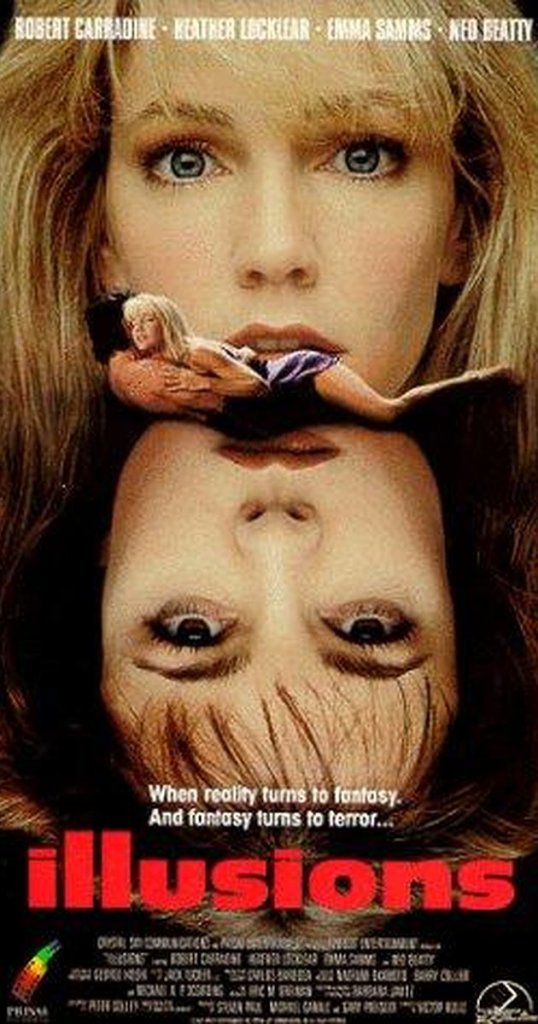
Lisa Cleans Out Her DVR: Illusions (dir by Victor Kulle)


(Lisa is currently cleaning out her DVR.  It’s taking forever and she’s loving every minute of it.  This is almost as fun as a Degrassi marathon.  Lisa recorded the 1992 psychological thriller, Illusions, off of Indieplex on March 1st.)

Illusions gets off to a pretty good start.  In a blue-tinted room, a man and a woman make out, with the whispered dialogue suggesting that they’re doing something that they’ve specifically been told not to do.  The woman is worried when an older woman opens the door but the man assures her that the older woman can’t see.  Soon, the film is switching back and forth, from the forbidden lovers to the old woman chopping up a huge chunk of meat.  The opening reminded me of the classic Italian horror film, Beyond The Darkness.

It’s an enjoyably surreal scene, one of many to be found in Illusions.  When we first meet Jan Sanderson (Heather Locklear), she’s waking up from a nightmare.  She’s in a hospital, recovering from some sort of earlier breakdown.  Her doctor (Susannah York) doesn’t think that Jan is ready to leave the hospital but Jan disagrees.  Jan can’t wait to rejoin her husband.

Her husband is Greg Sanderson (Robert Carradine), an archeologist who is currently working at a dig and who doesn’t appear to have much in common with Indiana Jones.  When Jan leaves the hospital, she moves into a house near the dig, one that Greg is renting.  As soon as Jan moves into the house, strange things start to happen.

For instance, she meets the caretaker, George (Ned Beatty).  George is an alcoholic, one who has recently been abandoned by his wife and his children.  According to Greg, George has a skill for telling scary stories.  For instance, there’s the one that he tells Jan about a murder that occurred in the house years ago.  Maybe George isn’t exactly the guy you want to have talking to someone who is recovering from a nervous breakdown?

However, before Jan can spend too much time getting freaked out about George, something else happens.  Greg’s sister arrives.  From the minute that Laura (Emma Samms) arrives, it’s obvious that she and Jan don’t like each other.  That Jan is nervous around her sister-in-law is understandable.  I love my future sister-in-law and I still spend hours worrying about whether or not she thinks I’m as cool as I think I am.  What’s strange is that Laura seems to view Jan as almost being a romantic rival.  From the minute that Laura arrives, she and Greg are whispering to each other and sharing flirtatious jokes.

(The fact that Greg and Laura were the couple in the film’s opening scene certainly doesn’t do anything to make them any less creepy.)

Jan finds herself suspecting that Laura may be conspiring against her.  When she orders Greg to tell his sister to go home, Greg says that he will.  When Jan wakes up the next morning, Laura’s gone.  Greg says that he kicked her out.  But Jan is haunted by a nightmare in which she murdered her sister-in-law and Greg helped to cover it up…

WHAT’S GOING ON!?

Well, you probably already know.  You’ve seen Gaslight, right?  You’ve seen Diabolique.  Maybe you’ve even seen a few Lifetime films.  You know how this stuff works.  Illusions is not exactly a surprising film and the movie itself occasionally feels disjointed.  The use of body doubles during the nude scenes is jarringly obvious and Jan’s narration was supplied by an actress who clearly wasn’t Heather Locklear.  Locklear, Beatty, and Samms all gave good performances but Robert Carradine was oddly cast.  His presence in the film made me think of Illusions as being Sam McGuire: The Early Years.

And yet, I still kinda liked Illusions.  It’s got just enough weird dream sequences for me to enjoy it.  You know me.  There’s nothing I love more than a weird dream sequence.  Many a mediocre film has been saved by blue mood lighting.


Lisa Cleans Out Her DVR: Madame Curie (dir by Mervyn LeRoy)


(Lisa is currently in the process of cleaning out her DVR!  How long is it going to take her?  Probably about as long as it took scientists to discover radiation.  Still, she’s not giving up!  She recorded the 1943 best picture nominee, Madame Curie, off of TCM on February 16th.)

It would appear that if you wanted to produce a best picture nominee in the early 40s, the easiest way to do it was to cast Walter Pidgeon and Greer Garson as husband and wife.

Consider the evidence: In 1941, Blossoms in The Dust was nominated for best picture.  Greer Garson and Walter Pidgeon played wife and husband.

In 1942, Mrs. Miniver won best picture.  Greer Garson and Walter Pidgeon played husband and wife.  Interestingly enough, Garson actually starred in another best picture nominee that year, Random Harvest.  Random Harvest is a far better picture than Mrs. Miniver and actually featured a better performance from Garson but it did not include Walter Pidgeon.  Make of that what you will.

Then, in 1943, Greer Garson and Walter Pidgeon starred in Madame Curie.  Again, they played husband and wife and, again, their film was nominated for best picture.

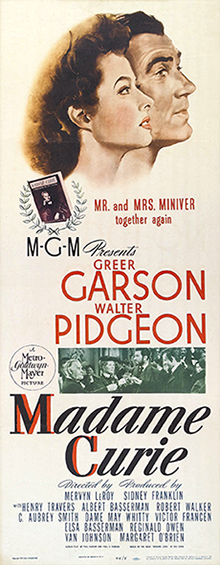
As you can tell from the poster above, Madame Curie was advertised as being “Mr. and Mrs. Miniver together again.”  Actually, Garson and Pidgeon are playing characters far different from the stalwart and very British heroes of their previous film.  Instead, they are playing the Curies, Marie and Pierre.  The film opens with Pierre meeting Marie at a party and it juggles scenes of their romance with scenes of them discovering and playing with radiation.  Of course, it’s a struggle at times.  Their colleagues are dismissive of their efforts.  Both Pierre and Marie tend to get so caught up in their research that they close themselves off from the outside world.  Their efforts pay off when they isolate radium and win the 1903 Nobel Prize.  Of course, then Pierre gets run over by a horse while out buying his wife a pair of earrings.  Can Marie continue to do their research without him?

The unfortunate thing is that the movie pretty much ends with Marie winning her first Nobel Prize, which means that it leaves out some of the most interesting aspects of her life.  For instance, during World War I, she developed mobile X-ray units and worked in field hospitals.  She was also active in the struggle for Polish independence, even naming the first element that she ever discover polonium after her native country.  She spent almost her entire career working with radioactive material, often carrying radioactive isotopes in her pockets.  In 1934, Marie died of radiation poisoning.  Her research notes and other papers are so highly radioactive that they’re kept in a lead box and I assume that they probably glow whenever the lid is shut.  If you want to study Marie Curie’s notes, you have to put on a radiation suit.  Unfortunately, none of this is discussed in the resolutely positive movie.

Judging from what I’ve seen on TCM, Greer Garson appears to have been the Meryl Streep of her day, undeniably talented but a bit too obvious in her technique and just a little boring.  The same can be said of Madame Curie, which is a very well-made but not extremely memorable movie.  It’s like a lot of the films that were nominated for best picture in the 30s and the 40s — a big, prestige picture that never exactly comes to life.  The film is probably at its strongest in the beginning, when Walter Pidgeon does a pretty good job of playing Pierre as a brilliant introvert who is almost too shy to talk to Marie.  But, as the film progresses, it just becomes another slow-moving MGM biopic.

What movie beat Madame Curie for Best Picture?

None other than Casablanca.

Lisa Cleans Out Her DVR: Wimbledon (dir by Richard Loncraine)


(Lisa is currently in the process of cleaning out her DVR!  It is probably going to take her forever.  She recorded the 2004 romantic comedy, Wimbledon, off of Cinemax on February 15th.)

I wish I could play tennis.

Actually, I guess it would be more correct for me to say that I wish I could play tennis well.  I mean, I can hold the racket and I can run around the court and I can hit the ball and sometimes, it goes over the net.  I can do all the yelling and the grunting and the jumping.  I’m pretty good at slamming my racket down on the court whenever I miss a shot.  I can play the game but I just can’t win.  I’m way too easily distracted and that’s a shame because I’ve been told that I look cute in a tennis skirt.

It’s not for lack of trying either!  There’s a tennis court a few blocks away from my house and I’ve challenged both my sister and my BFF to several matches.  And, every time, they have totally kicked my ass.  In fact, now that I think about it, the only time I’ve ever won a set was because my opponent was feeling sorry for me and they had such confidence in their own abilities that they didn’t mind throwing a game or two.

(For the record, I’ve been told that, if not for my boobs getting in the way, I would have a pretty good golf swing.  But I don’t play golf so there you go…)

Anyway, I may not be able to play tennis but that doesn’t mean that I can’t enjoy a movie about people I can.  I really like Wimbledon.  I mean — yes, it’s a totally predictable sports movie.  You know, as soon as you see the opening credits, that Kirsten Dunst and Paul Bettany are going to fall in love.  They’re the prettiest people in the movie so, of course they’re meant to be together!  And, as soon as you see Sam Neill’s name, you know that he’s going to be playing the well-intentioned but clueless authority figure who tries to keep them apart.  When James McAvoy’s name appears, you yell, “He’ll be Paul Bettany’s best mate!”  (Actually, he plays Paul’s eccentric younger brother.)  And as soon as Jon Favreau’s name appears, you’re like, “Comic relief!”

Of course, since the movie is called Wimbledon, you know that the movie is going to be about tennis and you know that Paul Bettany and Kirsten Dunst are going to be competing at Wimbledon while falling in love.  You know that one of them will make it to the finals while the other sits in the stands and provides emotional support.  It’s just a question of which one.

As I said, it’s all totally predictable and yet, that’s actually a part of the film’s appeal.  With the plot being so obvious, you’re freed up to just appreciate the film as a vehicle of movie star charisma.  Paul Bettany and Kirsten Dunst are two of my favorite actors and I think they’re both criminally underrated.  In Wimbledon, Bettany is playing the older, veteran tennis player, the one who is playing at his final Wimbledon before retiring.  When he falls in love with Kirsten, it gives him a renewed sense of focus and, for the first time, he finds that he actually has a chance to win it all.  Kirsten, meanwhile, is the up-and-coming star.  Her father (Sam Neill) worries that Kirsten’s relationship with Paul will distract her and keep her from playing her best and it turns out that he’s absolutely right.

Even if you haven’t seen the film, you know everything that is going to happen but that’s okay.  Kirsten Dunst and Paul Bettany have got a really likable chemistry.  You want things to work out for them.  You want both of them to win championships and eventually get married and have a pretty family.  Bettany, in particular, proves that he can make even the most clichéd of lines sound fresh and spontaneous.  Add to that, both Paul and Kirsten look adorable in tennis white and that’s really all that most people ask for when it comes to a film like this.

Wimbledon is an enjoyable and predictable movie, one that won’t leave you feeling depressed or questioning the meaning of existence.  It may not be perfect but it’s certainly likable and sometimes, that’s all you need.

Lisa Cleans Out Her DVR: Scorpio (dir by Michael Winner)


(Lisa is currently in the process of cleaning out her DVR!  Having recorded over 150 movies since last January, she understands that this might be an impossible task but she’s going to try anyway!  She recorded the 1973 spy thriller, Scorpio, off of Retroplex way back on January 24th!)

On the surface, Jean Laurier (Alain Delon) would appear to be the perfect man.

He’s handsome.  He looks really good in a suit.  He’s wealthy.  He’s French.  And — get this — he loves cats!  He’s the type of guy who, when he discovers a stray cat in his hotel room, immediately starts to pet it and then gives it a saucer of warm milk.  He and his girlfriend (Gayle Hunnicutt) spend their spare time looking at cats and talking about how cute they are.  At one point, even though he’s just killed a man, Jean pauses when he sees a stray cat watching…

Oh, did I mention that Jean kills people for a living?  Well, he does but I’m sure they’re all bad guys.  Seriously, he’s just so charming (and he really, really loves cats) that you really can’t hold it against him that he’s an independent contract killer.  Add to that, his code name is Scorpio.

I have to admit that the film’s title — Scorpio — is the main reason that I chose to record this movie.  I’m a scorpio myself.  In fact, I’m such a scorpio that if I believed in astrology, I would point to my existence as proof that the stars actually do determine our fate.  Seriously, you don’t want to mess with us scorpios.  We’re scorpions.  We sting.

But anyway, back to the movie.

When Scorpio is busted on a trumped-up narcotics charge (or maybe it was a legitimate narcotics charge, it was kind of hard to keep track), the CIA gives him a choice.  He can either go to prison or he can do a job for them.  Apparently, the CIA believes that Scorpio’s friend and mentor, Cross (Burt Lancaster), is a double agent who has been selling information to the Russians.  They want Cross eliminated.

Scorpio takes the job but it’s not going to be easy.  Cross is a veteran spy.  He has connections all across the world and he’s a ruthless killer, the type who forces a man to swallow a cyanide pill and then says, “You’ve got 30 seconds to live.”  In fact, the only person that Cross seems to care about is his wife (Joanne Linville) but he still doesn’t hesitate to abandon her when he realizes that their house is being watched

Cross taught Scorpio everything that he knows but there’s one lesson that Scorpio is still learning and that is to trust no one.  Is Cross actually a spy or is he being set up?  And, if Cross is being set up, what’s to prevent the same thing from happening to Scorpio?

Scorpio is probably one of the most cynical films that I’ve ever seen.  If Scorpio was a political protest, it would be full of people carrying cardboard signs reading, “Nothing Matters” and “All Is Darkness.”  Remember that annoying as Hell scene in SPECTRE where James Bond got drunk and demanded to know who a rodent was working for?  Well, imagine the disillusionment of that scene stretched out for two hours.

Fortunately, no one in Scorpio is as whiny as Daniel Craig was in SPECTRE.  In many ways, Scorpio is a triumph of old-fashioned movie star charisma.  Burt Lancaster is perfectly cast as the world-weary Cross while Alain Delon makes for a compelling Scorpio.  Both of them are believable killers and the film becomes as much about the competition between Lancaster’s old school Hollywood style of acting and Delon’s more refined (and very French) style of cool as it is about the competition between Scorpio and Cross.

Scorpio‘s a good little spy thriller, more than worth keeping an eye out for.