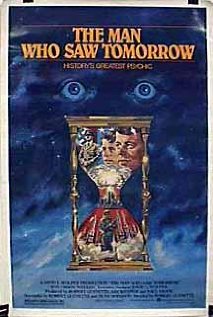
 If you have ever wanted to witness the sad fate that awaits most geniuses who challenge the system, you could not do any worse than to watch The Man Who Saw Tomorrow.
The Man Who Saw Tomorrow is a low-budget “documentary” about Nostradamus, the 16th century French alchemist who some people consider to be a prophet and others consider to be a charlatan. Nostradamus has been credited with predicting everything from the rise of Napoleon and Hitler to the 9-11 terror attacks. Others argue that the writings of Nostradamus were so obscure and prone to mistranslation that they could be interpreted in just about any way. While he did write about an evil dictator that he called “Hister,” he was also widely credited with predicting an atomic war in 1999.
The Man Who Saw Tomorrow argues that Nostradamus was indeed a prophet and it makes its case through cheap historical reenactments and a lot of stock footage. The Zapruder film is used. So is footage from A Tale of Two Cities, War and Peace, Earthquake, and Waterloo (Be sure to keep an eye out for Rod Steiger). Some of the predictions, like Edward Kennedy becoming President and World War III starting in 1986, are easy to laugh at. Others, like conflict in the Middle East leading to a nuclear war, would be frighteningly credible if the film wasn’t so obviously made on the cheap. No skepticism of Nostradamus is implicitly acknowledged but there are interviews with a few believers, including psychic Jeane Dixon (whose first name the film misspells).
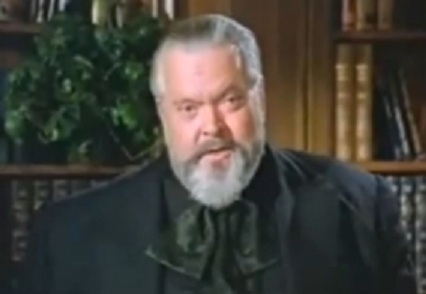
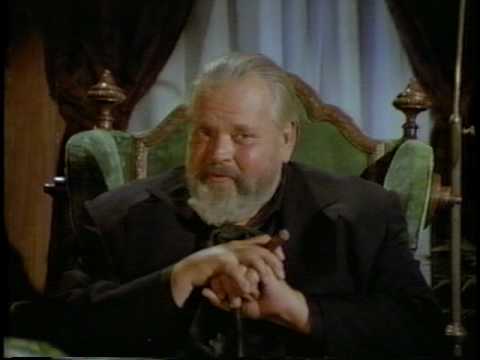
And narrating it all is none other than one of the most important filmmakers of all time, Orson Welles. Sitting at a desk in front of a bookcase and occasionally puffing on a cigar, the director of Citizen Kane lends his deep and recognizable voice to the film’s narration but also adds just a touch of sarcasm to his tone. The movie may believe that Nostradamus saw the future but Welles is going to damn well make sure that everyone understands that he does not. When Welles talks about Nostradamus’s predictions for the future, he says, “But before continuing, let me warn you now that these predictions of the future are not at all comforting – and I might go on to add that these visions of the past, these warnings of the future, are not the opinions of the producers of this film. They’re certainly not my opinions.” He really emphasizes that last sentence, as if he had already grown weary of people approaching him in the streets and asking him if he thought Nostradamus had predicted Watergate.
Sadly, Welles spent a good deal of his career doing jobs like this. The films and the roles were often beneath his talent but they provided Welles with the money that he needed to pursue his own projects, many of which were never to be completed. At the time he did The Man Who Saw Tomorrow, Welles was trying to raise the money to complete post production on his final film, The Other Side of The Wind. The Other Side of The Wind would remain unfinished at the time of Welles’s death but it now appears that, 41 years after principal photography was completed, the film may finally see the light of day thanks to Netflix.
As for The Man Who Saw Tomorrow, it seems only fair to give Orson Welles the final word. When asked about the film and Nostradamus on The Merv Griffin Show, Welles replied, “”One might as well make predictions based on random passages from the phone book.”
Well said, Orson. Well said.



 Through the Shattered Lens