Film Review: Britney Ever After (dir by Leslie Libman) #FreeBritney


britney-ever-after-trailer

Earlier tonight, I watched the latest Lifetime celebrity biopic, Britney Ever After.

Ever since that ill-fated Aaliyah movie, Lifetime biopics have had a reputation for being hot messes and I’m sure that a lot of people will say the same thing about Britney Ever After.  Britney Ever After is about Britney Spears, following her from her first tour with *NSYNC through her relationship with Justin Timberlake through her marriages to both Jason Alexander and Kevin Federline and finally concluding with her well-publicized breakdown in 2008.  As usually seems to happen with these biopics, the whole story is framed by interviews with a documentary crew.  From what I saw, the twitter reaction was pretty savage and I’m sure that there will be all sorts of snarky reviews tomorrow.

But you know what?

As far as Lifetime celebrity biopics go, Britney Ever After was not that bad.

It suffered from some obvious problems.  Since neither Britney nor her management had anything to do with the making of the film, none of Britney’s original music was heard.  That means there was no Oops! I did it again!  There was no Baby One More Time.  No Toxic.  No If U Seek Amy.  There was no Work Bitch, which incidentally is both the greatest song that Britney’s ever done and my favorite song to sing while stuck in traffic.  I think it was mentioned, at one point, that Britney was working on a song called Womanizer but I may have misheard.  When the actress playing Britney sang, it was only to cover songs by other artists.  In the film, Britney performed I Love Rock and Roll and a bit of Walking After Midnight.

For what I presume are legal reasons, the film had to be circumspect.  Yes, Justin Timberlake (played by Nathan Keyes) was a character in the movie but he was portrayed so blandly that he could have been any hyperactive teenager with good hair.  Jason Allen Alexander (Kelly McCabe) shows up just long enough to marry Britney and then be told that the marriage is going to be annulled.  Amazingly, Britney’s entire marriage to Kevin Federline (Clayton Chitty) takes place over less than 10 minutes of screen time.  Adnan Ghalib (Serge Jaswal) and Sam Lufti (Benjamin Arce) get more attention that Kevin but both of them are portrayed so negatively that they probably wish they hadn’t.

(Adnan and Sam both made the mistake of testifying about Britney in court, meaning that their douchebaggery was a part of the public record and free for Britney Ever After to portray.)

As for Britney’s “rivalry” with Christina Aguilera (which, early in their careers, pretty much defined both of their public personas), it goes unmentioned.  Christina is only briefly seen in a long shot.  For those of you hoping for any details about the dark side of life at the Mickey Mouse Club, Britney Ever After is not for you.  Really, the film’s main problem was one of logistics.  Britney Ever After had only 90 minutes to tell the story of a very dramatic and complicated life.  If the film felt rushed, that’s because it had a lot to show and not much time to do it.

But, even with all that in mind, Britney Ever After was not the disaster that some seem to believe that it was.  In the role of Britney, Natasha Bassett did far better than I was expecting.  There were some issues, of course.  Her attempt to duplicate Britney’s Southern accent led to her sounding more like Jessica Simpson than Britney Spears.  During the film’s early scenes, she seemed almost too innocent to be believed but it quickly became apparent that this was intentional on the film’s part.  One of the themes running through the film was how Britney’s image was continually shaped by her parents, her management, and her boyfriends.  In the end, Britney is portrayed as having no control over her own life.  When Britney suffers a break down in 2007, she’s at least trying to live her own life.  When everyone around her panics, are they concerned about her health or are they concerned about her image and their investment in her career?  This unanswered question hangs over the final 30 minutes of Britney Ever After.  If Natasha Bassett never quite seemed to be Britney, she was still very believable as a character living the exact same life and dealing with the exact same issues.

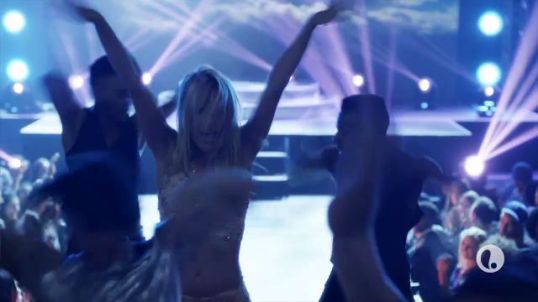
Plus, there was an enjoyably silly scene where Britney ran into Justin in a club and they had an epic dance off.  If only all relationship issues could be solved by a dance off!

That said, I was a bit disappointed that, at no point, was Crossroads mentioned.

(Seriously, a Britney movie with no mention of Crossroads!?)

But give the film some credit.  It did a good job of capturing the suffocating experience of being hounded by paparazzi.  And the film was even-handed and compassionate when it came to portraying Britney’s 2007 breakdown.  Like Britney, I’m bipolar and I’ve always felt that I could understand what she was going through while the rest of the world was finding so much entertainment in her very public struggle.  Since 2008, Britney’s father has had conservatorship over her life and control of all of her assets.  For nearly ten years, Britney Spears has not been allowed to stand on her own and has essentially made a lot of money for everyone but her.  During the documentary segments that provide a wrap-around to the film’s story, Britney Ever After obliquely hints at this sad reality.  In those sequences, there’s a sadness to Bassett’s performance, an acknowledgement that Britney has paid a price for public stability.

Britney Ever After was on Britney’s side, which is more than can be said of many other biopics.

#FreeBitney!


A Movie A Day #49: Body Chemistry 4: Full Exposure (1995, directed by Jim Wynorski)


51tj679zxfl

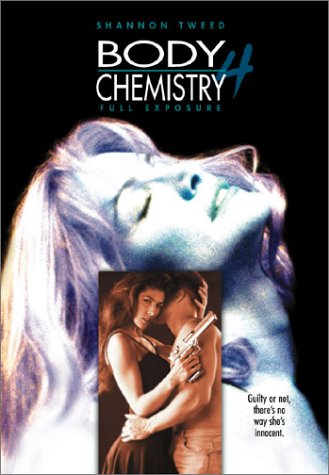
After five years of kinky sex and murder, the Body Chemistry franchise ended with Body Chemistry 4: Full Exposure.

Like the third film, Full Exposure was directed by Jim Wynorski and produced by Andrew Stevens.  Shannon Tweed stepped into the role of murderous Dr. Claire Archer, replacing Shari Shattuck.  Shannon Tweed was always one of the most talented of the actresses who regularly appeared on what was then nicknamed Skinemax.  It wasn’t just that Tweed always seemed to being give it her all in her films’ frequent sex scenes.  Tweed also had the look and style of an old-fashioned femme fatale.  It was easy to imagine her trading sultry quips with Alan Ladd or Tom Neal.  This made Tweed perfect for the role of Claire Archer and her performance was a noticeable improvement on Shari Shattuck’s.  It’s just too bad the rest of the film was such a snoozefest.

In Full Exposure, after getting away with three murders in the first two Body Chemistry films, Claire has finally been arrested.  She is on trial for killing Alan Clay (Andrew Stevens) at the end of the third film.  However, she has a hotshot lawyer named Simon Mitchell (Larry Poindexter) and she is soon up to her old tricks, having sex with Simon in his office, a parking garage, and an elevator.  Simon’s aide, Lane (Marta Martin), has come across proof of Claire’s crimes but Claire has a plan to take care of that.  She always does.

Full Exposure starts out as a typical Body Chemistry film, with neon-lit sex scenes, but it quickly get bogged down in lengthy courtroom sequences.  In the previous three films, Claire at least had some sort of motivation but here, it’s never clear why she would try to destroy her lawyer’s life during the trial instead of waiting until he had, at least, gotten her off the hook.  Tweed is a perfect Claire but the rest of the cast is just going through the motions.   Though Claire once again got away with murder, there were no more chapters to her story after this one.  The Body Chemistry franchise managed to do a lot with a very thin premise but Full Exposure shows, that by the fourth film, there was no where left to go.

The Game’s Afoot: THE SEVEN-PER-CENT SOLUTION (Universal 1976)


gary loggins's avatarcracked rear viewer

71

Sherlock Holmes has long been a favorite literary character of mine. As a youth, I devoured the Sir Arthur Conan Doyle stories, marveling at the sleuth’s powers of observation and deduction. I reveled in the classic Universal film series starring Basil Rathbone and Nigel Bruce as Holmes and Watson, and still enjoy them today. I read Nicholas Meyer’s 1974 novel “The Seven-Per-Cent Solution” as a teen, where a coked-out Holmes is lured by Watson to Vienna to have the famed Sigmund Freud cure the detective of his addiction, getting enmeshed in mystery along the way. I’d never viewed the film version until recently, and while Meyer’s screenplay isn’t completely faithful to his book, THE SEVEN-PER-CENT SOLUTION is one of those rare instances where the movie is better than the novel.

72

This is due in large part to a pitch-perfect cast, led by Nicol Williamson’s superb performance as Sherlock. We see Holmes at his worst…

View original post 393 more words

“The Lego Batman Movie” — About As Close To Perfect As You Can Get


Ryan C. (fourcolorapocalypse)'s avatarTrash Film Guru

cym_yo1w8aqqn_z

It may not be a “cool” thing to admit, but I’ll let you in on a little secret — it’s okay to just want to feel good once in awhile.

It is, after all, a hopelessly fucked-up world that we live in right now : our nuclear arsenal is in the hands of an unhinged, delusional madman who is clearly cracking under the strain of a job he probably didn’t even want and is in no way even mature enough to handle; a lunatic religious zealot is eagerly waiting in the wings to succeed him when he undoubtedly crashes and burns; our closest international allies seem to be inexorably lurking toward a barely-rebranded fascist nationalism themselves; rising global temperatures and sea levels probably threaten our future even more than the would-be despots do — if you think about too hard, it can all seem pretty hopeless.

Can these problems be…

View original post 647 more words

“The Wild Storm” Promises To Be Exactly That


Ryan C. (fourcolorapocalypse)'s avatarTrash Film Guru

the_wild_storm_1_1

Hollywood probably wore the term “re-imagining” to death even before comics did, but if we want to be brutally honest, it’s a word that’s become flat-out cringeworthy across all media by this point, and not without good reason. To “re-imagine” something, after all, means that time and effort that could go into actually imagining something new is going into updating an existing idea, and there’s also an implication, at the very least, that affixes itself to the notion that the original (often beloved) idea itself is in need of some touch-up work. The track record of “re-imaginings” is a pretty lousy one in the funnybook medium, of course — many a promising, or even established, creative career has been sidetracked by attempting pointless re-vamps of characters and concepts that originated in the minds of Kirby, Eisner, Ditko, Kurtzman and the like that had literally no chance to come anywhere near…

View original post 927 more words

Music Video of the Day: Rise by Bad Brains (1993, dir. Paul Rachman) + Death


I said I would try to get every genre of music I could into Black History Month.

Here we have the hardcore punk band Bad Brains. They’ve been around for a long time now. They started out in 1976 as a jazz fusion band before migrating to Hardcore Punk. They released their self-titled debut album in 1982. There are some good songs on that album, but the one of special note is Banned in D.C., which was based on an unofficial ban put on them in clubs in 1979 in Washington, D.C. I’m kind of surprised since the all-black proto-punk band Death only didn’t have their record released in the early-to-mid-70s because they refused to change their name. That was it. It would get released decades later, but I’ll leave it to you to watch the movie A Band Called Death (2012).

https://www.youtube.com/watch?v=A2qi-YAR7m8

Then again, the mostly white hardcore punk band Dead Kennedys took endless flack all the way up to Tipper Gore, among many others, so it’s believable. What isn’t believable, but is true, is that Dead Kennedys would perform under their actual name at my high school in the early-80s. I thought it was a myth until numerous people who had been there told me stories about that night. That’s a story I will have to look into more detail at some point.

If the director of this music video sounds familiar, then that’s because he also directed Hunger Strike by Temple Of The Dog and a couple of videos for Alice In Chains. One has to wonder what the conversation was between the band and Rachman:

Bad Brains: We’ll take one part Smells Like Teen Spirit, two parts Jeremy, and feel free to sprinkle in a little Faith No More and Living Colour.
Rachman: You got it!

I’m not complaining. You can see the same sort of thing with their video for the song God Of Love. The group was inspired by musicians like Black Sabbath and Bob Marley. They even got their name from the Ramones song Bad Brain. So why not draw on the music videos of bands they no doubt help to inspire. Makes sense to me.

Enjoy!