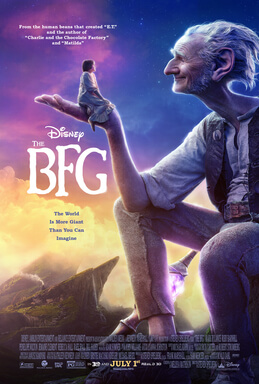
Playing Catch-Up: The BFG (dir by Steven Spielberg)


the_bfg_poster

I heard so many negative things about Steven Spielberg’s latest film, The BFG, that I was really expecting it to be terrible.  When it came out this summer, a lot of critics seemed to take an almost perverse delight in talking about its flaws and some people actually seemed to be thrilled over the fact that it flopped at the box office.

And I have to admit that the commercials that I had seen didn’t really fill me with much desire to actually sit through the movie.  Mark Rylance looked vaguely grotesque as the giant.  Add to that, I spent several months convinced that BFG stood for “Big Fucking Giant.”  Once I was reminded that he was actually a Big Friendly Giant, I was kinda like, “But wouldn’t my way be more fun?”

But anyway, I finally watched The BFG last night and it’s actually not terrible.  Don’t get me wrong.  It’s not great.  In many ways, this movie is Spielberg at his most sentimental.  Imagine if every triumphant musical cue in Lincoln was stretched out for two hours and you might have an idea as to how he approaches The BFG.  At times, I had a hard time following the film’s storyline, largely because the pacing was totally off.  As a director, Spielberg never seems to be quite sure if he’s making a film exclusively for kids or if he’s trying to make a film that adults can appreciate with their children.  It’s a tonal mess.

And yet, for all those weaknesses, The BFG has enough sweet moments that it feels a little bit churlish to be too critical of it.  Spielberg’s heart seems to be in the right place, even if he is struggling to figure out how to express himself.  As I watched the film, I felt bad about being so dismissive of what I had seen of Rylance’s performance in the commercials leading up the actual film.  Rylance gives a heartfelt and warm performance, playing a giant who, because he is so nice, is bullied by even bigger giants.

As I said, I struggled to follow the film’s story.  I knew that BFG had been forced to abduct an orphan named Sophie (Ruby Barnhill) because she saw him and he couldn’t risk her accidentally revealing his existence to the rest of the world.  I also understood that BFG also had protect her from the other giants because the last child he befriended was eaten by those other giants.  But then there was all this stuff about dream time and eventually, Queen Elizabeth II showed up and declared war on the evil giants and I was just so confused.  For once, Spielberg’s skills as a story-teller fail him.  It’s hard to believe that they same director who did the simple and economical Duel also did The BFG.

To be honest, the folks at Pixar, with their trademark mix of sentiment and subversion, would have been the ideal team to take on The BFG.  Spielberg’s instincts are so resolutely mainstream that he doesn’t seem to understand how to best approach some of the story’s more “out there” elements.  But that said, The BFG isn’t terrible.  Mark Rylance does a really good job as the giant and, as you would expect from any Spielberg film, the film is undeniably visually impressive.

The BFG may not be great but it’s not awful.
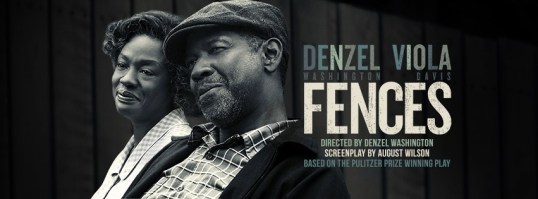
Playing Catch-Up: Fences (dir by Denzel Washington)


Well, 2016 is officially over and soon, it will be time for me to start posting my picks for the best of the year!  I’ve still got a lot of movies that I need to review (and, in some cases, watch) before making out that last so let’s not waste any time!  It’s time to start playing catch up!

fences

In Fences, Denzel Washington plays Troy Maxson.  When the film begins, Troy is 51 years old and lives in Philadelphia in the 1950s.  He’s a proud, charming, and often angry man.  He’s the type of man who can tell a wonderful story and who can make you laugh but, at the same time, you’re always aware that he could explode at any minute.  It’s hard not to like Troy Maxson but, at times, it’s hard not to be a little scared of him.

Troy is a garbage man, apparently destined to spend the rest of his working life hanging onto the back of a garbage truck because his union does not allow black to drive the trucks.  Troy has recently complained about the lack of black drivers and, as he tells his best friend, Bono (Stephen McKinley Henderson), he’s now expecting to be disciplined.  However, to his great surprise, he is instead reassigned to be a driver, making him the first black man to work as a driver for the Philadelphia Sanitation Department.

And that may not seem like much today but, as the film makes clear, that was a huge deal in the 1950s.

Troy, of course, didn’t grow up wanting to be a garbage man.  As he tells his son, Troy left home when he was just a teenager and made his living as a mugger.  During one robbery, he accidentally killed a man and spent the next decade in prison.  It was in prison that he first met and befriended Bono.  It was also in prison that Troy discovered that he was a pretty good baseball player.  Upon his release, he played for the Negro League.  Though everyone agrees that Troy was a good player (and Troy is always quick to claim that he was the best), he never played for the Major Leagues.  The film suggests that, after the league was integrated, Troy tried out but was rejected.  His wife, Rose (Viola Davis), says that Troy was rejected because, at the age of 40, he was too old.  Troy says it was because of the color of his skin.

As I said, it’s hard not to admire Troy.  He’s a man who stands up for himself and he seems to sincerely love his wife.  When his oldest son, a musician named Lyons (Russell Hornsby), comes by to ask for money, it’s hard not to laugh with and appreciate the style with which Troy shows his irritation.  Troy is so charming that, it’s only after Lyons leaves, that you realize that Lyons practically begged his father to come see him play and Troy pretty much blew him off.

And then there’s Troy’s youngest son, Cory (Jovan Adepo).  Cory is in high school.  He’s a football player and he’s recently been scouted by a college.  Troy tells Cory that he’s wasting his time and that no black man will ever be given a fair chance in the NFL.  He tells Cory that he needs to get a real job, like he did.  And as Troy continues to yell at Cory, you start to understand Troy’s jealousy.  Cory has an opportunity that Troy will never have, not due to any difference in talent as much as to the fact that Troy grew up at a time when segregation was the unquestioned law of the land whereas Cory is coming of age the beginning of the civil rights era.

At one point, Cory asks his father, “Why don’t you like me?”

“I don’t have to like you,” Troy replies and the words sting.

Troy is a character about whom you’ll have mixed feelings.  Beyond his anger at his son, he’s also exploiting his mentally impaired brother, Gabe (Mykelti Williamson).  Gabe has a metal plate in his head, the result of his service in World War II.  Gabe receives a monthly disability check and Troy has been using that money to support his family.

Through it all, Rose remains by his side, listening to him when he’s angry and, whenever she can get a word in, acting as his conscience.  But then, Bono asks Troy about his relationship with Alberta, the new girl at work and Troy confesses what the audience suspected.  Not only is Troy cheating on his wife but Alberta is pregnant….

Troy is a great character and Denzel Washington gives perhaps his best film performance in the role.  (Washington already played the role on stage.)  In many ways, Troy is a monster but, at the same time, it’s impossible not to feel for him.  His anger is real.  His selfishness is all too real.  But his pain and his (legitimate) frustrations are very real, as well.  Troy Maxson is a character who, like everyone, struggles to maintain his balance as he walks the line between right and wrong.  He makes several mistakes but he’s never less than fascinating and Washington’s volcanic performance is never less than enthralling.  Matching Washington every step of the way is Viola Davis, giving a powerful performance as the loyal but outspoken Rose.

In fact, the entire film is a master class of great acting.  (If Mykelti Williamson occasionally goes a bit overboard as Gabe, that has more to do with the character than the performer.)  Though the film is dominated by Washington and Davis, I think special mention has to be made of Stephen McKinley Henderson, who brings a lot of understated wisdom to the role of Bono.

Denzel Washington also directed Fences and, unfortunately, he’s not as good a director as he is an actor.  While he goes get brilliant performances from his cast, Fences never really breaks free from its theatrical origins.  It’s very much a filmed play as opposed to a cinematic work of art and, the few scenes that attempt to “open up” the play feel somewhat awkward.  In the end, Fences is best as a record of incredible acting.

Music Video of the Day: Bang-A-Boomerang by ABBA (1975, dir. Lasse Hallström)


They finally escaped the white dimension! Too bad it was for a lousy song and video.

Okay, there are a few things of note here.

First is the obvious. They are on location rather than in a studio. However, they don’t really make use of it. It feels like it was out of necessity or they felt it was humanizing instead of having them all dolled up as usual. They would make better use of location shooting in their later videos such as Knowing Me, Knowing You.

We get the first video that implies a relationship between band members beyond the band. This is something that would be crucial to Knowing Me, Knowing You. I don’t know if any of them ever paired off like Fleetwood Mac was famous for doing, and it doesn’t matter to me either.

This is also the first video that has a title on it. We’ll see that on I Do, I Do, I Do, I Do, I Do and Mamma Mia as well.

This is also the first video where we not only see to people go face-to-face, but they do it to the point where they look like they are either about to make-out or head-butt each other.

We get our usual use of profile shots, but there’s also something you didn’t really see in Waterloo and Ring, Ring. We’ve seen the camera pan and around band. However, this is the first video where we move from a head shot of one member to another without an edit. It really only serves to match the pace of the video with the song in the same way as the quick face-to-face and comic book inserts do, but we’ll see it used to great effect in Knowing Me, Knowing You. Still, like this; Waterloo; and Ring, Ring, this moving around means that the performance the band is giving is still going on even if the camera is somewhere else. It makes me wonder how scripted a lot of these early videos were, and how much was Hallström telling them to get up there and recreate one of their live performances while he built a video around it on-the-fly.

I guess you could call this music video a dry-run for Knowing Me, Knowing You.

Enjoy!

ABBA retrospective:

  1. Ring, Ring by ABBA (1973, dir. Lasse Hallström)
  2. Ring, Ring by ABBA (1973, dir. ???)
  3. Waterloo by ABBA (1974, dir. Lasse Hallström)