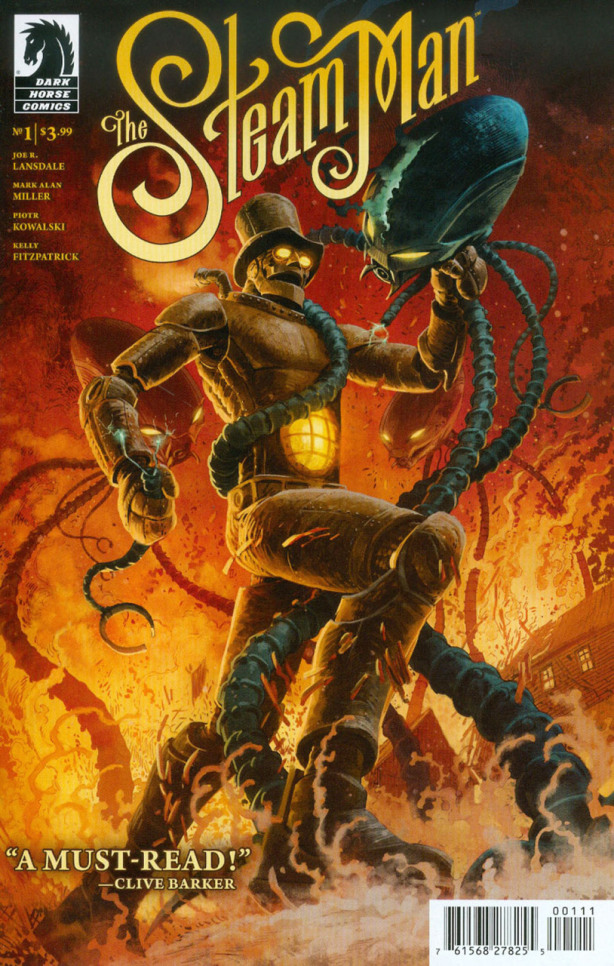
Okay, so tomorrow’s the big day, and despite being massively “under the gun” time-wise, I thought I’d take a few minutes to talk about The Steam Man #1 from Dark Horse Comics just in case there are a few (or, heck, even one) of you out there looking for a good new horror comic to pick up at your LCS in honor of Halloween.
Although, in all honesty, it may not be fair to label this as purely a horror series since there are so many sci-fi influences added into the mix, particularly and most obviously of the “steampunk” variety. After all, the premise here is that an intrepid crew of five are “piloting” a gigantic steam-powered robot through the (unpaved) highways and byways of the Old West looking for trouble, so it’s more than fair to say that what we’ve got on our hands here is something of a…
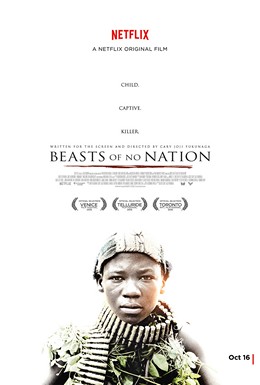
Like many of the films that we’ve looked at this October, Beasts of No Nation is a horror movie. However, the horror to be found in Beasts of No Nation is not due to a ghost or a vampire or a zombie or a serial killer wearing a mask. Instead, Beasts of No Nation is a harrowing look at a real-life horror that is currently happening even as you read this review.
Abraham Attah plays Agu, a 12 year-old boy living in a small village in an unnamed African country. In many ways, Agu is a normal child. He likes to hang out with his friends. He looks up to his older brother and his father. He loves his mother. He goes to school, he goes to church, and he prays regularly. Though his village may be poor, he and his friends still find ways to keep each other entertained.
However, Agu is living his life in the middle of a war zone. Though the details are intentionally left obscure, his country is in the middle of a civil war. Throughout the film, we continually hear people talking about the different warring factions but we never learn the specifics of what those factions believe or why they’re all fighting each other in the first place. And, of course, it really doesn’t matter. The only thing that’s important is that they are fighting and Agu is about to sacrifice his childhood to their war.
When his village is attacked by government forces and his brother and father are killed in front of him, Agu runs into the jungle. It’s there that he’s eventually captured by one of the many different rebel factions. This faction is led by the Commandant (Idris Elba), a charismatic and messianic figure who recruits Agu to serve as one of his child soldiers.
(I’m assuming that the Commandant was, at least in part, based on Joseph Kony of Kony 2012 fame.)
At first, the Commandant presents himself as being a father figure to Agu and Agu looks up to him. The Commandant, for his part, orders Agu to kill a possibly innocent man and also keeps Agu and his other child soldiers stoned on various drugs. Whereas he once only wanted to reach the capital city and be reunited with his mother, Agu now becomes a ruthless killer. During the day, he fights. And, at night, he and the other soldiers run the risk of being sexually assaulted by the Commandant.
It’s a harrowing film, one that is made all the more poignant by the fact that, even as he’s committing terrible acts, Agu still remains, in many ways, an innocent child. It’s significant that, when the Commandant takes the soldiers to a brothel, Agu ends up sitting in a corner. He’s too young for the brothel but, under the twisted logic of his circumstances, he’s old enough to kill and be killed. It’s not easy to watch but it is a film that should be watched because this is what is happening in certain parts of the world right now.
Beasts of No Nation has gotten a lot of deserved attention for both Attah and Elba’s performances. It has also gotten a lot of attention because it’s being distributed by Netflix. At the same time the film opened in theaters, it was also made available online. And, to be honest, I’m glad that I watched Beasts of No Nation on Netflix because it allowed me to pause the film whenever it got too overwhelmingly sad. I cried a lot of tears while watching Beasts of No Nation. That’s just the type of film that it is.
Beasts of No Nation is not an easy film to watch. It doesn’t offer any easy solutions and the film itself ends on a note of terrifying ambiguity. But watch it you should. It’s an important film about a real-life outrage and it not only deserves to be seen but it needs to be seen as well.
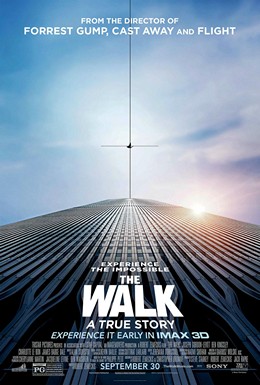
If you didn’t get a chance to see Robert Zemeckis’s latest film, The Walk, in a theater and, at the very least, in 3D, you really missed out.
In fact, I’m actually a bit surprised that The Walk hasn’t gotten more attention than it has. Over the past year, whenever I would see the trailer play before another movie, it always seemed like a palpable sense of excitement descended over the theater. Then, The Walk was released, it got wonderful reviews, and …. nothing. Down here in Dallas, it played in theaters for three weeks and then it went away. Since I was on vacation for two of those weeks, I nearly missed it!
But I’m glad that I didn’t miss it. I say this despite the fact that I’m beyond terrified of heights and The Walk is all about creating the experience of balancing on a wire that’s been suspended between two of the tallest buildings in the world. As I watched the film, there were many times when I struggled to catch my breath. I had to put my hands over my mismatched eyes a few times. But I’m still glad that I saw the film.
The Walk is based on a true story. In 1974, French street performer Philippe Patet (Joseph Gordon-Levitt, who is even more adorable here than usual if that’s possible) and a group of accomplices manage to suspend a high wire between the twin towers of the just constructed World Trade Center. High above New York City, Philippe walked across the wire a total of six times. In the film, Philippe narrates the story while standing on top of the Statue of Liberty. From the minute that we see Gordon-Levitt and he starts to speak in a theatrical (but never implausible) French accent, we immediately like and relate to Philippe. By the end of the film, his triumph is our triumph.
At the same time, we also feel his sadness. Up until the film’s final line, when Philippe makes a subtle reference to it, 9-11 is never explicitly mentioned in The Walk but the shadow of that monstrous attack still looms over frame of the film. By recreating both Philippe’s act of daring and the Twin Towers themselves, Zemeckis attempts to reclaim the legacy of the World Trade Center from the asshole terrorists who destroyed it.
And The Walk really does put you right there on that wire. If ever there’s been a film that you must simply see in 3D, it’s The Walk. Just be prepared to watch some of the movie through your fingers.
Oh my God, y’all — are you ready to see the very first horror movie ever made!?
Okay, so I guess I should be honest and admit that this is more of a comedy than a horror film. But it was reportedly the first film ever made to contain horror elements. (In this case, the film takes place in a haunted castle and features ghosts.) The Haunted Castle is only 3 minutes long and it’s definitely a bit primitive but that’s understandable when you consider that The Haunted Castle was made in 1896!
The Haunted Castle was a French film and it was directed by George Melies. Yes, the same George Melies who was played by Ben Kingsley in Hugo.
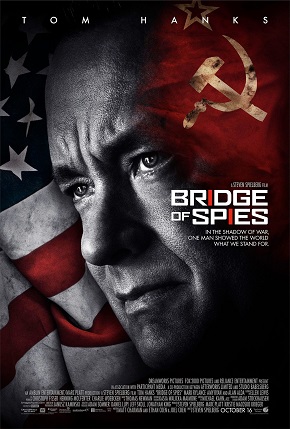
I saw Bridge of Spies last weekend and I’m a little bit surprised that I haven’t gotten around to writing a review until now. After all, this is not only the latest film from Steven Spielberg but it also stars the universally beloved Tom Hanks and it’s currently being touted as a possible best picture nominee. (Mark Rylance, who plays an imprisoned spy in this film, is also emerging as a front runner for best supporting actor.) The screenplay was written by the Coen Brothers. (Oddly enough, films scripted by the Coens — like Unbroken, for instance — tend to be far more conventional and far less snarky than films actually directed by the Coens.) Even beyond its impressive pedigree, Bridge of Spies is a historical drama and by now, everyone should know how much I love historical dramas.
And the thing is, I enjoyed Bridge of Spies. I thought it was a well-made film. I thought that Tom Hanks was well-cast as an idealistic lawyer who stands up for truth, justice, and the Constitution. I agreed with the pundits who thought Mark Rylance was award-worthy. It’s become a bit of a cliché for Amy Ryan to show up as an understanding wife but it’s a role she plays well and she made the most of her scenes with Tom Hanks. Steven Spielberg knows how to put a good film together. This really should have been a film about which I rushed home to rave.
And yet, at the same time, I just could not work up that much enthusiasm for Bridge of Spies. It’s a good film but there’s nothing unexpected about it. There’s nothing surprising about the film. Steven Spielberg is one of the most commercially successful directors in history and the American film establishment pretty much orbits around him. He’s good at what he does and he deserves his success. Unfortunately, he doesn’t have a subversive bone in his body. Bridge of Spies is a lot like his previous Oscar contender, Lincoln. It’s very well-made. It’s the epitome of competence. But there’s not a truly surprising or unexpected moment to be found in the film.
And I have to admit that, even as I enjoyed Bridge of Spies, I still found myself frustrated by just how risk-adverse a film it truly was. After all, we’re living in the age of Ex Machina, Upstream Color, and Sicario. Bridge of Spies is a good movie and, in many ways, it provides a very valuable history lesson. (The film’s best moments were the one that contrasted the U.S. with the cold desolation of communist-controlled East Germany.) But, overall, it just didn’t make a huge impression on me. It was just a a little bit too safe in its approach.
Since I just shared 4 shots from 4 Dario Argento films, I figured why not take this week’s horror scene that I love from an Argento film as well?
Argento’s 1995 film The Stendhal Syndrome has always gotten mixed review but I think it’s actually one of the better of his post-Tenebrae films. In the scene below, police detective Anna Manni (Asia Argento) wanders through Florence and finds herself overwhelmed by the sheer beauty of the place. Eventually, while looking at Bruegel’s Landscape With The Fall of Icarus, Anna is so overwhelmed that she faints and has a fantasy where she swims through the ocean and kisses a fish. Of course, as this happens, she is watched by serial killer Alfredo Grossi (Thomas Kretschmann).
I have to admit that one reason why I like this scene (and this film) is because I had a similar experience when, the summer after graduating high school, I visited Florence. No, I didn’t faint but I definitely found myself wandering around in a bit of a daze. Standing in Florence is like finding yourself in the middle of living painting. It’s an amazing experience and one that I recommend to everyone.
4 Shots From 4 Films is just what it says it is, 4 shots from 4 of our favorite films. As opposed to the reviews and recaps that we usually post, 4 Shots From 4 Films is all about letting the visuals do the talking.
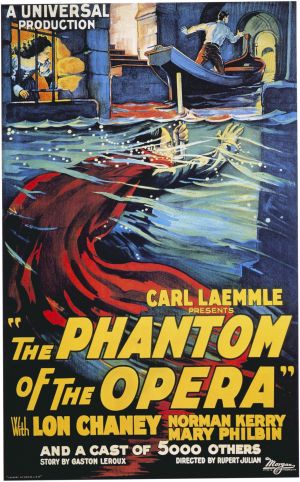
Today’s horror movie on the Shattered Lens is both a classic of silent era and one of the most influential horror films ever made. It’s one that I previously shared in 2013 but it’s such a classic that I feel that it is worth sharing a second time. Add to that, the original video that I embedded has been taken off of YouTube.
First released in 1925, The Phantom of the Opera is today best known for both Lon Chaney’s theatrical but empathetic performance as the Phantom and the iconic scene where Mary Philbin unmasks him. However, the film is also a perfect example of early screen spectacle. The Phantom of the Opera was released during that period of time, between Birth of the Nation and the introduction of sound, when audiences expected films to provide a visual feast and Phantom of the Opera certainly accomplishes that. Indeed, after watching this film and reading Gaston Leroux’s original novel, it’s obvious that the musical was inspired more by the opulence of this film than by the book.
This film is also historically significant in that it was one of the first films to be massively reworked as the result of a poor test screening. The film’s ending was originally faithful to the end of the novel. However, audiences demanded something a little more dramatic and that’s what they got.
Good morning! Out of the musty, cobwebbed vault of TV horror comes Bela Lugosi in a rare television appearance on 1949’s SUSPENSE. Complete with commercials for sponsor AutoLite spark plugs, here’s Bela in Edgar Allen Poe’s THE CASK OF AMONTILLADO:




 Through the Shattered Lens