Embracing the Melodrama Part II #62: Time After Time (dir by Nicholas Meyer)


TimeAfterTime79So, I just gave the 1979 film Home Before Midnight a fairly negative review but I simply cannot end the 70s section of Embracing the Melodrama on such a negative note!  So, before we move on to the 80s, allow me to suggest another film from 1979 that you could watch while you’re not watching Home Before Midnight!

Time After Time opens in London.  The year is 1893.  Writer H.G. Wells (Malcolm McDowell) is having a dinner party so that he can show off his latest invention, a time machine.  Among his guests is a surgeon named John Stevenson (David Warner).  What nobody at the party suspects is that Stevenson also goes by the name Jack the Ripper and that he enjoys killing prostitutes.  When a detective from Scotland Yard shows up at Wells’s home, Stevenson jumps into the time machine and escapes into the future.  Since Stevenson does not have the “non-return key,” the machine returns back to 1893 but Stevenson has apparently escaped.

Wells uses the machine to pursue Stevenson and soon finds himself in 1979 San Francisco.  Wells had expected to find that the future would be a utopia but instead, he discovers the world of 1979 is loud, polluted, violent, angry, and dangerous.  (Kinda like the world of 2015…)  As Wells pursues Stevenson, he struggles to adjust to the world of the “future,” and he also meets a bank clerk, Amy Robbins (Mary Steenburgen).

Time After Time is probably the sweetest movie ever made about Jack the Ripper and that’s largely because of the romance between both Wells and Amy and the two actors who played them.  After watching Time After Time, I was not surprised to learn that McDowell and Steenburgen got married shortly after appearing in this film.  They were so incredibly sweet together!

Add to that, considering the he’s best known for playing villains and other menacing types, it’s interesting to see Malcolm McDowell plays such a gentle and nice character.  Wells’ befuddlement is charming to watch.  There’s a great scene where Amy calls Wells on a landline phone and Wells stares down at the receiver in frightened amazement.

Time After Time is a really good and likable movie.  It’s sweet and it proves that even hunting for Jack the Ripper can be a romantic experience if it’s done with the right person.  Watch it and enjoy!

Embracing the Melodrama Part II #61: Home Before Midnight (dir by Pete Walker)


-Home_Before_Midnight-_DVD_coverIf there’s any director who deserves to be rediscovered and be given a critical reevaluation, it’s … well, I was going to say that it’s Pete Walker but honestly, I’ve only seen a handful of Walker’s films.  And really, my admiration of Walker as a filmmaker is largely due to one film, 1974’s Frightmare.  So, I’ll just say that, based on Frightmare, Walker might deserve a critical reevaluation.

Unfortunately, I’m not reviewing Frightmare right now.  Instead, I’m taking a quick look at another Pete Walker film, 1979’s Home Before Midnight.

It’s going to be a quick look because there’s really not that much to say about Home Before Midnight.  The film opens with two 14 year-old girls hitchhiking.  Carol (Debbie Linden) is blonde and wild.  Ginny (Alison Elliott) is brunette and responsible.  They end up getting picked up by a truck driver who quickly decides that he’d rather just give a ride to Carol.  So, Carol and the driver drive off together and Ginny ends up alone and, once again, hitchhiking.  Eventually, Ginny is picked up by Mike (James Aubrey), a songwriter in his 30s.

Not realizing that Ginny is only 14 years old, Mike takes her back to his flat and they have sex.  Afterward, Mike discovers just how young Ginny is and tells her that they can be friends but that they can’t have sex because it’s illegal.  Ginny agrees.

And then Mike and Ginny end up having sex again anyway…

Anyway, as you can probably guess, things don’t go well as far as Mike and Ginny’s “romance” is concerned.  Though Ginny swears to her parents that she and Mike are just friends, her parents see Mike being interview on television, along with an unlikely rock star named Nick (Chris Jagger, far less charismatic brother of Mick).  When Mike is asked if he has a girlfriend, Nick announces that not only does Mike have a girl but her name is Ginny.  Soon, Ginny is moving on to boys her own age and Mike is on trial.

As someone whose first “serious” boyfriend was 9 years older than her and who has always appreciated a certain maturity in men, there were a few bits of Home Before Midnight to which I could relate.  Occasionally, the first part of the film even captures the excitement of having a secret and forbidden love.

But ultimately, the film just fails.  To put it lightly, Home Before Midnight is no An Education.  Instead, it’s a painfully boring film, one that pretends to examine a serious issue but then doesn’t even play fair.  We’re told that Ginny is 14 but the actress playing her was 20 and looked and acted like she was close to 30.  As well, about 90 minutes into the film, Ginny’s personality is totally changed, the better to portray Mike as somehow being a victim.  The film makes so many excuses for Mike and the camera spends so much time lingering on Ginny’s frequent naked body (and remember, Ginny is being played by a 20 year-old but is only supposed to be 14) that it actually becomes creepy to watch.

Ultimately, the most interesting thing about Home Before Midnight is the fact that it features Mick Jagger’s younger brother, Chris, in a supporting role.  Chris Jagger looks close enough to Mick that you would guess that they were related.  But Chris has absolutely none of Mick’s charisma and it’s actually funny to hear Chris continually being described as being one of the biggest stars in the world.  Chris Jagger makes Justin Bieber look like Adam Levine.

If you still want to see this boring and creepy movie, it’s currently available on Netflix.  However, I would suggest that your time would be better spent watching any other Pete Walker film.

http://www.youtube.com/watch?v=50fylKl8XsE

Happy 100th Birthday, George Orson Welles!


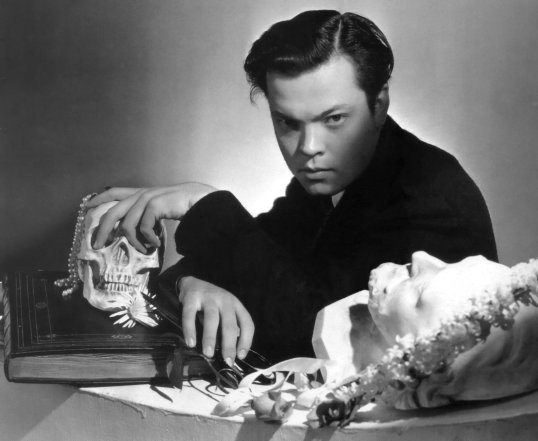
Orson+Welles+Early+CareerToday is the 100th birthday of the great filmmaker and showman Orson Welles!  And what better way to celebrate than listening to the famous 1938 radio broadcast of War of the Worlds?  Reportedly, this caused mass panic when it was originally aired as people tuned in late and were convinced that the Earth actually had been invaded by Martians!

(Like Martians would want this dump!  Seriously….)

Enjoy and join us all in wishing Orson Welles a happy 100th!

“Secret Wars” Is Staggeringly Stupid — Say That Five Times In A Row Really Fast


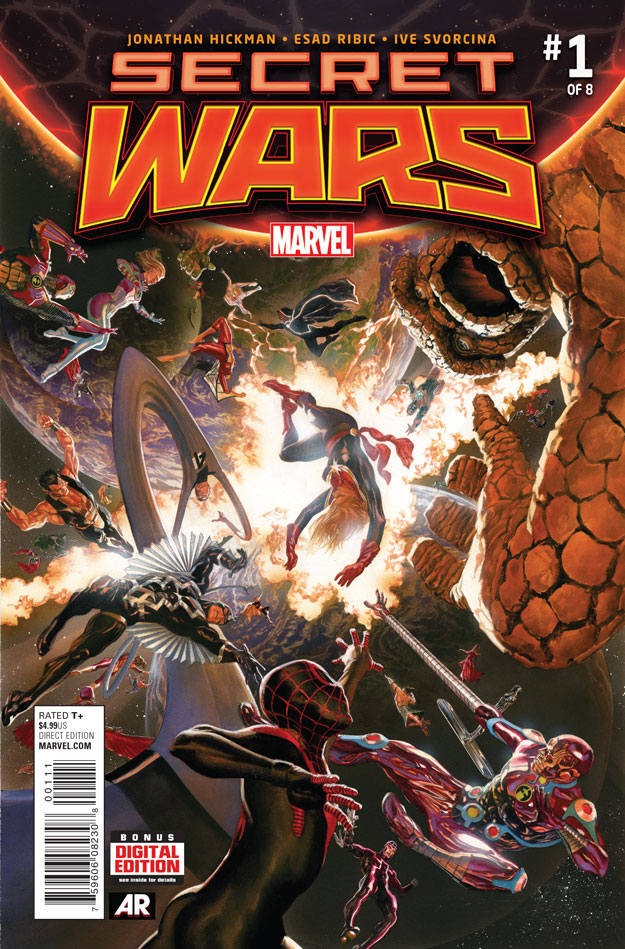
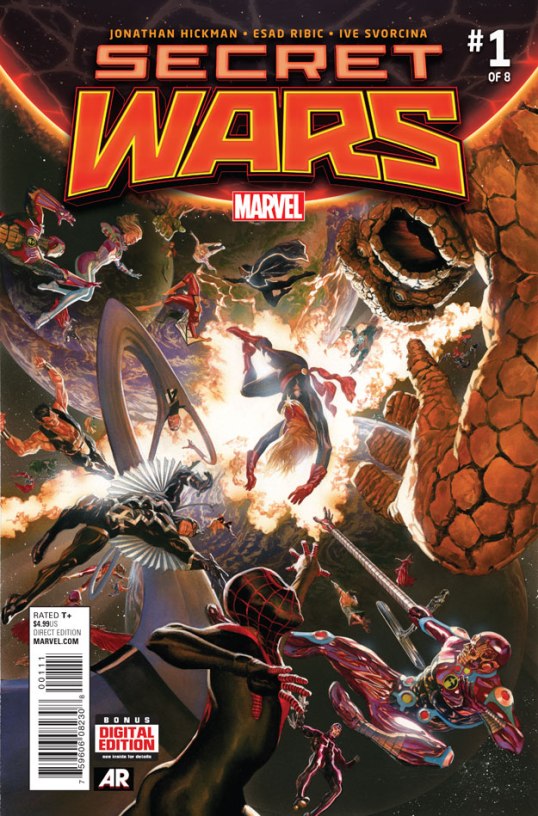
SCWARSCOV2015001_DC11

As my review of DC’s Convergence a few weeks back clearly gave away, I’m not much of a fan of these company-wide “blockbuster” crossover events in comics. I mean, seriously, what’s to like? The main titles are invariably a bunch of useless fight sequences strung together under the flimsiest of pretexts; the tie-in books either have almost nothing to do with said main title or else tie into it too much; the cover prices for everything are jacked up by a buck or two; and in the end, the status quo that we promised would be “forever changed” either isn’t at all, or ends up being pretty much like the old within the space of a few months.

In short, they’re a hustle any way you look at it.

People are wise to this by now, of course, which is why both Marvel and DC have promised that their latest cash-grabs really will shake things up in a fundamental way, and in Marvel’s case they’ve even pretty much given away how the just-released-today Secret Wars is going to end : the so-called 616 and Ultimate Universes will be no more, consolidated down into one, single, “new” universe (except they’re not calling it the “New Universe” because they’ve had bad luck with that name already).

So — the only reason to read Secret Wars (which, by the way, has nothing to do with the original cross-over series of that name and frankly doesn’t even make any logical sense because events in this series are hardly “secret” in the least) is to see exactly how they go about the business of universal consolidation. If that grabs your fancy, then by all means, shell out $4.99 for this over-sized first issue, and $3.99 for each subsequent issue, and knock yourself out. If you think you might have better things to do with your time and money, though, heed my warning and simply stay away.

SCWARS2015001_DC17

For the discerning sucker with more money than sense, Marvel has offered up no fewer than 11 different covers for this extravaganza (I’ve included Alex Ross’ main painted cover, and the coolest of the bunch, John Tyler Christopher’s “toy variant,” with this review), and rest assured, once you open the book up, the feeling of “this is some big, momentous shit” will be shoved down your throat from the word “go.” I have no real problem with the intro page that Marvel puts in most of their monthly books, and a “title page” here and there doesn’t bother me, but Secret Wars #1 contains no fewer than seven more or less wasted pages — an “intro” page, a double-page title spread, a “cast of characters” page, an “in memoriam” page marking the passing of the 616 and Ultimate Universes at the end, and two all-black splash pages designed to signify said mutual ending right before the “in memoriam” page. I mentioned before that this was an “over-sized” first issue, and now you know why : when you subtract all that nonsense, plus the cover art reproduction page, plus the full-page “next issue” blurb, plus the six-page “free” preview of Uncanny Inhumans #0, essentially what you’ve got left is a standard-sized comic book. That you just paid a buck extra for.

I could forgive all of that, though, if the standard-sized-comic-hiding-inside-a-bigger-one was actually any good. Unfortunately, Secret Wars #1 isn’t.
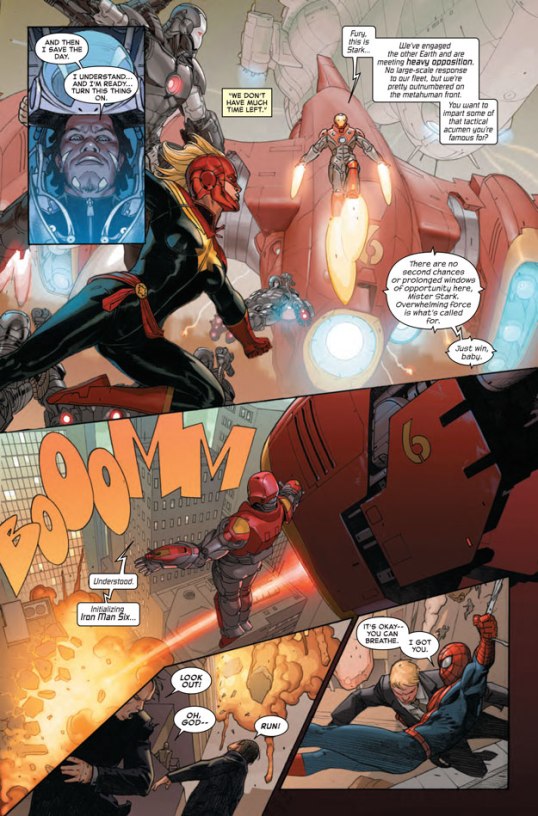
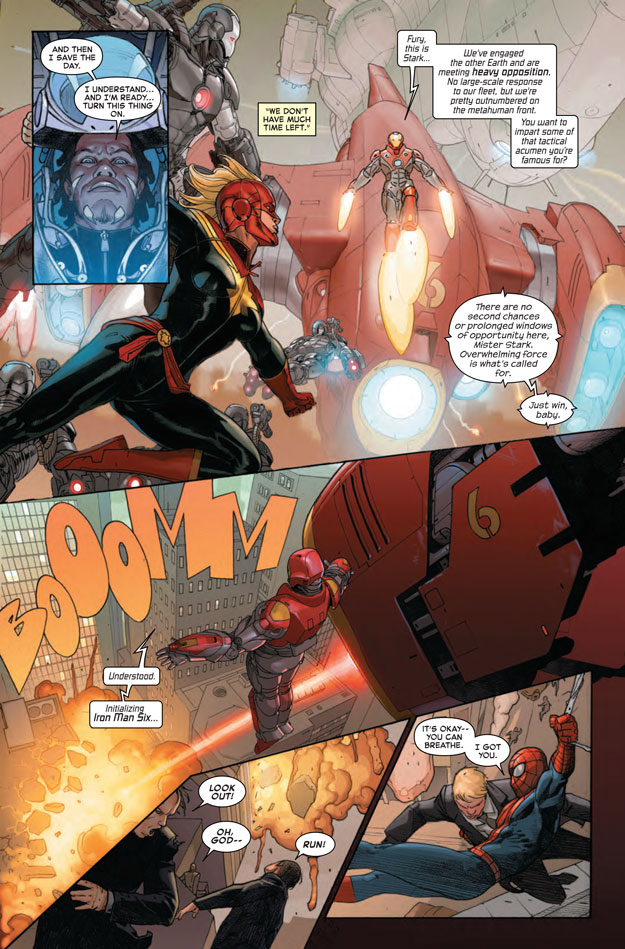
SCWARS2015001_int3-1 (1)


Which isn’t meant as a knock of any sort on artist Esad Ribic — his work here may not rise to the level of prior efforts like Thor & Loki : Blood Brothers, but, as you can see, it’s still pretty good. Ive Svorcina employs a solid and effective color palette, as well, so all in all, you’ve gotta say that the book looks pretty good — unfortunately, the story is pure, unmitigated crap.

Apparently this “arc” actually got started some time ago in  Secret Wars writer Jonathan Hickman’s various Avengers books, so if you haven’t read those, you’re going to be lost from the outset here, with no quarter given by either Marvel editorial or the creators to help bring you up to speed. I know Hickman loves his so-called “design pages” — especially in his Image books — but in all the wasted space in this issue, they couldn’t be bothered to include so much as a single “our story thus far —” paragraph? Please.

Bad form, to be sure, but it’s bad form in service, as you’d expect, to the almighty dollar — you see, Marvel have just released a trade paperback collection of all that Secret Wars prelude shit that they want you to spend $29.99 on.

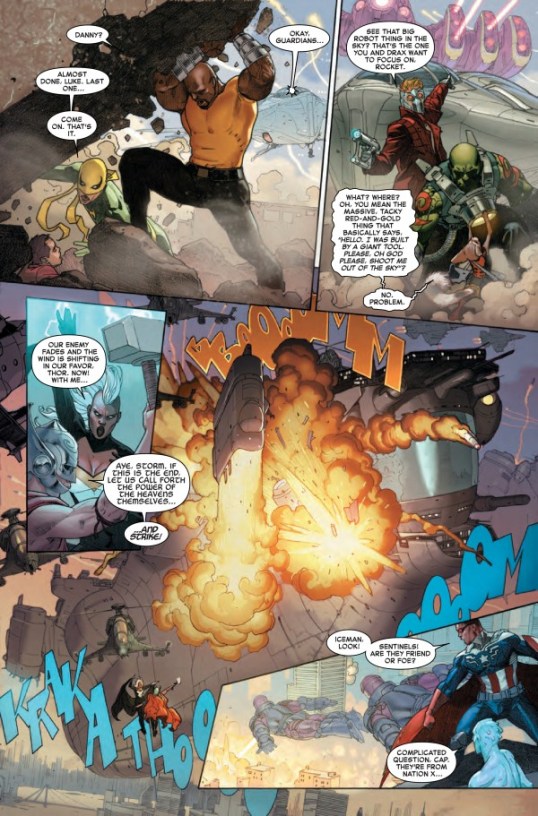
The bulk of the “action” here is just a bunch of big-city disaster sequences and some half-baked plan launched by the 616 Reed Richards and Black Panther to save the “scientific elite” while the grunts from both their universe and the Ultimate one literally fight to the death during something less-than-ominously titled an “incursion” (which apparently involves both universes trying to co-exist on the same — I dunno, dimensional plane or something) to decide which version of reality will win out and which will be completely fucking remorselessly slaughtered. Damn, I knew Reed and T’Challa were 1%ers, but this is some seriously cold-blooded shit even for that crowd.

Let’s just fast-forward to the end, shall we?  The Richards/Panther plan doesn’t work, Cyclops unleashes the “Phoenix Force” at the same time the scheme falls short, and then — total darkness. But we know it’s not over because we know there are seven issues left to go, plus a boatload of tie-in books like Secret Wars : BattleworldSecret Wars Journal, and, just to drive home the point that Marvel has no original ideas left whatsoever, re-makes of Infinity GauntletCivil War, and Old Man Logan that are all gonna dove-tail in with this mess, as well. Thanks for the five bucks, see you back at the comic shop next week for even more!
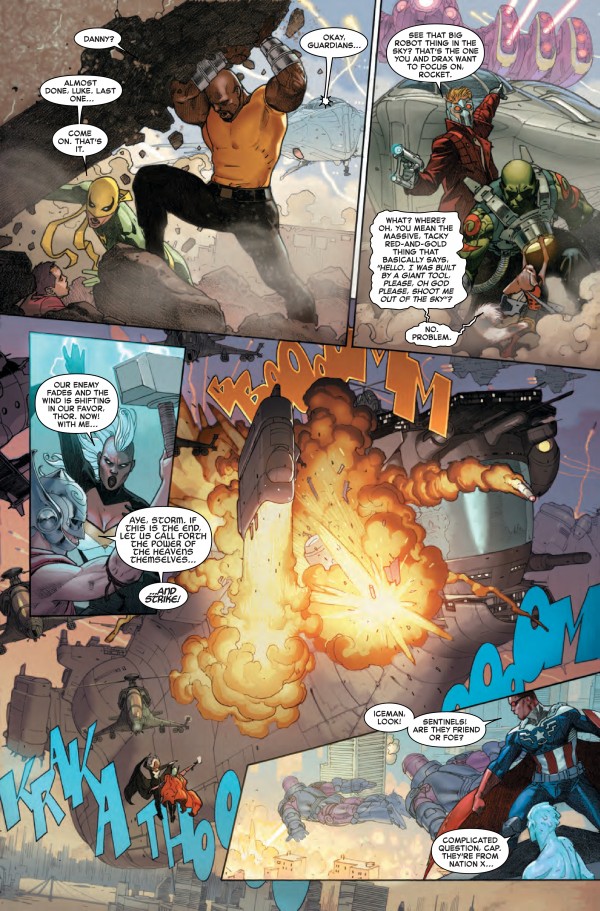
Secret-Wars-1-2015-Spoilers-Preview-2-600x911

On a purely economic level, of course, this all makes a mercenary kind of sense — most of these titles will sell, and the main Secret Wars book will sell a ton. But creatively, none of this can be justified in the least. The “reality vs. reality” premise is virtually indistinguishable from DC’s already-running (and equally lousy) Convergence, Hickman’s script is a dour, humorless, senseless cluster-fuck, and nobody makes anything happen at all in this first issue — everything just happens to them. Plus, we get to  find out that, when push comes to shove, most of these characters are assholes more concerned with saving their own kind (our social, economic, and super-powered “betters”) than actually, ya know, protecting us like they always claim they’re out to do. As a comic book, then, Secret Wars #1 is a complete failure of imagination, common sense, and even basic human decency. As a makeshift blueprint for would-be totalitarian elitists who want to make certain that all of us “pawns” are sacrificed to protect the “queens and kings,” though, who knows? Maybe it’ll come in handy when the shit hits the fan.


It’s The Beginning Of The End In “Empire Of The Dead : Act Three” #2


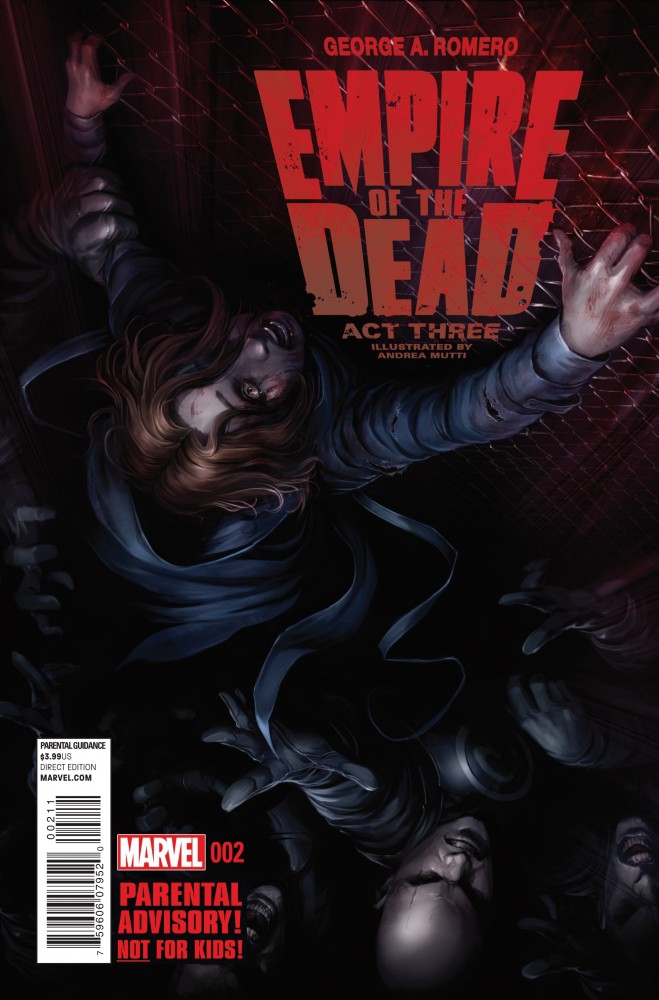
EmpireoftheDeadActThree002cvr-659x1000

Okay, if we want to be technically accurate about things, I guess we could say that last month’s opening installment of George Romero’s Empire Of The Dead : Act Three was the “beginning of the end,” since it appears that some combination of editorial decision-making on Marvel’s part and agreement among the book’s creators (specifically, I’m sure, Romero himself) has come about to wrap this four-color epic up a bit sooner than originally announced (after three five-issue “arcs” rather than the previously-mentioned four or five — that’s what selling fewer than 10,000 copies a month does, ya know), but it didn’t really feel like the big wrap-up was imminent until this second issue hit the stands today. Gone is some of the dilly-dallying that had slowed down previous issues here and there, gone are a fair number of the supporting players (although they’re sure to be back), and, most crucially — gone are the zombies!

Seriously. There’s not a one of ’em to be found in the pages of this book. And that’s more than just a little weird.

122-1951x3000

Wih the “shamblers” having temporarily shambled off-stage, our erstwhile “street urchin,” Jo, takes commands the spotlight for about the first half of this issue, as she makes a new friend in her detention center/concentration camp, and the two of them quickly try to effect an escape once they figure out —or at least make an educated guess at — the true purpose of their new “home.”  After that,  it’s back to the “palace intrigue” swirling around Mayor Chandrake, his less-than-faithful wife, and his quickly-falling-apart-at-the-seams political opponent, Chilly Dobbs. Trust me when I say if our vampiric sitting chief executive of New York can’t beat this guy, well — he just plain doesn’t deserve to stay in office.

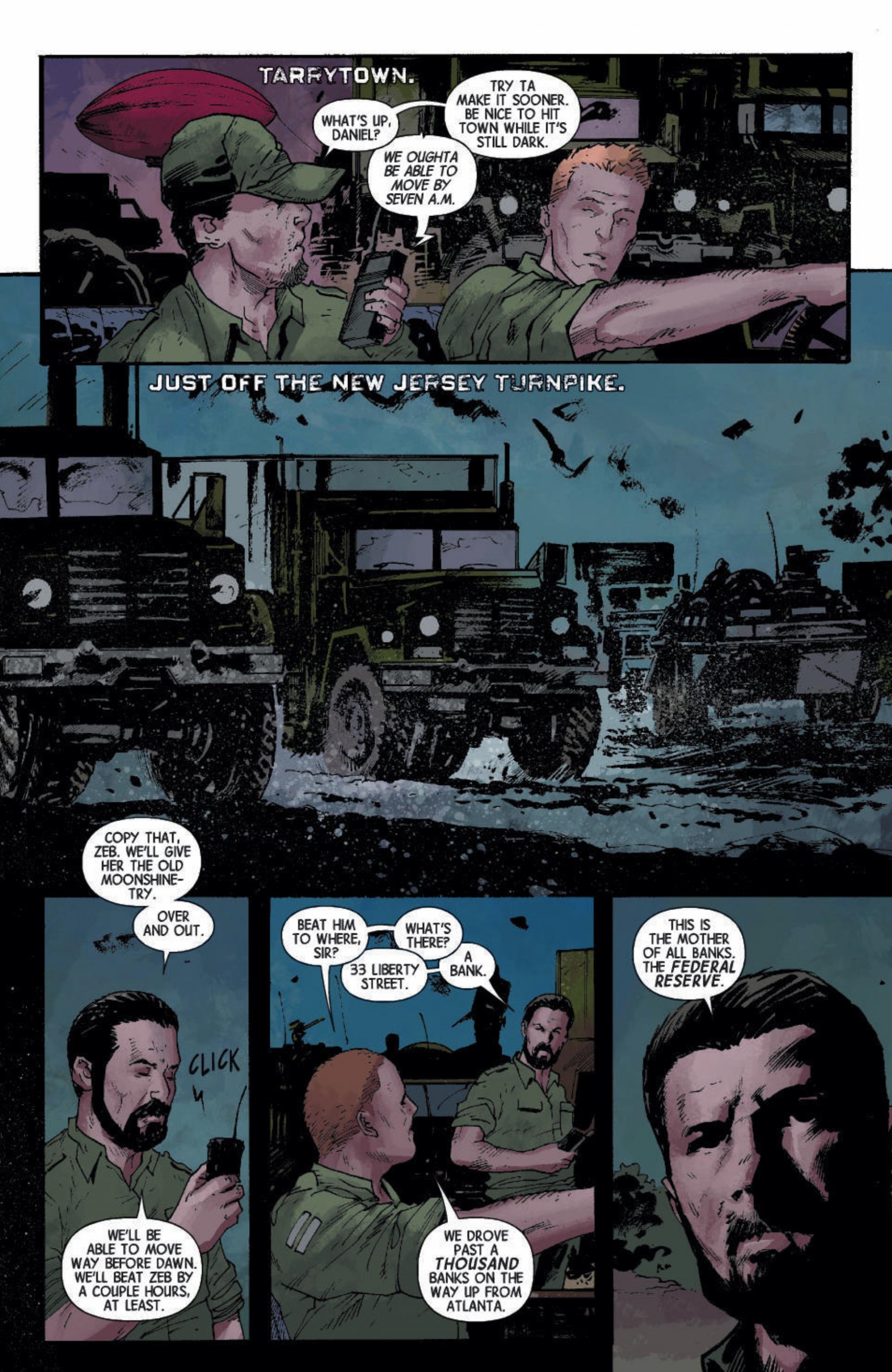
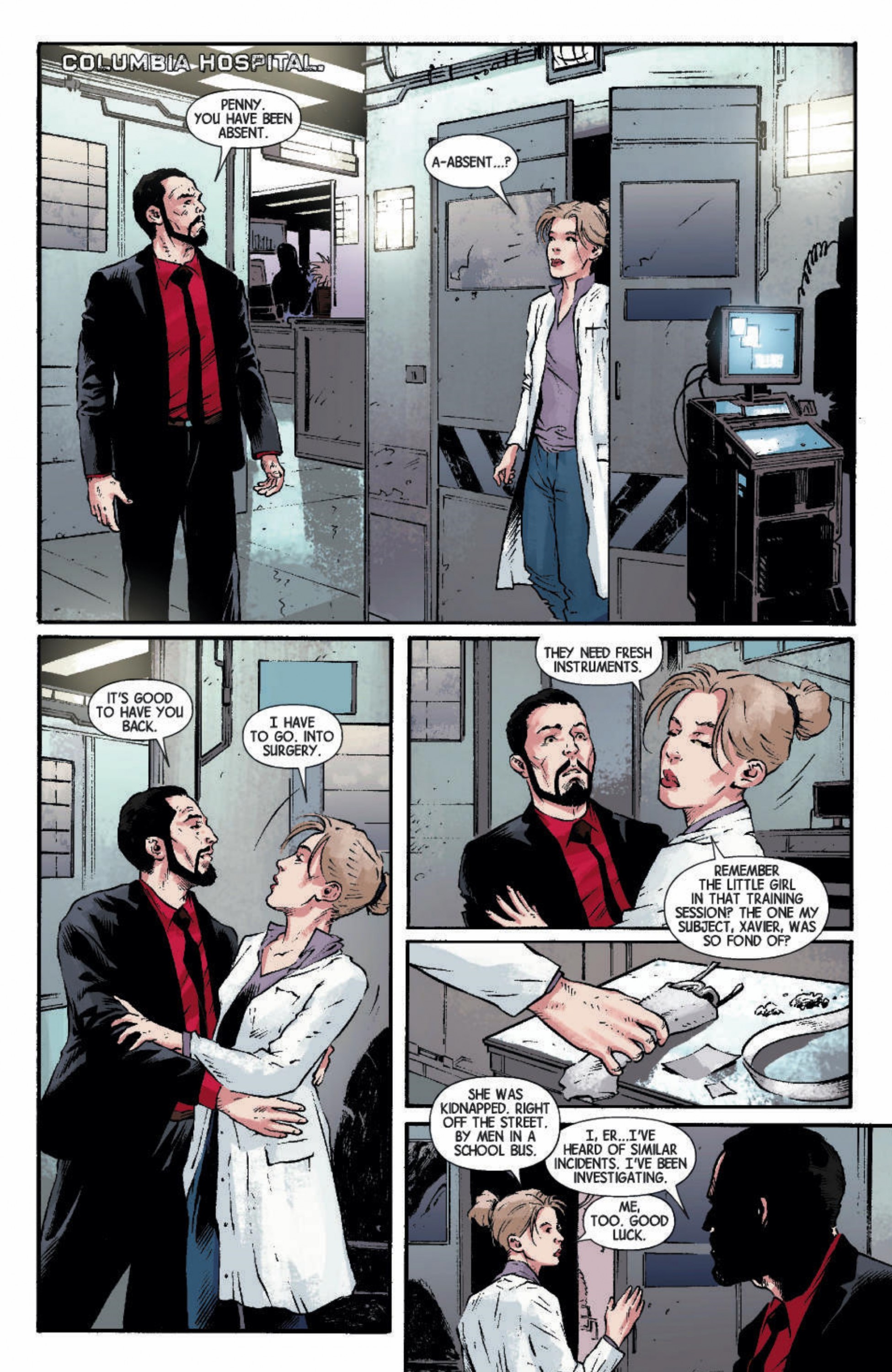
Dr. Penny Jones pops up for a brief moment — as seen below — but don’t expect any appearances from Paul Barnum. Detective Perez, or Xavier this time out — the action here is pretty concentrated and generally of the “set-up-for-a-big-climax” variety. The “rebel crew” once — and possibly still, to some extent — allied with Dixie Peach has a big part to play, though, as they reveal an audacious scheme to rip off the Federal Reserve Bank of New York in the midst of all their otherwise-random destruction — and that destruction finally begins in earnest as this issue wraps up.

222-1951x3000

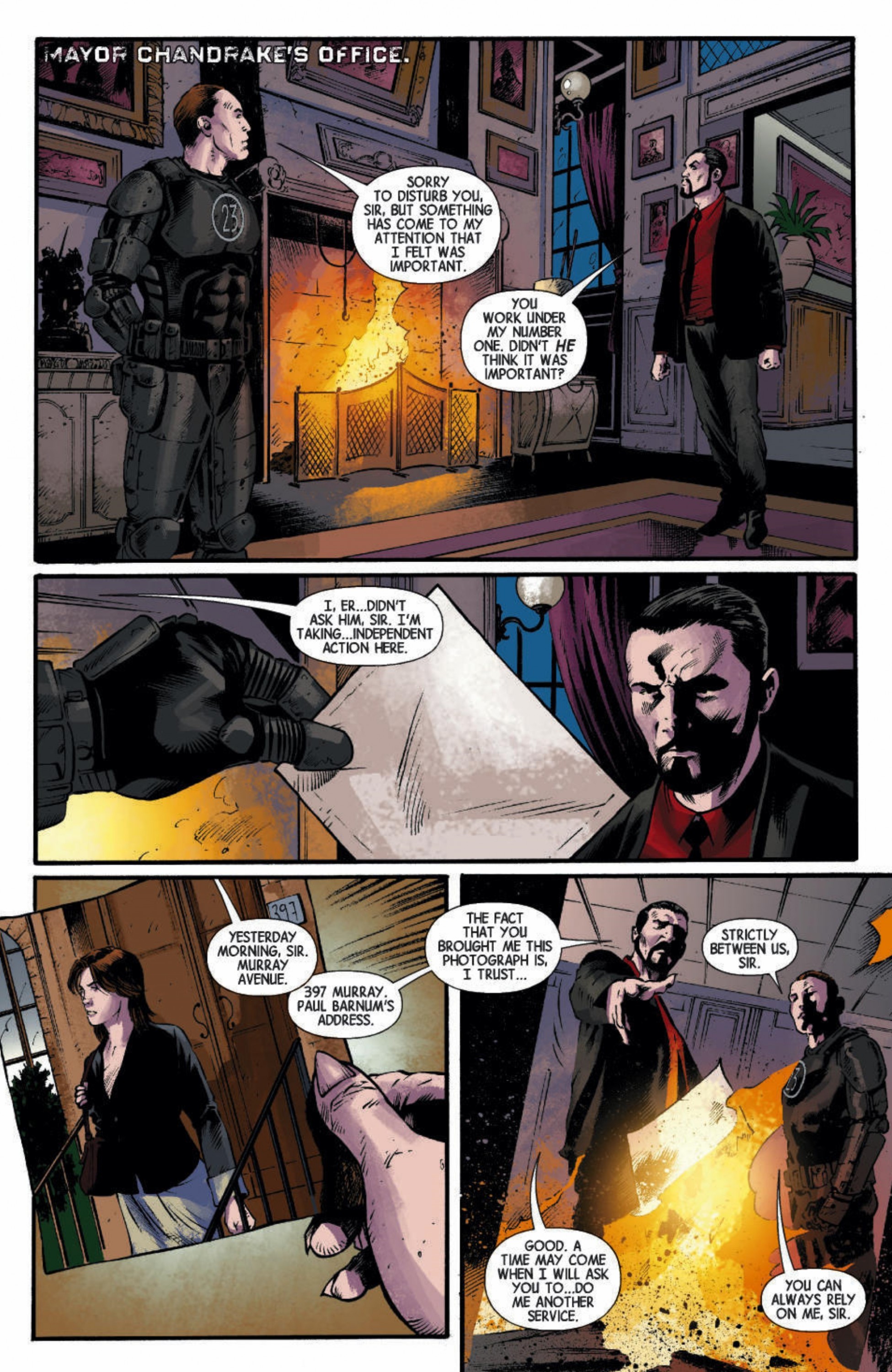
As you can see from the preview pages I’ve included with this review (feeling decidedly un-lazy today), Andrea Mutti continues with his obviously-Maleev-influenced ways here and the art looks pretty good on the whole, certainly a step up from what we were served in the second act, while Romero, for his part,  has thrown all subtlety out the window with his scripting and is painting his characters with pretty broad brush-strokes at this point. Yeah, it may be clumsy at times,  but it  serves the purposes of the story just fine now that we’re in “time is definitely of the essence” mode.

418-1951x3000

So, yeah — the end is nigh, and in Empire Of The Dead : Act Two #3 you can definitely feel it fast approaching. The once-sprawling chessboard is getting tighter and tighter as the pieces move ever closer together and the moves they’re able to make become reduced exponentially. I have a pretty solid feel of where it’s all going and where each of our players is going to end up once it’s finished, but I certainly wouldn’t put it past Romero to still have a wild card or two left in his hand (shit, I’m mixing my game metaphors here) that he’s saving for precisely the right moment.


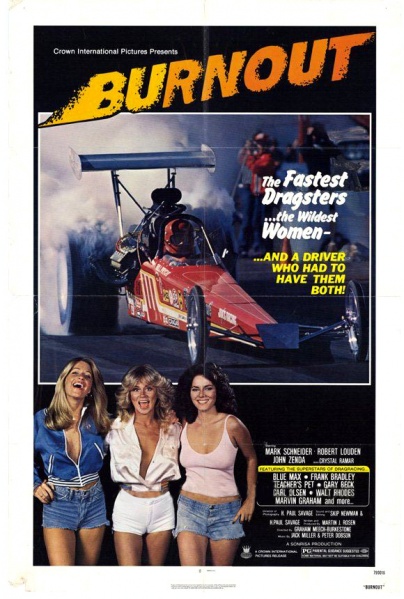
Embracing the Melodrama Part II #60: Burnout (dir by Graham Meech-Burkestone)


404px-BurnoutLe sigh.

In the future, when I decide to do a HUGE and impractical series of reviews, I’m going to make sure that I only include films that I’ve already seen.  Because, seriously, I added Burnout without knowing much about the film, other than it was a Crown International Film.  Eventually, I hope to be able to say that I’ve reviewed every single film released by Crown International.  I knew that I’d have to watch and review Burnout some time so why not now?

CIP_Logo

Before adding the film to my list of films to review, I did at least read a synopsis of the film’s plot.  Here’s what it says on the back of Mill Creek’s Savage Cinema box set:

“A trouble teenager, whose sole desire is to become a great drag racer, almost ruins his own dreams when he spurns his dad’s racing advice.  But support from his girlfriend enables him to prove his abilities to the racing world.”

Hey, that sounds really melodramatic, doesn’t it?  (In fact, it sounds kinda like the plot of the film At Any Price…)  That’ll be perfect for a series called Embracing the Melodrama, Part II.  Let’s watch it right now…

Well, don’t bother.  Burnout is basically 75 minutes of stock footage with 15 minutes of bad actors mouthing really bad dialogue.  Whenever we watch the races, we hear an announcer saying stuff like, “This is really exciting!” or “This is his first time to race!” or “OH MY GOD!  THIS IS REALLY FREAKING EXCITING!” (okay, I may have imagined that last one) and you have to be thankful for the announcer because otherwise, you’d never know who actually won anything.  This is one of the worst acted, worst edited, worst directed, worst written films that I’ve ever seen.  And, after countless posts in which I’ve defended their films, I have to announce that this is probably a strong contender for the worst film to ever be released by Crown International.

Bleh!  Enough of this review.  Burnout is 90 minutes of my life that I will never get back.  I refuse to spend any more time thinking about it.


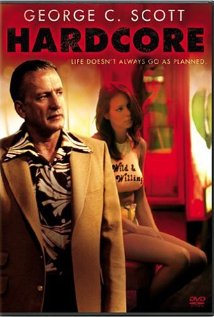
Embracing the Melodrama Part II #59: Hardcore (dir by Paul Schrader)


Hardcore_(1979_film)

“Turn it off…turn it off…turn it off…TURN IT OFF!” — Jake Van Dorn (George C. Scott) in Hardcore (1979)

Jake Van Dorn (George C. Scott) is a businessman who lives in Grand Rapids, Michigan.  He’s a deeply religious man, a sincere believer in predestination and the idea that only an elite few has been prelected to go to Heaven.  Jake is divorced (though he occasionally tells people that his wife died) and is the father of a teenage girl named Kristen (Ilah Davis).

One of the first things that we notice about Jake is that there appears to be something off about his smile.  There’s no warmth or genuine good feeling behind it.  Instead, whenever Jake smile, it’s obvious that it’s something he does because that what he’s supposed to do.  Indeed, everything Jake does is what he’s supposed to do and he expects his daughter to do the same.

When Kristen goes to a church camp in California, she soon disappears.  Jake and his brother-in-law, Wes (Dick Sargent), fly down to Los Angeles and hire a sleazy private investigator, Andy Mast (Peter Boyle), to look for her.  A few weeks later, Andy shows Jake a pornographic film.  The star?  Kristen.

Jake is convinced that Kristen has been kidnapped and is being held captive.  Wes tells Jake that he should just accept that this is God’s will.  Andy tells Jake that, even if he does find Kristen, Jake might not want her back.  Finally, Jake tells off Wes, fires Andy, and ends up in Los Angeles himself.  Pretending to be a film producer and recruiting a prostitute named Nikki (Season Hubley) to serve as a guide, Jake searches for his daughter.

The relationship between Jake and Nikki is really the heart of the film.  For Jake, Nikki becomes a temporary replacement for his own daughter.  For Nikki, Jake appears to be the only man in the world who doesn’t want to use her sexually.  But, as Jake gets closer and closer to finding his daughter, Nikki realizes that she’s getting closer and closer to being abandoned.

Hardcore is a pretty good film, one that was shot in location in some of the sleaziest parts of 70s Los Angeles.  Plotwise, the film is fairly predictable but George C. Scott, Season Hubley, and Peter Boyle all give excellent performances.  (The scenes were Scott pretends to be a porn producer are especially memorable, with Scott perfectly capturing Jake’s discomfort while also subtly suggesting that Jake is enjoying himself more than he wants to admit.)  And, even if you see it coming from miles away, the film’s ending will stick with you.

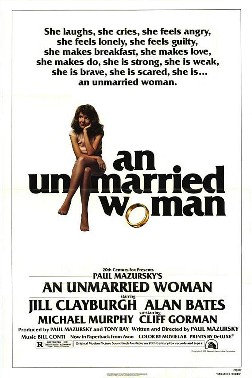
Embracing the Melodrama Part II #58: An Unmarried Woman (dir by Paul Mazursky)


Unmarried_womanI have mixed feelings about the 1978 best picture nominee An Unmarried Woman and I really wish I didn’t because this is one of those films that I really want to love.

Erica (Jill Clayburgh, who did not win the Oscar that she deserved for this film) appears to have the perfect life.  She works at an art gallery in New York.  She has smart, sophisticated friends.  She has an accomplished teenager daughter (Lisa Lucas).  She has a beautiful apartment.  Early on in the film, she wakes up and literally dances from her bedroom to the living room and back again.

And, of course, she has a husband.  His name is Martin and he’s a successful stock broker.  Of course, there are hints that everything might not be perfect.  She and Martin are a cute couple but they’re not exactly passionate.  One need only watch Erica carefully wash dogshit off of Martin’s expensive running shoes to tell who is getting the most out of the marriage.  Add to that, Martin is played by Michael Murphy and, as anyone familiar with 70s cinema knows, Murphy specialized in playing well-dressed, outwardly friendly heels.  And, of course, the film is called An Unmarried Woman and the title can’t be true as long as Erica’s married.

So, you’re not exactly surprised when Martin suddenly breaks down in tears and tells Erica that he’s fallen in love with a younger woman and that he’s leaving her.

The rest of the film deals with Erica’s attempts to adjust to suddenly being an unmarried woman and a single mom.  We follow as she struggles to get back her confidence.  The scenes of Erica dealing with her suddenly rebellious daughter really struck home to me, largely because I’m a rebellious daughter of divorce myself.  There’s a few great scenes of Erica turning to her girlfriends for support.  (Importantly, one of Erica’s friends is happily married, as if the film wants to make sure that we understand that not all marriages are as bad as Erica and Martin’s.)  We watch as Erica starts dating again, having a memorable one-night stand with the obnoxious but oddly likable Charlie (Cliff Gorman).  Finally, she ends up dating a rugged, bearded artist (Alan Bates) and she has to decide whether she wants to remain independent or not.

And it’s all amazingly well-acted and fun to watch but I have to admit that I was a little bit disappointed the first time that I saw An Unmarried Woman.  For some reason, I couldn’t bring myself to like it as much as I wanted.  The more I thought about it, the more clear my issue with it became.

As a character, Eric was simply too wealthy.

As I watched Erica struggle with being an unmarried woman, it was hard for me not to compare her struggles with the struggles that my own mom had to deal with after her divorce.  The film, and specifically Clayburgh’s lead performance, got so much right.  But there’s a difference — a huge difference — between an unmarried woman who has an apartment in Manhattan and a dream job at an art gallery and a woman like my mom who worked multiple jobs, spent hours worrying about how to pay the bills, and who had to do all of this while dealing with four stubborn daughters.  And so, whenever I saw Erica talking to her therapist about how upset she was over suddenly being single, there was a part of me that wanted to say, “Try doing it while living in South Dallas and having to deal with a brat like me.”

The second time that I watched An Unmarried Woman, I was able to better appreciate the film.  Now that I knew that Erica’s experiences were not going to be universal, I could focus on Jill Clayburgh’s great performance in the lead role.  I could marvel at how marvelously wimpy Michael Murphy was in the role of Martin.  I could laugh at Cliff Gorman’s comedic performance.  As for Alan Bates as that bearded artist — well, sorry, that still didn’t work for me.  Eventually, I could accept Erica’s perfect apartment and her perfect job but suddenly introducing a perfect boyfriend who also happened to be a passionate and financially successful painter; it all felt like a bit too much.

But, in the end, An Unmarried Woman is a good film and a valuable historical document of its time.  If for no other reason, see it for Jill Clayburgh’s lead performance.

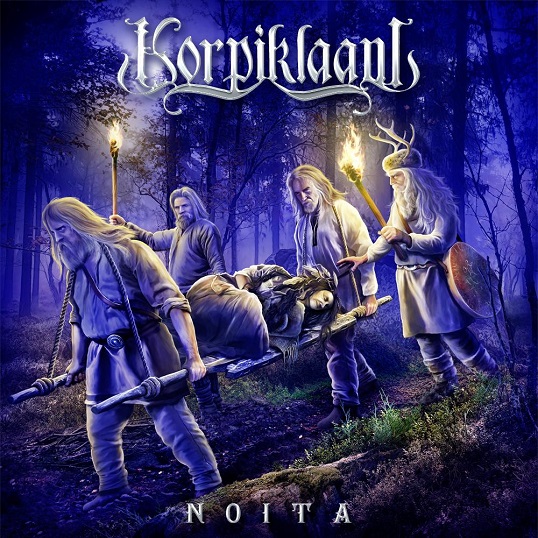
Review: Korpiklaani – Noita


Korpiklaani have been pretty heavily criticized over the years for what has been perceived as a highly “gimmicky” sound. That view has a faint shred of legitimacy, but it gets blown way out of proportion. With bands like Alestorm and Nekrogoblikon managing to pump out really impressive albums without the slightest hint that they take any of their music seriously, it is easy to falsely impose on the genre a spectrum ranging from hoax to serious. You’re either writing brutal pagan metal homages to Odin or you’re dressing up as a mutant snork and dancing a jig, right?

It doesn’t really work like that. Bands like Kalevala (Калевала) and Troll Bends Fir (Тролль Гнёт Ель) can come off as fun-loving boozers, but you can’t escape the impression that they have a deep respect for their cultural heritage. Finntroll sing about dim-witted fantasy monsters eating people, and they’re heavy as hell. Being light-hearted and fun certainly does not make a folk metal band “gimmicky”, as if all folk traditions are inherently morbid. Doing it for nine albums without showing much inclination towards anything but fun and relegating your only English language songs to tantrums about not having enough beer–well, that can tarnish an image. I do understand why people might see Korpiklaani as a having a one-track mind.

But it really shouldn’t, and they really don’t. Not if sounding the same means maintaining the quality that turned people to them in the first place while honing their musical talents along the way. Not when for every track devoid of lyrical content the listener writes off eight others as the same because they don’t speak Finnish. Korpiklaani were very well received when they first appeared with Spirit of the Forest back in 2003. Folk metal was still fairly new then, and Jonne Järvelä was a frontrunner, not a bandwagoner. He had contributed to Finntroll’s Jaktens Tid in 2001, and prior to changing his band’s name to Korpiklaani he had released folk metal under the monicker “Shaman” beginning in 1999. He was recording non-metal Finnish folk music earlier than that. As folk metal picked up steam, Korpiklaani’s pop-centric, lighter brand–characterized by very simplistic metal riffs underscoring catchy yolk vocals, accordion, violin, and an occasional whistle–came under fire. Why?

That’s an open question. I really don’t get it. My best guess is that people experienced Spirit of the Forest and Voice of Wilderness when folk metal was still a novelty. They didn’t really love the band; they just loved the direction that metal was heading in, and Korpiklaani were a prominent example of that. As the scene broadened and more variety became available, some people were quick to throw Korpiklaani under the bus because the band’s pop tendencies made them feel a little insecure in their metal manliness. Korven Kuningas (2008), Karkelo (2009), and Ukon Wacka (2011) got a lot of negative reviews. But to me, the band just kept getting better. Spirit of the Forest gave us “Pellonpeikko”, and “Wooden Pints” is certainly nostalgic, but the album had a lot of half-formed filler tracks too. It has all the feel of an early, less developed work in a band’s discography. They really started to nail the folk on Voice of Wilderness in 2005, and Jonne Järvelä’s distinctive yolk-style vocals–the band’s most unique traditional feature–really didn’t fully mature until Tales Along This Road (2006) and Tervaskanto (2007). Their next three albums took all the heat, but they were only guilty of not offering further development. They didn’t really need to. The band was in their prime.

Manala (2012) was the first and only Korpiklaani album that I had misgivings about. It was distinctly heavier, with folk instrumentation feeling subservient to metal guitar riffs rather than the other way around. For that, it actually got some positive feedback. Korpiklaani were abandoning that “folk gimmick” and getting back to their “metal roots”, or some nonsense like that, as if the band even had metal roots. My speculation was, I think, a bit more realistic: Long-tenured violinist Jaakko “Hittavainen” Lemmetty retired after Ukon Wacka. Short of digging the jewel case out from my basement, I can’t even find a clear answer as to who played violin when Manala was recorded in 2011. Teemu Eerola replaced Hittavainen on tour that year, and Tuomas Rounakari stepped in as the band’s permanent violinist shortly after. I have to believe that there is a direct correlation between Manala‘s lack of a strong folk component and the transitional state of the band’s lineup at the time.

Korpiklaani did not record another album for three years. That’s a long stretch by their standards, and in the meantime Juho Kauppinen, their accordionist since Tales Along This Road, left as well. Was the band doomed to drift ever further from their unique poppy folk sound into the cesspool of generic derivative heavy metal?

Not at all, as it turns out. Noita sounds strikingly successive, but in a way that works wonderfully. It takes Manala and drives it back into where the folk left off on Ukon Wacka. The first track, “Viinamäen Mies”, opens powerfully with a driving violin and a nice accordion accompaniment. Where the folk drifts out, the passages are brief enough to feel like a showcase of Jonne Järvelä’s vocals rather than a void in the content. The song is a total return to Korpiklaani’s poppy folk roots, and that feeling persists through the first two tracks.

Track: Lempo

The third song, “Lempo”, slows down the pace and stretches things out in a turn that is, for them at least, a bit on the heavy side. Unlike Manala though, the guitar is hardly alone in giving it an edge. The vocals are great, as always, and the folk instrumentation blends in and out of playing harmony to the plodding verses and busting out solos in really fluid form.

The rest of the album is a mix of these two approaches, and it is surprisingly the latter that comes out strongest. “Sahti” and “Luontoni” give us two more upbeat, fun songs that don’t feel remotely contrived, and then the album slows back down for the long haul. The violin on “Minä Näin Vedessä Neidon” is about as heavy metal as that instrument gets, and I was especially impressed on the closing track–“Sen Verran Minäkin Noita”–by how Tuomas Rounakari and Sami Perttula seem to have mastered improvisation over long, drawn out metal chords. Moreover, the rhythms on that song are way more diverse than we’re used to from Korpiklaani, tipping a hat to prog and viking metal. It’s one of the few songs in their catalog that don’t follow a standard verse-chorus-verse pattern. I can’t help but think “this is way too awesome to be Korpiklaani” when I listen to it. And I’m one of the people that never lost faith in the band.

It’s hard to imagine, listening to Noita, that Sami Perttula and Tuomas Rounakari were new to this band. Perttula totally gets their sound, and he brings a fiery spirit that wants to imbue anything and everything with rambling accordion harmonies. Rounakari offers much the same on violin, and also a great deal of thoughtfulness. In an English-language interview released by Nuclear Blast to promote the album, he explains each song quite articulately. He even points out cultural relevance in “Sahti”, a song that turns out to be about (surprise!) drinking. (It’s kind of funny, because Järvelä and Perttula’s bad English cater to every negative stereotype surrounding them. I write this song because I like get drunk!) If you didn’t know any better, you would think Korpiklaani had been Rounakari’s baby all along. Hittavainen was a hard man to replace, but I’m not complaining about who they found.

The album does have one very unfortunate, glaring flaw, and it’s called “Jouni Jouni”. “Jouni Jouni” is a cover of Billy Idol’s cover of Tommy James and the Shondells’ mind-numbingly stupid hit classic “Mony Mony”, and it appears right smack in the middle of the damn album. You know what makes even less sense? Noita has a “hidden” bonus track, “Antaja”, and that song sounds totally normal. Instead of putting “Antaja” in the main mix and relegating “Jouni Jouni” to the end of the line after a few minutes silence (or better yet, deleting all record of its existence), they cram it smack in the middle between “Minä Näin Vedessä Neidon” and “Kylästä Keväinen Kehto”. Bad Korpiklaani! Bad!

But this album is great. In fact, I think it’s their best. Yep. Noita: my new favorite Korpiklaani album. Pick up your copy via Nuclear Blast.

(Nuclear Blast is being a bit douchey about youtube samples, but if you want to check out some of the better tracks before you buy and can find them, I recommend “Kylästä Keväinen Kehto” and “Sen Verran Minäkin Noita”.)