VGM Entry 49: The Game Boy in ’91


VGM Entry 49: The Game Boy in ’91
(Thanks to Tish at FFShrine for the banner)

How was the Game Boy doing? 1989 and 1990 were fairly dismal (remember that what I presented was the best out of close to one hundred titles), but things had to improve sooner or later. And Capcom released not one, but two Mega Man games for the system in 1991. Surely they would make the most of Game Boy sound and give their competitors something to strive for.

Well, no. I suppose not. I don’t know what Mega Man did with those scissors last time he whooped him, but this is about the most impotent rendition of Cut Man conceivable. The only track Makoto Tomozawa actually gets right in Mega Man: Dr. Wily’s Revenge is Fire Man, and that’s too little too late for redemption. Part of the problem might be that Capcom outsourced their Game Boy titles. Mega Man: Dr. Wily’s Revenge, released in July, was still generally well received.

The sequel Mega Man II, pumped out a mere five months later by a different developer than Dr. Wily’s Revenge, was more of a total botched job. The team supposedly had no familiarity with the game series when they got tasked with it. This doesn’t necessarily show in the music so much as in the gameplay. I’ve never played it, but it’s supposedly just a dumbed down and spliced port of Mega Man 2 and Mega Man 3.

Kenji Yamazaki, to be fair, did a moderately decent job of maintaining the general style of the series. Despite being an original score, his is more true to form than Makoto Tomozawa’s attempt to arrange songs from the original Mega Man. But it still leaves a lot to be desired. If the tracks at 3:18 and 7:31 feel like they could be Mega Man classics, the track at 1:28 kind of makes me want to die.

How Capcom missed the bandwagon after Gargoyle’s Quest is beyond me, because Konami sure didn’t. I couldn’t find any composition credits for F-1 Spirit (known as World Circuit Series in North America and The Spirit of F-1 in Europe), but the music kicks ass. The decision to keep that running motor sound effect in the background throughout the game was certainly questionable, but I’m not going to say they’d have been a little better off without it. It’s not an obvious nuisance, adding an extra gritty feel to an already really chippy soundtrack. I think the excellent selection of percussion tones does the job well enough on its own, but hey, if they want to keep it as noisy as possible I’m not going to complain. The Game Boy was good at that. The tunes are perpetually catchy, the drumming is loud and intense, and the constant distortion of the sound effect keeps everything good and heavy even when the main melody occasionally chills out.

Sports games have a long history of terrible soundtracks, but Konami really nailed it this time. And it wouldn’t be their greatest accomplishment in 1991 either.

This game has a funny name. I mean, it’s not a port of Castlevania II: Simon’s Quest. Castlevania II: Belmont’s Revenge is an entirely different game. There’s no obvious explanation for why Konami chose to go this route. Why not call it Castlevania: The Adventure II? The Japanese titles straighten this out, sort of. Castlevania: The Adventure was Legend of Dracula there, whereas the original 1986 Castlevania was Devil’s Castle Dracula. So there was no ambiguity in naming it The Legend of Dracula II. This was actually the only title in the series that made any sense at all.

See, the game Haunted Castle was also called Devil’s Castle Dracula. Oh, and so was the game Vampire Killer. And you know Castlevania IV? Yeah, that was also called Devil’s Castle Dracula. And while our The Adventure was Legend of Dracula, our Simon’s Quest was Devil’s Castle Legend. It’s kind of like how they confusingly called the North American N64 Castlevania installment Castlevania instead of, you know, Castlevania 64. Except they really still haven’t straightened things out forty-some titles later.

But whatever. I wish I could post every single track from Castlevania II: Belmont’s Revenge for you, because there isn’t a downer in the mix. You can find a complete collection on youtube, compliments again of explod2A03. Hidehiro Funauchi didn’t just perfect the Game Boy sound on this one; he nearly surpassed every game in the series while doing so. If you put all the songs of the early Castlevania titles in the same medium I suppose Castlevania II: Belmont’s Revenge might not come out on top. The melodies aren’t quite as catchy, and the songs are a bit more repetitive in general. But I do believe it makes more effective use of its system’s capabilities than Castlevania IV or any of the NES titles. The whole album is in constant motion, even on some of the softer songs, and while the back and forth speaker-hopping doesn’t quite work through headphones–the contrast is just too severe–it greatly enhances the effect out my speakers.

“Evil Gods” is my favorite song in the game. It’s deliciously distorted, embracing as its main drive the sort of tones that many Game Boy musicians had gone out of their way to avoid up to that time. The sound is really massive, more so I think than even a lot of major Commodore 64 works. Hidehiro Funauchi figured out how to make the Game Boy sound amazing, and it had a lot more to do with choosing the right sounds than with writing a catchy melody.

http://www.youtube.com/watch?v=MQdmmglXU9g

Yeah, 1991 was definitely the year that Game Boy music came into full bloom. Ultimately the prize goes to Ryoji Yoshitomi for his masterpiece Metroid II: Return of Samus. It is everything that the original Metroid didn’t quite manage to be. Metroid tried really hard to feel like an ambient and natural element of the game. It tried to bring the planet to life through sound, it just… didn’t.

Metroid II starts out like a Hitchcock nightmare, and the chaotic random blips which soon join in don’t exactly soothe the soul either. By the one minute mark I’m thoroughly unnerved, and then something really pretty happens. What’s going on here? Well, I think this is Ryoji Yoshitomi nailing the whole point of the game. Here you are on SR388, the Metroid home planet, sent to exterminate their species. Sure, the place is creepy as hell, but it’s also a living organism. You want to breathe life into the planet through the music? This is how you do it. Using sound effects of the ground shaking as the drum beat was a pretty sweet final touch.

Most of the music in Metroid II is more upbeat than the introduction. The track beginning around 2:05 is one of the most memorable I’ve heard on the Game Boy, and it’s so astonishingly well attuned to the system that it really couldn’t have sounded any better on the SNES or beyond. The bass and drums feel like they’re a part of the earth below you, not some tune playing in the background. Sure, sci-fi and chiptunes go hand in hand, but plenty of other musicians missed the mark. And what about that mesmerizing number at 4:08, eh? It’s pretty much post-rock, and I think I could contently listen to it for hours on end if I could get my hands on the ost.

Not every track in the game is great. The one at 3:26 is nothing to brag about, and the ending theme is a stereotypical and irrelevant jingle, albeit pretty. But I’m sold. Yoshitomi’s soundtrack lives and breathes in rhythm with the planet it’s set upon. It accomplishes exactly what the original Metroid soundtrack set out to, and I think, alongside Yoshitomi’s creative genius, the beautiful and unique tones of the Game Boy made it happen.

Scenes I Love: Clannad After Story


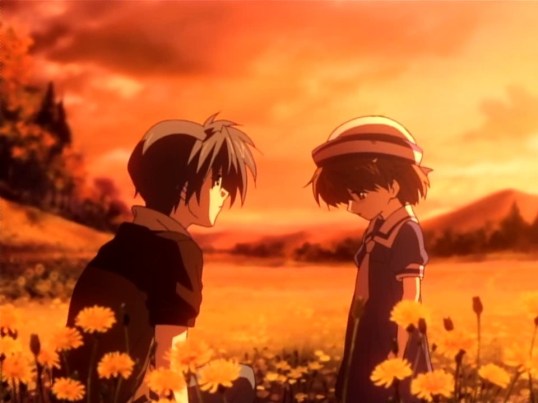
After people see this scene they will think I’m either crazy or a glutton for heartache for loving this scene. It’s hard to disagree with that statement. There’s a reason why I love this scene from the anime series Clannad After Story and it has less to do with the tone of the scene, but a major reason why anime is not just for kids or about boobs, tentacle rape and all the other things adults in the Western media dismiss the art form for.

This scene from Clannad After Story happens between the series’ main lead in Tomoya who has now come to the realization that he must now make amends to the daughter he left behind to be cared for by his wife’s family. It’s a powerful scene that has brought many to tears from young teen girls to grown-ass men who probably bawled more than the former. One doesn’t even have to have seen the previous season to this anime or any episodes leading up to this scene. The moment itself has enough of a backstory that one cannot help but get caught up in the moment. It’s also a scene that does a great job of emphasizing that bond between parent and child even when the former hasn’t lived up to their responsibilities.

I think if more people watched anime like Clannad After Story their opinions of anime would change for the better and see it in a new and positive light.

VGM Entry 48: Streets of Golden Hedgehogs


VGM Entry 48: Streets of Golden Hedgehogs
(Thanks to Tish at FFShrine for the banner)

With the new higher standards brought on by the Super Nintendo, Sega Genesis/Mega Drive composers would have to start trying a little harder if they wanted to compete. Some certainly did pick up the pace, and 1991 might be considered the first year with a decent selection to choose from.

http://www.youtube.com/watch?v=-m8mnn_Ni5s

There were a couple famous soundtracks in the mix. Streets of Rage (Sega) by Yuzo Koshiro is certainly one of them. I do not possess the patience to listen to each and every Genesis/Mega Drive soundtrack like I’ve been doing with the Game Boy, nor did I ever own the system as a kid. I can only really pick and choose these titles based on my perception of popular opinion. But the one series that popped up more consistently than any other on people’s lists was Streets of Rage.

It’s a chill, laid back score that I could listen to all day without ever really tiring of, and the gritty melodies make it a lot more down to earth and appropriate for a street fighting game than the more airy sounds I tend to associate with this sort of musical style. And perhaps more importantly, the music I associate with this style was mostly written long after Streets of Rage.

I mean, Koshiro deserves a lot of additional credit for being the first game musician to really try this–or else, the first to really pull it off. It’s a style I take for granted today, and perhaps that’s why Streets of Rage doesn’t strike me as immediately as it ought to, but in 1991 games just didn’t ever sound like this. A lot of them couldn’t, really. You couldn’t do this on the SNES. The bass and drum tones just weren’t good enough. You certainly couldn’t do it on anything earlier outside of the arcade. Koshiro did an outstanding job of acknowledging and exploiting the Genesis’s best sound qualities, and perhaps a lot of the best system scores to follow are a bit in debt to him.

http://www.youtube.com/watch?v=ayrDtB6b7R4

We’ve all heard “Green Hill Zone”. As a game intended to compete with the Mario series, the music of Sonic the Hedgehog (Sega), composed by Masato Nakamura, definitely falls a little short, but that doesn’t make it bad. The songs were sufficiently catchy, and for a high-speed game they provided a pleasant counterweight.

One of the distinct features of Sonic the Hedgehog is the bass lines. Songs like “Spring Yard Zone” (1:58) are really made by them, and even such hopelessly generic tracks as “Labyrinth Zone” (2:49) maintain a distinct Sonic the Hedgehog flavor through the bass.

I could post a lot of other also-rans that are much better than previous Genesis music yet stil leave something to desire. Jewel Master by Motoaki Takenouchi and Zero Wing by Tatsuya Uemura, Toshiaki Tomisawa, and Masahiro Yuge certainly fall into this category. But I just don’t feel that they’re all that valuable in the larger picture. With so many unconditionally great scores out there by 1991, being the best for a particular system simply no longer mattered all that much.

http://www.youtube.com/watch?v=63Vz2g8vHqU

The real Genesis winner for me this year is Golden Axe II (Sega), by Naofumi Hataya, and you’ll hear why in the very first sound in the game. What that crushing drum beat is doing here is beyond me, but I love it. It makes absolutely no sense in what is ultimately a bluesy jam title track, but I couldn’t care less. From start to finish, the soundtrack to Golden Axe II is underwritten by a restrained desire to be heavy metal.

http://www.youtube.com/watch?v=fC-9NYjkcEw

This shines on some tracks more than others. “Ravaged Village”, for instance, lacks the heavy drumming, but the highly distorted bass tones do the job. Maybe not ‘metal’ in this instance, it still retains quite an edge. The bass feels like a pool of lava bubbling beneath you. There’s something very familiar sounding about this sort of bass with that snake-like melody on top, but I can’t quite put my finger on it–perhaps a coincidental similarity in a later game.

This was Naofumi Hataya’s first game score by the way, as far as I can tell. He joined Sega in 1990, and would go on to play a major role in the Sonic the Hedgehog franchise up through the present day. If his future works were as good as this one, I have a lot to look forward to.

http://www.youtube.com/watch?v=77Gy0Y9vdqA

“Castle” is completely ridiculous, accenting a slow, foreboding song which meets all of the stereotype standards for a fantasy game with a crushing mechanical drum line that I’m pretty sure is trying to punch me in my face through my headphones.

Thank you for being awesome, Naofumi Hataya.

Film Review: Branded (dir by Jamie Bradshaw and Aleksandr Duleyran)


Is it too early to declare that Branded is the worst film of 2012? 

Probably.  After all, there’s still 3 more months left in October and who knows what could happen.  I’m still holding out hope that Zero Dark Thirty will be just as bad as I’m expecting it to be and I recently realized that I find the trailer for The Sessions to be kind of annoying.  There’s still a slight chance that I’ll see a film worse than Branded before 2013.

However, I do think that it’s safe to say that Branded is the worst film of 2012 so far.

At the very least, Branded deserves the award for 2012’s most deceptive trailer.

On the basis of the trailer, you would be perfectly justified in expecting Branded to be a rip-off of John Carpenter’s classic They Live.  You would be justified in expecting that the film would be a thriller, involving aliens using advertising to control people’s minds.

What you would not expect is that Branded would turn out to be an overlong, extremely preachy and didactic film about a Russian advertising guru who, after producing an ill-fated reality show, spends 6 years living as a shepherd until he happens to ritualistically sacrifice a red cow and is therefore inspired to lead an advertising war against fast food companies.  You wouldn’t expect the film to be such a confused mess that, while watching it, you actually find yourself standing up to leave the theater because you’ve mistakenly assumed that the film is over (as I did several times).  You also probably wouldn’t expect that the entire film would be narrated by yet another cow, this one floating around in the night sky and sending down lightning bolts to both enlighten and destroy various advertising gurus.

All of that happens and more!  And you know what?  As interesting as it may appear to be in writing, it’s all unbelievably dull when watched on-screen.  The Russian advertising genius is played by Ed Stoppard and his American girlfriend is played by Leelee Sobieski and, as a couple, they have absolutely zero chemistry.  You never believe their relationship and, as such, it’s difficult to understand why Sobieski’s character is so determined to make things work with a guy who appears to be insane.  Sobieski’s father is played by Jeffrey Tambor.  Whereas everyone else in the film underplays to the point that they sometimes appear to be sleepwalking, Tambor overplays every scene, as if he thought he was appearing in an episode of Arrested Development instead of this movie.  In the end, the best performance in the film comes from the talking cow in the sky, even if she seems awfully proud for a character who spends the entire movie spouting banal clichés.

(Seriously, did you know that advertising is a form of manipulation?  Well, you do now!  Thanks, Space Cow!)

For no particular reason, Max Von Sydow is in the film as well.  His role is really just a cameo and the entire time he’s on-screen, he’s got a small smile on his lips as if he’s saying, “Did you really pay money to watch this crap?”

In its defense, there is one — and only one — impressive scene in Branded but you can see that scene in the trailer for free.

There might be a worse film than Branded released this year.

But I doubt it.

VGM Entry 47: Sim City


VGM Entry 47: Sim City
(Thanks to Tish at FFShrine for the banner)

I’d like to focus in depth for a moment on a soundtrack that you might not have expected to even make the cut. Sim City, composed by Soyo Oka, doesn’t get all that much praise. It’s fairly often forgotten, and almost always blown off as a mere solid effort. But I think it’s really quite a brilliant work of art–one of the Super Nintendo’s finest.

http://www.youtube.com/watch?v=_QpFy8vVdPI

Soyo Oka got her start as a video game composer with Nintendo, working on five forgotten titles for the NES between 1988 and 1989 before graduating to the SNES and being tasked with three higher profile projects: Pilotwings in 1990, Sim City in 1991, and Super Mario Kart in 1992. For whatever reason her work load diminished a bit after that: she was charged with arranging Koji Kondo’s music for Super Mario All-Stars in 1993 and then stepped back to the NES to team up with Shinobu Amayake for the final licensed game to ever be released on the system, Wario’s Woods, in 1994. She departed from Nintendo in 1995.

It’s a shame that her career with them was so brief, because during this time her distinct, often jazzy style rose to be the second voice of Nintendo. You could always tell a Soyo Oka score from one of Koji Kondo’s despite their many similarities, and if Kondo was probably better, Oka nevertheless remains terribly under-appreciated today.

The concept of Sim City presents a bit of a musical challenge. Just how ought a city simulation in a modern setting sound? I think she completely nailed it, and I rather wish this compilation was better organized to show it. The menu music that starts at 0:45 here says it all. It’s a wonderfully visual work: the lazy trumpets and accompanying hum depict towering and stationary skyscrapers surrounded by that staccato higher pitch early morning hustle and bustle, with the rapid yet never rushing stop-and-go bass tying it all together.

Following the short Dr. Wright theme (which, I should point out, is substantially better than most of the “shopping” game tunes it resembles) we are treated (at 1:47) to the first of six population-themed songs which garudoh unfortunately fails to present chronologically. “Village” is your lowest population, and the tones she chooses are just perfect to distinguish it from a standard RPG small-town theme; it puts you in the same warm, safe place, but it still feels entirely modern, in an Earthbound sort of way.

Humor me and pause the video for a moment. The next track, “Growth”, starting at 2:33, is merely a brief interlude which really doesn’t belong here, but it’s a good opportunity to switch videos since what follows in garudoh’s is misplaced.

http://www.youtube.com/watch?v=1hZG208APbA

“Town” is a beautiful and brilliant transition. The main melody of “Village” is retained, but instead of a lazy country town you now have a population on the move beginning to become acquainted with sophistication. The classical theme perfectly retains a feeling of a small world while giving you a sense of progress which “Village” lacks.

http://www.youtube.com/watch?v=VVEDYdRrqJ4

“City” is perhaps the weakest link of the six, but you can definitely get a feeling for Oka’s intentions here. It’s a great deal faster and less stable than “Town”, but it still clings to a sense of something classical. The musical progression has reached a stage of uncertainty; a small community is on the brink of losing its identity and giving way to the future, but it has yet to make that final step. “City” is a track best appreciated in context, and I think what follows explains a lot about it.

http://www.youtube.com/watch?v=0JEnGbcm1TQ

“Capital” is definitely my favorite Soyo Oka song in any game. The opening segment is just stunning. Your population has finally taken the last step and acknowledged its collective existence. It brilliantly captures that adventurous and fleeting sensation of being an anonymous unit in a perfectly attuned machine, and it appropriately comes to an end far sooner than anyone would like, returning to the more private experience of “Village”, only now presented in a sort of dreamy, surreal state, conditioned by the memory of that brief sensation at the start of the song.

http://www.youtube.com/watch?v=bspGsYtEZB4

“Metropolis” lays all dreams of harmony to rest. The lazy trumpets of the menu tune are back, but here the staccato overlay is harsh and synthy, the bass down to business. It’s a real city now, not some idealistic vision of one, and this machine’s only collective consciousness is apathy triumphant. Gameplay-wise you’re getting down to business too, and if that first residential block you ever built is getting in the way of the new sports stadium, it’s time to send out the eviction notices.

http://www.youtube.com/watch?v=5Ba2Kf3NR7A

“Megalopolis” is an interesting track to end on. Fast paced and pleasant, you’ve got to love the machine to get this far. The fun is in striking the perfect balance now, not in micromanaging a paradise. But the song still slows down for a moment to reflect on your roots, and for all practical purposes it’s an end credits theme. There’s no winning. There’s just perpetual motion and memory. And so the track loops on and the game continues, but in some off sense you’ve reached the end.

Soyo Oka is one of the most underrated composers in the history of the business, and Sim City is her finest work.

Artist Profile: William Luberoff (1910–2002)


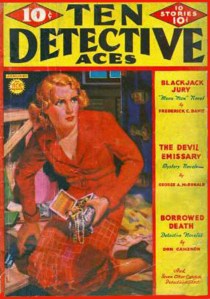
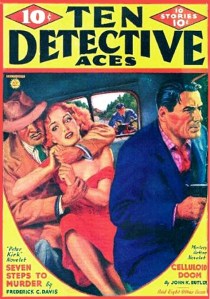
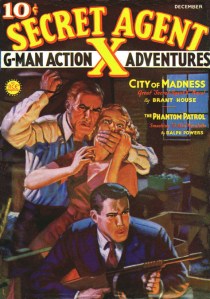
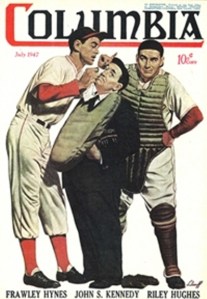
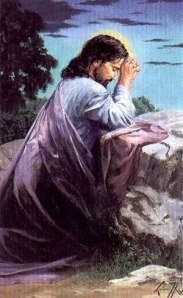
William Luberoff had no formal training but he was one of the most prolific illustrators of the pulp era.  He began his career doing covers and illustrations for magazines such as Climax, Secret Agent X, and Saga and he also designed over 60 cover for Columbia, one of America’s top Catholic-interest magazines.  He retired from the magazine market in the 1960s and devoted himself to doing religious paintings.  While I was researching him for this post, I came across many of his paintings that I remembered first seeing in catechism class.  Luberoff’s painting Baseball can be seen in the Baseball Hall Of Fame.

Trailer: Lincoln (dir. by Steven Spielberg)


One of the films for 2012 that’s seen by many as a major player in the end of the year Awards season. Steven Spielberg’s long-delayed and gestating historical drama about Abraham Lincoln will finally make it onto the big-screen this early November. Spielberg had initially chosen Liam Neeson to play the 16th President of these United States but as the project continued to get delayed he backed out and in comes Daniel Day-Lewis to take on a very difficult role.

Lincolnis based off of Doris Kearns Goodwin’s biography of the 16th President, Team of Rivals: The Political Genius of Abraham Lincoln. With Tony Kushner tasked with finally hashing out a final draft of the screenplay the film finally went into production in 2009. The cast is an ensemble led by Day-Lewis that includes several past Academy Award and Emmy winners like Tommy Lee Jones, Sally Field and Hal Holbrook with other acting luminaries like Joseph Gordon-Levitt, Walton Goggins, David Straithairn, Jared Harris and Jackie Earle Haley.

The first trailer finally arrived today, September 13, 2012, during a Google+ hangout with Spielberg and Gordon-Levitt and reaction to the trailer seems to range from “give Daniel Day-Lewis the Oscar already” to “an Oscar-bait if there was ever one”. No matter where one sat in their reaction to this trailer it will be interesting to see if Spielberg will come out with a film that doesn’t come off as maudlin and manipulative, but deliver a film that explores and tries to explain why Lincoln became such a beloved President in his time despite making so many unpopular decisions and sitting through the worst era of American history (Civil War) and decades since his death.

Here’s to hoping that the film is less like Amistad and more like Schindler’s List in terms of tone and narrative. We know why Lincoln is seen as the greatest President we ever had. What we want to know is the why’s.

Lincoln arrives in the theaters this November 9, 2012.

VGM Entry 46: Konami in ’91


VGM Entry 46: Konami in ’91
(Thanks to Tish at FFShrine for the banner)

It was to be expected that Nobuo Uematsu and Koji Kondo would make magic on the Super Nintendo. Plenty of other composers did as well at an early stage. Konami in particular launched a number of impressive titles in 1991, and I think I’ll take a moment to showcase three of them.

http://www.youtube.com/watch?v=UjuSIUKdnjA

Super Castlevania IV was composed by Masanori Adachi and Taro Kudo, both of whom remain rather obscure figures in the game music industry. There was actually a false rumor going around that Masanori Adachi died during the 1994 Sega Mega-CD port of Snatcher. In a sort of ‘meet the staff’ easter egg (in which Adachi also participated), Kudo jokingly wrote “Rest in peace, Mr. Adachi!” Credits to his name are so few that this has been taken literally by many, but it would make his future compositions quite a miraculous feat.

Super Castlevania IV marks a major reconception of the series’ sound, which will not be completely apparent in these opening tracks. Skip ahead a bit, to “The Chandeliers” (4:29) and “Secret Room” (6:35) for instance, and you will get a much better feel for the degree of diversity introduced in Adachi and Kudo’s new vision. At times the game embraces its classical roots to the fullest. They take full advantage of the SNES’s capacity for authentic piano, organ, and string sounds to cut out all the rock filler, when the situation calls for it. The album still has plenty of contemporary drumming, but it doesn’t feel quite as rock driven as the NES games, much to its benefit in my opinion. Rock would still infuse plenty of new compositions, but the SNES allowed a lot more room for diversity. I think Adachi and Kudo accomplish the most when they go for the straight classical sound, as on “The Chandeliers”, but they make a commendable effort to explore a large variety of styles appropriate for different elements of gameplay.

The first three tracks in this mix are of course the classic series staples “Vampire Killer” (1:05), “Bloody Tears” (0:00), and “Beginning” (1:50), from Castlevanias I, II, and III respectively. It’s certainly nice to hear the old familiar songs in an improved medium, and they did a fairly good job with them (though I do think this version of “Bloody Tears” could use some work–they play it too safe with the main melody and drum track for the addition of the flute and heavier percussion at the end to accomplish its desired effect), but what I think is more significant is that these three songs don’t stand out as anything really above and beyond the rest of the score. On the Nintendo they were exceptional, and familiarity is definitely a plus, but I honestly like a lot of Adachi and Kudo’s original compositions just as much.

http://www.youtube.com/watch?v=8HkyAiV4Kbc

If you’ve been keeping up with my posts, you should be thoroughly familiar with Ganbare Goemon by now. If you haven’t been, you probably don’t know what I’m talking about. Six years and six sequels after the launch of the series, a Ganbare Goemon game finally made it to North America. The port, retitled The Legend of the Mystical Ninja, didn’t launch until 1992, but the Japanese Ganbare Goemon: Yukihime Kyuushutsu Emaki from which it derives came out in 1991. Though well in keeping with the traditions of the series, The Legend of the Mystical Ninja was something of a musical novelty for western gamers.

Its composers were somewhat obscure. I could find very little on either Kazuhiko Uehara or Harumi Ueko, and though Ueko continues to appear in soundtrack credits up to the present day (mostly under the peculiar alias Jimmy Weckl), Uehara seems to all but vanish after a brief career in the early 1990s. It’s a shame, if the two in collaboration were capable of producing this kind of quality. But Uehara may also be a Yoshihiro Sakaguchi type–a sound programmer confusingly credited with a few other artists’ original compositions. I’ve seen him specified as the programmer in certain liner notes, and it would also explain the occasional credit he receives for what was I believe Mutsuhiko Izumi’s Turtles in Time score. But again, I don’t know just how extensively sound programmers were involved in composition. So this might be the work of Harumi Ueko, or he and Uehara might both have played fairly equal roles.

The Legend of the Mystical Ninja presents an oriental score, as you can tell, and I think it does a delightful job of it. If it is reasonable to expect more out of a SNES title than improvements on the same old NES sounds, then perhaps a little more situational diversity was in order. The light-hearted and adventurous style can only capture so many moods. But what it does well–create a sense of light-hearted adventure–it does exceptionally well. It’s the hoaky town and shop themes that prevent The Legend of the Mystical Ninja from being a consistently excellent soundtrack. The music written for the field of combat is all spectacular.

http://www.youtube.com/watch?v=8-RTENXlwfw

0:36. That is where you’ll want to skip to if you can’t handle some classic 90s cheese. A year before it became known to most of us as Teenage Mutant Ninja Turtles IV, Konami released this game to the arcade under its SNES port’s subtitle, Turtles in Time. I was pretty shocked to find this, actually. Konami’s original Teenage Mutant Ninja Turtles (that is, confusingly, Teenage Mutant Ninja Turtles II: The Arcade Game on the NES) and X-Men were by far my two favorite arcade games as a kid. I had no idea Turtles in Time even existed as such. Anyway, Mutsuhiko Izumi did the hard-rocking soundtrack. The music is largely the same in both games, and while nostalgia leads me to favor the SNES version, the arcade original is probably just a slight bit better–but only slightly, and this is debatable.

http://www.youtube.com/watch?v=SCLt8NcDWaA

For instance, if you skip to 3:38 in the arcade mix and 2:43 in the SNES version–“Bury My Shell At Wounded Knee” if memory serves me–you’ll find a major disparity between the drum tracks. Turtles in Times‘s percussion is essentially indistinguishable from a real drum set. Turtles IV can’t compete there, but it does its best to compensate with some pretty wild sound effects and a really bizzare distorted bass. These features throughout the game grant the SNES port a unique and immediately identifiable sound all of its own. In some cases this paid off to such an extent that the port sounds slightly better than the original. Such is, I think, the case for the Super Shredder fight music.

I am lead to believe that Kazuhiko Uehara or Harumi Ueko, the same names associated with The Legend of the Mystical Ninja, were responsible for Turtles in Time‘s SNES port, and if so 1991-1992 was a pretty successful period for the both of them. Turtles IV is an outstanding and fairly faithful adaptation, recreating the original sound where technology allows and inventively maintaining the spirit of the original where it does not.

I can’t say I’ve heard too many instances, at a time when port soundtracks were necessarily different, of an original game soundtrack and a port both being equally exceptional. It worked out this time, compliments of Mutsuhiko Izumi, Kazuhiko Uehara, and Harumi Ueko.

….

Oh yeah, that brief nightmare at the start of the arcade version sampler? That was from the Turtles’ 1990 “Coming Out of Their Shells” tour. What

the fuck?

Trailer: Atlas Shrugged, Part 2


Nearly every film fan that I know is excited about the fact that the trailer for Steven Spielberg’s Lincoln is going to be available for viewing today.  Everyone, that is, but me.  To me, Lincoln sounds like yet another big-budget, self-conscious prestige film that was primarily made to win awards (and considering just how weak this year has been so far, it may very well do that).  Lincoln sounds like a film that people will respect but never actually enjoy. 

Add to that, this is an election year and I know I’m not looking forward to having to listen to all the toadsuckers comparing their particular candidate to Daniel Day-Lewis as Abraham Lincoln.  Seriously, it’s going to get tedious.

(That said, I seriously hope that I’m wrong because I’m a lover of both film and history.  It’s not the film’s subject matter that concerns me as much as it’s the deafening hype that surrounds the film and demands that I love it before I even see it.)

As soon as the trailer for Lincoln is available on YouTube, either myself or another Shattered Lens will undoubtedly share it on this site.  For now, however, I’m going to share another recently released trailer for another film about politics. 

If Atlas Shrugged, Part 2 is anything like the first film in the trilogy, it’ll be the type of trashy, low-budget fun that always manages to annoy the usual gang of complacent critical elitists.  If nothing else, it should be interesting to see just how overwrought the reaction (both pro and con) will be to this particular film. 

AMV of the Day: Mayoi Calling Araragi (Bakemonogatari)


It’s quit an early Thursday morning and I just thought to pick a brief but very interesting piece of AMV as the latest “AMV of the Day”.

It’s actually called a MAD video. A type of fan-made video very popular in Japan where fans take an audio clip from a favorite anime (or even a non-anime) and splice it together with piece of music and try to match the dialogue with the beats and tempo of the song. This particular MAD is by creator called fillin and take the comedic way the Bakemonogatari character of Mayoi Hachikuji always stutters the name of the series’ lead in Araragi.

The song used is the Moogle’s Theme from the Final Fantasy V soundtrack. The video pretty much works perfectly as Mayoi’s stuttering of Araragi’s name matches the tempo and melody of the song perfectly. One thing that’s clear is that this video is quite addictive to watch since it loops and plays again once it finishes. I think I watched and listened to it for almost an hour straight and would’ve continued longer if sleep hadn’t called.

Anime: Bakemonogatari

Song: Moogle’s Theme from Final Fantasy V

Creator: fillin


Past AMVs of the Day