VGM Entry 12: Zelda and Dragon Quest


VGM Entry 12: Zelda and Dragon Quest
(Thanks to Tish at FFShrine for the banner)

Two fantasy-style games in 1986 achieved massive retail success and thereby brought the genre to the attention of the masses. These, it should be fairly obvious, were The Legend of Zelda (Nintendo) and Dragon Quest (Enix). Both games are likewise frequently cited among the most important soundtracks for the Famicom/NES. I think this can be a bit misleading.

The Legend of Zelda had a truly epic main theme, with which Koji Kondo almost certainly surpassed his work in Super Mario Bros. Whether it was the best video game song written up to that point is really a matter of personal preference; it is not as though it had no competition. Regardless, this was the first installment of Nintendo’s second major franchise gaming series, and the sort of anthem Koji Kondo was able to craft for Link had enormous marketing benefits. It’s not as though lead characters in Nintendo’s games became popular out of the shear force of the company’s good name. No one really remembers say, Professor Hector (Gyromite and Stack-Up) or Mr. Stevenson (Gumshoe). If Link was going to become a franchise character, he was going to need a theme song, and in that regard Koji Kondo pulled through once again.

What else did The Legend of Zelda have going for it musically? Well… very little. I mean, the Underground Level theme (3:18) is pretty cool–all 18 seconds of it. It reminds me of some of Uematsu and Mitsuda’s later works. But there just isn’t much else to this game. The title screen and overworld theme are variations on the same (awesome) melody. Death Mountain (3:48) sounds like it was thrown together in five minutes, and the ending theme (1:42), while catchy, is simply in the wrong game. It is Mario music.

Koji Kondo is one of the most important figures in the history of video game music, no doubt about it, but the bar had not been raised quite so high on the NES in 1986 as it had been in the home computing world. Thus The Legend of Zelda sounds great within the context of its system, but a little primitive in the larger scope of things.

The interesting thing about Dragon Quest to my western ears is that the game series was never all that hot here. I seem to recall reading at the time of Dragon Quest VIII‘s Japanese release–and we’re talking 2004 so I may be very much mistaken–that the game franchise had sold more copies than Final Fantasy. At any rate, it is important to recognize that this series was huge in Japan. The original Dragon Quest formalized nearly every stereotype of traditional RPGs. This video should make that fairly clear, and it’s pretty significant to note that this was not a product of Eastern adventure/RPG traditions. Yuji Horii took his inspiration from the Ultima and Wizardy series on the Apple II, and it’s at this point that the two genres really diverge. Japan would become the centerpoint of both Eastern and Western traditions, and just a Legend of Zelda served as the quintessential starting point for the modern adventure game, Dragon Quest permanently defined the RPG.

Like The Legend of Zelda‘s overworld theme, Dragon Quest‘s title theme became a series staple, but “Overture March” took quite a while to grow on me. A good many other ears might hear delicious nostalgia, but its quality does not immediately jump out at me. It’s really how Koichi Sugiyama continually developed and improved upon it in future games that makes the original fun to revisit. The rest of the soundtrack was, like Ultima III and Ultima IV, perfectly well suited for the RPG experience, and wider distribution meant that Sugiyama would be much more influential in standardizing this approach. I would be shocked if “Unknown World” (1:40) did not heavily influence Nobuo Uematsu. It could be a chiptune take on a Final Fantasy VII track, and it’s quite pleasant. Still, and unlike Kenneth W. Arnold’s works, the original soundtrack does have its flaws. The combat music (2:22) is terrible, grating on the ears on the first listen let alone after the constant encounters one expects in an RPG.

But in setting the standards for the series he would faithfully continue to compose for the next twenty five years (the man is now 81 years old and still making music), Koichi Sugiyama also set the standard for what RPGs should sound like. The standard was already in practice, as I hope I have shown, but the enormous influence that the Dragon Quest series would have on video games in Japan probably prevented a lot of deviation from this norm in the future. And much to Koichi Sugiyama’s credit, the music definitely improved over time. Dragon Quest II, released by Enix in January 1987, less than a year after the series debut, would retain the original’s best tracks while replacing the obvious duds with significant improvements.

By Dragon Quest III (Enix, 1988), Koichi Sugiyama had firmly established himself as one of the best RPG composers of the 1980s. His emphasis on continuity and improvement of past works rather than wholly original soundtracks allowed each game to feel both refreshing and entirely familiar. In the cases of the best tracks, the changes are barely even noticeable. “Overture March” in Dragon Quest III begins almost identically to the original for instance. The melody is a little more staccato, and that’s it. If it’s not broke, why fix it?

I don’t know that I would call either The Legend of Zelda or Dragon Quest great soundtracks. The Legend of Zelda contained an especially great song, but I feel like allowing one song to carry a game was beginning to be a cop-out by 1986. Dragon Quest formed a more complex whole, and it’s definitely closer to excellence, but I feel like it still lets the shortcoming of the NES get the better of it at times in sound selection for what were certainly wonderful melodies. It’s also got the Combat theme to deal with, and such a reoccurring flaw is hard to ignore. Koichi Sugiyama would continually improve, and Koji Kondo too would be stepping up his game before the Famicom expired, particularly with Super Mario Bros. 2 in 1988.

AMV of the Day: Means to an Endgame (Code Geass)


I was going to pick something lighthearted for the next “AMV of the Day” but decided to save Mr. Satan for a later date when I return to posting more Anime Expo 2012 stuff. So, I chose an AMV that I would categorize as the opposite of lighthearted and could be considered as very dark, indeed.

“Means to an Endgame” is the latest from AMV producer extraordinaire tehninjarox. He picks one of my favorite Florence + The Machine songs in “Seven Devils” and uses it to musically score and highlight just how much of a devil the main protagonist of the anime series really turns out to be. This is not to say that Lelouch is a bad guy. He’s just very focused on taking down his enemies to make the world a better place for his crippled sister. How he goes about this includes committing what he calls evil actions for the greater good.

The video itself does a great job in matching up with the song that one would almost think that Lelouch (the man in the black armor and cape) was the villain of this piece. While I’m not like fellow anime contributor pantsukudasai in that mecha doesn’t do it for him, I myself don’t mind mecha anime and it was mecha that first brought me back to the artform during the mid-80’s. This video just shows just how far mecha anime has gone from just being about pilots in giant fighting robots fighting it out. Code Geass has it’s share of mech fighting but it also has a strong, dramatic narrative that blurs the distinction of who the good guys and bad guys are.

Just like another great AMV producer in Chiikaboom, one tehninjarox has become a favorite of mine with each new video he releases. This one definitely make’s my favorite list.

Anime: Code Geass

Song: “Seven Devils” by Florence + The Machine

Creator: tehninjarox


Past AMVs of the Day

VGM Entry 11: Ultima


VGM Entry 11: Ultima
(Thanks to Tish at FFShrine for the banner)

Ultima I, Wizardry, Bokosuka Wars, and Dragon Slayer–if we ignore this last title’s half-hearted attempt–all lacked my topic of interest here: music. When music first came to Eastern-style adventure/RPGs is as difficult to pinpoint as a precise definition of the type of game itself. The NES port of Bokosuka Wars had continuous music, albeit much to its detriment, but a December 14, 1985, release date renders this historically insignificant; Koji Kondo’s work in The Legend of Zelda would take the Japanese gaming world by storm only two months later. There may have been others with some music of worth, but they have evaded my notice. Western RPGs are an entirely different matter.

Kenneth W. Arnold’s work experience summary on LinkedIn claims that “Ultima III was the first game for personal computers (Apple II originally) with a musical score.” I have found no reason to doubt this claim. If I have overlooked an earlier RPG with music, it should nevertheless stand that Arnold’s work on Ultima III: Exodus (Origin Systems, 1983) is among the very first.

Much more importantly, it’s amazing. The songs are exquisitely attuned to the properties of the Mockingboard A sound chip. The deep tones carry a real sense of depth into the gameplay, and the natural distortion is wholeheartedly embraced to create a sense of something hinged between danger and mystery–this idea of an old world that is never entirely safe or wholly understood. The style of each song is ideal. It’s got everything you could expect in an RPG soundtrack: an adventurous overworld theme, a peaceful tune for towns, a haunting dungeon, and an especially noteworthy tense combat melody. In what is quite possibly the first RPG soundtrack ever written, one finds style-scenario associations which are pretty much the same today. Kenneth W. Arnold deserves a lot more credit for Ultima III than the history books grant him, not because he invented RPG music–I am inclined to believe such games naturally lend themselves to particular musical styles–but because he did everything right the first shot out the gate, without any previous standard having been set. And he did it so well that his works still stand among the finest today. Cheers to that.

It just got better from there. Ultima IV: Quest of the Avatar (Origin Systems) was released on September 16, 1985, and with it Kenneth W. Arnold achieved a level of quality in RPG music that even Nobuo Uematsu would not be topping any time soon. The Castle theme especially (3:09) is one of the most commanding of its kind for any RPG. Shopping (1:34) presents an audio vision of some medieval market place filled with crooked old cranks peddling dubious potions. The combat theme (5:27) is a mere 12 seconds long, yet its exciting, adventurous spirit lends itself to continuous repetition better than nearly any other RPG non-boss battle music I’ve heard.

Credit goes to Apple Vault for actually reproducing this music. It wasn’t easy to come by. Ultima must be one of the most heavily ported series in history, with Ultima III appearing on the Atari 800, Commodore 64, IBM PC, Amiga, Atari ST, Mac, PC-8801, PC-9801, FM-7, NES, and MSX2, and Ultima IV appearing on the Atari 800, Commodore 64, IBM PC, Amiga, Atari ST, PC-8801, PC-9801, FM-7, FM Towns, Sharp X1, Sharp X68000, NES, MSX2, and SMS. Most of these ports contained the original music adapted for different sound chips, and you can see how the original Apple II Mockingboard take might get lost in the clutter. Some of these ports are pretty good approximations. Others, like the NES version, inexplicably toss out Arnold’s soundtrack altogether. But the game was originally intended to be heard on an Apple II Mockingboard, and I believe this is the most accurate version you’re going to find. Accuracy does matter here, I think. Given the amount of attention to tone quality I think Arnold put into this, preserving the medium is just as important as preserving the melodies themselves.

It’s no matter of chance that many of the best game soundtracks were RPGs. By nature among the most diverse games in setting, they naturally demand a diverse score. Thus it was the case that Ultima III, possibly the first RPG soundtrack ever, might also have been the longest soundtrack up to that time, clocking in at about six and a half minutes in 1983. But it’s the shear quality that deserves most of the attention. Kenneth W. Arnold was brilliant. These are the first truly great RPG soundtracks, and it’s a shame that they have been largely forgotten.

VGM Entry 10: The RPG


VGM Entry 10: The RPG
(Thanks to Tish at FFShrine for the banner)

The music of Super Mario Bros. was also somewhat unique in that it merged flawlessly with a game which had nothing to do with sports or space aliens. The electronic nature of early video game music generated futuristic sounds, and a whole ton of early games being space shooters, the music naturally lent itself to synthesis. Konami’s 1983 space shooter Gyruss is a perfect example of a harmonized audiovisual experience of this sort. But good synthesis also meant stylistic relativity. Not every game on the market involved shooting down space invaders, outrunning enemies through a maze, or bashing in faces with a pixilated club. Many innovative new ideas were in the works which would require a very different sort of soundtrack.

The style of most lasting consequence for video game music was the adventure/role playing game, and it has an extensive history. Link did not spring forth from the head of Shigeru Miyamoto clad in shining armor, and someone somewhere out there still goes around telling people that he was larping as Legolas years before this fancy shmancy new “Dungeons & Dragons” game came along. I think it correct to say that The Legend of Zelda and Dragon Quest, both released in 1986, were respectively the first adventure game and the first RPG to have massive market success, but both distinct styles emerged from long-standing traditions, and their music was a sort of natural consequence of the nature of the games, not a single individual’s revolutionary new idea.

All joking aside, if you want to go all the way back, you really do have to look at D&D. The first computer RPGs were under construction less than a year after the pen and paper game’s initial publication (TSR, 1974), and they were directly inspired by it and the works of J.R.R. Tolkien. These were private affairs, designed by programmers in their spare time, and there were quite a few of them. Gary Whisenhunt and Ray Wood’s dnd, Rusty Rutherford’s pedit5, and Don Daglow’s Dungeon seem to be the most frequently cited surviving 1974-1976 creations, and there are plenty of rumors of slightly earlier lost works.

A lot of the features of “traditional” video RPGs are direct descendents of tabletop games. They evolved fairly linearly, reaching a proto-modern format by the time of Richard Garriott’s Ultima I: The First Age of Darkness (California Pacific) and Andrew Greenberg and Robert Woodhead’s Wizardry: Proving Grounds of the Mad Overlord (Sir-tech Software), both released for the Apple II in 1981.

RPG-esque evolutions in Japan were far more diverse, but perhaps a bit less exciting. With no D&D tradition rendering particular game features canonical from the very beginning, developers were more experimental, merging all sorts of features from western RPGs, simulations, strategy games, and standard action types. The earliest examples are quite difficult to find samples of, perhaps in part because of the language barrier, but the tradition does appear to have begun a bit later than in the west. Koji Sumii’s Bokosuka Wars, released by ASCII for the Sharp X1 home computer in 1983, is an interesting example of a strategy game set in a Zelda-esque overworld of forests, mountains, and castle walls.

Yoshio Kiya’s Dragon Slayer, released for the PC-8801 by Nihon Falcom in 1984, is a more obvious inspiration for The Legend of Zelda, with its strong emphasis on puzzle solving, though the graphics are deplorable for its time and the sound a travesty. (Scott Joplin? Really?) But whatever their flaws, these games were the prototypes. They set the stage for great things to come. And at least in the west, RPG music would appear on the stage in fairly perfected form in the first instance.

6 Trailers For Team Chacal


Hi!  Are y’all enjoying the Olympics?  I’m not but I’m still occasionally watching them and asking myself questions like, “Why do male beach volleyball players actually get to wear clothes while competing?”  and “Are there any countries other than America, Great Britain, and China competing this year?”  Seriously, if you were just to judge from the coverage on NBC, it would appear that the USA is the only team competing in the majority of the events.  It’s a bit unfair to those of us who, while American, are also proud of the fact that our ancestors came from Ireland, Italy, Spain, and Germany. 

Therefore, this edition of Lisa Marie’s Favorite Grindhouse and Exploitation Film Trailers is dedicated to those countries that are being ignored by NBC (and probably the BBC as well).  I’m talking about such worthy countries as Albania, San Marino, and especially the beautiful island republic of Chacal.

Here are 6 trailers for Team Chacal.

1) Gymkata (1985)

It’s not quite gymnastics and it’s not quite karate — instead, it’s Gymkata!

2) Jack the Ripper (1976)

From director Jess Franco comes a film that’s either about Jack the Ripper or the current Mayor of London, Boris Johnson. 

3) Terrorgram (1988)

The name pretty much says it all.

4) Castle Freak (1995)

I can still remember this one on HBO when I was like 12 years old.  It actually gave me nightmares, it was so scary!

5) Two Evil Eyes (1990)

I’ve been planning on seeing this movie for a while now.  It was directed by both George Romero and Dario Argento!

6) Goldengirl (1979)

I’ve shared this one before but, with it being the Olympic season and all, I simply had to share this trailer again.  Have you figured out her secret yet?

What do you think, Trailer Kitty?

VGM Entry 09: Nintendo’s turn


VGM Entry 09: Nintendo’s turn
(Thanks to Tish at FFShrine for the banner)

If a bit humbled by less apparent contemporaries, Koji Kondo’s work in Super Mario Bros. (Nintendo, 1985) nevertheless stands as the most recognized video game music in the world. Your average Joe on the street is more likely to identify it than a Beatles or Dylan song. A lot of this has to do with successful marketing. Super Mario Bros. is not the most distributed game of all time. In fact, it barely sneaks into the top 10, at roughly 40 million copies sold. A lot of this has to do with dirt cheap mobile phone distribution. (Apparently that Angry Birds game has broken 1 billion. I still have no interest in checking it out, and anyway it’s pretty easy to exploit a free download to your heart’s content to get into the world record book. Does one seventh of the world’s population even own smartphones?) Of games that actually require you spend a little, the 2006 title Wii Sports is leading the records at 79 million. It must be that economic depression…

But really, if you asked people what they thought was the all-time best seller I’m pretty sure most would mention Nintendo’s 1985 classic, and that is an indication of the company’s groundbreaking marketing strategy. If you owned a Nintendo, you knew Mario and his music. And if you played video games in the late 80s, you probably owned a Nintendo. The company has moreover been persistently re-releasing the game ever since its conception, not to mention incorporating features of its classic soundtrack and iconic characters into newer games. The only prior game that really offered this sort of bundle–very catchy music, memorable characters, massive distribution–was Pac-Man.

But a 5 second song that doesn’t even loop and a big yellow dot just aren’t all that satisfying. Oh the ghosts had names, and I’m sure if I was born a few years earlier I’d have gotten a kick out of pretending they were somehow relevant and imagining some sort of weird plot to it all. (Preferably a better one than the Hanna-Barbera 1982 Pac-Man tv series.) But all of the important features, while present, were just too simplistic to stand the test of time. And it wasn’t a game design you could make good sequels to.

What Super Mario Bros. really offered was a full package. The “best” music of its day? No. The most memorable characters? Not in isolation. But all of the features came together to make a game that really had no flaws. Nintendo knew it, and they ran with it.

If I tried to compare Koji Kondo’s music to other game musicians of the day, I might sound a little unfair. He certainly wasn’t revolutionary in style; his music was if anything retro, harking back to earlier carnival- esque soundtracks, whereas electronic experimentation was the cutting edge. Compared to the likes of Monty on the Run (which by the way, despite being only one song, was longer than the Super Mario Bros. soundtrack in its entirety), the game sounds a little childish. But that was, after all, the target audience, and let’s not split hairs here. Koji Kondo is brilliant. He wrote a soundtrack that was simultaneously extraordinarily catchy and quite aesthetically pleasing. It never clashes with the game. It never speaks out louder than the game. It just merges harmoniously, and keeps on playing in your head when you power off.

Maybe that should be remembered as one of his greater contributions to video game music. A lot of the Commodore 64 tracks I’ve been listening to, while feeling more progressive than Super Mario Bros., seem to disregard their games entirely. A good case in point is Roland’s Rat Race.

Another 1985 title, composed by Martin Galway, Roland’s Rat Race (Ocean Software) is a sleazy little bop, perfect for an inner-city street fighter, or perhaps, in consideration of the peculiar opening sequence, something to do with extraterrestrial pimps. It’s great stuff, way better than the vast majority of soundtracks that would ever appear on the Nintendo Entertainment System. But the problem here should become pretty obvious when you take another look at the game’s cover art.

You will find irrelevant soundtracks up to this day, and plenty of carefully coordinated ones prior to Koji Kondo, but I do have to wonder if perhaps Super Mario Bros.‘ success lead to developers demanding a little more attention to audio relativity.

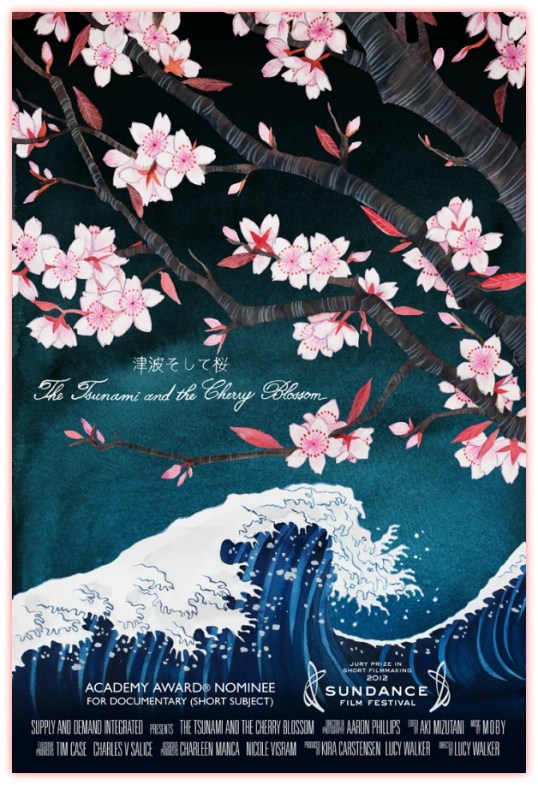
Review: The Tsunami and the Cherry Blossom (dir. by Lucy Walker)


March 11, 2011, off the coast of the Tōhoku region of the Japanese main island, an undersea earthquake measuring 9.1 on the Richter scale hit the region. The damage incurred by the Tōhoku region was cataclysmic but it would take the arrival of the mega-tsunami that followed the earthquake which would show the rest of the world the horror the people of Japan were experiencing first-hand that fateful day on March 11, 2011.

Documentary filmmaker Lucy Walker was already set to film a documentary short about the cultural importance of the cherry blossom to the Japanese people, but the disaster which struck on March 11 changed the overall theme of her documentary short. The Tsunami and the Cherry Blossomwould still look at the importance of the cherry blossom to the Japanese nation, but now it also would signify how this simple, but beautiful flower now begins the healing process for those affected by the earthquake and the tsunami and how it helped solidified the nation.

The film doesn’t try to make the scenes of disaster as it happened and the aftermath become exploitative. Walker does a great job of just letting the landscape of devastation speak for itself the reality and existential horror of the event and how it has affected the nation of Japan. Even the typical interviews of the survivors during the film comes off as something cathartic and healing even as the first-hand accounts from the subjects being interviewed and film brings about emotions of heartbreak and extreme sorrow.

Yet, the film does show the resiliency of the Japanese people in the face of cataclysm and its aftermath through their shared love and admiration for that simple cherry blossom that’s become so intertwined with the Japanese culture. A flower of such simple beauty yet one that doesn’t live for long that helps inform outsiders how the fatalistic attitude that Westerners see as inherent in Japanese culture is really a misunderstanding. Just like the cherry blossom the Japanese people see the impermanence of life as something beautiful, to be cherished and lived to its fullest. The film shows just how even in the aftermath of this disaster the nation of Japan still looks at the resiliency of the cherry blossom to survive and grow in a land of waste and debris as a sign that the survivors must now give up.

“The plants are hanging in there, so us humans better do it too.”

This simple observation from a survivor looking to do his part in rebuilding the affected region best exemplifies the ideas in this film. As someone who has admired the culture and people of Japan this film by Lucy Walker helps in showing that even in the face of tragedy that boggles the mind the capacity of the human spirit to persevere exists.

The Tsunami and the Cherry Blossomis a film that should be more readily available for everyone to watch, but unfortunately has only made the film festival circuits and the too little airings on HBO. So, if this film ever airs on HBO and/or makes its rounds to where one lives I highly recommend they watch it.

‘Beasts of the Southern Wild’ Review (dir. Behn Zeitlin)


“Everybody loses the thing that made them. The brave men stay and watch it happen. They don’t run” young little Hushpuppy tells us. It is this defiance against disaster, in its many forms, that is the core of the joyous’Beasts of the Southern Wilds’. It is director Behn Zeitlin’s first feature film, and with it he has created a mesmerizing and beautifully poetic surrealist fable of love, strength, childhood and innocence; a fable whose fantastical atmosphere, universal themes and a stunning performance by then six year old Quvenzhane Wallis make it one of the year’s best films.

The story follows a young girl named Hushpuppy (Wallis), who lives with her father Wink (Dwight Henry) in a small commune called the Bathtub located in a New Orleans bayou on the Mississippi delta. The Bathtub is inhabited by a group of individuals cut off from the world, south of the levees, dependent on nature and each other. Hushpuppy calls it “the prettiest place on Earth”, though in reality they live in squalor. This simple living doesn’t phase the residents of the Bathtub who are survivors, living amongst the beauty and harshness of nature for generations. They celebrate their existence with wild parties, fireworks and drinks; not caring about the world north of the levee’s, or the potential dangers of nature’s fury. They consider themselves adaptable, able to find a way to go on no matter what the world throws at them. This is something Hushpuppy is just learning as the films begins. She is still naive and curious about everything, and spends much of her time listening to the heartbeats of baby chicks, while imagining they speak to her in code.

Like the other children of the Bathtub, Hushpuppy learns about the world from her father and a makeshift schoolhouse run by an eccentric ‘medicine woman’. Here she it taught that the universe is held together by very intricate and delicate pieces, and one disruption could tear it all apart, cause the ice caps to melt, the waters to rise and an ancient boar- like beast known as the Auroch’s to be reborn. It is meant to be more metaphorical than anything and scare the children right, but for Hushpuppy it causes her imagination to run wild. She is still at an age where the world around her, though often confusing, is a place of wonder still open for exploration.

Her father Wink has outgrown such thinking and the Bathtub has made him a rough and often disgruntled man, who isn’t against striking his daughter. But his tough ways stem from his desire to make sure Hushpuppy is hardened and able to survive when he is gone. It hasn’t been easy for him raising her alone ever since her mother “swam away”, as we are told, though it is unknown if she is dead or just gone. However, Hushpuppy believes her mother is somewhere across the water, near a light that flickers across the bay, reminiscent of the green light in ‘The Great Gatsby’.

One day Wink goes missing, leaving Hushpuppy to care for herself. When he returns he is dressed in a hospital gown and we slowly come to understand that he is sick but doesn’t want to tell her. Angry at him for disappearing Hushpuppy hits him in the chest causing him to fall over in a great deal of pain; an effect of his secret illness, but she thinks it is all her doing. Suddenly thunder erupts, a storm is coming. Soon after a hurriance bares down on the Bathtub, flooding the place they call home, leaving its resident’s displaced, hungry and struggling in way that only their ancestors would have ever experienced. Being the naive little girl she is Hushpuppy believes that she has disrupted the natural order of things, broken one of the pieces holding the universe together and everything is now falling apart. She envisions the ice caps cracking, and the Auroch’s springing back to life, coming to get her.  She holds a lot of this emotional weight on her shoulders but it doesn’t stop her. No, instead as she puts it “the entire universe depends on everything fitting together just right…if you can fix the broken piece, everything can go right back.” So she sets out to reverse whatever mistake she has made, help her father and in doing so possibly find her mother.

What made me fall in love with ‘Beasts of the Southern Wild’ is how in the first few minutes, before the title screen, Zeitlin creates the world of the Bathtub with such great detail. It is liking jumping head first into this whole new world we have never seen, a slice of Americana with an aura of mysticism; and from their he builds upon the characters, their relationships and the emotions that flow through every scene. Zeitlin handles everything with such great delicacy, like he truly believes the Bathtub and its residents are intricate pieces of a larger cosmos and by showing that they are just small pieces of a much bigger puzzle the emotions they express, the love and the struggles they share, are all the more profound. It helps to reaffirm that even in the great expanse of space and time it is love, imagination and determination through whatever adversary that ends up meaning the most.

This is something Hushpuppy ends up learning first hand. “Somtimes you can break things so bad, they can’t be put back together” she says, which is all too true. People get sick, people leave us, people die; storms come, water rises, towns are destroyed, homes are lost forever and nothing can be done to stop it. But this isn’t a film about lost, no it is one of hope. Even after all the hardship the people of the Bathtub and young little Hushpuppy go through, it is love and family that ultimately persevere. In this sense Hushpuppy realizes that the pieces that hold the universe together aren’t all physical, that there is more to the world than just what we see or could ever imagine; and even in death the ones we love stay with us. In this way it was very reminiscent of ‘The Tree of Life’ from last year. Which isn’t the only thing it has in common with Malick’s films. Both also share similar sense of wonder in its observations of man and nature, intoxicating visuals, and even voice over narrations to let us listen to the most inner thoughts of the main characters.

With that said, the most fantastic aspect of the film is definitely the performance by the young Quvenzhane Wallis, who is deserving of an Oscar nomination. This is her first role, and she really makes the character her own. Not only is she able to carry the burden of the heavy emotions that run through the story, but on the physical side she is in every way as rough and capable as Hushpuppy, who with her dazzling smile, courage and fierceness would give Katniss a run for her money.

Dwight Henry, a New Orleans resident, baker, father and first time actor, also really adds a lot to the character of Wink that another actor couldn’t. He lived in New Orleans through Katrina. He knows first hand the struggles and life style of residents of Louisiana and he brings that experience to the character. As with Wallis, he also handles the emotions of the story so well, and together the two have a chemistry that makes watching their struggles all the more heartbreaking.

The last thing I need to mention is the score, which is in every way a part of the soul of the film. It is moving and whimsical, propelling the tone and emotions of the story with every beat. It adds to what is already a very sensory film whose emotions, through visuals, performances and sound just flow off the screen. So much so that by its end you’re standing it puddles wondering if the ice caps are really melting; until you realize the water is just your own tears. Honestly, when the credits began to roll no one in the theater got up. It was a rather remarkable sight to behold, and the first time I have experience such a thing. It was like everyone was letting it all sink in, wiping the tears from their faces, and not wanting to leave the Bathtub.

It is this ability to so fully engross the viewer that makes ‘Beasts of the Southern Wild’ perhaps the best film I’ve seen so far this year. From its beautiful beginning, where it sets up the world of the film with delicacy and great detail, to the profound, often heart-wrenching, but ultimately joyous ending, you won’t want to walk away from the story and characters of this modern fable. In this way it is an absolutely magical, ambitious and unique movie going experience. One that can not be missed.

Trailer: Zero Dark Thirty


After the success Kathryn Bigelow had with her award-winning film The Hurt Locker it was just part of the norm that people began to wonder what she would do to follow-up the film which gave her the Oscar for Best Director. There was talk of her making an action thriller about the Tri-Border Region in South America that many intelligence agencies consider a major haven for global organized crime and terrorist groups of all kinds. This particular idea bounced around for months then nothing came of it. Then news came about around late-Spring to early Summer 2011 that Bigelow and The Hurt Locker writer and collaborator Mark Boal came upon the idea that would be Bigelow’s follow-up.

The film that the two decided upon would be an action thriller detailing the global manhunt for Osama Bin Laden. Maybe it was just a coincidence, but this decision became even more important once news broke out on May 2, 2011 that the hunt for America’s Most Wanted criminal was finally over and that Operation Neptune Spear was a success with the death of Bin Laden.

Zero Dark Thirtyis the title of Bigelow’s film about the details and backstory which led up to this special operations mission on May 2, 2011. The first trailer for the film has been released by Sony and it’s short on details other than some voice overs over satellite imagery. I’m sure there’ll be more trailers that will open up what this film will truly be about leading up to it’s December release date (just in time for awards season).

It’s going to be interesting how Bigelow will do with this follow-up to The Hurt Locker. If her history is anything to go by then it shouldn’t disappoint even if some of her detractors will be chomping at the bit to see it fail and further see her Best Director Oscar win as a fluke done to keep the award from her ex-husband James Cameron.

Zero Dark Thirty is scheduled for a December 19, 2012 release date…just two days from the end of the world.

VGM Entry 08: Ports complicate the picture


VGM Entry 08: Ports complicate the picture
(Thanks to Tish at FFShrine for the banner)

While I have noted that composers remained within regional spheres, games certainly did not. Ports reigned supreme, and it was not uncommon for a game to appear around the world in a half dozen different formats. Each of these required a group of programmers familiar with the given system, and it was certainly not always the case that the original arcade version remained the best at the end of the day.

Take Commando (Capcom, 1985) for instance. The original main theme was composed by Tamayo Kawamoto, an obscure name which will persistently resurface throughout this series of articles. It’s certainly a commanding little march (utilizing the YM2203, if my previous article has peaked anyone’s interest in this regard), and I’d have fed in my quarter in the hopes of hearing more. But quite a number of Kawamoto’s soundtracks are better known for what other artists made of them in the port process than in their original form, and Commando is no exception.

Put it in the hands of Rob Hubbard and, well, did you expect anything less? This wild ride might be his most famous 1985 work after Monty on the Run, and it’s all the more enhanced when you realize how distinct it was from the original. Again Hubbard shines best when he is expanding and improvising upon the music of others. The potentially performable original work is completely lost here, transformed into a uniquely SID sound and style, and with all due respect to Tamayo Kawamoto, its certainly not worse off in consequence. The problem, which would go on to haunt countless composers down the line, is that most fans of Commando have no idea Kawamoto had any part in writing it.

The composition was actually a single day project, and the entire port was pushed through by Elite Systems in a mere two months. Hubbard briefly discussed it in an interview by Jason ‘Kenz’ Mackenzie’s Commodore Zone magazine. (Issue 10 as best I can tell, probably released in 1997): “There is an interesting story behind Commando. I went down to their office and started working on it late at night, and worked on it through the night. I took one listen to the original arcade version and started working on the c64 version. I think they wanted some resemblance to the arcade version, but I just did what I wanted to do. By the time everyone arrived at 8.00am in the morning, I had loaded the main tune on every C64 in the building! I got my cheque and was on a train home by 10.00 am…

Yie Ar Kung-Fu (Konami, 1985) is an especially odd game to consider, because its ports varied so drastically. I couldn’t find a stand-alone sound sample of the original arcade version, but you can hear it well enough beneath the sound effects of this gameplay video. The upbeat, distinctly Asian sound is a refreshing change of pace from the usual video game song styles, and in consideration of what Rob Hubbard did with Commando, you can imagine the potential for new arrangements this presents. Arguably the most famous version of the game’s music, however, is a completely bizarre departure.

The only rational explanation I can think of for Martin Galway having replaced the traditional Asian music theme with a completely irrelevant cover of “Magnetic Fields” by Jean Michel Jarre is that the title screen music is, in fact, completely irrelevant. I think perhaps Galway, either by request or on his own initiative, submitted the song as an all-purpose Commodore 64 option for Imagine Software, who produced the European computer ports of the game, and that it found its way into Yie Ar Kung-Fu simply because it happened to be available at the time. It is not one of Galway’s finer works, but I suppose you can do what you want to the loader screen. It was the combat music that really defined the game.

Even so, the actual gameplay music to the Commodore 64 port of Yie Ar Kung-Fu is as unexpectedly similar to the arcade as the title screen is unexpectedly divergent. The arrangement makes no effort whatsoever to expand upon or even properly convert the original arcade gameplay music to suit the SID sound. Instead we’re met by an unimaginative attempt to emulate the original as closely as possible, marred by SID distortion which could have so easily emphasized the music’s finest features but instead just drowned them out. I mean, this is far more appropriate than Galway’s load screen, but so much for a middle ground between total disregard for the original and a carbon copy.

And then you have the Famicom/NES version, released in April 1985. (That’s five months before Super Mario Bros., to put things in context.) Without altering the style of the arcade version in the slightest, it offers an almost entirely original song. It’s really the best version of Yie Ar Kung-Fu out there–you’d be hard-pressed to argue otherwise–and its existence is a bit puzzling. Who composed it?

The notes I’ve found on Yie Ar Kung-Fu credit Miki Higashino, but they fail to distinguish between the arcade and NES versions, as if these weren’t completely different songs. Now, I am inclined to think Higashino wrote both, which is quite remarkable considering she was only 17 years old at the time. (The only other really famous game musician I can think of to get this early of a career start is Tim Follin.) The other titles credited to Higashino in the mid-80s don’t exhibit this kind of quality, but in consideration of the fact that ten years later she would compose one of the greatest game soundtracks of all time (Suikoden), I know she had it in her. The Suikoden soundtrack is predominantly folk and traditional music (like Yie Ar), and the consistency of style between the arcade and Famicom songs favors a single composer.

The other thing Higashino-authorship has going for it is that she worked for Konami, who made both the arcade and Famicom versions. She would have been involved in the sound team of both, so it’s reasonable to believe she would have had the liberty to create an entirely new song when it came time to program the port. Her hands would have been tied for the European versions, which were produced by Imagine Software. On a final interesting note, the MSX version ports the Famicom soundtrack, not the original arcade music.

It’s all just speculation though. Anyone at Konami could have potentially been responsible for the changes. I’ll leave you with one final version that was most certainly not arranged by Miki Higashino. … Ok, I’m really going to try to avoid video game covers where they aren’t historically relevant, but you have to admit this Markdoom Shehand cover is one of the most awesome things ever.