From David Lynch’s 1986 “mystery” Blue Velvetcomes this scene. Frank Booth (Dennis Hopper) visits Ben (Dean Stockwell), who, we’ve been told previously, is “one suave fucker.” Ben proceeds to prove it by “performing” In Dreams. On just the basis of sheer perversity, this is one of the greatest scenes in film history. Also appearing in this scene — the daughter of Ingrid Bergman (Isabella Rossellini), an actor who would play bad husbands on not only Sex and the City but Desperate Housewives as well (Kyle MacLachlan), an actor who had previously appeared in One Flew Over the Cuckoo’sNest and would later show up in The Two Towers (Brad Dourif), and my very distant cousin, the late, great Jack Nance.
(Jack is the little man with the mustache and the hat. He had the title role in Lynch’s first film, Eraserhead.)
Yesterday, I posted a tracking shot from Jean-Luc Godard’s Weekend. Today, I want to offer up another great tracking shot, this one from a much better director and a much better movie: Orson Welles’ Touch of Evil. This 3 and a half-minute, unedited tracking shot begins in the United States and ends in Mexico. It also starts off one of the greatest films of all time.
Jeff and I have been in Baltimore since last Friday and I’ve been having a great time seeing the sights (I thought I’d found the rowhouse where they hid all those bodies on The Wire but Jeff says all condemned buildings look the same) and just getting to meet and hang out with my boyfriend’s family. We went shopping on Saturday, bonding on Sunday, and on Monday night, they took me to see the fireworks at Baltimore Harbor. And, on Tuesday, we went to the movies and saw the new Tom Hanks/Julia Roberts romcom Larry Crowne at the wonderful Harbor East Cinema. Now, I have to admit that I wanted Larry Crowne to be a really sweet, funny movie because we were seeing it not only with Jeff’s younger sister but with his mom as well.
So, imagine my horror as Larry Crowne flickered across the screen for 90 minutes and it quickly became apparent that we weren’t watching a cinematic classic. Far from it. With each flat punchline and uninspired piece of on-screen business, the feeling of despair at the pit of my stomach grew and grew. Oh my God, I thought, they’re going to think about this movie now whenever they think about me. In their heads, I will forever be equated with a bad, boring movie. In their heads, in their heads…zombie…zombie…zombie…
Suddenly, I had another terrifying thought. What if they, like a handful of other people in the audience, actually enjoyed the film? What if, during the end credits, they looked over at me and said, “Wasn’t that wonderful? That Tom Hanks really delivers.” What would I do? In my mind, I replayed all of the fun that I’d had in Baltimore up to that moment. Damn you, Larry Crowne, I thought, things were going so well!
By the time the end credits had finished, I literally felt like I was aboutto be ill.
And that’s when Jeff’s mom looked over at me and said, “Well, Tom Hanks sure did drop the ball on that one.”
Glory! Glory! Hallelujah! I wanted to shout. Not only did we agree on the overall quality of the film but she also specifically went out of her way to blame Tom Hanks and not me! Seriously, I can’t begin to tell you how happy this made me.
As for Larry Crowne, it’s the story a guy named Larry (played by Tom Hanks, who also directs) who loses his retail job because he doesn’t have a college education. So, he enrolls at the local community college where, for some odd reason, he quickly captures the attention of a girl named Talia (Gugu Mbatha-Raw) who is several years younger and makes it her mission to make Larry into a cool guy. Why does Talia take such an interest in this guy? The movie never really says. It’s not for any sort of romantic reason as Talia has a boyfriend (played by Wilmer Valderamma). The only thing that she has in common with Larry is that they both drive motor scooters. In fact, Talia’s in a gang of scooter riders. And by that, I mean that there’s like 20 to 30 people in this group. We never learn any of their names or why they’re all hanging out together. Seriously, it all seems so false and cutesy that, after a good start, the entire film falls apart once Larry and Talia meet. In the end, it just seems like another case of a Hollywood film in which a down-on-his-luck caucasian is validated by the fact that a member of a minority group has developed an inexplicable interest in his life.
Anyway, one of Larry’s classes is taught by Julia Roberts and oh my God, can we just be honest here? I know all you boys love her and stuff but seriously, Julia Roberts is aging terribly and she looks just awful here. It doesn’t help that the character she’s playing here comes across as a brittle, self-centered psychotic with a drinking problem. Whenever you see Larry starting to get near her, you just want to yell out, “No, Larry — she’s crazy!” Julia’s performance gets better as the film goes on but it’s still hard to warm up to her character. Not only does she appear to have been born with a scowl on her face but she’s also not much of a teacher. Seriously, what type of public speaking professor interrupts her students while they’re giving a speech? Anyway, Tom and Julia eventually end up pursuing each other, though not because it makes any sense for their characters to feel any sort of attraction towards each other. This is the type of romantic comedy where the romance feels like an afterthought. It’s as if someone said, “Wait — both Tom and Julia are in this movie? Well, make sure they fall in love.”
Now, the frustrating thing with Larry Crowne is that it’s never actually bad enough to be a “so bad that’s it’s good” type of film. Instead, the film settles very early for a very complacent, almost lazy sort of mediocrity. As a result, the film is ultimately not terrible but instead, just very forgettable. It’s heart it is in the right place. Tom Hanks has said that this film is meant to be an “antidote to cynicism” and, if that’s the case, he can take pride that there’s not a cynical bone in the film’s body. It’s all very earnest, very well-intentioned, and finally just very, very bland.
Sometimes, a little cynicism is just what the doctor ordered.
As you may or may not know, I’ve been on a road trip with my very good friend Jeff since Monday of last week.
That seems like as good an excuse as any to highlight this legendary 7-minute track shot (without any cuts) from Jean-Luc Godard’s 1967 film Weekend. Weekend, by the way, was probably the last worthwhile film made by Godard before he became just another irrelevant Marxist with a film crew.
I have to admit that this scene takes some patience if you’re not familiar with Godard’s 1960s aesthetic but let me ask you this? Do you love me? If you love me, you’ll watch this scene and stick with it to the end. The punch line isn’t totally unexpected but it does rank as one of Godard’s most effective attacks on the bourgeois value system.
I’m late in saying this but I wanted to make sure that I said “Happy birthday, USA!” before the day ends and it’s the Fifth of July. And when it is the Fifth and you’re tempted to stop thinking about the Fourth, consider this:
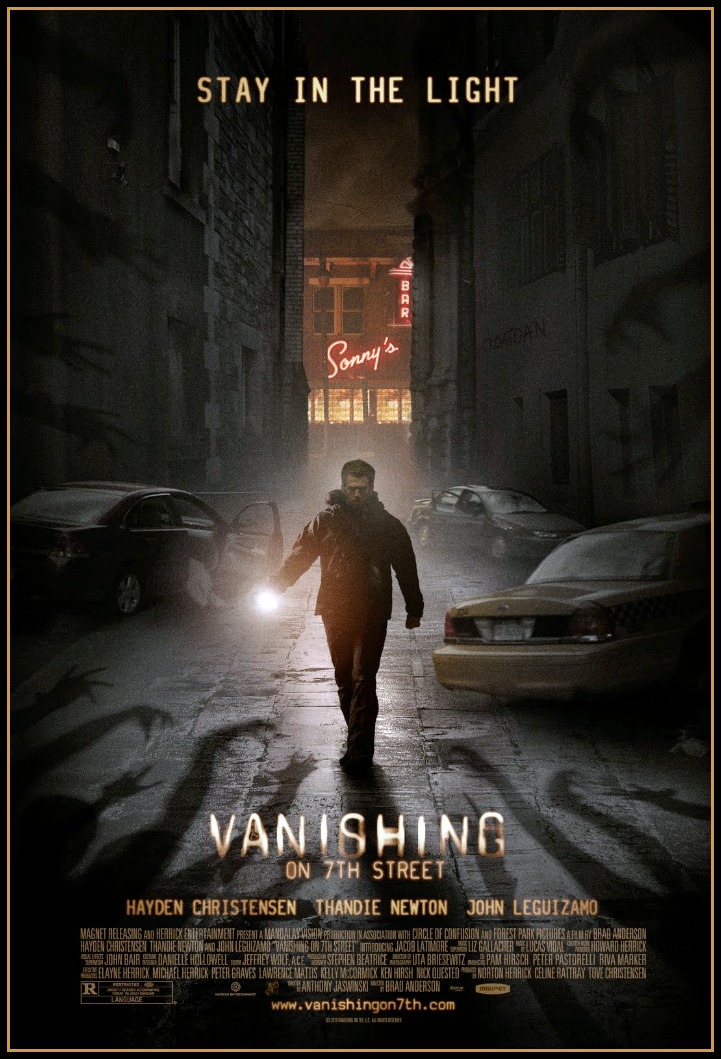
In the genre world of horror and thrillers there’s been one name who always seem to be on the verge of breaking out. He has done some exceptionally well-crafted horror and thrillers which never could get a mainstream audience to commit to but always gathering a cult-following upon their release. He has done some wonderful work as a TV director for such acclaimed shows as Fringe, Treme, Boardwalk Empire and The Wire. His best known work was a thriller collaboration with Christian Bale in The Machinist. While it’s a film more well-known for the extremes an actor was willing to go for to make their performance as authentic as possible it was also a film which showed style and talent in it’s filmmaker. The person I speak of is Canadian filmmaker Brad Anderson whose latest film was another low-budget horror-thriller which looks to be gaining a cult-following once again despite not being well-received by the mainstream critics. Vanishing On 7th Street was a film using the screenplay of Anthony Jaswinski which puts an interesting, claustrophobic and, at times, entertaining twist on the oft-used and well-ridden post-apocalyptic genre.
The film begins with film projectionist Paul in his projection booth reading up on the lost colony of Roanoke and the mysterious word left behind: CROATOAN. It’s through his point of view that we first see the beginning of what could be the end of the world as lights begin to flicker then go out throughout the theater and the mall it’s located in. Paul investigates this event only to discover sets of clothing and accessories where theater patrons and employees used to be in. With each passing moment the darkness — punctuated by just the flashlights of Paul and a lone mall security guard — becomes to take on an ominous tone before the film sudden moves ahead three days into what would become the major setting for the film: a lit bar on a deserted and darkened stretch of 7th Street in Detroit, Michigan.
We meet the rest of the main cast in this bar. There’s Luke who used to be a TV anchorman who discovers to his horror just what might have been the cause of the disappearance of most everyone in the world as he tries to find his girlfriend at the TV station they both worked at. It’s in these flashbacks to Luke’s early experience with the dark apocalypse that we see some of the most perfectly shot scenes of a major city devoid of life. An urban setting where the sudden disappearance of people during the power outage the night before has caused an eerie detritus of crashed vehicles, empty clothing and, in a sudden and violent sequence, a lone airline crashing in the background. It’s through Luke and the lone survivor in the bar, a 12-year old boy named James (Jacob Latimore), that we begin to try and piece together just what might have caused the event which continues to plague those left behind for the last three days.
The film posits the basic concept that darkness itself was the culprit for the disappearance of everyone and what continues to stalk those still left behind, alive and desperate for answers. While the film never really give definite answers as to the cause the two other characters in the back outside of Luke and James bring their own theories. There’s Rosemary (Thandie Newton), the distraught mother searching for her infant son, who thinks what’s going on around them is the the prophecized Rapture and those left behind were those who have sinned and were now being tormented for whatever sins they might have committed. On the other side is Paul from the beginning of the film who Luke rescues from an illuminated bus stop shelter who believes the very thing which caused the disappearance of the Roanoke colony during the 16th-century has now returned on a global-scale. His reasonings run the gamut of scientific causes from wormholes, black holes, gamma ray burst, nanotech gone amok and even an accident from a particle collider.
The audience are left to decide amongst themselves which explanation holds merit since neither one has enough backing to be the true answer. Vanishing On 7th Street leaves much of the questions raised by the dark apocalypse around these surviving characters to be left ambiguous and unanswered which at times becomes a detriment to the narrative as a whole. It’s a testament to Brad Anderson’s direction that the film was able to move past the apparent weaknesses in Anthony Jaswinski’s script and deliver a taut thriller (the film never truly gets to the level of horror) that just builds and builds with tension from beginning to an end that seemed almost too rushed.
With a low-budget and minimal cast the film tries to create some of the tension in the film be a construction of the differences between the four main characters. The actors were pretty game to try and make their characters more complex than what the script have provided, but in the end they still seem too basic for anyone of them to become sympathetic for the audience to truly care for their well-being. The film has to finally rely on just them as the last people on the planet as the main crux for the audience to latch onto. All the actors involved never become too cartoonish or stereotypical in their performance, but some of their decision-making in the middle and latter section of the film were too horror-typical, but they do add to the film’s many scenes of mounting terror as characters drop flashlights, lose light sources and other such problems with the living shadows in the darkness creeping up to try and take those still left. These scenes do look to be too stereotypical of other horror films but under Anderson’s direction there’s a palpable sense of claustrophobia and menace in these shadows.
What truly sells the film despite these flaws outside of Anderson’s direction would be the minimalist score by first-time film composer Lucas Vidal. His composition for the film were at once ominous and haunting. At times his score shows off hints of influences from the more doom-laden scores of Philip Glass. The other component of the film which definitely added to the atmosphere of inevitable doom to the film was Uta Briesewitz cinematography which made great use of darkness and solitary light sources to create islands of safety in a sea of encroaching terror we never truly comprehend. It’s the trifecta of Anderson’s directing, Vidal’s minimalist doom orchestration of a score and Briesewitz’s cinematography which gives Vanishing On 7th Street enough reasons to be a film which stands out as a fine piece of genre filmmaking despite weaknesses in the script.
Brad Anderson truly seem to be a filmmaker destined to remain in the fringes of mainstream cinema. His Vanishing On 7th Street continues to be another example of his great work in the horror-thriller genre. Despite same flaws which could turn off some of those who see this film it doesn’t diminish the fact that even at it’s worst this film was still an entertaining piece of post-apocalyptic work which brings some new ideas into the genre. Maybe a stronger treatment of the script would’ve made for a near-perfect thriller and one which could’ve had more horror to it, but Anderson was able to make a good enough film with an average script that I think deserves for this film to be seen by more people. For every horror remakes we get from Michael Bay’s Platinum Dunes to the latest in the Saw-like torture porn horror it’s good to see that such films as Vanishing On 7th Street exist to be the solitary beacon of light in a sea of cookie-cutter, by-the-numbers horror films that seem to dominate each film year after the other.
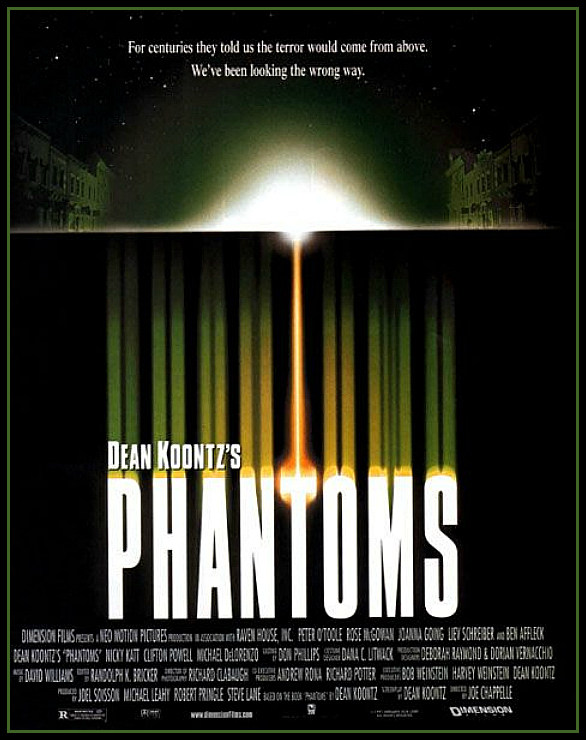
If there was ever an actor in the last twenty years who has suffered ridicule regarding his body of work it would be Ben Affleck. Nevermind the fact that he has actually done very good work as an actor. People tend to view his acting work through some very bad film projects which the online film bloggers (and trolls) have lambasted year after year. One such film which has gained a cult following for all the reasons is the 1998 horror film Phantoms which was adapted from the Dean Koontz horror novel of the same name. This was a film which came out of nowhere and which no one really saw when it first hit the theaters. There’s a reason for this and the main reason for this being that the film was really awful though not without some entertaining bits.
Phantoms starred Ben Affleck in a role that really seemed more suited for an older actor. His Sheriff Hammond in the novel was much older and fit the backstory told in both novel and film that never truly fit Affleck’s youthful appearance and mannerism. He’s joined in this Joe Chappelle production by classically-trained veteran actor Peter O’Toole (who must’ve really needed the money to sign up for this film) in the role of Dr. Exposition dump aka Timothy Flyte who ends up explaining to the surviving cast of characters the very danger facing them in the abandoned town of Snowfield. Rounding out the cast is Liev Schrieber as the creepy Deputy Stu Wargle who becomes a sort of plot device as the film moves forward. To add to this mix are Joanna Going and Rose McGowan as sisters who first discover that their town has just gone through a terrible event.
The novel this film was based on was pure scifi-horror pulp which stressed one’s suspension of disbelief, but was quite entertaining from beginning to end. Dean Koontz is like the generic fast-food version of Stephen King. This film adaptation borrows heavily from films such as Carpenter’s The Thing and the remake of The Blob. This wouldn’t have been a bad thing since the film’s story does bring into it an interesting concept of an ancient enemy which might or might not have been responsible for unexplained mass disappearances of people and animals throughout history going back to prehistoric times.
What Phantoms ends up doing which ruins the film as a whole was to rush through the narrative it was adapting it. The film pretty much goings through a checklist of all the major scenes in the novel, takes those scenes and truncates them to fit uncomfortably into a 90+ minute film. Some of these scenes could’ve been extended a few more minutes to add to a sense of grandiose to a film that needed it despite it’s B-movie foundation. One such scenes would be the arrival of a special Army unit designed to combat unexplained events, but the film treats this sequence from their arrival right up to their untimely demise in less than 15 minutes. I think in the hands of a much more capable filmmaker these scenes would’ve made the film much more entertaining.
Phantoms was a horror film that could’ve become a 90’s cult-classic if it had been given the proper time and effort from it’s producers, but seeing that it was the Weinsteins of Miramax and Dimension Films this final product was probably the best Joe Chappelle could’ve come up with. Weinsteins during the 1990’s were more concerned of pushing their Oscar-baiting film productions than actually giving time and effort to all their films. If there was any reason to see Phantoms it would be to see just why it kept being mentioned in Kevin Smith’s Jay and Silent Bob Strike Back. Other than that there’s really no reason to see it unless there’s nothing else on.
When I think of the 4th of July, one of the biggest memories for me (other than recognizing what it took to declare the country free), are Fireworks in the street. Here in NYC, there was once a time where anyone could get a hold of fireworks, and the views you’d get in the sky were just as bright and beautiful as they are on the Hudson. Add to that a little baseball, and you have an easily memorable scene. Enjoy and may you all have a Safe and Happy Independence Day.
Also, which five films would you have nominated for best picture if the five actual nominees had not been options? Again, you can vote for up to five films.
It is now just minutes since the 4th of July finally arrives in the US once more (at least on the West Coast since the East Coast has been celebrating the 4th of July for 3 hours now). What better way to celebrate the arrival of another 4th of July than to pick the song of the same name for today’s latest “Song of the Day”.
Soundgarden’s Superunknown album from 1994 may be part of the grunge scene which sprouted during the early 1990’s but this album has more metal about it than the grunge espoused by the disciples of Cobain. The song I picked for today I consider the best in the album which contains other classics. “4th of July” is such a heavy song that so many casual fans of the album fail to miss the heavy influence of early Black Sabbath in the song. They also fail to realize just how un-grunge it is with its dark lyrics (not emo mind you, but dark in a palpable sense). “4th of July” becomes an accidental introduction for newbie metal fans to the world of doom metal.
This song is the very definition of heavy and doom. From the heaviness in the guitar riffs to the subdued, but evocative way Cornell sings the dark lyrics (lyrics I always thought of someone just experiencing and living through the aftermath of a nuclear war). But in the end this song really shows it’s Black Sabbath and doom metal pedigree from the sludge-like sound coming out of the bass guitar chords.
“4th of July” once heard cannot be unheard. It’s a song that grabs one by the throat, doesn’t let go until the final doom-laden lyric and note has finally faded into the air.
HAPPY 4th of JULY!
4th of July
Shower in the dark day Clean sparks driving down Cool in the waterway Where the baptized drown Naked in the cold sun Breathing life like fire Thought I was the only one But that was just a lie
Cause I heard it in the wind And I saw it in the sky And I thought it was the end And I thought it was the 4th of July
Pale in the flare light The scared light cracks & disappears And leads the scorched ones here And everywhere no one cares The fire is spreading And no one wants to speak about it Down in the hole Jesus tries to crack a smile Beneath another shovel load
And I heard it in the wind And I saw it in the sky And I thought it was the end And I thought it was the 4th of July
Now I’m in control Now I’m in the fall out Once asleep but now I stand And I still remember Your sweet everything Light a Roman candle And hold it in your hand
Cause I heard it in the wind And I saw it in the sky And I thought it was the end And I thought it was the 4th of July
 Through the Shattered Lens