That appears to be the question at the heart of the 2000 film adaptation of William Shakespeare’s most famous play. In this adaptation, a young Ethan Hawke plays a Hamlet who is no longer a melancholy prince but who is instead a film student with a petulant attitude.
As you probably already guessed, this is one of those modern day adaptations of Shakespeare. Denmark is now a Manhattan-based corporation. Elsinore is a hotel. Hamlet ponders life while wandering around a Blockbuster and, at one point, the ghost of his father stands in front of a Pepsi machine. While Shakespeare’s dialogue remains unchanged, everyone delivers their lives while wearing modern clothing. It’s one of those things that would seem rather brave and experimental if not for the fact that modern day versions of Shakespeare have gone from being daring to being a cliché.
At the film’s start, the former CEO of the Denmark Corporation has mysteriously died and his brother, Claudius (Kyle MacLachlan), has not only taken over the company but he’s also married the widow, Gertrude (Diane Venora). Hamlet comes home from film school, convinced that there has been a murder and his suspicions are eventually confirmed by the ghost of his father (Sam Shepard). Meanwhile, poor Ophelia (Julia Stiles) takes pictures of flowers while her brother, Laertes (Liev Schreiber), glowers in the background. Polonius (Bill Murray) offers up pointless advice while Fortinbras (Casey Affleck) is reimagined as a corporate investor and Rosencrantz (Steve Zahn) wears a hockey jersey. Hamlet spends a lot of time filming himself talking and the Mousetrap is no longer a player but instead an incredibly over-the-top short film that will probably remind you of the killer video from The Ring.
I guess a huge part of this film’s appeal was meant to be that it featured a lot of people who you wouldn’t necessarily think of as being Shakespearean actors. Some of them did a surprisingly good job. For instance, Kyle MacLachlan was wonderully villainous as Claudius and Steve Zahn was the perfect Rosencrantz. Others, like Diane Venora and Liev Schreiber, were adequate without being particularly interesting. But then you get to Bill Murray as Polonius and you start to realize that quirkiness can only take things so far. Murray does a pretty good job handling Shakespeare’s dialogue but that doesn’t change the fact that he’s totally miscast as the misguided and foolish Polonius. One could easily imagine Murray in the role of Osiric. Though it may initially seem a stretch, one could even imagine him playing Claudius. But he’s simply not right for the role of Polonius. Murray’s screen presence is just too naturally snarky for him to be convincing as a character who alternates between being a “tedious, old fool” and an obsequious ass kisser.
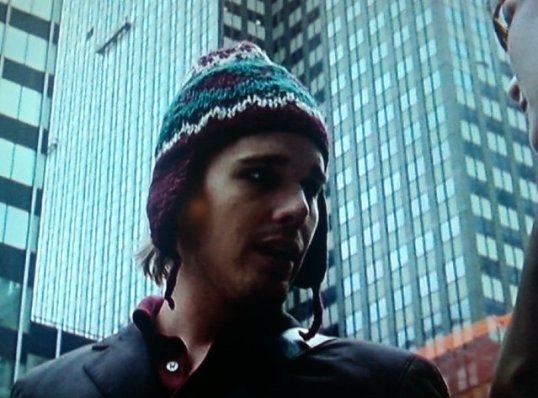
Considering that he spends a large deal of the movie wearing a snow cap while wandering around downtown Manhattan, Ethan Hawke does a surprisingly good job as Hamlet. Or, I should say, he does a good job as this film’s version of Hamlet. Here, Hamlet is neither the indecisive avenger nor the Oedipal madman of previous adaptations. Instead, he’s portrayed as being rather petulant and self-absorbed, which doesn’t necessarily go against anything that one might find within Shakespeare’s original text. Hawke’s not necessarily a likable Hamlet but his interpretation is still a credible one.
At one point, while Hamlet thinks about revenge, we see that he’s watching Laurence Olivier’s version of Hamlet on television. There’s Olivier talking to Yorick’s skull while Hawke watches. It’s a scene that is somehow both annoying and amusing at the same time. On the one hand, it feels rather cutesy and more than a little pretentious. At the same time, it’s so over-the-top in its pretension that you can’t help but kind of smile at the sight of it. To me, that scene epitomizes the film as a whole. It’s incredibly silly but it’s so unapologetic that it’s easy to forgive.
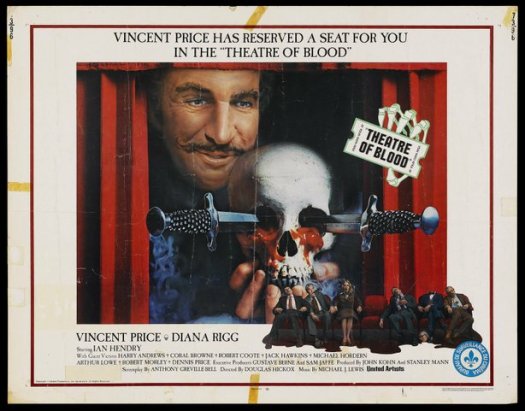
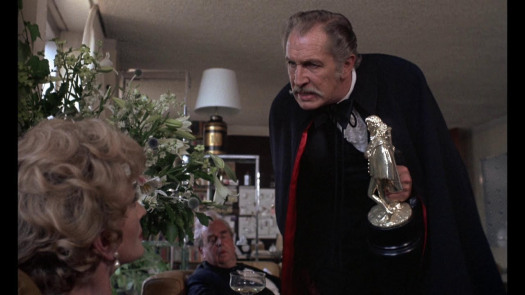
Vincent Price traded in Edgar Allan Poe for William Shakespeare (and American-International for United Artists) in THEATER OF BLOOD, playing an actor’s dream role: Price not only gets to perform the Bard of Avon’s works onscreen, he gets to kill off all his critics! As you would imagine, Price has a field day with the part, serving up deliciously thick slices of ham with relish as he murders an all-star cast of British thespians in this fiendishly ingenious screenplay concocted by Anthony Greville-Bell and directed with style by Douglas Hickox.
Edward Lionheart felt so slighted by both scathing criticism and once again being stiffed at the prestigious Critics’ Circle award, he broke up their little soiree by doing a swan dive into London’s mighty Thames. His body was never found, and everyone assumed they had seen Lionheart’s final performance, but unbeknownst to all he was fished out of the river…
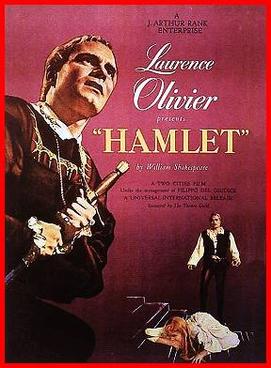
(With the Oscars scheduled to be awarded on March 4th, I have decided to review at least one Oscar-nominated film a day. These films could be nominees or they could be winners. They could be from this year’s Oscars or they could be a previous year’s nominee! We’ll see how things play out. Today, I take a look at the 1948 best picture winner, Hamlet!)
Hamlet is a film of firsts.
It was the first British production to win the Oscar for Best Picture. In winning, it beat out three American films (Johnny Belinda, The Snake Pit, and The Treasure of the Sierra Madre) and one other British film (The Red Shoes).
It was also the first adaptation of Shakespeare to win Best Picture. Of course, it wasn’t the first Shakespeare adaptation to be nominated. That honor would go to 1935’s A Midsummer Night’s Dream. Adaptations of Romeo and Juliet would be nominated in 1936, 1961, and 1968. Henry V (which, like Hamlet, was directed by and starred Laurence Olivier) was a 1946 nominee. Then there was 1953’s Julius Caesar.The Dresser featured scenes from Shakespeare. Shakespeare in Love imagined the circumstances behind the writing of Romeo and Juliet. However, Hamlet was the first to win.
It also remains the only traditional Shakespearean adaptation to win. West Side Story updated Romeo and Juliet while Shakespeare in Love … well, let’s just not get into it.
It was the first Best Picture winner to be directed by the man starring in the movie. Laurence Olivier was nominated for both Best Director and Best Actor. He lost the directing Oscar to John Huston but he won for his performance as Hamlet. In winning, he became the first actor to direct himself to an Oscar.
Finally, Hamlet was the first of 24 films to feature both Peter Cushing and Christopher Lee! In fact, this was Lee’s film debut. Now, before anyone gets too excited, I should point out that Cushing and Lee don’t actually interact. In fact, Lee doesn’t even speak in the film. He appears in the background as a Spear Carrier and it’s pretty much impossible to spot him. He has no dialogue and wasn’t even listed in the final credits. From what I’ve read, I don’t think Lee and Cushing even knew each other at the time and, when they later met, they were surprised to learn that they had both appeared in the film. For his part, Cushing plays Osiric, the courtier who everyone remembers because he had such a cool name.
It’s always fun to play “what if.” Rosencrantz and Guildenstern do not appear in Olivier’s adaptation of the play. To modern audiences, that might seem strange but, really, that’s just because we’re all familiar with the two characters from Tom Stoppard’s Rosencrantz and Guildenstern Are Dead. When Olivier filmed Hamlet, he excised portions of the play in the interest of time. (Hamlet uncut runs over four hours. Olivier’s version clocks in at nearly three.) Rosencrantz, Guildenstern, Fortinbras, and the second gravedigger are all dropped from Olivier’s version and, to be honest, none of them are particularly missed.
And yet … as I watched Hamlet, I found myself wondering what would have happened if Olivier had kept Rosencrantz and Guildenstern around and had cast Cushing and Lee in those roles. It probably wouldn’t have happened, of course. Cushing maybe but Lee was a total unknown at the time. Still, how amazing would that have been?
As for the actual film, Olivier’s Hamlet turned out to be far more cinematic than I was anticipating. Olivier’s camera snakes through the darkened hallways of Elsinore Castle while Olivier’s Hamlet veers between self-righteous fury and apparent madness as he seeks revenge on his Uncle Claudius (Basil Sydney). As Hamlet grows more obsessed with death and vengeance, the castle seems to grow darker and the hallways even more maze-like, as if the castle’s changing shape to conform with the turmoil in Hamlet’s mind. Among the cast, Jean Simmons is poignantly fragile as Ophelia while Eileen Herlie is the perfect Gertrude, despite being 12 years younger than the actor playing her son. Olivier gives a wonderfully physical performance as Hamlet, killing Polonious with a demented gleam in his eye and literally leaping towards his uncle at the end of the film.
If you’re one of those people who thinks that Shakespeare is boring … well, Olivier’s Hamlet probably won’t change your mind. One thing I’ve noticed about the “Shakespeare is boring” crowd is that nothing can change their minds. But, for the rest of us, Olivier’s Hamlet is an exciting adaptation of Shakespeare’s more difficult play.
You won’t miss Rosencrantz and Guildenstern at all. And seriously, Fortinbras who?
(Lisa is currently in the process of cleaning out her DVR! This could take a while. She recorded the 2001 high school film O off of Cinemax on July 6th.)
Tell me if this sounds familiar.
O (Mekhi Phifer) is one of the only black students attending an exclusive high school in South Carolina. Despite a past that involves petty crime and drugs, O appears to have his life on the right track. As the captain of school’s basketball team, O is the most popular student at his school. Everyone looks up to him. Everyone wants to be him. He’s even dating Desi (Julia Stiles), the very white daughter of the school’s very white headmaster (John Heard). At a school assembly, Coach Duke Goulding (Martin Sheen) describes O as being like a son to him. When O is awarded the MVP trophy, he shares it with his teammate, Michael Cassio (Andrew Keegan).
Watching all of this with seething jealousy is Hugo Gaumont (Josh Hartnett). Hugo is a teammate of O’s. In fact, he even thought that he was O’s best friend. That was before O shared his award with Michael. Making Hugo even more jealous is that he happens to be the son of the coach. For every kind word that Duke has for O, he has a hundred petty criticisms for Hugo. Whereas O has overcome drug addiction and is proclaimed as a hero for doing so, Hugo is secretly doing steroids, trying to do anything to improve himself as a player and hopefully win everyone’s love.
So, Hugo decides to get revenge. Working with a nerdy outcast named Roger Calhoun (Elden Hansen), he manipulates O into thinking that Desi is cheating on him with Cassio. He also tricks Cassio into getting into a fight with Roger, leading to Cassio getting suspended from the team. To top it all off, Hugo gets O hooked on drugs, once again. Finding himself consumed by a violent rage that he thought he had under control, O starts to obsess on determining whether or not Desi has been faithful to him…
If that sounds familiar, that’s because O is basically Othello, transported to modern times and involving privileged teenagers. Even though the whole modernized Shakespeare thing has become a bit of a cliché, it actually works pretty well in O. Hugo’s obsessive jealousy of the “cool kids” feels right at home in a high school setting and director Tim Blake Nelson and writer Brad Kaaya do a fairly good job of transporting Shakespeare’s Elizabethan melodrama to the early aughts.
(Actually, O was filmed in 1999 but it sat on the shelf for two years. After a spate of school shootings, distributors were weary about releasing a film about high school students trying to destroy each other.)
Admittedly, O has its share of uneven moments. Martin Sheen, playing the type of role that always seems to bring out his worst instincts as an actor, goes so overboard as the coach that he threatens to sink almost every scene in which he appears and Rain Phoenix is miscast as Hugo’s girlfriend. Even Julia Stiles struggles a bit in the role of Desi. However, both Mekhi Phifer and Josh Hartnett are perfectly cast as O and Hugo. Phifer brings just the right amount of arrogant swagger to the role while Hartnett is a sociopathic marvel as Hugo. Tim Blake Nelson’s direction is occasionally overwrought, relying a bit too heavily on a groan-inducing metaphor about taking flight and claiming the spotlight. However, both Nelson and the film deserve some credit for not shying away from directly confronting and portraying the source material’s cultural and racial subtext.
O is hardly perfect but it is always watchable and, at its best, thought-provoking.
Men of Respect comes to us disguised as a gangster movie but it is actually a modern-day version of MacBeth. Mike Battaglia (John Turturro) is one of Charlie D’Amico’s (Rod Steiger) top lieutenants but he is upset because D’Amico has announced that his successor will be Bankie Como (Dennis Farina). When Mike stumbles across a fortune teller, he is told that not only will he soon be in charge of the D’Amico crime family but that he will hold the position until the stars fall from the sky and that he will never be harmed by a “man of woman born.” At the instigation of his ambitious wife, Ruthie Battaglia (played by Turturro’s real-life wife, Katherine Borowitz), Mike murders Charlie, Bankie, and everyone else who is standing in his way. Even as D’Amico’s son (Stanley Tucci) starts to recruit soldiers for an all out war, Mike remains confident. Even when one of this soldiers sees a fireworks show and says, “Jeez, it looks like stars from falling from the sky,” Mike remains cocky. When his wife starts to complain that she can not get the blood stains (“the spot”) out of the linen, Mike is not concerned. Why not? “All these guys were born of a woman,” Mike says, “they can’t do shit to me.”
Turning MacBeth (or any of Shakespeare’s tragedies) into a Mafia film is not a bad idea but Men of Respect‘s attempt to translate Shakespeare’s language to 20th century gangster talk leads to some memorably awkward line readings from an otherwise talented cast. By the time Matt Duffy (Peter Boyle) announced, in his Noo Yawk accent, that he was delivered via caesarean section, I could not stop laughing. Even the scenes of gangland mayhem feel like second-rate Scorsese. The idea behind the film is intriguing and there are a lot of recognizable faces in the cast but Men of Respect gets bogged down as both a Shakespearean adaptation and a gangster film.
Every year there’s always going to be that one filmmaker who takes on the challenge of putting their personal take on one of William Shakespeare’s classic dramas. It’s been going on since the advent of motion pictures and I don’t see it ending anytime soon.
This year it looks like we may have a winner with the latest adaptation of Shakespeare’s MacBeth. The film stars Michael Fassbender and Marion Cotillard as Lord and Lady MacBeth with Australian filmmaker Justin Kurzel in the director’s chair.
MacBeth has been getting such advance rave reviews due to it’s screening at this year’s Cannes Film Festival where it entered for competition for the Palme d’Or. The film itself just judging from the trailer below looks like a visual feast that one’s up the dark, gritty aesthetic of HBO’s Game of Thrones.
There’s still no announced release date for MacBeth for the North American market but with the critical buzz surrounding the film after Cannes it won’t be too long til it get one.
There’s finally a trailer out about the little film that Joss Whedon made while doing post on his previous little film called The Avengers.
Much Ado About Nothingis a modern and Whedon’s own interpretation of the classic William Shakespeare comedic play. Filmed over the span of 12 days in Whedon’s own Santa Monica home, the film has a cast of Whedom alumni who either has worked with the writer-director on one of his tv series or in his films. The trailer itself has a coolness factor that has to be part jazz used in the trailer and half seeing all the familiar faces Whedon fans have come to know and love through the years like Amy Acker, Alex Denisof, Nathan Fillion and, more recently, Clark Gregg.
Much Ado About Nothing premiered at the 2012 Toronto International Film Festival and will make it’s North American wide release on the date of June 7, 2013.
As some of you may know, I’ve spent the past two years on a mission. It is my goal to eventually see and review every single film that has ever been nominated for best picture. After taking a few months off, I am now ready to continue that quest. For that reason, I recently sat down and watched the 1953 best picture nominee Julius Caesar.
Julius Caesar is an adaptation of William Shakespeare’s classic play about political intrigue, assassination, and demagoguery in ancient Rome. (Technically, what follows is full of spoilers but come on, people — it’s Shakespeare!) The citizens of Rome love their leader, Julius Caesar (played here by a very imperial Louis Calhern) but a group of senators led by Cassius (John Gielgud) fears that Caesar’s popularity will lead to the collapse of the Roman Republic. Cassius recruits Caesar’s close friend Brutus (James Mason) into a conspiracy to assassinate Caesar on the Ides of March. However, once the deed has been done and Brutus has explained the motives behind the assassination to the Roman public, the previously underestimated Mark Antony (Marlon Brando) delivers his famous “Lend me your ears!” speech and soon, the people of Rome turn against the conspirators. In the end, the conspiracy’s efforts to save the Roman Republic instead leads to the birth of the Roman Empire.
Speaking as someone who loves both Shakespeare and history, it was an interesting experience to watch this particular version of Julius Caesar. As directed by Joseph L. Mankiewicz (who later revisited the material in the infamous 1963 Best Picture nominee Cleopatra), Julius Caesar present a very traditional (and occasionally stagey) interpretation of Shakespeare’s play. However, by this point, we’ve become so used to Shakespeare being presented with a gimmick (like modern-day costumes, for instance) that the traditional approach almost feels like something new and unexpected. That said, Julius Caesar is definitely not the Shakespearean film to show to your friends who stubbornly insist that Shakespeare is boring or impossible to follow. Julius Caesar was obviously made by people who appreciate Shakespeare and that remains the film’s best audience.
When Julius Caesar was first released in 1953, it received a lot of attention because of the casting of Marlon Brando as Mark Antony. An outspoken method actor who had been nicknamed “the mumbler” precisely because of his own internalized style of acting, Brando was considered to be too contemporary of an actor to be an effective Shakespearean. Once the film was released, critics agreed that Brando had proven that, even while mumbling, he made for an electrifying Mark Antony and that, despite only having a few scenes, his charismatic presence dominated the entire film. Out of an impressive cast, Brando received the film’s only nomination for acting.
It is true that, even when seen today, Brando does dominate the entire film. He delivery of Mark Antony’s famous oration over Caesar’s bloody corpse remains one of the best Shakespearean performances to have ever been preserved on film. It’s odd to watch this young, sexy, and energetic Brando and compare him to the legendary eccentric that we all usually think of whenever we hear the man’s name.
That said, Brando’s performance would not be half as effective if it wasn’t surrounded by the more traditional (but no less compelling) performances of James Mason and John Gielgud. Mason brings a brooding intensity to the role of Brutus and Gielgud is the Cassius by which all future Cassiuses must be judged. Their performances might not be as flamboyant as Brando’s but they’re no less important. Ultimately, the clash between the acting style of Brando and the styles of Gielgud and Mason nicely parallel the conflict over the future of the Roman Republic.
Julius Caesar won the Oscar for best art design and was nominated for picture, actor, cinematography, and original score. Brando lost the award for best actor to Stalag 17’s William Holdenwhile the Oscar for best picture of 1953 went to a far more contemporary film, From Here To Eternity. Brando, however, would win best actor the next year for his performance in On The Waterfront.
Earlier today, I saw Roland Emmerich’s new film Anonymous and wow. I don’t even know where to begin with just how thoroughly bad a film Anonymous is. Yes, I know that this film has gotten good reviews from mainstream sellouts critics like Roger Ebert. And yes, I heard the old people sitting behind me and Jeff in the theater going, “So, do you think Shakespeare really wrote those plays?” after the movie ended. I’m aware of all of that and yet, I can only say one thing in response: Anonymous is the worst film of 2011 so far.
In its clumsy and rather smug way, Anonymous attempts to convince us that the plays of William Shakespeare were actually written by a boring nobleman named Edward De Vere (Rhys Ifans, giving a very boring performance). De Vere, you see, is obsessed with writing but as a member of a noble family, he cannot publicly do anything as lowbrow as publish his plays himself. So, he pays playwright Ben Johnson (Sebastian Armesto) to take credit for the plays. However, Johnson has moral qualms about taking credit for another man’s work. However, Johnson’s sleazy (and, the film suggest, sociopathic) friend Will Shakespeare (Rafe Spall, who at least appears to be enjoying himself in the role) has no such qualms and, after murdering Christopher Marlowe, Will is soon the most celebrated “writer” in England. Meanwhile, Queen Elizabeth I (Vanessa Redgrave, giving a performance so terrible that you know she’ll probably get an Oscar for it) is growing senile and De Vere starts to realize that he can use his literary talents to attempt to determine who will sit on the English throne after Elizabeth dies.
However, before we can even start in on that plot, we have to sit through the film’s opening sequence. Taking place in the modern day, we watch as actor Derek Jacobi (and not Malcolm McDowell, I’m sad to say) delivers a lecture on why he thinks that Shakespeare didn’t write a word. His argument basically comes down to the fact that Shakespeare was “the son of a glovemaker” and therefore, how could he have become the world’s greatest writer? How could he have written about royalty when he himself was a commoner who didn’t go to a prestigious university? How could he have been a genius when we know so little about his life? And blah blah blah. I understand that Jacobi actually frequently gives lectures like the one we hear in this film and I, for one, will make sure never to attend one because, quite frankly, Jacobi comes across like something of a pompous ass here. It doesn’t help that Emmerich films Jacobi’s lecture in much the same way he filmed the world falling apart in 2012. Seriously, a boring old man ranting on a stage is still a boring old man regardless of how many times the camera zooms into his boring, old face.
This introductory lecture pretty much sets the tone for the entire film to follow and, by screwing this up, Emmerich pretty much screw up everything that follows. However, Jacobi is not entirely blameless for the film’s failure. Number one, he delivers the lecture with all the righteous fury of someone talking about something … well, something more relevent than whether Edward De Vere wrote Shakespeare’s plays. Secondly, Jacobi comes across as if he’s sincerely convinced that he’s telling me something that I haven’t already heard from a high school English teacher, a college creative writing instructor, and a drama professor. Seriously, guys — the whole idea that some people claim Shakespeare was a fraud is not that mind-blowing. Thirdly, and most importantly, Jacobi’s main argument seems to primarily be an elitist one. Shakespeare is not “one of us” so therefore, Shakespeare must be a fraud. In short, Derek Jacobi comes across as a snob, a bore, and an upper-class twit. He’s the type of blowhard that you secretly dread will end up moving in next door to you. I can imagine him now coming over and saying, “Hi, my name’s Derek Jacobi. Might I borrow some salt and while you get it, I’ll explain why I hate glovemakers so.”
Both the film and Sir Derek George Jacobi reveal next to no regard for the wonders of imagination when they argue that Shakespeare couldn’t have written about royalty because he himself was not of royal blood. But, I wonder — how hard is it to write about royalty, really? Is Hamlet really a play about a prince or is it a play about a man who is struggling to maintain his idealism in an increasingly harsh world? Is Henry V really about royalty or is it about a formerly irresponsible boy who is being forced to grow up? To take Jacobi’s argument to its logical conclusion, why could Shakespeare not write about royalty but apparently De Vere could write about gravediggers and loan sharks?
The answer to that question is not to be found in Ifans’ glum, humorless performance. As played by Rhys Ifans, Edward De Vere is a blank slate who seems to be incapable of the joy and the love of life that is apparent in some of the plays that Jacobi credits him with. The film’s version of Edward De Vere doesn’t seem to be capable of telling a good joke, let alone writing one. Yet, we are to believe that he is the author of Much Ado About Nothing? It’s enough to make you wonder if anyone involved in this film has ever bothered to read Shakespeare or do they just use his work (and a wikipedia-level understanding of British history) as a roadmap for their own conspiracy theories?
Once you get past the whole Shakespeare-as-fraud thing, it’s a bit difficult to really talk about the plot of Anonymous because there really isn’t much of a plot. There’s a lot of people plotting things and there’s a lot of scenes of distinguished looking men standing in ornate waiting rooms and either whispering or yelling about who deserves to succeed Elizabeth as ruler. I’m an unapologetic history nerd and I usually love all the soap opera theatrics of British royalty (both past and present) so I should have taken to these scenes like a cat pouncing on a bird but I didn’t. All of the palace intrigue left me cold and bored, largely because it all just felt as if they were being randomly dropped in from other, better films about the Elizabethan era. The plot of Anonymous doesn’t so much unfold as it just shows up uninvited and then refuses to go home.
Storywise, Anonymous tells us the following (and yes, these are spoilers):
1) Queen Elizabeth, the so-called “virgin” queen, was apparently something of a slut and had a countless amount of illegitimate children who apparently all ended up living next door to each other as if they were all in the cast of some sort of renaissance sitcom. “This week on Tyler Perry’s Meet the Tudors…”
2) Her first bastard son was none other than Edward De Vere who several years later — unaware of his true parentage — would become Elizabeth’s lover and would end up impregnating Elizabeth with the Earl of Southampton. The Earl of Southampton would eventually grow up to become De Vere’s ward though he would never realize that he was also De Vere’s son and half-brother. (And all together now: Ewwwwww!)
3) The Earl of Southampton would then go onto to become an ally of the Earl of Essex, yet another one of Elizabeth’s unacknowledged sons and when Essex would attempt to claim his right to succeed to the English throne, De Vere would attempt to aid in his efforts by writing Richard III.
4) Oh, and finally, William Shakespeare personally murdered playwright Christopher Marlowe. In real-life, Marlowe was murdered in 1593. The film takes place in 1598 so I’m guessing that either the filmmakers are just stupid or else they “embellished” the story in order to give us another reason to hate Shakespeare. However, seeing as how Emmerich and Rhys Ifan and Derek Jacobi have been out there bragging about how authentic and scrupulous this film is, it’s hard to really forgive the “whole embellishment” argument when they’re essentially accusing Shakespeare of committing a very real crime against a very real contemporary. It’s especially odd that the film pretty much drops the whole Shakespeare-as-murderer subplot right after bringing it up. It’s hard not to feel that the filmmakers assumed that nobody would either bother or be smart enough to catch them on this.
Needless to say, this material is all so melodramatic and over-the-top that it should have been great fun, a so-bad-its-good masterpiece of bad dialogue and tacky costumes. Well, the film is full of bad dialogue and the costumes are tacky but yet, the film itself is never any fun. The film’s sin isn’t that it’s ludicrous. No, this film commits the sin of taking itself far too seriously. This is a film that has fallen in love with its own delusions of adequacy. In short, this is a film directed by Roland Emmerich.
Indeed, there’s many reasons why Anonymous fails as a film. John Orloff’s screenplay is ludicrous, the film’s premise is never as interesting as it should be, the film’s version of 16th Century London is so obviously CGI that it resembles nothing less than a commercial for Grand Theft Auto: The Elizabethan Age, and the film is full of overdone performances. (Vanessa Redgrave might get an Oscar nomination for her performance here but seriously, she’s beyond terrible.) Ultimately, however, all of the blame must be given to Roland Emmerich. As a director, he is just so damn literal-minded that he doesn’t seem to be capable of understanding just how stupid this movie truly is. At first this film might seem like a change of pace for Emmerich but after watching just a few minutes, it quickly becomes apparent that we’re dealing with the same idiot who had arctic wolves running around New York City in The Day After Tomorrow.
I’ve seen a few interviews with Emmerich in which he has said that the question of Shakespeare’s authorship is something that “many people don’t want to discuss.” If I remember correctly, he said the same thing about the Mayan prophecy that the world would end in 2012 and I wouldn’t be surprised if he trotted out that line in regards to climate change back when he did Day After Tomorrow. Sadly, what Roland Emmerich doesn’t seem to get is that people are willing to discuss all of those topics. They just don’t want to discuss them with him.
Speaking of the evil that men do, this sexploitation film from Michael and Roberta Findlay is pretty rough even by today’s standards. Don’t watch this if you’re easily offended. If you are easily offended, just remember that ten years after making this film, Michael Findlay was decapitated by a rotating helicopter blade.
On a slightly less disturbing note, here’s the trailer for Moving Violation. The film is actually a bit more odd than you might guess from just the trailer.
This is one of the most financially succesful films of all time and apparently, it extended the life of the Southern drive-in by a good decade or so. It’s actually a pretty good movie.

 That Bill Shakespeare really gets around.
 Through the Shattered Lens