Cleaning Out The DVR #2: The Bridge on the River Kwai (dir by David Lean)


The_Bridge_on_the_River_Kwai_poster

Last night, after I watched Captains Courageous, I continued to clean out the DVR by watching the 1957 film, The Bridge On The River Kwai.

The Bridge On The River Kwai is a great film but it’s not necessarily an easy one to review.  It’s always easier to review a film when you can be snarky and dismissive but The Bridge On The River Kwai is one of the few films that can truly be called great.  Everything about it — from the directing to the cinematography to the script to the acting (especially the acting!) — works.  It’s a 3 hour film that never drags.  It’s a rousing and exciting adventure story that also works as an anti-war film.  As directed by David Lean, it’s probably about as perfect as a film can get.

The Bridge On The River Kwai takes place during World War II and really, it’s two films in one.  One film tells the story of Shears (William Holden), a POW at a Japanese prison of war camp in what was then Burma and what is now Myanmar.  Knowing that, under the rules of the Geneva Convention, officers are exempt from manual labor, Shears pretends to be a commander.  However, when the camp’s commandant, the harsh Col. Saito (Sessue Hayakawa), announces the all prisoners — regardless of rank — will have to build a railway bridge over the River Kwai, Shears manages to escape.  With the help of local villagers, Shears makes it to an Allied hospital.

It’s at the hospital that Shears has a two-scene romance with a nurse because the film’s producer, Sam Spiegel, was worried that the film was too male dominated.  It’s also at the hospital that Shears is informed that he will be returning to the POW camp, with a group of British commandos, on a mission to destroy the bridge.  When Shears explains that he’s not even an officer, British Maj. Warden (Jack Hawkins) explains that’s why the Americans have agreed to let the British use Shears for their mission.

The film’s 2nd storyline deals with Col. Nicholson (Alec Guinness), the senior British officer at the POW camp.  When we first meet Nicholson, he’s in a battle of wills with Saito.  When Nicholson insists that no officer will work on the bridge, Saito first forces all of the British officers to spend an entire day standing in the heat.  When that doesn’t work, Saito has Nicholson locked in an iron box.  However, Nicholson refuses to back down and becomes a hero to the other prisoners.  Realizing that the bridge will never be finished on time and that he will be required to commit suicide because of his failure, Saito decides to take a different approach to dealing with Nicholson.

After releasing Nicholson from the iron box, Saito shows him the poor job that the British prisoners have been doing on the bridge.  Saito appeals to Nicholson’s vanity.

And it turns out that Col. Nicholson is a very vain man indeed.

Soon, Nicholson is ordering his men to do a good job on the bridge, announcing that they are going to show the Japanese what the British can accomplish.  Nicholson claims that the project will be a morale booster and that the bridge will be a permanent monument to British ingenuity.

This part of the film is an unexpectedly nuanced character study and Guinness gives a brilliant performance.  For the film’s first hour, Nicholson is our hero but then, just as suddenly, he reveals himself to be a far more complicated character and our feelings towards him become much more mixed.  We’re forced to reconsider everything that we previously felt towards him.  Was Nicholson standing up for his men because it was the right thing to do or was he doing it because he desired the camp’s adulation?  His motives are complicated and difficult to figure out and the implications are, at times, rather frightening.  About the only thing that can definitely be said about Nicholson is that he becomes so obsessed with showing what the British can do that he loses sight of what the Japanese are going to do with that bridge once it is complted. Nicholson’s short-sightedness become a metaphor for blind nationalism and war in general.

When these two storylines finally intersect, it leads to one of the most justifiably climaxes in cinema history, one that leads one of the film’s few surviving characters to exclaim, “The madness, the madness!”

As I mentioned earlier, The Bridge On The River Kwai won the Oscar for best picture and for once, not even I can disagree with the Academy.

Cleaning Out The DVR: Picnic (dir by Joshua Logan)


Original_movie_poster_for_the_film_Picnic

Tonight, I continued to clean out the DVR by watching the 1955 film Picnic.

Now, Picnic is kind of a strange film.  It’s one of those films from 50s that takes place in a small town where everyone is obsessed with sex but, since it’s the 1950s, nobody can just come out and say that they’re talking about sex.  So, instead, all of the dialogue is very discreet.  For instance, when Madge Owen (Kim Novak) talks to her mother, Flo (Betty Owens), about her date with her boyfriend, Alan (Cliff Robertson), Madge confesses that they spent the night kissing.  Flo asks if Madge if they have done anything more than kiss but, of course, she never comes straight out and says what “more” would be.  The audience knows what she’s talking about but it’s as if the world would actually end if anyone actually uttered the word.  “Oh mom!”  an embarrassed Madge says before confirming that she and Alan haven’t done anything more than kiss.

Flo desperately wants Madge to marry Alan because Alan is rich and his father owns the town’s grain elevator.  Marrying Alan would allow Flo to move up in the town’s strict social hierarchy.  However, Madge isn’t sure that she loves Alan.  Certainly, Alan seems to be a good man with a good future but he’s not a romantic.  Instead, he is someone who has his entire life already mapped out for him.

On Labor Day, a stranger comes to town.  His name is Hal Carter and he shows up riding on a freight train.  He’s come into town to see his old friend, Alan.  It turns out that Hal and Alan went to college together and were members of the same fraternity.  Hal was a star football player but he eventually flunked out of school and has spent the last few years drifting around the country.  However, Hal is now ready to settle down and he wonders if his old roommate Alan can get him a job at the grain elevator.

Now, here’s the strange part.  Hal is played by William Holden.  When he made Picnic, William Holden was 38 years old and looked closer to being 45.  (By contrast, Cliff Robertson, in the role of his former college roommate, was 32 and looked like he was 25.)  Hal spends a lot of time talking about his traumatic childhood and how he is finally ready to settle down and start acting like an adult.  In short, Hal talks like a 30 year-old but he looks like he’s nearly 50.  It’s odd to watch.  But even beyond the age issue, William Holden was an actor who always came across as being both confident and cynical.  Hal is a secret romantic with a deep streak of insecurity.  As great an actor as he may have been, William Holden is so thoroughly miscast here that it actually becomes fascinating to watch.  It brings a whole new subtext to the film as you find yourself wondering why no one is town finds it strange that a middle-aged man is still struggling to deal with his childhood.  When all the town’s young women ogle that shirtless Hal, it’s as if he’s wandered into a town populated only by teenagers with daddy issues.

(Paul Newman played the role of Hal in a Broadway production of Picnic.  And really, that’s who the ideal Hal would have been, a young Paul Newman.)

The majority of the film takes place at the town’s Labor Day picnic, where almost every woman in town is driven to distraction by the sight of Hal dancing.  Even the spinster teacher, Rosemary (Rosalind Russell), is so turned on by Hal’s masculinity that she makes a pass at him and accidentally rips his shirt.  Of course, some of Rosemary’s behavior is due to the fact that she’s drunk.  Her date, the befuddled Howard Bevans (Arthur O’Connell), made the mistake of being whiskey to the picnic.

Hal also dances with Madge’s 13 year-old sister, Millie (Susan Strasberg).  I have to admit that, even though I related strongly to Madge, Millie was my favorite character in the film.  Millie wears glasses and can recite Shakespeare from memory.  She knows that everyone around her is full of it and she’s willing to call them on it.  Of course, Millie herself ends up with a crush on Hal and it’s a dream for her when she finally gets to dance with him.

(Strasberg was 17 years old but is believable as a 13 year-old.  At the same time, since Hal appears to be nearly 50, his sudden closeness to Millie carries an icky, if unintentional, subtext.)

But then Madge suddenly appears, wearing a pink dress and literally emerging from the black night.  She starts to sway to the music.  As she slowly approaches Hal, he forgets about Millie and soon is dancing with Madge.  It’s actually a rather striking scene, one that so full of dream-like sensuality that it almost seems more like it was directed by surrealist David Lynch as opposed to the usually workmanlike Joshua Logan.

(In the video below, the scene freezes about 12 seconds in, before starting up again at the 16 second mark.  This is a glitch with the upload and is not present in the actual film.)

Needless to say, a drifter can’t just come into town and steal his ex-roommate’s girlfriend without drama following.  Picnic starts out as a slightly overheated examination of small town morality and then, after about an hour, it goes the full melodrama route, complete with police chases, stolen cars, a fist fight in an ornate mansion, and a lot of big speeches about the importance of love.  Needless to say, it’s all a lot of fun.

Picnic was nominated for best picture of the year.  However, it lost to the far more low-key Marty.

Cleaning Out The DVR: Born Yesterday (dir by George Cukor)


Born_yesterday

After I watched Goodbye, Mr. Chips, I decided to watch one more film that I had recorded off of TCM.  The movie I chose was Born Yesterday.

This 1950 film was directed by George Cukor and stars three Academy Award winners.  The lead actor was William Holden, who would win best actor three years after the release of Born Yesterday.  The villain was played Broderick Crawford, just a year after playing his Oscar-winning role in All The King’s Men.  Finally, the true star of the film was Judy Holliday, recreating her Broadway role of “dumb intelligent blonde” Billie Dawn.  For playing Billie, Holliday would win the award for best actress of the year.

In Born Yesterday, Billie is the girlfriend of Harry Brock (Broderick Crawford).  The crude and not particularly intelligent Harry has made a fortune as a “junkman” and, though the film never comes out and explicitly says so, it is suggested that Harry may have ties to the Mafia.  Harry has come to Washington, convinced that he can buy his way into political power.  Harry’s lawyer (Howard St. John) suggests that Harry should marry Billie, specifically because a wife cannot be compelled to testify against her husband.

However, there’s a problem.  Billie is uneducated and lacks formal manners.  Of course, Harry is even worse but then again, Harry is a rich white guy and, therefore, he doesn’t have to be polite or know what he’s talking about  After Billie embarrasses him during a meeting with a congressman, Harry hires journalist Paul Verrall (William Holden) to teach Billie how to fit in with Washington society.  At first, Paul refuses but, ultimately, he takes the job because he needs the money.

As Paul teaches Billie, it quickly becomes apparent that Billie is not as dumb as everyone assumes.  In fact, she has an insatiable desire to learn.  When Paul takes her on a tour of Washington, Billie is excited to learn the story behind every monument and to take a look at every historical artifact.  (When Paul shows her the bill of rights, Billie immediately reads the 2nd Amendment and gets Paul to explain it to her.  As Paul explained that it meant that citizens had the right to bear arms, my sister walked through the room and said, “You got that right.”)  Judy Holliday perfectly captures Billie’s excitement as, for the first time in her life, she’s actually treated like someone with a brain.

Billie also starts to fall in love with Paul.  After reading one of Paul’s articles, an obviously impressed Billie tells him, “I think it’s the best thing I ever read.  I didn’t understand a word.”  At the same time, Paul starts to fall for Billie.

Meanwhile, Harry is not falling for anyone but himself.  He continues to bribe congressmen but now, Billie not only realizes what Harry is doing but also understands that it’s illegal and goes against everything that the authors of the Constitution envisioned.  After a rather nasty scene in which she is repeatedly slapped by Harry, Billie goes down to the Lincoln Memorial, hears the voice of old Abe himself, and is finally ready to stand up for herself, for Paul, and for the American way of life.

(“When you steal from the government, you steal from yourself, you dumb ox!” she yells at Harry.)

Born Yesterday was based on a stage play and, with the exception of the scenes where Paul and Billie explore D.C., the entire film takes place in Harry’s hotel suite.  The film never quite escapes its theatrical origins.  Broderick Crawford bellows his lines out to the last row and William Holden feels miscast.  (That same year, he gave a far more interesting performance in Sunset Boulevard.)

But ultimately, Born Yesterday is mostly designed to showcase Judy Holliday as Billie Dawn.  When the film first started, I have to admit that I had my doubts about Holliday’s performance.  Her character was so stereotypically ditzy and spoke in such a nasal whine of a voice that I found myself wishing that the film had been made with either Marilyn Monroe or even Jayne Mansfield in the Billie Dawn role.  But, as the film progresses, I started to better appreciate Holliday’s performance.  I started to notice the sadness and the insecurity lurking underneath the surface.  I discovered that there was unexpected nuance to both the character and the performance.  By the time she was running through the National Archives and asking Paul questions about George Washington, she had totally won me over.

Still, Holliday’s victory for best actress does seem a little strange.  After all, to win the Oscar, Holliday defeated All About Eve‘s Bette Davis and Anne Baxter and Sunset Boulevard‘s Gloria Swanson.  Holliday’s performance definitely deserved a nomination but it’s a bit more difficult to argue that it deserved the Oscar.  Of course, Davis and Baxter played two tough and sarcastic divas, neither one of whom depended on a man for their success.  Swanson, meanwhile, played an older woman who ends up murdering her much younger lover.  Billie, meanwhile, is never without a girlfriend and doesn’t murder anyone.  Perhaps it’s understandable that certain Academy voters would be more comfortable with Billie Dawn than they would with Norma Desmond or Margo Channing.

Born Yesterday was also nominated for best picture but it lost to All About Eve.

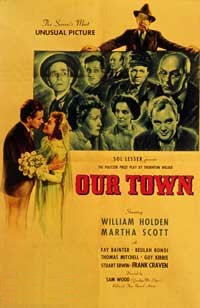
Lisa Reviews an Oscar Nominee: Our Town (dir by Sam Wood)


Original_movie_poster_for_the_film_Our_Town_(1940_film)

(SPOILERS BELOW!  THE END OF THIS FILM WILL BE REVEALED!  I will also be revealing who played George Gibbs but that’s probably not as big a spoiler.  It depends how you look at it.)

I was only 15 years old when I first read Our Town.  Because I was a theater nerd, I knew a little about the play.  For instance, I knew it took place in a small town.  I knew that it was narrated by a character known as the Stage Manager.  I knew that the play was meant to be performed on a bare stage, with no sets or props.  What I did not know, as I innocently opened up that booklet, is that Our Town is probably one of the most traumatically depressing plays ever written.

When the stage manager appears at the start of the play and talks about the town of Grover’s Corner, he lulls you into believing that you’re about to see a sentimental, comedic, and old-fashioned celebration of small town life.  We meet the characters and they all seem to be quirky in a properly non-threatening way.  Joe Crowell shows up delivers a newspaper to Doc Gibbs.  The stage manager mentions that Joe will eventually grow up to attend to M.I.T.

“Awwwww!  Good for Joe!” the audience says.

And, the Stage Manager goes on to inform us, as soon as Joe graduates, he will be killed in World War I, his expensive education wasted.

Okay, the audience thinks, that was a dark moment but this play was written at a time when World War I was still fresh on everyone’s mind.  Surely the rest of the play will not be quite as dark…

And fortunately, George Gibbs and Emily Webb show up.  They’re young, they’re likable, and they’re in love!  George and Emily get married and they’re prepared to live a long and happy life in our town!  Good for them!  YAY!

And then Act III begins…

Oh my God, Act III.  Act III begins with almost everyone dead.  Emily died in child birth so she hangs out at the local cemetery and talks to all the other dead people, the majority of whom only have vague memories of their former lives.  Emily relives the day of her 12th birthday and discovers that it’s too painful to remember what it was like to once be alive.  Emily asks the Stage Manager if anyone truly appreciates life.  The Stage Manager replies, “No.”  In the world of the living, George Gibbs sobs over his wife’s grave….

And the play ends!

OH MY GOD!

Seriously, reading Our Town was probably one of the most traumatic experiences of my life!

The 1940 film version of Our Town is a little less traumatic because it changes the ending.  In the film version, Emily doesn’t die.  She nearly dies while giving birth to her second child and the entire third act of the play is basically portrayed as being a near-death hallucination.  But, in the end, she survives and she comes through the experience with a new found appreciation for life.

And it’s certainly the type of happy ending that I was hoping for when I first read the play but, as much as I hate to admit it, the story works better with Emily dying than with Emily surviving.  The play presents death as being as inevitable as life and love and it makes the point that there’s nothing we can do to truly prepare for it.  By allowing Emily to live, the film gives us a ray of hope that wasn’t present anywhere else in Our Town.  The happy ending feels inauthentic.  If Emily could live then why couldn’t Joe Crowell?  For that matter, why did Emily’s younger brother have to die of a burst appendix on a camping trip?

But, other than the changed ending, Our Town is a pretty good adaptation of the stage play.  While the film features an actual set (as opposed to the bare stage on which theatrical versions of Our Town are meant to be performed), director Sam Wood does a good job of retaining the play’s surreal, metatheatrical style.  Making good use of shadow and darkness, Wood and cinematographer Bert Glennon made Grover’s Corner seem like a half-remembered memory or a fragment of a barely cohesive dream.

Frank Craven, who originated the role on Broadway, is properly dry as the Stage Manager and, in the role of Doc Gibbs, Thomas Mitchell is so sober and respectable that it’s hard to believe that, in just 6 years, the same actor would play the delightfully irresponsible Uncle Billy in It’s A Wonderful Life.  Emily and George are played by Martha Scott and an impossibly young William Holden, both of whom give wonderfully appealing performances.

With the exception of that changed ending, Our Town is a worthy adaptation of a classic play.  It was nominated for Best Picture but lost to another literary adaptation, Alfred Hitchcock’s Rebecca.

Embracing the Melodrama Part II #19: Sunset Boulevard (dir by Billy Wilder)


Sunset Boulevard

“All right, Mr. De Mille, I’m ready for my close-up!”

— Norma Desmond (Gloria Swanson) in Sunset Boulevard (1950)

First released in 1950 and nominated for Best Picture, Billy Wilder’s Sunset Boulevard is one of the greatest and most influential films of all time.  It’s also something of a difficult film to review because, in order for one to truly understand its greatness, it needs to be seen.  A description simply will not do.  You have to experience, first hand, the performances of Gloria Swanson, William Holden, and Eric Von Stroheim.  You have to see, with your own eyes, the way that Billy Wilder perfectly balances drama, satire, and horror.  I can tell you about how cinematographer John F. Seitz perfectly contrasts the empty glossiness of Hollywood with the dark shadows that fill the ruined mansion of Norma Desmond but, again, it’s something that you owe it to yourself to see.  You need to hear the perfectly quotable dialogue with your own ears.  You need to experience Sunset Boulevard for yourself.

And, while you’re watching it, think about how easily one bad decision could have screwed up the entire film.  Sunset Boulevard is famous for being narrated by a dead man, a screenwriter named Joe (William Holden).  When we first see Joe, he’s floating in a pool.  Originally, however, the film was to open with the dead Joe sitting up in the morgue and telling us his story.  Reportedly, preview audiences laughed at the scene and it was cut out of the film.  And Wilder made the right decision to remove that scene.  Sunset Boulevard may be famous for being a strange film but, when you actually watch it, you realize just how controlled and disciplined Wilder’s direction actually is.  Sunset Boulevard may be weird but it’s never less than plausible.

Joe Gillis is a former newspaper reporter-turned-screenwriter.  He may have started out as an idealist but, as the film begins, he’s now just another Hollywood opportunist.  While trying to hide from a man looking to repossess his car, Joe stumbles upon a dilapidated old mansion.  The owner of the mansion is none other than Norma Desmond (Gloria Swanson), a silent film star who has sent been forgotten but who still dreams of making a comeback.  (When Joe tells her that she used to be big, Norma famously responds that she’s still big and it’s the pictures that have gotten small.)  Norma has written a script and the opportunistic Joe convinces her to hire him as a script doctor.

Joe moves into the mansion and discovers a world that has never moved past the 1920s.  Norma’s butler and former director, Max (played by Gloria Swanson’s former director Erich Von Stroheim) writes letters that he claims were sent by Norma’s fans.  Norma spends her time watching her old movies.  Occasionally, other forgotten silent screen stars (including Buster Keaton) drop by to play cards.

Encouraged by Joe’s vapid flattery and a mysterious phone call from a Paramount exec, Norma has Max drive her down to the studio.  Greeted by the older employees and ignored by the younger, Norma visits with director Cecil B. DeMille (who plays himself).  In a rather sweet scene, she and DeMille remember their shared past.  DeMille obviously understands that she’s unstable but he treats her with real respect, in contrast to the manipulative Joe.

As for Joe, he’s fallen for a script reader named Betty (Nancy Olson) and wants to escape from being dependent on Norma.  However, Norma has invested too much in her “comeback” to just allow Joe to leave…

Sunset Boulevard is a wonderful mix of film noir and Hollywood satire.  And, though the film may be narrated by Joe and told from his point of view, it’s firmly on Norma’s side.  As easy as it is to be dismissive of Norma’s delusions, she’s right in the end.  It is the pictures that have gotten small and, as she proves towards the end of the film, she is still as capable of making a grand entrance as she ever was.

Joe may have been too stupid to realize it but Norma Desmond never stopped being a star.

http://www.youtube.com/watch?v=Y3P0Zpe-2og

Horror Film Review: Damien: Omen II (dir by Don Taylor)


DamienomenII

The first sequel to The Omen was 1978’s Damien: Omen II.  Damien: Omen II is an odd film, one that is not very good but yet remains very watchable.

Damien: Omen II takes place 7 years after the end of the original Omen.  Antichrist Damien Thorn (now played by Jonathan Scott-Taylor) is now 12 years old.  He lives with his uncle Richard (William Holden) and Richard’s 2nd wife, Ann (Lee Grant).  His best friend is his cousin Mark (Lucas Donat).  In fact, the only problem that Damien has is that his great-aunt Marion (Sylvia Sidney) can’t stand him and views him as a bad influence.  Fortunately, as usually seems to happen whenever someone puts an obstacle in Damien’s life, there’s always either a black dog or a black crow around to help out.

Damien and Mark are cadets at a local military academy where Damien deals with a bully by glaring at him until he falls to the ground, grabbing at his head.  In history class, Damien shocks his teacher by revealing that he knows the date of every battle ever fought.  Damien’s new commander, Sgt. Neff (Lance Henriksen), pulls Damien to the side and tells him to stop showing off and to quietly bide his time.

Meanwhile, Richard is busy running Thorn Industries.  One of his executives, Paul Buhler (Robert Foxworth), wants to expand Thorn’s operations into agriculture but his plans are opposed by Richard’s executive vice president, Bill Atherton (Lew Ayres), who considers Paul to be unethical.  However, during an ice hockey game, Bill falls through the ice and, despite the efforts of everyone to break through the ice and save him, ends up floating away.  Paul is promoted and pursues his plans to make money off of world famine.  In between all of this, Paul finds the time to speak to Damien and tell him that he has a great future ahead of him.

Along with Thorn Industries, Richard also owns the Thorn Museum in Chicago.  The museum’s curator is Dr. Charles Warren (Nicholas Pryor) who was a friend of the archeologist Karl Bugenhagen (Leo McKern) who, in the first film, revealed that not only was Damien the antichrist but that the only way to kill him was by stabbing him with the Seven Daggers of Meggido.  Dr. Warren is also friends with Joan Hart (Elizabeth Shepherd), a reporter who both knows the truth behind Bugenhagen’s death and who has also seen an ancient cave painting that reveals that the Antichrist looks exactly like a 12 year-old Damien Thorn.

Much as in the first film, just about everyone who comes into contact with Damien ends up getting killed in some odd and grotesque way.  Crows peck out eyes.  Trucks run over heads.  One unfortunate victim is crushed between two trains.  Another is chopped in half by an elevator cable.  At times, Damien: Omen II feels less like a sequel to The Omen and more like a forerunner to Final Destination.

Damien: Omen II is one of those films that I like despite myself.  It’s bad but it’s bad in a way that only a film from the 1970s could be and, as such, it has some definite historical value.  The script is full of red herrings, the acting is inconsistent, and the film can never seem to make up its mind whether Damien is pure evil or if he’s conflicted about his role as Antichrist.  As I watched the film, I wondered why the devil could so easily kill some people but not others.

And yet, Damien: Omen II is so ludicrous and silly that it’s undeniably watchable.  If the first film was distinguished by Gregory Peck’s defiant underplaying, the second film is distinguished by the way that William Holden delivers every line through manfully clenched teeth.  Everyone else in the cast follows Holden’s lead and everyone goes so far over-the-top that even the most mundane of scenes become oddly fascinating.

For me, the film is defined by poor Lew Ayres floating underneath that sheet of ice while everyone else tries to rescue him.  On the one hand, it’s absolutely horrific to watch.  I’m terrified of drowning and, whenever the camera focused on Ayres desperately pounding on the ice above him, I could barely bring myself to look at the screen.  But, at the same time, we also had William Holden screaming, “OH GOD!” and Nicholas Pryror enthusiastically chopping at the ice with a big axe and dozens of extras awkwardly skating across the ice.  Somehow, the scene ended up being both horrifying and humorous.  It should not have worked but somehow, it did.

And that’s pretty much the perfect description of Damien: Omen II.  It shouldn’t work but, in its own way, it does.

Embracing the Melodrama #31: When Time Ran Out (dir by James Goldstone)


If I had been alive in the 70s, I would have been terrified if I had ever found myself in the same general location of Paul Newman, William Holden, Ernest Borgnine, Red Buttons, Jacqueline Bisset, or Burgess Meredith.  Just based on the movies that they spent that decade appearing in, it would appear that disaster followed them everywhere.

Just consider:

Both Paul Newman and William Holden were trapped in The Towering Inferno. 

Ernest Borgnine and Red Buttons both ended up taking an unexpected Poseidon Adventure together.

Jacqueline Bisset was a flight attendant in the first Airport and nearly got killed by a mad bomber.

And finally, Burgess Meredith was a passenger on The Hindenburg.

Seriously, that’s a dangerously disaster-prone bunch of thespians!

So imagine how terrifying it must have been on the set of the 1980 film When Time Ran Out when all 6 of those actors — along with a lot of other disaster film veterans — were first gathered in one place.  People were probably running for their lives, both on-screen and off.

Lava3

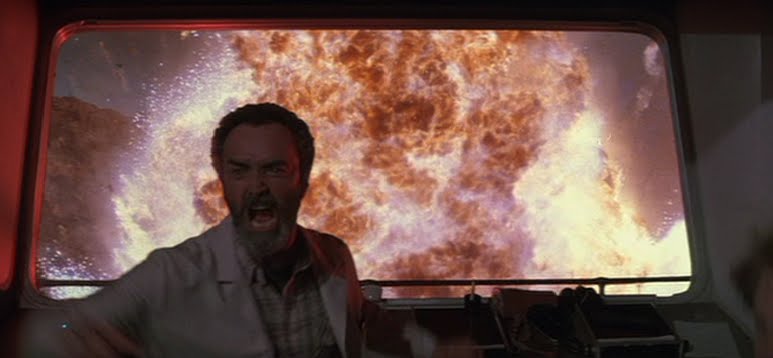
When Time Ran Out takes place on an island in the South Pacific.  Shelby Gilmore (William Holden, playing yet another ruthless but essentially good-hearted businessman) owns a luxury resort that happens to be sitting dangerously close to an active volcano.  Oil rigger Hank Anderson (Paul Newman) is convinced that the volcano is about to erupt but Shelby’s son-in-law, Bob Spangler (James Franciscus), refuses to listen and claims that even if the volcano does blow, the resort will be safe.

(As a sidenote, why were William Holden’s son-in-laws always too blame in disaster movies?  First, you had Richard Chamberlain in The Towering Inferno and now, it’s James Franciscus in When Time Ran Out…)

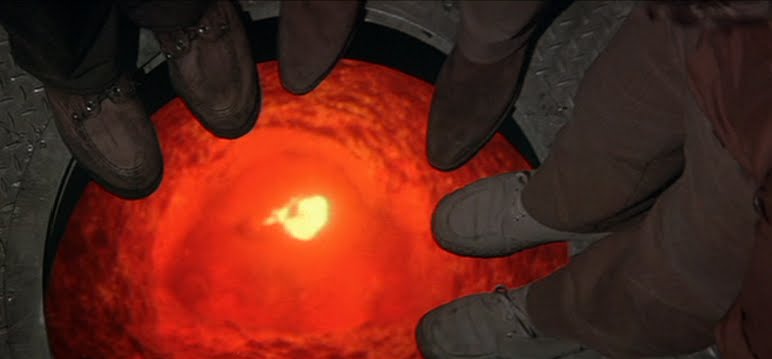
Suspended over a volcano

Suspended over a volcano

You can just look at the film’s title (When Time Ran Out!) and guess that Bob is probably wrong.  However, Bob has other things on his mind.  First off, he’s cheating on his neurotic wife (Veronica Hamel) with a native islander (Barbara Carrera) who happens to be married to the hotel’s general manager, Brian (Edward Albert).  Brian also happens to be Bob’s half-brother and is therefore owed at least half of Bob’s fortune but nobody but Bob realizes that.

And, of course, there are other colorful guests at the hotel who will soon find themselves either fleeing from or drowning in molten lava.  There’s a white-collar criminal (Red Buttons) who is being pursued by a detective from New York (Ernest Borgnine, of course).  There’s also two retired tightrope walkers (Burgess Meredith and Valentina Cortese) and you better believe that there’s going to be a scene where one of them is going to have to walk across a plank that happens to be suspended over a river a lava…

Told ya!

Told ya!

Eventually, that volcano does erupt and…well, let’s just say that When Time Ran Out is no Towering Inferno as far as the special effects are concerned.  The scene where one random fireball flies out of the volcano and heads for the resort is particularly amusing for all the wrong reasons.  Not only does the volcano apparently have perfect aim but it’s also painfully obvious that the fireball is streaking across a matte painting.  This is the type of film where, when people plunge into a river lava, they do so with heavy lines visible around their flailing bodies.  That, along with the cast’s obvious lack of interest in the material, adds up to make When Time Ran Out a film that is memorable for being so ultimately forgettable.

The Horror!

The Horror!

(It’s odd to consider that this film was directed by the same James Goldstone who directed such memorable films as Rollercoaster and Brother John.)

When Time Ran Out is something of a historical oddity because it was the last of the old 70s all-star disaster films.  (This may have been released in 1980 but it’s a 70s film through and through.)  The movie was such a monumental failure at the box office that it pretty much ended an era of disaster films.

For that reason, it also feels like an appropriate film with which to close out the 70s.  Tomorrow, we’ll continue to embrace the melodrama with the 1980s.

when time


Embracing the Melodrama #28: The Towering Inferno (dir by John Guillermin)


The_Towering_Inferno_1974-500x300

I have a weakness for the old, all-star disaster movies of the 1970s.  It could be because those movies remind me of how fragile life really is and encourage me to make the most of every minute.  Or maybe it’s because I have my phobias and, by watching those movies, I can confront my fears without having to deal with a real-life tornado, hurricane, tidal wave, avalanche, or fire.

Or maybe I just have a weakness of glitz, glamour, and melodrama — especially when it involves a huge cast of stars and character actors.  Yes that’s probably the reason right there.

Case in point: the 1974 best picture nominee, The Towering Inferno. 

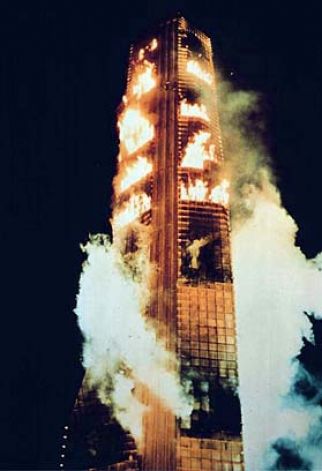
As is the case with most of the classic disaster films, The Towering Inferno is a long and big movie but it has a very simple plot.  The world’s tallest building — known as the Glass Tower — has been built in San Francisco.  On the night of the grand opening, a fire breaks out, trapping all the rich and famous guests on the 135th floor.  Now, it’s up to the fire department to put out the fire while the trapped guests simply try to survive long enough to be rescued.  Some will live, some will die but one thing is certain — every member of the all-star cast will get at least 15 minutes of screen time and at least one chance to scream in the face of the film’s still effective special effects.

628x471

As for the people trapped by the towering inferno, we don’t really get to know them or their motivations.  (Add to that, once the fire breaks out, everyone pretty much only has one motivation and that’s to not die.)  As a result, we don’t so much react to them as characters as we do to personas of the actors who are playing them.

Steve-McQueen-in-The-Towe-001

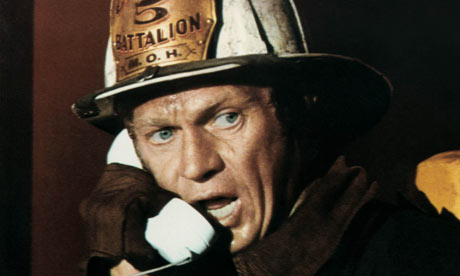
For instance, we know that Fire Chief O’Halloran is a fearless badass and a natural leader because he’s played by Steve McQueen.  McQueen brings a certain blue collar arrogance to this role and it’s a lot of fun to watch as he gets progressively more and more annoyed with the rich people that he’s been tasked with rescuing.

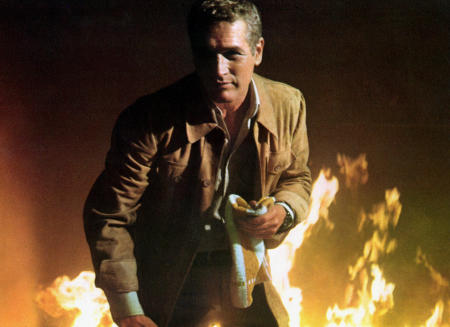
We know that architect Doug Roberts is a good guy because he’s played by Paul Newman.  Reportedly, Newman and McQueen were very competitive and, in this movie, we literally get to see them go-head-to-head.  And, as charismatic as Newman is, McQueen pretty much wins the movie.  That’s because there’s never a moment that O’Halloran isn’t in charge.  Doug, meanwhile, spends most of the movie begging everyone else in the tower to exercise the common sense necessary to not die.  (Unfortunately, despite the fact that he looks and sounds just like Paul Newman, nobody in the tower feels like listening to Doug.  If Towering Inferno proves anything, it’s that most people are too stupid to survive a disaster.)

paul-newman-inferno1

The tower’s owner, James Duncan, is played by William Holden so we know that Duncan may be a ruthless businessman but that ultimately he’s one of the good guys.  Holden gets one of the best scenes in the film when, after being told that people in the building are catching on fire, he replies, “I think you’re overreacting.”

Roger Simmons is Duncan’s son-in-law and we know that he’s ultimately to blame for the fire because he’s played by Richard Chamberlain.  Roger might as well have a sign on his back that reads “Doomed.”  The same can be said of publicity executive Dan (Robert Wagner) and his girlfriend, Lorrie (Susan Flannery).

The_Towering_Inferno_1974_Faye_Dunaway_Mike_Lookinland

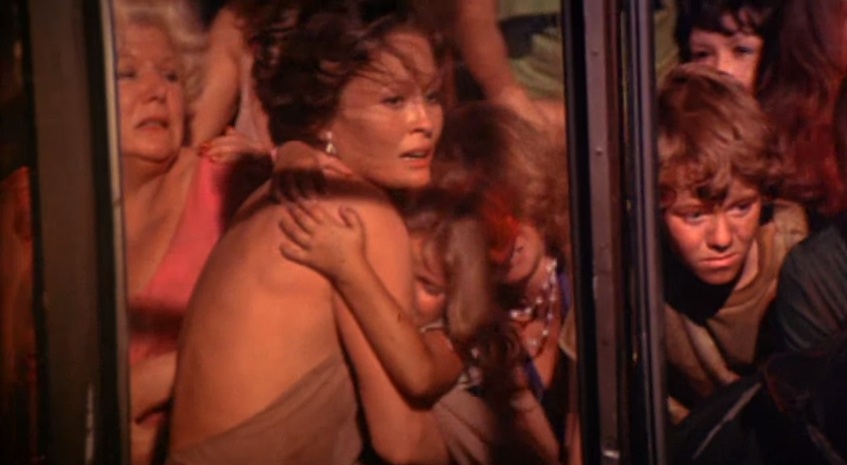
Faye Dunway is Susan.  She is Doug’s fiancée and she really doesn’t do much but she does get to wear a really pretty dress.  The same can be said of Susan Blakely, who plays Roger’s dissatisfied wife, and Jennifer Jones, who plays a recluse.  And good for them because if you’re going to be stuck in an inferno without much to do, you can at least take some comfort in looking good.

Then there’s Fred Astaire, who does not dance in this film.  Instead, he plays a kind-hearted con artist who ends up falling in love with Jennifer Jones.  Fred Astaire received his only Oscar nomination for his brief but likable performance in The Towering Inferno.

And finally, there’s the building’s head of security, Jernigan.  We know that he’s a murderer because he’s played by O.J. Simpson and … oh wait.  Jernigan is actually probably the second nicest guy in the whole film.  The only person nicer than Jernigan is Carlos, the bartender played by Gregory Sierra.

OJ

The real star of the film, of course, is the fire.  In the 40 years since The Towering Inferno was produced, there’s been a lot of advances in CGI and I imagine that if the film was made today, we’d be watching the fire in 3D and it would be so realistic that we’d probably feel the heat in the theater.  That said, the fire effects in The Towering Inferno are still pretty effective.  Now, I have to admit that I have a phobia (and frequent nightmares) about being trapped in a fire so, obviously, this is a film that’s specifically designed to work itself into my subconscious.  But that said, the scenes with various extras thrashing about in the flames are still difficult to watch.  There’s a scene where Robert Wagner and Susan Flannery find themselves trapped in a blazing reception area and it is pure nightmare fuel.

The Towering Inferno 9

The Towering Inferno is an undeniably effective disaster film.  At the same time, when one looks at the 1974 Oscar nominees, it’s odd to see The Towering Inferno nominated for best picture along with The Godfather Part II, Chinatown, and The Conversation.  Unlike those three, The Towering Inferno is hardly a great film.

But it is definitely an entertaining one.

toweringinferno2

James Bond Film Review: Casino Royale (dir by Ken Hughes, John Huston, Joseph McGrath, Robert Parrish, Val Guest, and Richard Talmadge)


As you probably already know, we here at the Shattered Lens have been counting down the days until the American release of Skyfall by reviewing every single film in the James Bond franchise.  Today, we take a look at the first non-EON Bond film, the epic, psychedelic 1967 spoof Casino Royale.

Where to begin?

When Ian Fleming’s first James Bond novel, Casino Royale, was published in 1953, veteran Hollywood producer Charles K. Feldman bought the film rights.  However, Feldman didn’t buy the rights to Fleming’s subsequent novels and was forced to sit by and watch as Albert Broccoli and Harry Saltzman had unexpected success with Dr. No and the subsequent EON-produced Bond films.  Much as Kevin McClory did with Thunderball, Feldman first attempted to co-produce a serious adaptation of Casino Royale with Broccoli and Saltzman.  However, when Feldman, Broccoli, and Saltzman couldn’t come to an agreement on how each side would be compensated in the proposed production deal, Feldman decided to make Casino Royale on his own.  He also decided that, instead of trying to compete with EON by making a “straight” James Bond film, his version of Casino Royale would be a satirical extravaganza.

Feldman’s vision of James Bond is apparent from Casino Royale’s opening credits.  While the credits are definitely based on the iconic openings of the EON Bond films, they’re also designed to play up the fact that Casino Royale — in the grand tradition of the Hollywood studios at their most excessive — is meant to be a big budget, all-star extravaganza.

Casino Royale actually starts out with a pretty clever premise.  It seems that the name “James Bond,” is simply a code name that has been assigned to several British spies over the years.  As M (played by John Huston, who also directed the first third of the film), explains it, the name “James Bond” strikes such fear in the hearts of Britain’s enemies that the name must be kept alive.

(Speaking for myself, this is an idea that I kinda wish that the official James Bond series would adopt.  If nothing else, it would certainly explain how Pierce Brosnan and Daniel Craig could possibly be the same person.)

The original James Bond (played by David Niven) has long since retired to his stately country estate, where he spends his time playing the piano and complaining about how the agents who have inherited his name are sullying his reputation with excessive womanizing and violence.  It turns out the Sir James Bond is a man renowned for his “celibate image.”  At the start of the film, Bond is asked to come out of retirement by not only M but the heads of the CIA, KGB, and French secret service as well.  SMERSH, an organization of female assassins that’s led by the mysterious Dr. Noah, has been eliminating agents worldwide and only the original (and very chaste) Bond can defeat them.  Bond, however, refuses and M responds by ordering a mortar attack on Bond’s estate.  The estate is blown up but so is M and Bond soon finds himself returning to London as the new head of MI6.

Interestingly enough, David Niven was one of the actors who was considered for the role of James Bond in Dr. No.  Reportedly, Ian Fleming was quite enthusiastic for Niven to take the role but, by the time that Dr. No went into production, Niven was considered to be too old.  There’s a nice bit of irony here in seeing David Niven playing a retired James Bond who spends a good deal of the film complaining about the men who have subsequently assumed his name.

Once Niven takes over MI6, he orders that, in order to confuse SMERSH, all British agents (including female agents) will be known as James Bond.  The rest of the film is divided into episodes that feature these new James Bonds battling SMERSH and the mysterious Dr. Noah.

Among these agents, there’s the handsome Coop (played by Terrence Cooper) who has been trained to resist all sexual temptations.

There’s Mata Bond (Joanna Pettet), the daughter of Sir James Bond and Mata Hari.

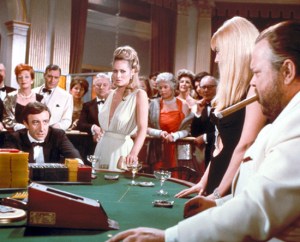
There’s Vesper Lynd (Ursula Andress) who is sent to seduce and recruit the expert gambler Evelyn Tremble (Peter Sellers) so that Tremble can beat SMERSH agent Le Chiffre (Orson Welles) at the Casino Royale.

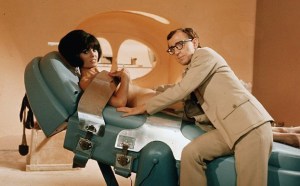
Best of all, there’s Sir James Bond’s nephew, Jimmy Bond.  Jimmy Bond is played by Woody Allen and … well, let’s just take a look at Jimmy’s first scene in the film:

Casino Royale had a notoriously troubled production history and most of those troubles seemed to center on Peter Sellers.  While the film was designed to be a broad, slapstick comedy, Sellers reportedly insisted on trying to play his role straight and even rewrote his lines to make his scenes more dramatic.  Welles eventually grew so disgusted with Sellers that he refused to be in the same room with him.  This caused quite a bit of difficulty since Sellers was in almost every scene that featured Welles.  Eventually, Sellers walked off the film and the film had to be hastily (and awkwardly) rewritten to account for his sudden absence.

When one watches Casino Royale today, it’s hard to escape the conclusion that Sellers was essentially correct.  While most of Casino Royale often feels disjointed and incoherent, the scenes featuring Sellers, Andress, and Welles are some of the strongest in the film.  Sellers’ dramatic approach doesn’t negate the film’s comedy.  If anything, it makes the comedy even stronger because Sellers actually seems to be invested in the reality his character, regardless of how ludicrous a situation that character may find himself in.

When I watched Casino Royale, I was struck by the stark contrast between the parts of the film that worked and the parts that didn’t.  This is a movie that truly swings from one extreme to another.  Either the film’s satire is working  brilliantly (mostly in the scenes featuring Woody Allen and Peter Sellers) or it’s falling completely flat (like in an extended sequence that features Deborah Kerr as a SMERSH assassin).

I found myself laughing more at the little scenes than the big set pieces.  For instance, I loved it when David Niven embraces Miss Moneypenny (Barbara Bouchet) just to be then told that she’s actually the daughter of the original Miss Moneypenny.  I don’t know much about the actor Terrence Cooper (though, according to Wikipedia, he was also a contender to take the role of James Bond in the official series) but I enjoyed the brief sequence where Moneypenny “tests” him to see if he can take on the Bond identity.  Unfortunately, the film doesn’t really have enough of these small, clever moments.

Ultimately, I found that Casino Royale works best when viewed as a time capsule.  Casino Royale was made at a time when the established major Hollywood studios (and veteran producers like Charles K. Feldman) were struggling to remain relevant.  Foreign films (including, it must be said, the James Bond films) were challenging the common assumptions of what could and what couldn’t be shown on-screen and the studio system reacted by trying to make films that would appeal to younger audiences while also reassuring older audiences that the movies hadn’t really changed that much.  The end result were films like Casino Royale that featured the occasional psychedelic sequence along with cameos from old (and safe) Hollywood stars like George Raft, William Holden, and Charles Boyer.  Casino Royale is the type of self-indulgent film that could only have been made in 1967 and, as such, it’s a valuable time capsule for all of us cinematic historians.

I also have to admit that, as excessive as Casino Royale may be, I happen to love excess.  Casino Royale might be overlong and occasionally incoherent but the costumes are simply to die for.  The film is a visual feast, if nothing else.

Casino Royale was released to scathing reviews and terrible box office but, in the years since, it has become something of a cult favorite.  Our own Trash Film Guru has identified Casino Royale as his favorite Bond film.  Myself, I found the film to be extremely flawed and yet oddly fascinating to watch.  Casino Royale is a total mess and that is both its greatest flaw and greatest strength.

Tomorrow, we’ll return to the official James Bond series by taking a look at You Only Live Twice.  

Film Review: Network (dir. by Sidney Lumet)


With the recent passing of director, Sidney Lumet, I decided to watch one of Lumet’s best-known films, the 1976 best picture nominee Network.

Network tells the story of Howard Beale (played by Peter Finch).  Howard is a veteran news anchor at a fictional television network.  Because his ratings are in decline, Howard is fired.  Howard reacts to this by announcing that he will commit suicide at the end of the next broadcast.  Ironically, so many people tune in to see Howard kill himself that his ratings improve and Howard gets to keep his job under the watchful eyes of news director Max Shumacher (William Holden) and network executive Dianne Christiensen (Fay Dunaway). 

At the same time, Max and Dianne are adulterous lovers.  The course of the film’s narrative finds Max abandoning his wife (Beatrice Straight) and Dianne, who is described as a “child of the tube,” enthusiastically trying to produce an early reality television show starring a group of Marxist revolutionaries.  They do this under the paranoid eyes of network president Frank Hackett (Robert Duvall) and Frank’s boss, the corrupt Arthur Jenson (Ned Beatty).

However, Howard Beale isn’t just an over-the-hill news anchor.  He’s actually a seriously mentally ill man who hears voices and who starts to see himself as some sort of messiah.  Eventually, this leads to a disheveled Howard giving a crazed speech in which he encourages viewers to yell, “I’m as mad as Hell and I’m not going to take it anymore!”  Yes, this is the famous scene that is always used whenever some pompous media jackass wants to criticize the current state of television.  Even though I think it’s one of the most overrated scenes in history, here it is:

Anyway, after this scene, Dianne starts to promote Howard as the “Mad Prophet of the Airwaves” and Max gets all outraged over how the news no longer has any integrity (bleh, Max is kinda full of himself) and eventually, Howard’s mad rantings get the attention of Arthur Jenson who has plans of his own for Howard.  The whole thing eventually ends on one of those rather dark notes that’s impressive the first time you watch it but just seems more heavy-handed and clumsy with subsequent viewings.

As you might be able to tell from my review, I almost felt as if I was watching two different movies when I watched Network.  For the first hour, the movie is a sharp and clever satire on the media.  The characters are sharply drawn, the performance are full of nuance, and even the villainous Dianne is allowed a bit of humanity.  And then, Howard gives his famous “mad as Hell” speech and the entire freaking film pretty much just falls apart as suddenly, all the characters start to act like cartoons.  The film’s satire becomes so heavy-handed that you actually find yourself wanting to watch something mindless and brainless just because you know it would piss off self-righteous old Max.  The actors stop acting and instead concentrate on shouting.  Whatever humanity Dianne had been allowed suddenly vanishes and she just becomes yet another stereotypical “castrating bitch.”  Max gets to spend a lot of time telling her why she’s worthless and it pretty much all comes down to the fact that 1) she’s under 40 and 2) she has a vagina.  (Never mind the fact that Max has abandoned his wife, apparently men are allowed to be assholes.)  By the time the 2nd half of the film ends, you don’t care about whatever the film’s message may have been.  You’re just happy that everyone has finally shut up.

As I sat through the second half of this film, it soon became apparent to me why Aaron Sorkin has continually cited Network‘s screenwriter Paddy Chayefsky as a major influence.  Chayefsky won an Oscar for writing Network and he’s constantly cited as one of the greatest screenwriters of all time but, quite frankly, his script isn’t that good.  Much like Sorkin’s work, you’re aware of the screenplay not because of what the characters say but because they say so much.  This is the type of film that is often wrongly called prophetic by bitter old men.  This is largely because the script itself was written by a bitter old man.  The only true insight one gets from this movie is the insight that the old will always view the young and the new as a threat.

And yet, even as the second half of the film collapses around us, Network still holds our attention.  We’re still willing to stick around to see how all of this ends (and keep an eye out for a 17 year-old Tim Robbins who made his uncredited film debut at the end of Network).  This has nothing to do with anything written by Paddy Chayefsky and everything to do with the direction of Sidney Lumet.  I once read somewhere that you can’t make a good film out of a bad script.  I’m not sure who said that though it has a definite William Goldman sound to it.   Well, if nothing else, Network proves that this is not always the case. 

To me, there is no more fitting tribute to Sidney Lumet than to say that he somehow managed to create something worthwhile out of Network.