Film Review: The Day After (dir by Nicholas Meyer)


“This is Lawrence. This is Lawrence, Kansas. Is anybody there? Anybody at all?”

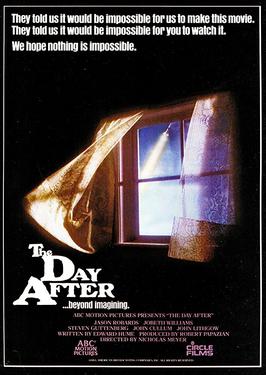
The words of Joe Huxley (John Lithgow) hang over the ending of The Day After, a 1983 film that imagines what the aftermath of a nuclear war would be like not on the East or the West Coasts but instead in the rural heartland of America.  Huxley is a professor at the University of Kansas and, as he explains early on in the film, Kansas would be an automatic target in any nuclear war because it houses a number of missile silos.  When he explains that, it’s in an almost joking tone, largely because the missiles haven’t been launched yet.  Instead, the only thing we’ve heard are a few barely noticed news stories about growing tensions between America and Russia.  About halfway through The Day After, the bombs go off and there are suddenly no more jokes to be made.

When the bombs drop over Kansas, we watch as cities and field and people burst into flames.  In a matter of minutes, several thousands are killed.  I’m almost ashamed to admit that I was probably more upset by the image of a horse being vaporized than I was by the death of poor Bruce Gallatin (Jeff East), the college student who was planning on marrying Denise Dahlberg (Lori Lethin).  I guess it’s because horses — really, all animals — have nothing to do with the conflicts between nations.  Humans are the ones who take the time to build bigger and better weapons and The Day After is one of the few films about war that’s willing to acknowledge that, when humans fight, it’s not just humans that die.

The bombing sequence is lengthy and I have to admit that I was a bit distracted by the fact that I recognized some of the footage from other movies.  A scene of panicked people running through a building was taken from Two-Minute Warning.  A scene of a building exploding and a construction worker being consumed by flames was lifted from Meteor.  As well, there’s some stock footage which should be familiar to anyone who has ever seen a documentary about the early days of the Cold War.  Still, despite that, it’s an effective sequence simply because it’s so relentless.  Some of the film’s most likable characters are vaporized before our eyes.  Steve Guttenberg, of all people, is seen ducking into a store.

Guttenberg plays Stephen Klein, a pre-med student who manages to survive the initial attack and takes shelter with the Dahlberg family at their ranch.  At first, it’s a bit distracting to see Steve Guttenberg in a very serious and very grim film about the nuclear apocalypse but he does a good job.  The sight of him losing both his teeth and his hair carries a punch precisely because he is reliably goofy Steve Guttenberg.

If the film has a star, it’s probably Jason Robards, the doctor who witnesses the initial blast from the safety of his car and then treats the dying in Lawrence, Kansas.  He does so, despite the fact that he doesn’t know if his wife, son, and daughter are even still alive.  He continues to do so until he also falls ill with radiation poisoning.  Knowing that he’s dying, he heads home just to discover that there is no home to return to.

Home is reccuring theme throughout The Day After.  Everyone wants to return to their home but everyone’s home has been wiped out.  “This is my home,” Jim Dahlberg (John Cullum) tries to explain before he’s attacked by a group of feral nomads.  Home no longer exists and trying to pretend like life can go back to the way it once was is an often fatal mistake.

Real happy film, right?  Yeah, this isn’t exactly a film that you watch for fun.  I have to admit that I made a joke about how I wouldn’t want to die while wearing the unfortunate blue jumpsuit that Jason Robards’s daughter chooses to wear on the day of the nuclear attack and I felt guilty immediately.  (Well, not that guilty.  Seriously, it was a terrible fashion choice.)  The Day After is a film that gives audiences zero hope by design.  It was made at a time when it was generally assumed that nuclear was inevitable and it was designed to scare the Hell out of everyone watching.  And while I can’t attest to how audience may have reacted in 1983, I can say that, in 2020, it’s still a powerful and disturbing film.

“Is anybody there? Anybody at all?” Joe Huxley asks and by the end of the film, the answer doesn’t matter.  The damage has already been done.
Lisa Reviews An Oscar Nominee: A Soldier’s Story (dir by Norman Jewison)


http://www.youtube.com/watch?v=SG1mF1jtul0

Set during World War II, 1984’s A Soldier’s Story opens with a murder.

On a rural road outside of a segregated army base in Louisiana, someone has gunned down Sergeant Vernon Walters (Adolph Caesar).  At the time, Walters was staggering back to the base after a night of heavy drinking.  Both the local authorities and Watlers’s fellow soldiers assume that the murder was the work of the Ku Klux Klan.  Captain Richard Davenport (Howard Rollins) isn’t so sure.

Captain Davenport is the officer who has been assigned to investigate the murder.  From the minute that he arrives at the base, the soldiers stare at him.  As Cpl. Ellis (Robert Townsend) explains it, the enlisted men are shocked because they’ve never seen a black officer before.  Some of the soldiers admire Davenport while other view him with suspicion, wondering what Davenport must have done or who he must have sold out to earn his commission.

Meanwhile, the other officers (who are all white) view Davenport with a combination of condescension and hostility.  Col. Nivens (Trey Wilson) only allows Davenport three days to wrap up his investigation and assigns the polite but skeptical Capt. Taylor (Dennis Lipscomb) to work with him.  Taylor suspects that Walters may have been murdered by the openly racist Lt. Byrd (Wings Hauser!).  Davenport, however, isn’t so sure.  Even though the official story is that Walters was a tough but fair sergeant who was respected by his company, Davenport suspects that one of them may have killed him.

Davenport and Taylor start to interview the soldiers who actually had to deal with Walters on a daily basis.  Through the use of flashbacks, Walters is revealed to be a far more complex man than anyone knew.  We see that Walters was a man who was bitterly aware of the fact that, even after a lifetime of military service, he was destined to always be treated as a second-class citizen by the nation that he served.  Unable to strike out at the men who the army and society had placed over him, Walters instead struck at the men serving underneath him.  While the man in Walters’s company wait for word on whether or not they’ll be allowed to serve overseas, Davenport tries to determine if one or more of them is a murderer.

A Soldier’s Story was adapted from a play but director Norman Jewison is careful to prevent the material from becoming stagey.  Effortlessly transitioning from the film’s present to flashbacks of the events that led to Walters’s murder, Jewison crafts both an incendiary look at race relations and a compelling murder mystery.  He’s helped by a strong cast of predominately African-American actors.  In one of his earliest roles, Denzel Washington plays Pfc. Peterson with a smoldering intensity.  David Alan Grier and Robert Townsend, two actors known for their comedic skills, impress in dramatic roles.  Seen primarily in flashbacks, Adolph Caesar turns Walters into a complex monster.

And yet, with all the talent on display, it is Howard Rollins who ultimately steals the movie.  As  a character, Captain Davenport has the potential to be a rather thankless role.  He spends most of the movie listening to other people talk and, because of his status as both an officer and a black man in the rural south, he’s rarely allowed to show much anger or, for that matter, any other emotion.  However, Rollins gives a performance of such quiet intelligence that Davenport becomes the most interesting character in the movie.  He’s the ultimate outsider.  Because of his higher rank and his role as an investigator, he can’t fraternize with the enlisted men but, as an African-American, he’s still expected to remain separate from and differential to his fellow officers.  As the only black officer on a segregated base, Davenport is assigned to stay in an empty barrack.  One of the best scenes in the film is Davenport standing alone and surveying the stark layout of his temporary quarters.  The expression on his face tells you everything you need to know.

(Towards the end of the film, when Davenport finally gets a chance to drop his rigid facade and, if just for one line, be himself, you want to cheer for him.)

A Soldier’s Story was nominated for best picture but it lost to another theatrical adaptation, Milos Forman’s Amadeus.


Cleaning Out The DVR: Widsom (dir by Emilio Estevez)


(I recorded the 1986 film, Wisdom, off of Retroplex on Mary 1st.)

http://www.youtube.com/watch?v=RF8xuGI-WxI


(SPOILER ALERT!  The ending of this film is so extremely stupid that there’s no way I’m not going to discuss it in this review.)

Meet John Wisdom (Emilio Estevez)!

He’s got one of those ironic names, as people in pretentious movies often do.  He’s extremely naive but his name is Wisdom.  He does a lot of stupid crap but his name is Wisdom.  And I guess the audience is meant to feel that Wisdom understands more than even he knows.

Or something like that.

Who knows?

Anyway, John Wisdom has got some issues.  He’s a college dropout who can’t get a good job because he has a criminal record.  He didn’t really do anything wrong, of course.  All he did was steal a car on the night of his high school graduation.  Hey, who hasn’t done that?  Anyway, Wisdom would be happy to just spend all day sitting around in his bathtub but his father (Tom Skerritt) insists that Wisdom find some sort of employment.

Eventually, Wisdom ends up working in a fast food restaurant.  It turns out that he’s not very good at it, which leads me to suspect that Wisdom probably wouldn’t be very good at any of the other jobs that he was pursuing either.  To be honest, the main reason that Wisdom works at the restaurant is so that Charlie Sheen can have a cameo as Wisdom’s boss.

(Strangely, Martin Sheen is nowhere to be found in the movie.  It wouldn’t surprise me if Emilio Estevez — who both directed and wrote the script — originally envisioned Martin playing his father.  Tom Skerritt does an extended Martin Sheen impersonation as Daddy Wisdom.)

Anyway, Wisdom decides that since the system refuses to give him a fair chance, he’s going to live the rest of his life as an outlaw.  So, Wisdom starts to rob banks.  However, instead of stealing all of the money, Wisdom is more interested in setting fire to mortgage and loan records.  Wisdom explains, via voice over, that he’s concerned about the working people who keeps getting screwed over by the banks.  That’s all good and well but I thought the whole reason that Wisdom started robbing banks was because there was no other way for him to make any money.  So, when did Wisdom go from being a greedy criminal to an altruistic rebel?

Naturally, Wisdom and his girlfriend, Karen (Demi Moore), becomes folk heroes.  Everyone wants to meet Wisdom and protect him from the police.  But eventually, Karen gets gunned down by a police helicopter.  Poor Karen.  She didn’t even want to rob banks.  Well, actually, she did want to rob banks.  And then she didn’t.  And then she did again.  Karen’s motivation and personality changes from scene-to-scene, largely because she’s a poorly written character.  But no matter.  She’s dead now.

But Wisdom’s still alive!  Except, soon, he finds himself surrounded by cops.  Standing in the middle of a football field (Oh my God!  The symbolism!), Wisdom is gunned down by law enforcement…

…except suddenly, Wisdom’s back in the bathtub.  Apparently, he was just daydreaming about his girlfriend getting gunned down in front of him.  Wait … what?  Seriously, what type of ending is that!?  At the very least, the film could have ended with Wisdom robbing a bank for real and accepting that his dream is destined to come true.  I mean, that would have been stupid but at least it would have been something.  Instead, things end with Wisdom leaving the bathroom.

So, basically, the entire film was just Wisdom daydreaming about robbing banks and eventually getting gunned down on a football field.  Oh, Wisdom.  You got some issues, sweetie!

Emilio Estevez directed this film a year after appearing in The Breakfast Club.  Like many directorial debuts, it’s incredibly dumb.  You can tell that Estevez wasn’t sure what he wanted to say but he was still damn determined to say it.  Why do so many actors end up directing such pretentious and/or boring movies?  On the plus side, there were a few attempts at deliberate humor (Wisdom is not a particularly organized bank robber) and Demi Moore did a fairly good job playing an inconsistent character.  Otherwise, Wisdom is mostly memorable for having one of the worst endings of all time.

Cleaning Out The DVR: Women of San Quentin (dir by William A. Graham)


(Lisa is currently in the process of cleaning out her DVR!  She’s got over 170 films to watch before the end of 2017!  Will she make it?  Who knows?  She recorded 1983’s Women of San Quentin off of Retroplex on January 25th.)

For some reason, back in January, I felt the need to record several prison movies off of cable.  I’m not sure where my mind was at that I would see a title like Women of San Quentin listed in the guide and think to myself, “That’s something I definitely need to record.”  Maybe I was thinking of pursuing a career as a prison guard.  That seems to be the easiest way to get a show on A&E nowadays.

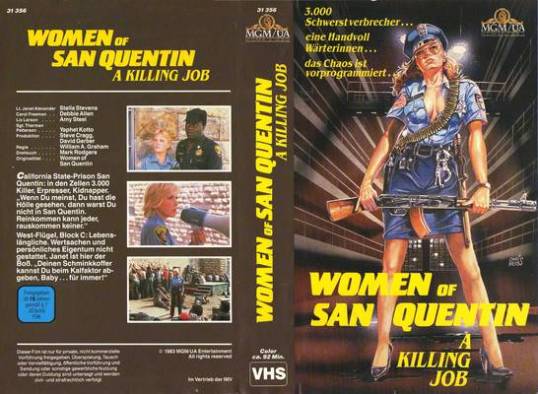
Anyway, I imagine that anyone reading this review is looking that title and considering the VHS cover art and they’re probably assuming that Women of San Quentin is some sort of Cirio Santiago-directed women in prison film.  And then consider the film’s cast: Amy Steel is best known for Friday the 13th Part II and April Fool’s Day.  Stella Stevens is an exploitation film vet.  One of the prisoners is played by Rockne Tarkington, who starred in a handful of blaxploitation films.  William Sanderson, star of the infamous Fight For Your Life, has a small role.  Yaphet Kotto plays a prison guard here but he’s best known for playing the villain in Live and Let Die.  Gregg Henry plays a sociopath.  Hector Elizondo and Debbie Allen play sympathetic guards.  Even Ernie Hudson, a now-respectable actor with several less-than-savory films on his resume, shows up.  Finally, consider this: Women of San Quentin was written by Larry Cohen, the man who directed both Black Caesar and It’s Alive.

However, despite all of that, Women of San Quentin is not an exploitation film.  Instead, it’s a made-for-TV movie.  (Director William A. Graham has over a hundred TV shows and made-for-TV movies to his credit.)  It follows several storylines.  Lt. Janet Alexander (Stella Stevens) is the tough-but-fair captain who is in charge of one of San Quentin’s most intimidating cell blocks.  She’s great at her job and she has a vaguely romantic relationship with Hector Elizondo but she’s also tempted to find a new career.  Charles Wilson (Ernie Hudson) steps up to lead the prison’s black inmates after another activist is assassinated.  Meanwhile, the leader of the Mexican Mafia plots a prison riot and Yaphet Kotto and Debbie Allen use any means necessary to discover what’s going to happen.

And then there’s Liz Larson (Amy Steel), the newest prison guard who struggles to prove that she belongs in San Quentin.  Sexist colleagues play cruel pranks on her.  The prisoners shout at her whenever she walks past their cells.  When she has to use a gun to break up a fight, she hesitates just a second too long.  Will she be able to step up when real trouble breaks out?  Among horror fans, Amy Steel is remembered for “surviving” several slasher films.  (Her performance as Ginny in Friday the 13th Part 2 largely set the standard for which all final girls are judged.)  Steel does a pretty good job as Liz but, actually, the entire movie is well-acted.  The script is frequently rudimentary but the cast is full of unique talent and it’s always fun to watch so many good actors playing opposite each other.

I assume that the Women of San Quentin was meant to be a pilot for a TV show or something.  It just has that feel to it.  If just for the cast alone, I would recommend watching Women of San Quentin if you get a chance.  I’m as surprised as anyone but, after all, where else are going to get a chance to watch Hector Elizondo, Yaphet Kotto, Stella Stevens, and Amy Steel all hanging out in a bar together?  There are certain opportunities that you just don’t miss.