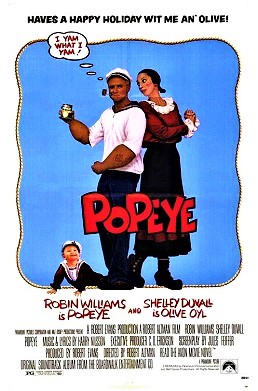
Popeye (1980, directed by Robert Altman)


I like Popeye.

Sometimes, I feel like I’m the only one.  Popeye got such bad reviews and was considered to be such a box office disappointment that director Robert Altman didn’t make another major film for a decade.  Producer Robert Evans, who was inspired to make Popeye after he lost a bidding war for the film rights to Annie, lost his once-sterling reputation for being able to find hits.  This was Robin Williams’s first starring role in a big screen production and his career didn’t really recover until he did Good Morning Vietnam seven years later.  Never again would anyone attempt to build a film around songs written by Harry Nilsson.  Screenwriter Jules Fieffer distanced himself from the film, saying that his original script had been ruined by both Robert Evans and Robert Altman.  Along with Spielberg’s 1941 and Michael Cimino’s Heaven’s Gate, Popeye was one of the box office failures that signaled the end of the era in which directors were given a ton of money and allowed to do whatever they wanted to with it.

I don’t care.  I like Popeye.  I agree with the critics about Nilsson’s score but otherwise, I think the film does a great job of capturing the feeling of a comic strip come to life.  Altman was criticized for spending a lot of money to construct, from scratch, the seaside village that Popeye, Olive Oyl (Shelley Duvall), Bluto (Paul L. Smith), Wimpy (Paul Dooley), and everyone else called home but it does pay off in the movie.  Watching Popeye, you really are transported to the world that these eccentric characters inhabit.  If the film were made today, the majority of it would be CGI and it wouldn’t be anywhere near as interesting.  Featuring one of Altman’s trademark ensemble casts, Popeye create a world that feels real and lived in.

Mumbling the majority of his lines and keeping one eye closed, Robin Williams is a surprisingly believable Popeye, even before he’s force fed spinach at the end of the movie.  Paul L. Smith was an actor who was born to play the bullying Bluto and there’s something very satisfying about seeing him (literally) turn yellow.  As for Shelley Duvall, she is the perfect Olive Oyl.  Not only does she have the right look for Olive Oyl but she’s so energetic and charmingly eccentric in the role that it is easy to see what both Popeye and Bluto would fall in love with her.  Though the humor is broad, both Williams and Duvall bring a lot of heart to their roles, especially in the scenes where they take care of their adopted infant, Swee’Pea.  Popeye may be a sailor but he’s a father first.

Popeye deserves a better reputation than it has.  It may not have been appreciated when it was originally released but Popeye has a robust spirit that continues to distinguish it from the soulless comic book and cartoon adaptations of today.

Film Review: McCabe & Mrs. Miller (dir by Robert Altman)


First released in 1971, McCabe & Mrs. Miller takes place in the town of Presbyterian Church at the turn of the 19th Century.

Presbyterian Church is a mining town in Washington State.  When we first see the town, there’s not much to it.  The town is actually named after its only substantial building and the residents refer to the various parts of the town as either being on the right side or the left side of the church.  The rest of the town is half-constructed and appears to be covered in a permanent layer of grime.  This is perhaps the least romantic town to ever appear in a western and it is populated largely by lazy and bored men who pass the time gambling and waiting for something better to come along.

When a gambler who says that he is named McCabe (Warren Beatty) rides into town, it causes a flurry of excitement.  The man is well-dressed and well-spoken and it’s assumed that he must be someone important.  Soon a rumor spreads that McCabe is an infamous gunfighter named Pudgy McCabe.  Pudgy McCabe is famous for having used a derringer to shoot a man named Atwater.  No one is really sure who Atwater was or why he was shot but everyone agrees that it was impressive.

McCabe proves himself to be an entrepreneur.  He settles down in Presbyterian Church and establishes himself as the town’s pimp.  Soon, he is joined by a cockney madam names Mrs. Miller (Julie Christie).  The two of them go into business together and soon, Presbyterian Church has its own very popular bordello.  Sex sells and Presbyterian Church becomes a boomtown.  It attracts enough attention that two agents of a robber baron approach McCabe and offer to buy him out.  McCabe refuses, thinking that he’ll get more money if he holds out.  Mrs. Miller informs him that the men that he’s dealing with don’t offer to pay more money.  Instead, they just kill anyone who refuses their initial offer.

Three gunmen do eventually show up at Presbyterian Church and we do eventually get an answer to the question of whether or not McCabe killed Atwater or if he’s just someone who has borrowed someone else’s legend.  The final gunfight occurs as snow falls on the town and the townspeople desperately try to put out a fire at the church.  No one really notices the fact that McCabe is fighting for his life at the time and, as befits a revisionist western, there’s nothing romantic or dignified about the film’s violence.  McCabe is not above shooting a man in the back.  The killers are not above tricking an innocent cowboy (poor Keith Carradine) into reaching for his gun so that they’ll have an excuse so gun him down.  McCabe may be responsible for making Presbyterian Church into a boomtown but no one is willing to come to his aid.  The lawyer (William Devane) that McCabe approaches is more interested in promoting his political career than actually getting personally involved in the situation.  Mrs. Miller, a businesswoman first, smokes in an opium den with an air of detachment while the snow falls outside.

It’s a dark story with moments of sardonic humor.  It’s also one of director Robert Altman’s best.  The story of McCabe and Mrs. Miller and the three gunmen is far less important than the film’s portrayal of community growing and changing.  Featuring an ensemble cast and Altman’s trademark overlapping dialogue, McCabe & Mrs. Miller puts the viewer right in the heart of Presbyterian Church.  There are usually several stories playing out at once and it’s often up to the viewer to decide which one that they want to follow.  Yes, the film is about Warren Beatty’s slick but somewhat befuddled McCabe and Julie Christie’s cynical Mrs. Miller.  But it’s just as much about Keith Carradine’s Cowboy and Rene Auberjonois’s innkeeper.  Corey Fischer, Michael Murphy, John Schuck, Shelley Duvall, Bert Remsen, and a host of other Altman mainstays all have roles as the people who briefly come into the orbit of either McCabe or Mrs. Miller.  Every character has a life and a story of their own.  McCabe & Mrs. Miller is a film that feels as if it is truly alive.

As with many of Altman’s films, McCabe & Mrs. Miller was not fully appreciated when initially released.  The intentionally muddy look and the overlapping dialogue left some critics confused and the film’s status as a western that refused to play by the rules of the genre presented a challenge to audience members who may have just wanted to see Warren Beatty fall in love with Julie Christie and save the town.  But the film has endured and is now recognized as one of the best of the 70s.

October Hacks: Wrong Turn (dir by Rob Schmidt)


Poor West Virginia!

Seriously, I’ve been to West Virginia.  It’s a beautiful state and the majority of the people that I met while I was there were just lovely.  And before anyone trots out all the usual stereotypes about rural communities, let me say that one of the nicest used book store that I’ve ever been to was in West Virginia.  It’s a nice state, one that feels like a throwback to a less cynical universe.  Even all of the bridges and the streets named after the loathsome Robert Byrd added to the lovely quaintness of the place.

And yet, when it comes to the entertainment industry, West Virginia is rarely portrayed in a positive light.  The coastal elite has never had much use for West Virginia or the surrounding states and that’s something that comes out in the films and television shows that are made in New York and California.  Whenever anyone says that they’re from West Virginia in a movie or a television show, you can be sure that they’re either going to be a meth cook or a villainous redneck.  West Virginia is one of those regions that’s never given much respect in Hollywood and that’s a shame.

Take Wrong Turn, for instance.  First released in 2003, the original Wrong Turn taught an entire generation that West Virginia was full of cannibals and blood farmers.  If you’re going to go for a drive in the wilderness of West Virginia, this film tells us, keep an eye out for barb wire booby traps.  If you’re going to hiking in the mountains, notify your next of kin because you probably won’t be coming back.  Wrong Turn follows a group of friends as they are tracked by a family of cannibal hillbillies and the main message seems to be, “For the love of God, stay out of Appalachia!”

(When I first started writing for this blog, I caused a mini-controversy when I said that no one would pay good money to see a film called The Vermont Chainsaw Massacre.  My point was that Texas has a reputation, albeit one that has more to do with fevered imaginings of out-of-staters than anything rooted in reality, that made it the only place where that film could really be effectively set.  The same is true of Wrong Turn.  It’s a story that people wouldn’t buy if it was happening anywhere other than in Appalachia.  Nobody would care about cannibals living in Minnesota, for instance.)

West Virginia slander aside, the original Wrong Turn holds up well.  It’s a slasher film from the era right before slasher films started taking themselves so seriously.  It’s a throwback to the rural horror films of the 70s, with an attractive cast getting picked off in various gruesome ways.  The cannibals are frightening and the victims are all likable without being so likable that you can’t handle seeing them killed off.  Jeremy Sisto and Lindy Booth both bring some comic relief to the film before their characters are dispatched.  Desmond Harrington is a sold-enough lead.  When I first saw Wrong Turn, my main reaction was that Eliza Dushku kicked ass and that was still my reactions when I rewatched it.  The film is bloody, shameless, and fully willing to give the audience what it wants without scolding them for it.  In short, it’s a perfectly fun slasher film and, watching it, it’s hard not to miss the era before horror films started taking themselves so damn seriously.

Wrong Turn‘s a fun movie.  But West Virginia is a lovely state and that should never be forgotten!


Retro Television Reviews: T and T 2.12 “Wendell’s Story”


Welcome to Retro Television Reviews, a new feature where we review some of our favorite and least favorite shows of the past! On Fridays, I will be reviewing T. and T., a Canadian show which ran in syndication from 1987 to 1990.  The show can be found on Tubi!

T.S. Turner protects a man who finds some money!  Didn’t he already do this?

Episode 2.12 “Wendell’s Story”

(Dir by Don McCutcheon, originally aired on January 30th, 1990)

Who is Wendell?

Wendell (played by Wayne Robson) is beloved figured in this show’s fictional Canadian city.  Wendell lives on the streets, sleeping in a tent in an alley and spendinh his days eating whatever food he happens to come across.  Wendell is good-natured and he doesn’t take it personally when the local teenagers toss a half-eaten apple at him.  Wendell is such a nice guy that, when he comes across a duffel bag full of money, he doesn’t keep the money for himself but he instead starts handing it out to random people.  It’s his way of thanking everyone for helping him and everyone is very polite about waiting their turn to be handed some money.

Way to go, Wendell!

Unfortunately, the duffel bag belonged to two incompetent crooks named Errol (Gareth Bennett) and Fritz (Dominic Cuzzocrea).  Now, when I say incompetent …. listen, T and T has featured it’s share of dumb criminals but there have never been any dumb as these two.  Not only do they lose the duffel bag but they also continually lose track of Wendell.  They’re the type of crooks whose ammo clips regularly fall out of the guns.  These guys may be incompetent but they do fire a gun at T.S. at one point.  T.S. escapes injury but, as he explains to Amy, shooting at him makes things “personal.”

T.S.’s plan to protect Wendell and catch the bad guys is to have his friend Decker wear a fake beard and pretend to be Wendell.  It’s a good plan, except the bad guys come up with a similar plan and, as a result, there are two fake Wendells wandering around and T.S. has to figure out which one to beat up.  T.S. gets so confused that it gives the bad guys time to to get the drop on him.  Fortunately, the bad guys once again fail to load their guns correctly, which gives T.S. and Decker time to knock them both out with one punch.

This was not a particularly complicated episode.  Nor was it a very suspenseful one, as the bad guys were such idiots that they never came across as being any sort of threat.  More time was spent with Wendell teaching Joe how to live on the streets than on the villains trying to get their money back.  (Why is Wendell teaching Joe how to live on the streets?  It was T.S.’s idea, which leads me to wonder if T.S. is planning on kicking Joe out of the gym at some point in the near future.)  As for Amy, she spent most of this episode setting up her new office and getting annoyed with the perfectly nice guy who had an office across the hall.  The show may be called T and T but it’s usually one T who gets to do anything.

This was a bit of a forgettable episode but Mr. T did yell, “Hey, fool!” after the bad guys attempted to shoot him so that was kind of fun.


Shattered Politics #72: Welcome to Mooseport (dir by Donald Petrie)


Welcome_To_Mooseport

The 2004 film comedy Welcome to Mooseport would probably be totally forgotten if not for one thing.  This is the film that was supposedly so bad that co-star Gene Hackman looked at the final cut and then probably looked over at the Oscars he won for The French Connection and Unforgiven and then probably looked back at the final cut and then announced, “I quit!”  There’s a reason why Hackman now spends his time writing novels and, according to most accounts, Welcome to Mooseport is that reason.

In Welcome to Mooseport, Gene Hackman plays Monroe “Eagle” Cole, the former President of the United States.  From the minute we first hear the President’s name, we know exactly what type of film Welcome to Mooseport is going to be.  It’s not enough to give Hackman’s a character a totally over-the-top name like Monroe Cole.  He also has to have a cutesy nickname.  The entire time I watched the film, I found myself wondering if Monroe Cole was listed on the presidential ballots as being Monroe “Eagle” Cole.  Personally, I always find it funny when people feel the need to include their nickname in the credits.  Is it really important for every William out there to let everyone know that some people call him Billy?

Anyway, Eagle is apparently the most popular president ever.  However, he’s also recently divorced and his ex-wife (Christine Baranski, playing the same role that she played in Bulworth) wants all of his property.  Eagle is forced to retire to one of the few residences that he has left, his vacation home in Mooseport, Maine.  In order to keep his wife from claiming that home, Eagle decides to run for mayor of Mooseport…

Now, right here, we’ve got a huge issue.  Eagle’s only motivation for running for mayor is because he doesn’t want to have to give over his vacation home to his wife.  But that could be anyone’s motivation.  One does not have to be President to want to keep the house in a divorce.  It would have been more interesting if Eagle, now out of office and struggling to adjust to no longer being the most powerful man in the world, ran for mayor because he really wanted the job.

But anyway, Eagle is not the only person running for mayor.  Hardware store owner Hardy Harrison (Ray Romano) is also running.  At first, Hardy wants to withdraw but then he sees Eagle flirting with Hardy’s longtime girlfriend (Maura Tierney) and Hardy suddenly decides that he’s going to run and he’s going to win.

I actually like Ray Romano as an actor and he doesn’t give a bad performance here.  But, at the same time, it’s obvious that his scenes were written to capitalize on his TV persona.  It’s easy to imagine stumbling across a rerun of Everybody Loves Raymond where Ray runs for mayor and has a panic attack when he loses.  The difference, of course, is that Ray Barone would not have been running against Gene Hackman (much less a former President).

Needless to say, Welcome to Mooseport has a sitcom feel to it.  After every line, you find yourself waiting for a laugh track.  Gene Hackman feels incredibly out-of-place in the film and there’s a discomfort to his performance.  Watching him in this film, you can see the wheels turning in his brain.  You can literally see Gene Hackman thinking, “I’m too old for this shit.”

And I guess he was because, in the 11 years since Welcome to Mooseport was first released, Gene Hackman has not appeared in another film.  Which is bad news for everyone waiting for Welcome to Mooseport Part II