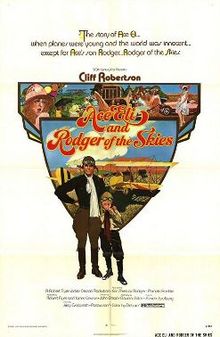
A Movie A Day #160: Ace Eli and Rodger of the Skies (1973, directed by John Erman as “Bill Sampson”)


Sometimes, the story behind a movie is more interesting than the movie itself.

A young Steven Spielberg received a “story by” credit for Ace Eli and Rodger of the Skies but, at one time, he was going to be credited with much more.  Spielberg wrote the treatment for Ace Eli and sold it to 20th Century Fox because he was hoping to make his directorial debut with the film.  However, shortly after selling the story, there was an executive shakeup at the studio.  Spielberg’s supporters were out and the men who replaced them gave the treatment to another screenwriter and director.  Spielberg was so angered by his treatment that it would be close to thirty years before he ever again worked with 20th Century Fox.  (In 2002, 20th Century Fox co-produced Minority Report with Dreamworks.)  Ace Eli ended up being directed by television veteran John Erman, who was so upset by the studio’s final edit of the film that he demanded to be credited under a pseudonym.

The plot of Ace Eli and Rodger of the Skies is recognizably Spielbergian.  Ace Eli (Cliff Robertson, who was a pilot in real life and who, after he won his Oscar of Charly, was involved in several flying films) is a stunt pilot in the 1920s.  After his wife is killed in a crash, Eli and his 11 year-old son, Rodger (Eric Shea), set off on a barnstorming tour.  Going from small town to small town, Eli deals with his pain through nonstop womanaizer.  With Eli refusing to take any responsibility for his actions, Rodger is forced to grow up quickly.  It is a typical Spielberg coming of age story, combining a nostalgia for the past with a clear-eyed portrayal of irresponsible adulthood.

In fact, it is easy to imagine the approach the Spielberg would have taken if he had been allowed to direct his story.  Unfortunately, Spielberg did not get to direct the film and John Erman takes an impersonal approach to the material.  Whereas Spielberg would have captured the excitement of both flying and life on the road, Erman keeps the audience at a distance.  An underrated actor, Cliff Robertson is still miscast as the irresponsible Ace Eli.  The reason why Cliff Robertson was perfect for the role of Uncle Ben in Spider-Man is the same reason why he feels all wrong as Ace Eli.  He is just too upstanding a citizen to be as impulsive as Eli often is.  An actor like Warren Oates would have been perfect for the role.

Steven Spielberg directing Warren Oates in Ace Eli and Rodger of the Skies?  That would have been something worth seeing!

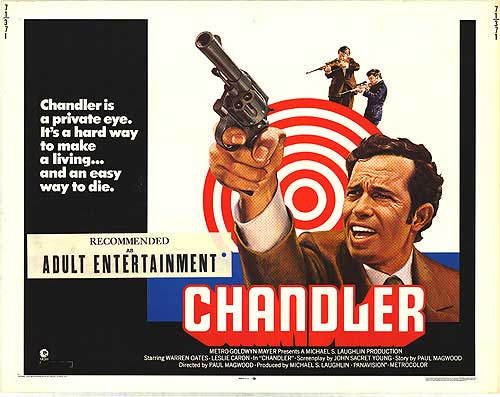
The Big Let-Down: CHANDLER (MGM 1971)


gary loggins's avatarcracked rear viewer

chandler1

“Some (producers) are able and humane men and some are low-grade individuals with the morals of a goat, the artistic integrity of a slot machine, and the manners of a floorwalker with delusions of grandeur”- Raymond Chandler, “Writers in Hollywood”, first published in Esquire Magazine, Nov. 1945

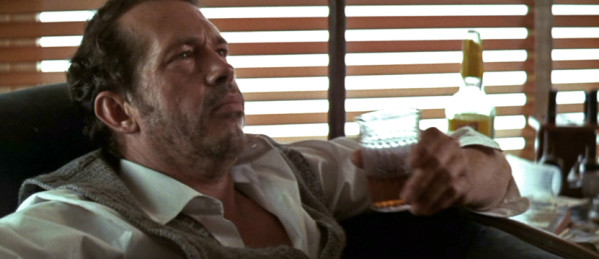
I had high hopes for CHANDLER, I really did. An homage to the hard-boiled fiction of Raymond Chandler (born July 23, 1888) with Warren Oates as the titular detective sounded like it’d be right up my dark alley. But as much as I wanted to like this movie, I was let down by its slow pace, convoluted script, and butchering by studio execs. Much of the film was cut, scenes were replaced, and the result is an evocative mood piece that ultimately doesn’t satisfy the noir lover in me.

chandler2

I don’t have a problem with Warren Oates as Chandler, with his Bogie-esque look and low-key performance…

View original post 342 more words

Film Review: The Rise and Fall of Legs Diamond (1960, directed by Budd Boetticher)


TheRiseFallofLegsDiamondIt’s the 1920s.  Prohibition is the law of the land and gangsters control the streets of New York City.  Jack Diamond (Ray Danton) and his tubercular brother, Eddie (Warren Oates), arrives in town.  Jack and Eddie are small-time jewel thieves but Jack has ambitions to be something more.  He works with his girlfriend, Alice (Karen Steele), as a dance instructor but he dreams of being the most powerful mobster in the world.  His first step is to get a job working as a bodyguard for New York crime lord (and fixer of the 1919 World Series), Arnold Rothstein (Robert Lowery).  Though Rothstein never trusts him, Jack works his way into his inner circle and even gets a nickname.  Because he is a dancer, he is renamed “Legs” Diamond.
From the minute that he starts working with Rothstein, Legs Diamond’s cocky personality and ruthless ambition make him enemies.  When he is shot three times, Legs shocks everyone by surviving and announces that he is invulnerable and cannot be killed.  After Rothstein is mysteriously gunned down, Diamond goes to war against Leo “Butcher” Bremer (Jesse White, better known as the original Maytag repairman) for control of the New York underworld.

The Rise and Fall of Legs Diamond was directed by the legendary Budd Boetticher, a bullfighter-turned-director who is best known for directing a series of low-budget westerns in the 1950s.  The violent and hard-boiled The Rise and Fall of Legs Diamond was Boetticher’s only gangster film and it’s a good one.  The Rise and Fall of Legs Diamond is tightly-written, fast-paced, and Lucien Ballard’s black-and-white cinematography ranks with the best of film noir.

The role of Legs Diamond was originally offered to future producer Robert Evans (of The Kid Stays In The Picture fame) but when Evans turned it down, the role was given to Ray Danton.  Though he is occasionally a little stiff, Danton still gives a good and tough performance as Diamond but it is still hard not to wonder what Evans would have been like in the role.  The rest of the cast is full of recognizable B-movie actors, all of whom do a good job.  Actress Dyan Cannon made her film debut in Legs Diamond, playing one of Diamond’s girlfriends.  Meanwhile, in only his third film role, Warren Oates is memorable and sympathetic as the sickly Eddie.  Though Oates does not get to do much in the film, his performance still shows why he went on to become one of the most popular and well-respected character actors of all time.

Though hardly historically accurate (in real life, Arnold Rothstein never knew Jack Diamond and Diamond received his nickname not because he was a dancer but because of the speed with which he ran away from the police), The Rise and Fall of Legs Diamond is an exciting and entertaining Depression-era gangster film.

LegsDiamond

Thank You, Mr. Peckinpah: Ride the High Country (1962, directed by Sam Peckinpah)


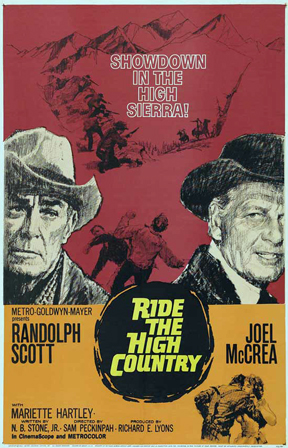
rideIt’s the turn of the 20th century and the Old West is fading into legend.  When they were younger, Steve Judd (Joel McCrea) and Gil Westrum (Randolph Scott) were tough and respect lawmen but now, time has passed them by.  Judd now provides security for shady mining companies while Gil performs at county fairs under the name The Oregon Kid.  When Judd is hired to guard a shipment of gold, he enlists his former partner, Gil, to help.  Gil brings along his current protegé, Heck Longtree (Ron Starr).
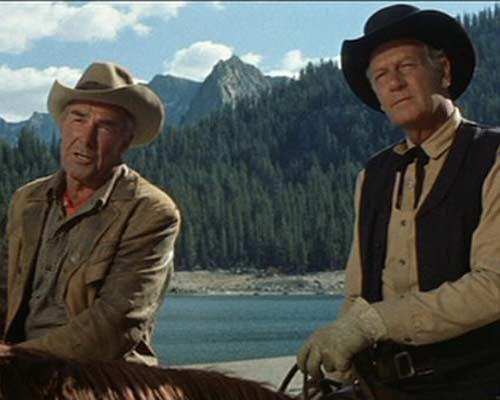
On their way to the mining camp, they spend the night at the farm of Joshua Knudsen (R.G. Armstrong) and his daughter, Elsa (Mariette Hartley).  Elsa is eager to escape her domineering father and flirts with Heck.  When they leave the next morning, Elsa accompanies them, planning on meeting her fiancée, Billy Hammond (James Drury), at the mining camp.

When they reach the camp, they meet Bill and his four brothers (John Anderson, L.Q. Jones, John Davis Chandler, and the great Warren Oates).  Billy is a drunk who is planning on “sharing” Elsa with his brothers.  Gil, Judd, and Heck rescue Elsa and prepare for a final confrontation with the Hammond Brothers.  At the same time, Gil and Heck are planning on stealing the gold, with or without Judd’s help.

Ride the High Country was actually Sam Peckinpah’s second film but it’s the first of his films to truly feel like a Sam Peckinpah film.  (For his first film, The Deadly Companions, Peckinpah was largely a director-for-hire and had no say over the script or the final edit.)  Peckinpah rewrote N.B. Stone’s original script and reportedly based the noble Steve Judd on his own father.  All of Peckinpah’s usual themes are present in Ride the High Country, with Judd and, eventually, Gil representing the dying nobility of the old west and the Hammond brothers and the greedy mining companies representing the coming of the “modern” age.  Ride The High Country‘s final shoot-out and bittersweet ending even serve as a template for Peckinpah’s later work in The Wild Bunch.

Much like the characters they were playing, Randolph Scott and Joel McCrea were two aging veterans on the verge of retirement.  For these two aging stars, who had starred in countless westerns before this one, Ride The High Country would provide both fitting farewell and moving tribute.  This would be the last chance that either of them would have to appear in a great movie and both of them obviously relish the opportunity.  The best moments in the film are the ones where Judd and Gil just talk with the majestic mountains of California in the background.

Among the supporting cast, Ron Starr and Mariette Hartley are well-cast as the young lovers but are never as compelling as Gil or Judd.  Future Peckinpah regulars R.G. Armstrong, L.Q. Jones, and Warren Oates all make early appearances.  Seven years after playing brothers in Ride the High Country, L.Q. Jones and Warren Oates would both appear in Peckinpah’s most celebrated film, The Wild Bunch.

The elegiac and beautifully-shot Ride The High Country was Sam Peckinpah’s first great film and it might be his best.

Randolph Scott and Joel McCrea in Ride The High Country

Randolph Scott and Joel McCrea in Ride The High Country

Film Review: China 9, Liberty 37 (1978, directed by Monte Hellman)


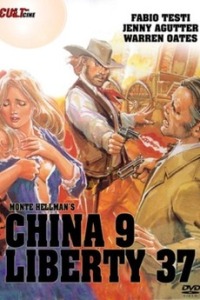
c9l37Directed by the legendary Monte Hellman, China 9, Liberty 37 is a revisionist take on the western genre.  Fabio Testi plays Clayton Drumm, a legendary gunslinger who is about to be hung for murder.  At the last minute, men from the railroad company show up and arrange for Clayton be released.  They want him to kill a rancher who is refusing to sell his land.  Clayton agrees but, before he leaves for his mission, he gives a brief interview to a writer from “out East.”  Cleverly, the writer is played by director Sam Peckinpah, to whose films China 9, Liberty 37 clearly owes a huge debt.

After telling the writer that his eastern readers have no idea what the west is truly like, Clayton rides out to the ranch.  Along the way, he gets directions from a nude lady (Jenny Agutter) who is swimming in a nearby stream.  When Clayton reaches the ranch, he meets his target.  Matthew Sebanek (Warren Oates) is himself a former gunslinger who used to kill people for the railroads.  From the minute they meet, Matthew knows who Clayton is and why he is there.  Both Clayton and Matthew have grown weary of killing and, instead of having the expected gunfight, they instead become fast friends.  Matthew allows Clayton to stay at the ranch and introduces him to his wife, Catherine, who it turns out was the same woman who Clayton talked to earlier.

China9Liberty37-02Catherine loves Matthew but resents his rough ways and feels that he treats her like property.  One night, she and Clayton go for a nude swim and then make love.  When Matthew finds out, he strikes his wife and, in self-defense, she stabs him in the back.  Believing Matthew to be dead, she and Clayton go on the run.

Matthew is not dead and, once he’s recovered from being stabbed, he and his brothers set off to track down the two lovers.  While Matthew chases after Clayton, he is being pursued by Zeb (Romano Puppo), another gunslinger who has been hired by the railroad to kill both Matthew and Clayton.

ftAs a western, China 9, Liberty 37 is more interested in its characters than in the usual gunfights.  There are no traditional heroes or villains and Monte Hellman emphasizes characterization over action.  Even while he is relentlessly pursuing Clayton and Catherine, Matthew admits that he does not blame Catherine for leaving him.  As for Clayton and Catherine, they are both consumed by guilt over their affair.  This is one of the few westerns where the main character often refuses to fire his gun.

As Clayton, Fabio Testi is stiff and inexpressive, but Jenny Agutter and Warren Oates are terrific.  Though their films were never as critically or financial successful, Warren Oates and Monte Hellman had as strong of a director/actor partnership as Martin Scorsese and Robert De Niro.  China 9, Liberty 37 was the fourth and final movie that Monte Hellman and Warren Oates made together.  It was also Oates’s last western before his untimely death in 1982.

china 9 oatesDirector Monte Hellman is as well-known for the films he did not get to make as for the ones he actually did make.  (Originally, Quentin Tarantino wanted Hellman to director Reservoir Dogs.  When Tarantino changed his mind and decided to direct it himself, Hellman was relegated to serving as executive producer.  A lot of recent film history would be very different if Tarantino and Hellman had stuck to the original plan.)  Like a lot of the films that Hellman actually did get to make, China 9, Liberty 37 was only given a sparse theatrical release and was often shown in a heavily edited version.  It has only been recently that the full version of China 9, Liberty 37 has started to show up on TCM.  It is an interesting revisionist take on the western genre and must see for fans of Monte Hellman, Jenny Agutter, and Warren Oates.
china9


Film Review: Crooks and Coronets (1969, directed by Jim O’Connolly)


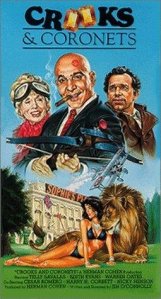
Crooks and CoronetsAfter taking off the month of October, I am now back on my Warren Oates kick.  The latest Oates film that I watched was Crooks and Coronets, a heist comedy that stars Oates and Telly Savalas as two career criminals plotting a robbery in England.
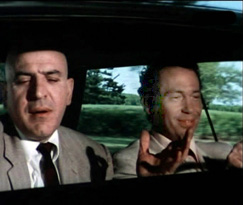
Crooks and Coronets starts with Herbie Haseler (Telly Savalas) getting released from prison.  Waiting for him is his partner-in-crime, Marty Miller (Warren Oates).  Because Herbie wants to go straight and doesn’t want to do any more time, he is not happy to learn that Marty stole a car just so he could pick Herbie up from prison.  Leaving the car behind, Herbie and Marty walk to a meeting with their old boss, New York gangster Nick Marco (Cesar Romero).  Nick reminds Herbie and Marty that they owe him money and tells them that they can not go straight until they pay him back.  Nick sends them to England to rob the estate of Lady Sophie Fitzmore (Edith Evans).

Crooks Coronets 03After arriving in the UK and meeting with Nick’s English counterpart, Frank Finley (Harry H. Corbett), Herbie and Marty infiltrate the Fitzmore estate.  Marty pretends to be a security expect while Herbie says that he is a librarian who is interested in cataloguing the Fitzmore library.  However, once they meet the kindly and eccentric Lady Sophie, neither one of them can bring themselves to rob her.  Instead, Marty helps Sophie fly an old World War I airplane while Herbie turns Fitzmore mansion into a tourist attraction.  When Nick and Frank show up and demand to know what the hold up is, Herbie and Marty have to find a way to stop the robbery.
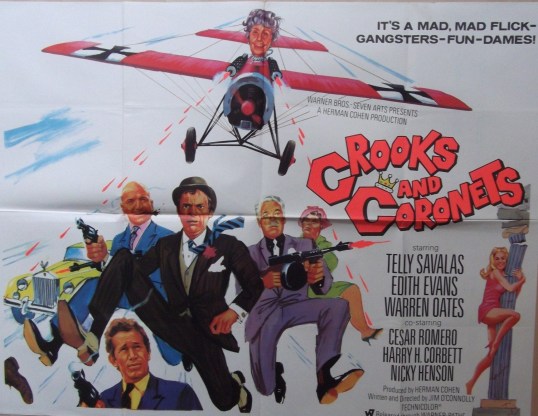
Crooks and Coronets is never exactly memorable but it is amusing throughout.  The main reason to watch it is for the performances of Edith Evans, Telly Savalas and Warren Oates.  Though this is not one of Warren’s better-known films, it was a personally significant one for him.  It was while filming Crooks and Coronets that Oates met British actress Vickery Turner.  Turner played the role of Annie, a tour guide who helps to protect the mansion from Nick and Harry.  She did not have a big role but she did look great in a miniskirt.  She and Warren Oates were married in 1969 and, after they were divorced in 1974, she went on to have a very successful career as a novelist.

crooks-and-coronets-original-uk-quad-poster-telly-savalas-cesar-romero-69-1246-p

Film Review: Barquero (1970, directed by Gordon Douglas)


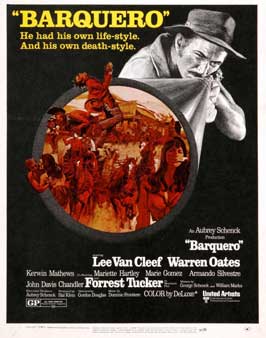
barquero-movie-poster-1970-1010695655Travis (Lee Van Cleef) is a former gunslinger who now makes his living taking settlers across a river on his small barge.  When we first meet him, he is telling a child to shut up and stop bothering him while he is guiding the barge.  He depends on the settlers on the other side of the river for his livelihood and they depend on him for transportation but he doesn’t like them and they don’t like him.  Travis only cares about two people, his Mexican lover, Nola (Maria Gomez) and an eccentric hunter named Mountain Phil (Forrest Tucker).

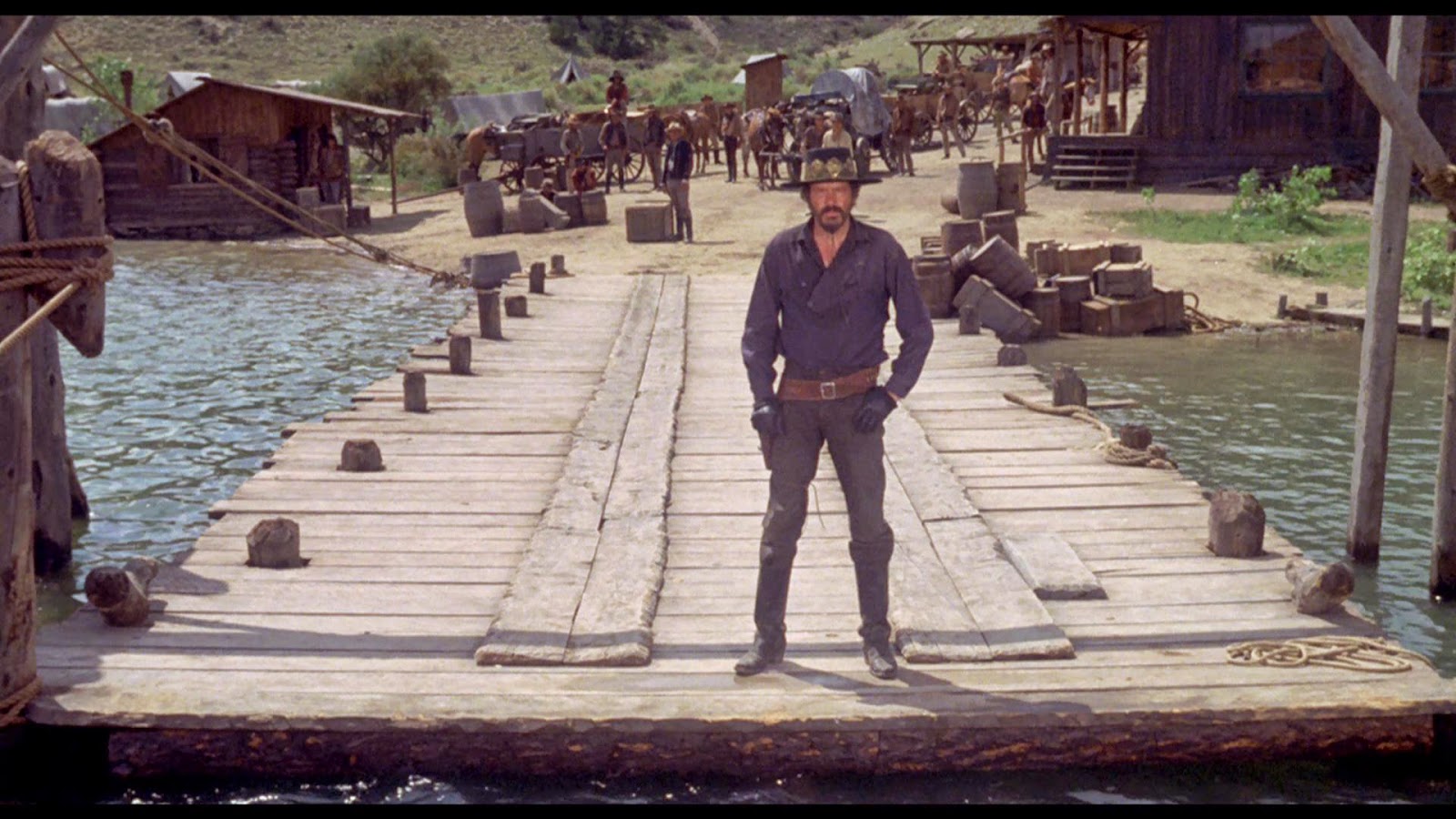
After stealing a shipment of silver, outlaw Jake Remy (Warren Oates) and his army of mercenaries need to cross the river to escape into Mexico.  To prevent anyone from following, they plan to destroy the barge afterward.  However, Travis and Phil find out that Remy is on the way and take the barge to the other side of the river.  When Jake and his gang arrive, a tense stand-off ensues, with the outlaws on one side of the river and Travis and the settlers trapped on the other.

Though Barquero was directed by the veteran American director Gordon Douglas (Douglas’s best known film is the 1950s giant ant film, Them!),  it was heavily influenced by contemporary Spaghetti Westerns and Sam Peckinpah’s The Wild Bunch.  This can be seen in both its graphic violence and in the casting of Lee Van Cleef and Warren Oates in the leading roles.

Travis was a perfect role for Van Cleef, a talented actor who was ignored by Hollywood until he found fame playing ruthless villains in European westerns.  Surly and unsmiling, Travis may seem like an unlikely hero but, like many of the best Spaghetti westerns, there are no traditional good guys in Barquero.  Travis is more interested in saving his boat than protecting the settlers.  He is a hero of circumstance.

As Jake, Warren Oates is a great villain.  In his very first scene, he and a prostitute watch as his gang massacre the citizens of a small town.  When the prostitute asks if she can come with them, Jake calmly replies, “I don’t think so” and shoots her dead.  Stuck on his side of the river, Jake smokes the local weed and starts to have violent hallucinations.  Soon, he is shooting bullets into the river.

Also doing good work are Forest Tucker as Mountain Phil and Kerwin Mathews.  Mathews, who is best remembered for starring in The 7th Voyage of Sinbad, plays the Marquette, a disgraced French nobleman who has started a second life as Jake Remy’s right-hand man.

Barquero starts with a bang but it struggles to keep up the momentum over its entire running time.  The opening shoot out is exciting but things slow down almost too much during the stand-off at the river.  It is an interesting but flawed western that deserves to be better known than it is and worth watching to see Lee Van Cleef and Warren Oates at their best.

Barquero-Oates-on-dock

Film Review: Race With The Devil (1975, directed by Jack Starrett)


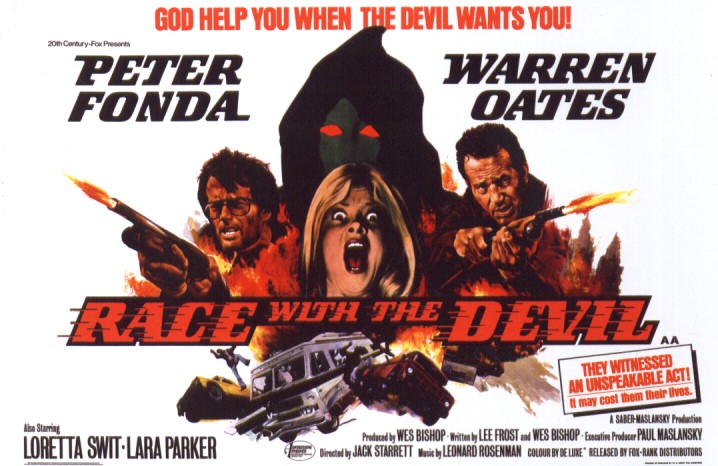
220px-RaceWithTheDevilWarren Oates and Peter Fonda versus …. SATAN!

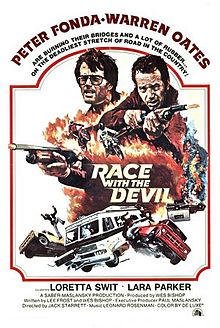
Roger (Peter Fonda) and Frank (Warren Oates) are lifelong friends and business partners who, along with their wives Kelly (Lara Parker) and Alice (Loretts Swit), are planning on taking the “best damn vacation we ever had.”  Traveling to Colorado in Frank’s RV, they decide to camp for a night next to a river.  Not only do Frank and Roger witness what appears to be a human sacrifice but they also have to run for their lives when they are spotted.  The local sheriff (R.G. Armstrong) tells them that they probably just saw a bunch of hippies killing an animal but Peter Fonda knows hippies and those were not hippies.  Taking some blood-stained dirt so it can be analyzed by the authorities, Roger and Frank try to drive on but find themselves being pursued by Satanists.

A relentless and entertaining B-movie, Race With The Devil is a hybrid of Rosemary’s Baby, Smokey and the Bandit, and Easy Rider, with some Parallax View-style paranoia mixed in as well.  Eventually, it seems as if everyone in rural Texas — from the sheriff to the gas station attendant to the residents of an RV park where our heroes try to spend the night — is a Satanist.  (Even a wrecked school bus turns out to just be an excuse to get the RV to slow down so the Satanic rednecks can attack, leading to Warren Oates’s classic line, “I don’t believe in a school bus on Sunday.”)

A big part of the fun of Race With The Devil is getting to watch Peter Fonda and Warren Oates acting opposite each other.  (A lot of drive-in patrons probably left Race With The Devil with a crush on the lovely Lara Parker as well.)  Friends both on and off-screen (Oates previously co-starred in Fonda’s directorial debut, The Hired Hand), Fonda and Oates are a lot of fun to watch playing off of each other in Race With The Devil, with Warren Oates’s natural intensity providing a good contrast to Fonda’s laid back style.

It may not rank up there with the movies that he appeared in for Sam Peckinpah and Monte Hellman but Race With The Devil is still one of Warren Oates’s most entertaining films.

race-with-the-devil-1

Film Review: Prime Time (1977, directed by Bradley R. Swirnoff)


Prime TimeThe great character actor Warren Oates appeared in a lot of fairly obscure movies but none are as obscure as Prime Time.

With a running time of barely 70 minutes, Prime Time is a comedic sketch film that was meant to capitalize on the then-recent success of The Groove Tube, Tunnelvision, The Kentucky Friend Movie, and the first season of Saturday Night Live.  According to the Unknown Movies Page, Prime Time was financed independently and was picked up for distribution by Warner Bros.  After the Warner execs saw the finished film, they decided it was unreleasable so the film’s production team sold the film to Cannon Pictures, who were famous for being willing to release anything.  The movie played in a few cities under the terrible title American Raspberry and then went straight to VHS obscurity.

Sketch comedies are usually hit-and-miss and Prime Time is definitely more miss than hit.  The majority of the film is made up of commercial parodies but, since most of the commercials being parodied are no longer on the air, the humor has aged terribly.  There is also a wrap-around story.  The President (George Furth) and a general (Dick O’Neill) try to figure out where the commercial parodies are coming from and stop them before the broadcast leads to a riot.   There are a few funny bits (including Harry Shearer as a stranded trucker looking for a ride and Kinky Friedman singing a song about “Ol’ Ben Lucas who has a lot of mucus”) but, for the most part, the film is epitomized by a skit where people literally get shit dumped on their head.  The film’s opens with an incredibly racist commercial for Trans Puerto Rican Airlines and it’s all downhill from there.

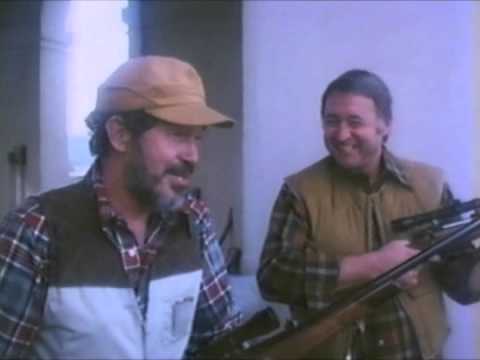
As for Warren Oates, he appears in an early skit.  He and Robert Ridgely (best known for playing Col. James in Boogie Nights) play hunters who take part in the Charles Whitman Celebrity Invitational, climbing to the top of the Tower on the University of Texas campus and shooting at the people below.  It’s even less funny now than it probably was in 1977.

How did Warren Oates end up in a movie like Prime Time?  Even great actors have bills to pay.  As for Prime Time, it is the one Warren Oates film that even the most dedicated Warren Oates fan won’t regret missing.

Warren Oates and Robert Ridgely in Prime Time

Warren Oates and Robert Ridgely in Prime Time

Film Review: Kid Blue (1973, directed by James Frawley)


KidBlueFor the past week and a half, I have been on a major Warren Oates kick.  The latest Oates film that I watched was Kid Blue, a quirky western comedy that features Warren in a small but key supporting role.

Bickford Warner (Dennis Hopper) is a long-haired and spaced-out train robber who, after one failed robbery too many, decides to go straight and live a conventional life.  He settles in the town of Dime Box, Texas.  He starts out sweeping the floor of a barber shop before getting a better job wringing the necks of chickens.  Eventually, he ends up working at the Great American Ceramic Novelty Company, where he helps to make ashtrays for tourists.

He also meets Molly and Reese Ford (Lee Purcell and Warren Oates), a married couple who both end up taking an interest in Bickford.  Reese, who ignores his beautiful wife, constantly praised Greek culture and insists that Bickford take a bath with him.  Meanwhile, Molly and Bickford end up having an affair.

Bickford also meets the local preacher, Bob (Peter Boyle).  Bob is enthusiastic about peyote and has built a primitive flying machine that he keeps in a field.  The town’s fascist sheriff, Mean John (Ben Johnson), comes across Bob performing a river baptism and angrily admonishes him for using “white man’s water” to baptize an Indian.

Bickford attempts to live a straight life but is constantly hassled by Mean John, who suspects that Bickford might actually be Kid Blue.  When Bickford’s former criminal partner (Janice Rule) shows up in town and Molly announces that she’s pregnant, Bickford has to decide whether or not to return to his old ways.

Kid Blue is one of a handful of counterculture westerns that were released in the early 70s.  The film’s biggest problem is that, at the time he was playing “Kid” Blue, Dennis Hopper was 37 and looked several years older.  It’s hard to buy him as a naïve naif when he looks older than everyone else in the cast.  As for Warren Oates, his role was small but he did great work as usual.  Gay characters were rarely presented sympathetically in the early 70s and counter-culture films were often the worst offenders.  As written, Reese is a one-note (and one-joke) character but Warren played him with a lot of empathy and gave him a wounded dignity that was probably not present in the film’s script.

Kid Blue plays out at its own stoned pace, an uneven mix of quirky comedy and dippy philosophy.  Still, the film is worth seeing for the only-in-the-70s cast and the curiosity factor of seeing Dennis Hopper in full counterculture mode, before he detoxed and became Hollywood’s favorite super villain.

o_kid-blue-dvd-dennis-hopper-warren-oates-5cdc