April Noir: Thief (dir by Michael Mann)


1981’s Thief tells the story of Frank (James Caan).

Frank is a professional diamond thief, one of the best in the business.  He’s so cool that he even has his own Tangerine Dream soundtrack.  After doing a stint in prison, Frank lives his life very carefully and with discipline.  He’s determined not to return to prison.  His mentor (played by Willie Nelson) is still behind bars and will probably die there.  In fact, Frank has even found himself thinking about abandoning his criminal lifestyle.  He’s got two front businesses, both of which are doing well.  (Frank’s used car lot looks like some sort of alien world.)  He’s fallen in love with a cashier named Jessie (Tuesday Weld) and it’s starting to seem like now would be a good time to settle down and become a family man.  The only problem is that Frank is working for Leo (Robert Prosky) and Leo has absolutely no intention of allowing Frank to walk away.  As Leo puts it, Frank belongs to him.  That’s not a smart thing to say to someone like Frank.

Frank’s an interesting character.  He’s the film’s hero, not because he’s a good guy but because he’s a smidgen better than most of the other bad guys.  He’s a professional, one who goes out of his way avoid unnecessary complications.  When we see him on the job, it’s impossible not to admire just how good he is at stealing stuff.  When he uses a blowtorch to break into a store or a safe, the screen is full of sparks and, for a few minutes, Frank looks like some sort of cosmic super hero brought to life.  We admire Frank but we discover early on that he’s willing to get violent.  He’s willing to pull a gun and threaten his way out of a situation.  Frank is loyal.  He visits his mentor in prison.  He takes care of his partner-in-crime, Barry (Jim Belushi, making his film debut).  He truly loves Jessie.  But, at heart, he’s a criminal who doesn’t hesitate to pull the trigger when he has to.  The question the film asks is whether one can just go straight, after years of breaking the law and living in the shadows.  Can Frank abandon the lifestyle, even for love?  Or is he destined to always be a thief?

Thief was Michael Mann’s feature film debut.  (The Jericho Mile was Mann’s directorial debut but it was made for television.)  Thief is full of the usual Mann themes and also Mann’s signature style, showing that Mann knew exactly what type of films he wanted to make from the start of his career.  The nights are full of shadows.  The days are deceptively calm.  The neon of Frank’s car lot glows like another dimension.  The final bloody shoot out takes place at night, in the type of suburban neighborhood in which most people would probably love to live.  And holding the film together is James Caan, giving a coolly centered performance as a man who has learned to hold back his emotions and who won’t be controlled by anyone.  Halfway through the film, Caan delivers a seven-minute monologue about life in prison and it’s an amazing moment, one in which Caan shows just how good of an actor he truly was.  Thief is an effective and stylish neo-noir, one that sticks with you as the end credits roll.
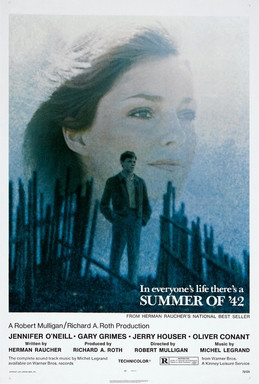
 

Back to School Part II #4: Summer of ’42 (dir by Robert Mulligan)


Summer_of_'42_POSTER

Originally, I was going to finish up the first day of my back to school reviews by talking about A Clockwork Orange.  I figured that, since the second film I reviewed was Andy Warhol’s Vinyl, it would just make sense that the fourth film would A Clockwork Orange.

But, I don’t know.  As I sat down and started to work on my fourth review, I realized that I’m not quite ready to write about A Clockwork Orange.  Instead, I’d rather hold off on that until tomorrow.  So, instead, I’m going to talk about Summer of ’42, another coming-of-age film that came out the same year.

That’s right — A Clockwork Orange and Summer of ’42 both came out in 1971 but — in content and sensibility — they might as well exist in different universes.  In fact, the only thing that they have in common is that they both tend to show up on TCM fairly frequently and that they’ve both influenced countless other films.

Speaking of TCM, that’s where I first saw Summer of ’42.  I have to admit that I’m writing this review from memory and that may not be the best way to review a film.  I saw Summer of ’42 about four months ago and, at the time, I thought it was a well-done but predictable little movie.  I even took notes for a future review but I didn’t get around to writing that review because … well, at the time, it just seemed like there wasn’t a lot to say about it.  Summer of ’42 is a sweet film but almost everything about it is right on the surface.  What you see is what you get.  I’m not surprised to discover that it was the 6th highest grossing film of 1971.  In a year that saw not only A Clockwork Orange but The Last Picture Show, The French Connection, Brother John, Billy Jack, Carnal Knowledge, Dirty Harry, Harold and Maude, Let’s Scare Jessica To Death, Klute, Straw Dogs, Pretty Maids All In A Row, and The Zodiac Killer, audiences were probably relieved to see a film that was neither violent, morally ambiguous, nor apocalyptic.

Instead, Summer of ’42 is a coming-of-age story that was specifically crafted to appeal to a world-weary audience’s nostalgia for the simple and carefree days of World War II.  This is one of those films where an older narrator continually reassures us that we’re seeing the most defining moment of his youth and all of the pretty images are in soft focus.  Hermie (Gary Grimes), Oscy (Jerry Houser), and Benjie (Oliver Conant) are three fifteen year-olds, all of whom are spending their summer on Nantucket Island.  Benjie is obsessed with sex but he’s nerdy.  Oscy is obsessed with sex but he’s a jerk.  Hermie is obsessed with sex but he’s the narrator so we already know that he’s too sensitive to lose his virginity to any girl his own age.

Luckily, there’s a woman in her 20s who is living in a nearby beach house.  Dorothy (Jennifer O’Neill) is beautiful but she’s married.  However, her husband’s a soldier and it is 1942 so, pretty soon, he’s out of the picture.  Hermie develops a mad crush on her and then, luckily for him, her husband dies and she spends a night teaching him the ways of love.  The next morning, she vanishes but leaves Hermie a note, telling him that she will never forget him and that it’s up to him to decide what their night together meant.

(Hermie never gets around to telling us what their night together meant so I guess it’s up to us to decide.  Personally, I just hope Hermie was careful who he told because, nowadays, a 23 year-old can get in a lot of legal trouble if she’s caught having sex with a 15 year-old.  Maybe things were different in 1942…)

As I said before, my initial response was that Summer of ’42 was sweet but predictable.  And that’s the way I still feel about it.  It was well-acted, well-filmed, and Jennifer O’Neill was amazingly beautiful but there was still something about Summer of ’42 that kind of bothered me.  We never really got to know who Dorothy was.  Her entire character was defined by her one night with Hermie.  Yes, I do understand that was kind of the point because the story was being told exclusively from Hermie’s point of view.  But it still bothered me.  Beyond being beautiful, tragic, and ultimately available, who was Dorothy?

But really, it wasn’t just something about the Summer of ’42 that was bothering me.  Instead, it was something about the coming-of-age genre in general.  I have lost track of how many nostalgic films and TV shows that I have seen that feature a narrator talking about the summer that he “became a man.”  It’s amazing how many awkward teenage boys apparently lost their virginity to a beautiful older woman who promptly vanished afterwards.  If, as has been recently suggested, I spent next summer in a rented beach house, am I going to be obligated to be the first lover of every 15 year-old, aspiring writer who happens to come wandering down the beach?  That could be time consuming, depending on how popular the beach is.

I guess what I’m saying is that perhaps somebody needs to remake Summer of ’42 and tell it from Dorothy’s point of view.

Just a thought.