Welcome to Retro Television Reviews, a feature where we review some of our favorite and least favorite shows of the past! On Mondays, I will be reviewing Miami Vice, which ran on NBC from 1984 to 1989. The entire show can be purchased on Prime!
This week, Vice helps the communists once again.
Episode 5.5 “Borrasca”
(Dir by Vern Gillum, originally aired on December 9th, 1988)
Martillo Borrasca (Juan Fernandez) is a drug dealer who uses the money to fund anti-communist revolutionaries in his native South American country. Castillo, Tubbs, and Switek want to arrest him, especially after Barrisco and his men use a machete to hack an undercover cop to death. CIA agent Reese (Brion James) wants the Vice Squad to lay off Barrisco because Barrisco is working to overthrow a communist.
Personally, I’m on Reese’s side. Sure, Borrasca is a bad guy and he deserves to be punished for his crimes but the communist dictators in South and Central America were just as bad. Just because they quoted Marx and spouted a lot of anti-imperialist propaganda, that didn’t change the fact that they oppressed their own people and many of them were involved in the drug trade themselves. This episode aired long before the rise of Hugh Chavez but one need only look at the state of Venezuela today to see that the CIA perhaps had a point.
Castillo, of course, doesn’t see it that way. He assassinated Barrisco while the latter is trying to make an escape via helicopter. “I have a code,” Castillo says. Really, Castillo? That’s your code? Assassinate a drug dealer but don’t do anything about the dictators who would have allowed the Russians to plant nuclear missiles in their countries?
This episode was actually pretty routine. How many times have we been through the whole “The Vice Squad is after a drug dealer who has friends in the government” thing? On the one hand, I always appreciate Miami Vice’s cynicism about the War on Drugs. On the other hand, it’s frequent defense of communism has always been one of the show’s more glaring blind spots. Communists make just as much money from the drug trade as capitalists.
Crockett was not in this episode. Instead, Tubbs worked with Switek. It was nice to see Switek get to more than usual but, in the end, this was definitely a Castillo episode.
Welcome to Retro Television Reviews, a feature where we review some of our favorite and least favorite shows of the past! On Mondays, I will be reviewing Miami Vice, which ran on NBC from 1984 to 1989. The entire show can be purchased on Prime!
This week, Crockett and Tubbs battle some corrupt cops.
Episode 4.18 “Badge of Dishonor”
(Dir by Richard Compton, originally aired on March 18th, 1988)
Badge of Dishonor opens with Underworld’s Glory, Glory playing on the soundtrack. It’s an early electronic tune, one that isn’t quite EDM but still definitely shows hints of what Underworld and a lot of other synth-pop bands would eventually become. Usually, that would be pretty cool but, unfortunately, the song also has a gospel music feel and I personally gospel music to be excruciatingly dull.
That’s certainly the case here, where the music is played over the opening teaser and the gospel sounds robs it of whatever momentum it might have had. The episode opens with a drug deal gone wrong. Tubbs is working undercover when he and his contacts are suddenly busted by four cops, who kill the real dealers and then steal the drugs and the money. Tubbs barely manages to escape with his life. It should have been an exciting opening but it had a “been there, done that” sort of feel to it. This isn’t the first Miami Vice episode to feature an drug deal gone wrong and it’s not even the first to feature corrupt cops.
The cops in question are all originally from Cuba. Back in Castro’s Hellhole, they were all members of the same street gang. After coming to Miami and building up lengthy juvenile records, the four men were subsequently hired after a race riot (a real-life event that Castillo discusses in his terse manner) led to demands for a more racially-balanced police force. Because the force desperately needed some non-redneck cops, no one bothered to do an extensive background check on the four men when they applied to be cops. Tubbs comments that the corrupt cops are setting “minority hiring back 400 years.”
Crockett and Tubbs’s investigation at first centers on a lieutenant (Reni Santoni) who they think is crooked because he lives on a yacht. The lieutenant explains that he married well and that he suspects the same four cops as Crockett and Tubbs. The lieutenant is subsequently murdered by the cops. It turns out that the corrupt cops are getting their information from an undercover detective named Madison Stone (Michele Shay). Stone has spent the past few years deep undercover, living in a homeless community on the riverfront. Stone is not herself corrupt. She’s just been manipulated and is now in an impossible situation. At least, that’s the way Tubbs views it. Myself, I just felt that Madison Stone appeared to be as bad at working undercover as Sonny Crockett.
Technically, this was a well-made episode. The main problem is that the plot itself just felt so familiar and the four corrupt cops were not particularly interesting. Compared to the usual flamboyant Miami Vice criminals, the cops were pretty bland. In typical Miami Vice fashion, it ended on a dark note. The corrupt cops were defeated but both Madison Stone and their lieutenant were dead. There’s no happy endings in Miami.
— Phillip Jeffries (David Bowie) in Twin Peaks: Fire Walk With Me (1992)
Even among fans of the show, Twin Peaks: Fire Walk With Me is controversial.
If you read Reflections: An Oral History of Twin Peaks, you’ll discover that many members of the television show’s cast either didn’t want to be involved in the film or didn’t care much for it when it came out. Fearful of being typecast, Kyle MacLachlan only agreed to play Dale Cooper on the condition that his role be greatly reduced. (Was it that fear of being typecast as clean-cut Dale Cooper that led to MacLachlan later appearing in films like Showgirls?) Neither Lara Flynn Boyle nor Sherilyn Fenn could work the film into their schedules.
When Twin Peaks: Fire Walk With Me premiered at Cannes, it was reportedly booed by the same critics who previously applauded Lynch’s Wild at Heart and who, years later, would again applaud Mulholland Drive. When it was released in the United States, the film was savaged by critics and a notorious box office flop. Quentin Tarantino, previously a fan of Lynch’s, has been very outspoken about his hatred of Twin Peaks: Fire Walk With Me. When I first told people that we would be looking back at Twin Peaks for this site, quite a few replied with, “Even the movie?”
And yet, there are many people, like me, who consider Twin Peaks: Fire Walk With Me to be one of David Lynch’s most haunting films.
It’s also one of his most straight forward. Twin Peaks: Fire Walk With Me is a prequel, dealing with the events leading up to the death of Laura Palmer. Going into the film, the viewer already knows that Laura Palmer (Sheryl Lee) is full of secrets. They know that she is using drugs. They know that she is dating Bobby (Dana Ashbrook), while secretly seeing James (James Marshall). They know about her diary and her relationship with the reclusive Harold (Lenny Von Dohlen). They know that she is a friend to innocent Donna Hayward (Moria Kelly, somewhat awkwardly taking the place of Lara Flynn Boyle). Even more importantly, they know that she has spent the last six years of her life being abused by BOB (Frank Silva) and that BOB is her father, Leland Palmer (Ray Wise). The viewer starts the story knowing how it is going to end.
Things do get off to a somewhat shaky start with a nearly 20-minute prologue that basically plays like a prequel to the prequel. Theresa Banks, who was mentioned in the show’s pilot, has been murdered and FBI director Gordon Cole (David Lynch) assigns agents Chester Desmond (Chris Isaak) and Sam Stanley (Kiefer Sutherland) to investigate. Chester and Sam’s investigation basically amounts to a quick reenactment of the first season of Twin Peaks, with the agents discovering that Theresa was involved in drugs and prostitution. When Chester vanishes, Dale Cooper is sent to investigate. Harry Dean Stanton shows up as the manager of a trailer park and David Bowie has an odd cameo as a Southern-accented FBI agent who has just returned from the Black Lodge but otherwise, the start of the film almost feels like a satire of Lynch’s style.
But then, finally, we hear the familiar theme music and the “Welcome to Twin Peaks” sign appears.
“And the angel’s wouldn’t help you. Because they’ve all gone away.”
— Laura Palmer (Sheryl Lee), Twin Peaks: Fire Walk With Me (1992)
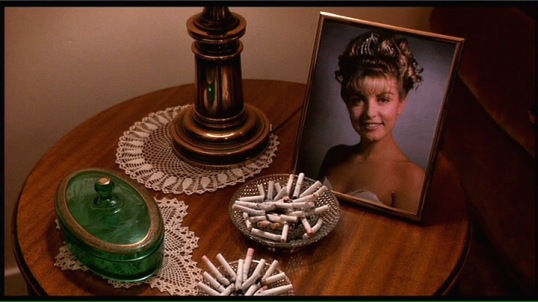
A year has passed since Theresa Banks was murdered. The rest of the film deals with the final few days of the life of doomed homecoming queen Laura Palmer. Laura smiles in public but cries in private. She is full of secrets that she feels that she has to hide from a town that has literally idolized her. She has visions of terrifying men creeping through her life and each day, she doesn’t know whether it will be BOB or her father waiting for her at home. She knows that the world considers her to be beautiful but she also know that, within human nature, there is a desire to both conquer and destroy beauty. When she sleeps, she has disturbing dreams that she cannot understand but that she knows are important. At a time when everyone says she should be happy to alive, all she can think about is death. Everywhere she goes, the male gaze follows and everything that should be liberating just feels her leaving more trapped. For all the complaints that Twin Peaks: Fire Walk With Me is somehow too strange to be understood, it’s not a strange film at all. This is David Lynch at his most straight forward. Anyone who thinks that Laura’s story is incomprehensible has never been a 17 year-old girl.
This is the bleakest of all of David Lynch’s films. There is none of broad humor or intentional camp that distinguished the TV show. After the show’s occasionally cartoonish second season, the film served as a trip into the heart of the darkness that was always beating right underneath the surface of Twin Peaks. It’s interesting how few of the show’s regulars actually show up in Twin Peaks: Fire Walk With Me. None of the characters who represented goodness are present. There’s no Doc Hayward. No Sheriff Truman. No Deputies Andy or Hawk. No Pete Martell. No Bookhouse Boys. Scenes were filmed for some of them but they didn’t make it into the final cut because their tone did not fit with the story that Lynch was seeking to tell. The Hornes, Dr. Jacoby, Josie, none of them are present either.
Instead, there’s just Larua and her father. As much as they try to deny it, Laura knows that she is going to die and Leland knows that he is going to kill her. Killer BOB and the denziens of the Black Lodge may be scary but what’s truly terrifying is the sight of a girl living in fear of her own father. Is Leland possessed by BOB or is BOB simply his way of excusing his own actions? If not for Leland’s sickness, would BOB even exist? When Laura shouts, “Who are you!?” at the spirit of BOB, she speaks for every victim of abuse who is still struggling to understand why it happened. For all the talk of the Black Lodge and all the surreal moments, the horror of this film is very much the horror of reality. Leland’s abuse of Laura is not terrifying because Leland is possessed by BOB. It’s terrifying because Leland is her father
David Lynch directs the film as if it where a living nightmare. This is especially evident in scenes like the one where, at the dinner table, Leland switches from being kindly to abusive while Laura recoils in fear and her mother (Grace Zabriskie) begs Leland to stop. It’s a hard scene to watch and yet, it’s a scene that is so brilliantly acted and directed that you can’t look away. As brilliant as Ray Wise and Grace Zabriskie are, it’s Sheryl Lee who (rightly) dominates the scene and the rest of the film, giving a bravely vulnerable and emotionally raw performance. In Reflections, Sheryl Lee speaks candidly about the difficulty of letting go of Laura after filming had been completed. She became Laura and gave a performance that anchors this absolutely terrifying film.
“Mr. Lynch’s taste for brain-dead grotesque has lost its novelty.”
— Janet Maslin
“It’s not the worst movie ever made; it just seems to be”
— Vincent Canby
If you need proof that critics routinely don’t know what they’re talking about, just go read some of the original reviews of Twin Peaks: Fire Walk With Me.
And yet, having just rewatched the show and now the movie, I can understand why critics and audiences were baffled by this film. This is not Twin Peaks the TV show. There is no light to be found here. There is no comic relief. (Even Bobby Briggs, who had become something of a goofy anti-hero by the time the series ended, is seen here shooting a man in the head.) There is no exit and there is no hope. In the end, the film’s only comfort comes from knowing that Laura was able to save one person before dying. It’s not easy to watch but, at the same time, it’s almost impossible to look away. The film ends on Laura’s spirit smiling and, for the first time, the smile feels real. Even if she’s now trapped in the Black Lodge, she’s still free from her father.
Since this was a prequel, it didn’t offer up any answers to the questions that were left up in the air by the show’s 2nd season finale. Fortunately, those questions will be answered (or, then again, they may not be) when the third season premieres on Showtime on May 21st.



 Through the Shattered Lens