Film Review: …. And Justice For All (Dir by Norman Jewison)


First released in 1979, ….And Justice For All will always be remembered for one scene.

Yell it with me, “YOU’RE OUT OF ORDER!  THE WHOLE TRIAL IS OUT OF ORDER!  THEY’RE OUT OF ORDER!”

When attorney Arthur Kirkland (Al Pacino) starts screaming in the middle of the courtroom, it’s a cathartic moment.  We’ve spent nearly two hours watching as Arthur deals with one insane situation after another.  One of Arthur’s partners, Warren (Larry Bryggman), cares more about his car than actually delivering the right documents to a judge.  Another of Arthur’s partners, Jay (Jeffrey Tambor), has a nervous breakdown and, after shaving his head, ends up throwing cafeteria plates at people in the courthouse.  Arthur has three clients, one of whom is indigent, one of whom is innocent, and one of whom is a wealthy and despised judge (John Forsythe) who has been accused of a rape that Arthur suspects he committed.  The system offers no mercy for Arthur’s innocent (or, at the very least, harmless) clients while going out of it’s way to defend the judge.  Meanwhile, another judge (Jack Warden), is driven to take suicidal risks, like flying a helicopter until it runs out of fuel and comes down in a nearby harbor.  The assistant district attorney (Craig T. Nelson) only cares about his political ambitions and finally, after one incident after another, Arthur snaps.  And it’s cathartic because we’re all on the verge of snapping as well.

That final moment, with its signature Al Pacino rant, is such a strong and iconic scene that it’s easy to forget that the film itself is actually rather uneven.  The script, by Barry Levinson and Valerie Curtin, owes a good deal to the work of Paddy Chayefsky.  Just as Chayefsky often wrote about men being driven mad by institutional failure, ….And Justice For All features character after character snapping when faced with the screwed-up realities of the American justice system.  The final “out of order” speech is obviously meant to be this film’s version of Howard Beale’s “I’m as mad as Hell and I’m not going to take it!” speech from Network and, much like George C. Scott in the Chayefsky-written The Hospital, Arthur spends a lot of time talking about what he doesn’t like about his job.  The thing that sets ….And Justice For All apart from the best works of Chayefsky is that Levinson, Curtin, and director Norman Jewison all take Arthur Kirkland at his word while one gets the feeling that Chayefsky would have been a bit more willing to call out Arthur on his self-righteousness.  Arthur has every right to be angry when Warren forgets to give a judge an important document while Warren is substituting for him in court.  At the same time, Arthur is the one who trusted Warren to do it.  In the end, the document was not about one of Warren’s client.  In fact, Warren knew absolutely nothing about the case or Arthur’s client.  The document was about Arthur’s client and Arthur was the one who decided trust someone who had consistently shown himself to not be particularly detailed-orientated.  One gets the feeling that Chayefsky would not have let Arthur off the hook as easily as Levinson, Curtin, and Jewison do.  Arthur’s perpetual indignation can sometimes be a little hard to take.

It’s a very episodic film.  Arthur goes from one crisis to another and sometimes, you do have to wonder if Arthur has ever had any human or legal interactions that haven’t ended with someone either going insane or dying.  There’s no gradual build-up to the film’s insanity, it’s right there from the beginning.  And while this means the narrative often feels heavy-handed, it also makes that final speech all the more cathartic.  It’s an uneven film and, of all of the characters that Pacino played in the 70s, Arthur is probably the least interesting.  But that final rant makes up for a lot and, fortunately, Pacino was just the actor to make it memorable.  For all it’s flaws, the final few minutes of ….And Justice For All make the film unforgettable.
 

Film Review: The Great Smokey Roadblock (dir by John Leone)


First released in 1977, The Great Smokey Roadblock tells the story of Elegant John Howard (Henry Fonda).

Elegant is not really his first name.  It’s a nickname, one to let us know that, in the world of independent truckers, John Howard was one of the good guys.  He never crashed his rig.  He never overcharged for a job.  He always arrived on time and in good shape.  John Howard was a good man but then he turned 60 and he got sick.  He spent months in the hospital, unable to work.  His truck was repossessed.  The movie starts with John sneaking out of his hospital room, stealing back his truck, and hitting the road in search of one final job.  Though John says he just wants to make enough money to get his truck back, the truth is that John is terminally ill.  If he’s going to die, he wants to die doing what he loves.  Of course, dying while driving could lead to some trouble for anyone else who happens to be on the road at the time but still, you have to respect John’s determination.  He’s a true American, independent to his core.

(My Dad occasionally made a living driving a truck so perhaps that’s why I’m partial to films like this one.)

John picks up a hitchhiker, a religious young man named Beebo Crozier (Robert Englund).  John picks Beebo up because Beebo was walking through the desert in a suit.  Beebo claims that he’s walking to Florida but John tells him that he can’t do that.  John will drive Beebo to Florida.  Of course, John also expects Beebo to pay for the gas that his truck uses because it’s not like John has any money.  At first, Beebo accuses John of cheating him.  (Henry Fonda cheating someone!?  Perish the thought!)  Soon, however, John has become Beebo’s mentor.

Everyone respects John but no one wants to hire him.  The only offer that John gets is from sleazy Charlie Le Pere (Gary Sandy), who has an agenda of his own.  Finally, John visits his old friend, Penelope (Eileen Brennan).  Penelope is a madam whose brothel has just been closed down.  John agrees to transport Penelope and her girls (including Susan Sarandon) to a new location on the East Coast.  Penelope offers to help John pay the bills.  Elegant John’s a pimp now!  (I was about to say that this seemed like an odd turn-of-events for Henry Fonda but then I remembered that he starred in The Cheyenne Social Club with Jimmy Stewart.)

There’s not really much of a plot to The Great Smokey Roadblock.  John, Beebo, Penelope, and the girls travel from one location to another.  They get thrown in jail by a notoriously corrupt deputy named Harley Davidson (Dub Taylor).  After they escape, they become minor celebrities.  Two counterculture journalists (played by Austin Pendleton and John Byner) show up and help them broadcast their story and the film comes to a halt while Pendleton and Byner exchange what sounds like improvised dialogue.  The police attempt to set up a roadblock to stop Elegant John and his Six Mystery Women.  I guess that’s the Great Smokey Roadblock of the title.

It’s a weird movie, in that the humor is extremely broad and often crude but Henry Fonda is playing a man who is not only terminally ill but who actually looks like he’s terminally ill.  (Henry Fonda himself was reportedly very ill during the filming of The Great Smokey Roadblock.)  As such, it’s a rather melancholy comedy, one in which every joke seems like it might be the last one that Elegant John will ever hear.  In the 70s, not even a trucker comedy could have a happy ending and, as such, The Great Smokey Roadblock feels like a drive-in film for the existential set.  The film’s plot doesn’t really add up to much and is full of plot holes that serve as evidence of a troubled production.  That said, there’s something rather charming about seeing a pre-Nightmare On Elm Street Robert Englund playing a gentle guy who ends up as Henry Fonda’s protegee.  Fonda and Englund play off each other well and their scenes together are the best thing about The Great Smokey Roadblock.

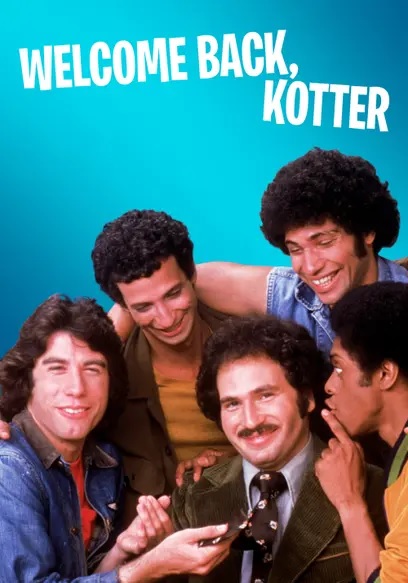
Retro Television Reviews: Welcome Back Kotter 2.9 “Hello, Ms. Chips” and 2.10 “Horshack vs. Carvelli”


Welcome to Retro Television Reviews, a feature where we review some of our favorite and least favorite shows of the past!  On Saturdays, I will be reviewing Welcome Back Kotter, which ran on ABC  from 1975 to 1979.  The entire show is currently streaming on Tubi!

This week, Mr. Kotter gets a student teacher!

Episode 2.9 “Hello, Ms. Chips”

(Dir by Bob LaHendro, originally aired on December 2nd, 1976)

Instead of telling a joke about a relative, Gabe starts the show by coming home from shopping with Julie.  When Julie says that everyone at the store was crazy, Gabe comments that the women were all pushing and shoving and “bumping into me.”

“I’m going back tomorrow!” Gabe declares while Julie gives him a pity laugh.

At Buchanan High School, Woodman introduces Gabe to his new student teacher, Ms. Wright (Valerie Curtin).

“Ms. Wright,” Gabe says, “My mother always said I’d meet you someday.”

“Keep your sick fantasies out of this, Kotter,” Woodman replies.  “Watch her carefully, you remember what happened to the last student teacher …. she still sends me ceramic wallets from the home.”

After Woodman leaves, Gabe gets to know Ms. Wright and discovers that she’s read about the Sweathogs in her textbooks.  Gabe acknowledges that the classroom is famous and adds, “Some of our best teachers have passed through the windows.”

The Sweathogs make their arrival.  Ms. Wright observes the way that Gabe handles getting them to read their essays on what they would do if they were president and then she steps in and tries to teach while looking through her thick lesson plan.  Needless to say, the Sweathogs do not react well to that and Epstein throws a fit when Ms. Wright reads his essay (which is actually a poem) about how he would make the world a better, flower-filled place as President.  Ms. Wright runs, sobbing, from the room.

Gabe tracks Ms. Wright down to the front office, where Ms. Wright is asking Mr. Woodman what it was like when he was a teacher.  Woodman proceeds to sing Nobody Knows The Trouble I’ve Seen.

“Didn’t they have spankings in those days?” Ms. Wright asks.

“Yes,” Woodman replies, “but my students only spanked me once.”

The next day, Ms. Wright tries again.  This time, she tires to imitate Gabe’s approach and awkwardly tells Epstein, “In your mouth with a sandwich,” when he tries to apologize her.  Ms. Wright tells a series of Kotter-style jokes but her cheery delivery is all wrong.  Ms. Wright suddenly announces that Gabe’s technique isn’t right for her and that she’s just going to quit.

“You can’t quit,” Freddie says, “You’re not a lousy teacher, we’re just lousy students!”

Ms. Wright learns a valuable lesson about not teaching from the book and not trying to teach like someone else but just teaching as herself.  Ms. Wright says that she wants to tell the class about President Buchanan.

“That name sounds familiar,” Vinnie says.

This was not a bad episode.  I appreciated that Ms. Wright had to find her own style as opposed to just blindly following Gabe’s style.  Speaking of Gabe’s style, he ends the episode telling Julie about his Uncle Wilford Kotter, who was in love with an elephant.

Episode 2.10 “Horshack vs. Carvelli”

(Dir by Bob LaHendro, originally aired on December 9th, 1976)

At the apartment, Gabe calls his Uncle Herman and tells him that Julie’s going to be home in five minutes and he doesn’t have a joke to tell her.  Gabe asks if anything funny has happened in Herman’s life recently.  Herman tells Gabe about a guy who crossed an elephant and a beaver.  Herman says that he once knew a guy who was so mean that he used to train homing pigeons and then move.  Judging from the expression on Gabe’s face, Herman then proceeds to tell him something really wild.

(Julie, by the way, apparently never comes home and, therefore, does not appear in this episode.)

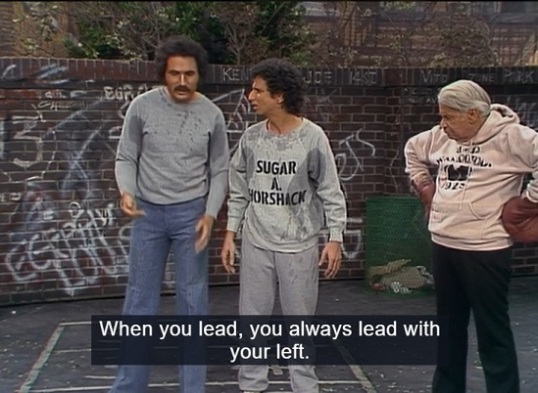
At school, the Silver Gloves Boxing Tournament is approaching and the Sweathogs are debating who will take on New Utrecht High’s most fearsome fighter, Carvelli (Charles Fleischer).  Woodman is especially concerned because he says that, in 20 years, Buchanan has never won the tournament.  When Gabe says that Bonzo Maretti won one year, Woodman replies, “Eating your opponent doesn’t count!”  Woodman wants a Sweathog to bring home a trophy.  Unfortunately, it appears that all of Woodman’s hopes rest on Arnold Horshack who is demanding to be the one to fight Carvelli.  As Horshack puts it, he’s tired of always being the one who is pushed to the side.

It’s time for a training montage, as Gabe and Woodman teach Horshack how to throw a punch.

Unfortunately, it doesn’t go well as Horshack ends up getting knocked down by Mr. Woodman.  “Maybe I should fight Carvelli!” Woodman says.

At the boxing match …. actually, I was expecting this to be one of those episodes where Horshack somehow ended up winning despite the odds but actually, he gets knocked out during the first round.  But all the Sweathogs are proud of him for having the guts to enter the ring so it’s a bit of a personal victory for him.  Plus, Gabe tells him a joke about his Uncle Maxie Kotter.

Yay!  Horshack finally won some self-respect!  Horshack was often the most cartoonish thing about this show and it’s rare that there was ever anything subtle about Ron Palillo’s performance but he deserves some credit for his work on this episode.  He revealed that, beneath the weird façade, Horshack was just as vulnerable and insecure as all the rest of the Sweathogs.  He didn’t win the fight but he won the audience’s heart and good for him!

Next week: Epstein is caught smoking!