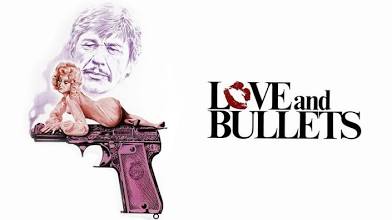
Brad’s “mini-review” of LOVE AND BULLETS (1979), starring Charles Bronson! 


Charles Bronson is an Arizona cop who goes to Switzerland to bring back a gangster’s girlfriend (Jill Ireland). The gangster (Rod Steiger) sends a hitman (Henry Silva) to kill her so she can’t tell his crime secrets to the authorities.  

This isn’t one of Bronson’s best films, but it’s still a fun movie to watch on a chilly, rainy day. There are some good action scenes set in various cold & snowy European locations. This is Bronson in “Bond” mode which is kind of fun and different. And what can you say about a stuttering Rod Steiger screaming at his advisors about the meaning of “love.” It’s fun stuff when you like Steiger as much as I do. I do deduct half a star because Steiger gets so mad at one point that he turns over a table with some of the biggest, most scrumptious looking shrimp I’ve ever seen. That was completely uncalled for and wasteful, but not quite as wasteful as Bronson and Henry Silva in the same movie without an epic battle of some sort. The fact that they didn’t fight it out on the Matterhorn itself can only be described as a missed opportunity. 

Days of Paranoia: The Anderson Tapes (by Sidney Lumet)


In 1971’s The Anderson Tapes, Sean Connery stars as Duke Anderson.

Duke is a career criminal, a safecracker who has just spent ten years in prison.  He’s released, alongside Pops (Stan Gottlieb), who spent so much time behind bars that he missed two wars and the Great Depression, and the quirky Kid (Christopher Walken, making his film debut).  Duke immediately hooks up with his former girlfriend, Ingrid (Dyan Cannon), and decides to rob the luxury apartment building where Ingrid is now living.

Of course, Duke will have to put together a crew.  It’s not a heist film without a quirky crew, is it?  Duke recruits the Kid and Pops.  (The Kid is happy to be in the game but he’s not a fan of violence.  Pops, meanwhile, has none of the skills necessary for living in the “modern” world and would much rather return to prison.)  Duke also brings in the flamboyant Tommy Haskins (an overacting Martin Balsam) and driver Edward Spencer (Dick Anthony Williams).  Duke goes to the mob for backing and Pat Angelo (Alan King) gives it to him on the condition that he take along a sociopathic racist named Socks (Val Avery) and that Duke kills Socks at some point.  Duke reluctantly agrees.

So far, this probably sounds like a conventional heist film.  Director Sidney Lumet mixes comedy and drama with uneven results but, overall, he does a good job of ratcheting up the tension and The Anderson Tapes is a good example of one of my favorite mini-genres, the “New Yorkers will be rude to anyone” genre.  At first glance, Sean Connery seems to be playing yet another super smooth operator, a confident criminal with a plan that cannot fail.  Duke seems like a criminal version of James Bond,  However, as the film progresses, we start to suspect that things might be getting away from Duke.  When Duke has to go the Mafia for support and is told that killing Socks is now a part of the job, we see that Duke isn’t as in-control of the situation as we originally assumed.  This is the rare Sean Connery film where he has someone pushing him around.

(Apparently, Connery took this role as a part of his effort to escape being typecast as Bond.  Perhaps that explains why Duke seems like almost a deconstruction of the James Bond archetype.)

Of course, what really lets us know that Duke isn’t as in-charge as he assumes is the fact that four different law enforcement agencies are following his every move.  From the minute he gets out of prison, Duke is being watched.  The apartment is bugged.  Security cameras records his every move.  Once the heist begins, we’re treated to flash forwards of breathless news reports.  The Anderson Tapes is less a heist film and more a portrait of the early days of the modern Surveillance State.  Of course, none of the agencies make any moves to stop Duke because doing so would reveal their own existence.  The film really does become a portrait of a government that has gotten so big and intrusive that it’s also lost the ability to actually do anything.

The Anderson Tapes is entertaining, even if it’s not really one of Lumet’s best.  Connery is, as always, a fascinating screen presence and it’s always entertaining to see a young Christopher Walken, showing early sings of the quirkiness that would become his signature style.  The Anderson Tapes is a portrait of a world where you never know who might be listening.

Late Night Retro Television Review: Friday the 13th 1.23 “Badge of Honor”


Welcome to Late Night Retro Television Reviews, a new feature where we review some of our favorite and least favorite shows of the past! On Fridays, I will be reviewing Friday the 13th: The Series, a show which ran in syndication from 1987 to 1990. The show can be found on YouTube!

This week …. OH MY GOD, IT’S JOHN STOCKWELL!

Episode 1.23 “Badge of Honor”

(Dir by Michelle Manning, originally aired on July 5th, 1988)

Victor Haas (David Proval) is a club owner and also the head of Canada’s most violent ring of counterfeiters.  Detective Russ Sharko (Val Avery) is obsessed with taking Victor down.  Victor attempts to dissuade Sharko by using a car bomb to take out Sharko’s wife.  That just makes Sharko more determined.  However, when Sharko’s obsession leads to a bust-gone-wrong and a dead cop, Sharko is kicked off the force.  Sharko now has to take Victor and his man down on his own.  Fortunately, he happens to own an antique sheriff’s badge.  When he pins the badge on someone, that person suffers a violent death.

This sounds like a job for Micki and Ryan.  (Jack, again, is out of town.)  However, Micki and Ryan are distracted by the arrival of Tim (played by one of my favorite 80s leading men, the superhot John Stockwell).  Tim is Micki’s ex-boyfriend and soon, he and Micki are picking up where they left off.  (When the season began, Micki was engaged so I guess Tim must have been the boyfriend before the fiancé.)  Ryan gets jealous because — surprise! — he’s kind of in love with Micki.  Of course, just a few episodes ago, Ryan was in love with a preacher’s daughter.  And then, after that, he was in love with Catherine, who was murdered by an evil journalist.  Ryan seems to fall in love easily so….

Actually, wait a minute.  RYAN AND MICKI ARE COUSINS!  WHAT ARE YOU DOING, RYAN!?  Of course, they’re not first cousins but still …. it just doesn’t seem right!

Anyway, at first, it seems like Ryan might be correct to be suspicious of Tim because Tim approaches Victor and offers to help him with his counterfeiting ring.  But then we learn that Tim is with the FBI!  Why is the FBI working in Canada?  I guess maybe the show’s producers were still trying to convince viewers that Friday the 13th took place in America, despite the fact that all of the directors and most of the actors were Canadian and the show itself was clearly filmed in wintry Canada.  (This episode is a bit of an oddity in that all three of the main guest stars — David Proval, John Stockwell, and Val Avery — were born in the Lower 48.)  The important thing is that Tim’s a good guy but — uh oh! — Tim also gets shot and dies at the end of the episode.  Micki is a little bit sad but Ryan is kind of relieved because it means he’ll have a chance to hook up with his cousin….

SERIOUSLY, WHAT THE HELL!?

This episode got a little bogged down with all of the counterfeiting stuff.  It felt more like an episode of Miami Vice than Friday the 13th.  The badge was also a bit of a boring antique because it didn’t really do anything other than kill people.  Other antiques changed the personality of the people who owned them and demanded a quid pro quo for their powers.  This antique is far more simple and kind of dull.

Oh well.  It’s a less-than-memorable episode but John Stockwell was hot and I’m a bit disappointed that he apparently won’t be making a return appearance.

Next week, we meet Ryan’s father and discover that he’s not a good man at all!

Retro Television Reviews: Blood Sport (dir by Jerrold Freedman)


Welcome to Retro Television Reviews, a feature where we review some of our favorite and least favorite shows of the past!  On Sundays, I will be reviewing the made-for-television movies that used to be a primetime mainstay.  Today’s film is 1973’s Blood Sport!  It  can be viewed on YouTube.

David Birdsong (played by Gary Busey, who was 29 at the time) is a high school senior with a potentially bright future ahead of him.  He’s the quarterback of his high school’s football team and it looks like he’s on the verge of leading his team to an undefeated season.  He’s getting recruited by all the big schools.  Scouts are coming to his games to watch him play.  He also has one of the highest GPAs at his school, though it’s suggested that might have more to do with his importance to the football team than his actual study skills.

“Don’t you have anything else you want to do with your life?” his high school principal (David Doyle) asks him and David’s reaction indicates that he’s never really given it much thought.  From the time he was born, David’s father, Dwayne (Ben Johnson), has been shaping his son to become a star athlete.  Dwayne is happiest when he’s watching David play, whether on the field or in the highlight reels that he keeps down in the basement.  When Dwayne sees that his son isn’t on the field, he’s the type of father who will get out of the stands and argue with the coach on the sidelines.  Dwayne continually tells David not to stay out too late.  The one time that David does, Dwayne slaps him hard enough to send his son to the floor.

Coach Marshall (Larry Hagman) is determined to get his undefeated season, no matter how hard he has to push his players.  The coach is the type who is convinced that his players respect him for his stern ways and his long-winded speeches but little does he realize that they all secretly despise him.  When one of his players drop dead of a heart attack during practice, Coach Marshall demands that the player stop being lazy and get up.  When he realizes that the player is never going to get up, Coach Marshall angrily asks, “Why did this have to happen now!?”  Later, at a pep rally, Coach Marshall announces that his team had a private meeting and agreed that they would win the final game in the player’s memory.  The team is disgusted but the rest of the town loves their coach.

David is never happier than when he’s on the field, playing football and being cheered by both the crowd and his team.  But, through it all, he sees reminders that the future in uncertain.  On the sidelines, David spots an injured player, watching the game with the knowledge that his dreams of getting a scholarship have ended.  When David visits a college, he’s reminded that being the best high school player doesn’t mean much in college and when he says that he’s a quarterback, he is told that his coach will ultimately decide who he is and David will accept the coach’s decision because David isn’t being offered a scholarship to think for himself.

When the film originally aired in 1973, it was called Birdsong but the title was changed to Blood Sport for both subsequent showings and for a European theatrical release.  Blood Sport is the more appropriate title because, even though the main character is named David Birdsong, the film is ultimately about all of the athletes who are expected to put their health at risk for the people on the sidelines.  It’s not just football that’s a blood sport, the film suggests.  It’s the entire culture that has sprung up around it, the one that cheers when players are at their best but which also looks away at the times when the players need the most help.

At 29 years of age, Gary Busey is a bit too old to be totally convincing as a high school senior but he still does a good job of capturing David’s gradual realization that he’s never really had any control over his own life.  Ben Johnson and especially Larry Hagman also give good performances as the two men who are living vicariously through David’s accomplishments.  Hagman is so believably obnoxious as the coach that you’ll want to cheer when someone finally finds the guts to stand up to him and tell him to just shut up for a minute.

The film ends on an ambiguous note, leaving many questions open about David’s future.  One hopes that he’s started to find the strength necessary to live his own life but it’s ultimately hard to say.  In the end, nothing is guaranteed, no matter how far you can throw a football.

October True Crime: Out of the Darkness (dir by Jud Taylor)


The 1985 film, Out of the Darkness, takes place in New York City.

It begins in 1977 and it ends in 1978.  As the opening title card informs us, it’s a film about a city that was living in fear of the gunman known as the Son of Sam.  One of the first images that we see is an a handgun being fired at two people who are making out inside of a car.  We then cut to a police station where a homicide detective (played by Sam McMurray) reads aloud the letter that the Son of Sam sent to Jimmy Breslin.

That said, David Berkowitz, the killer who claimed that he was told to murder by a dog before later changing his story and claiming that he was a part of a Satanic conspiracy, spends most of the film in the shadows.  His name isn’t even mentioned until the film’s final third.  Instead, the majority of the film focuses on Ed Zigo (Martin Sheen), a New York City detective who tries to balance his desire to catch the Son of Sam with taking care of his wife (Jennifer Salt), who is due to have surgery for her heart condition.  Ed Zigo is dedicated and intelligent New York cop, the type who has no problem walking into a Mafia-controlled bar and asking the owner if his son has any connections to the family business.  He’s also a dedicated family man who freaks out when his daughter goes out on a date.  When his wife dies after surgery, Ed Zigo deals with his grief by throwing himself into his work but, as he tells his priest (Hector Elizondo), he no longer has his old confidence.  He fears that he’s going to make a mistake that’s either going to put his partner (Matt Clark) in harm’s way or allow the Son of Sam to continue to killing.

And really, it’s not a problem that the film focuses less on the killer and more on the people trying to track him down.  Martin Sheen gives a strong and sincere performance as the dedicated Ed Zigo, perfectly capturing not only his dedication but also his fear and his weariness.  (In many ways, his performance here feels like a forerunner to his performance in The Departed.)  The film captures the feel of living in a city where no one trusts anyone and it is also a good example of a “New Yorkers will be rude to anyone” film.  Even with a killer running around, no one wants to listen to a word the police have to say.  When David Berkowitz does show up, he’s played by an actor named Robert Trebor who gives an appropriately creepy performance.

Interestingly enough, Joe Spinell also appears in Out of the Darkness, playing the small but important role of an early Son of Sam suspect.  Though he only appears in two scenes, Spinell makes a memorably seedy impression.  Of course, today, Spinell is remembered for playing a character based on the Son of Sam in the infamous 1980 grindhouse shocker, Maniac.

(Trivia fans will also want to note that Charlie Sheen has a wordless cameo as a man who shuts his apartment door in the face of Martin Sheen and Matt Clark when they attempt to ask him if he witnessed the latest murder.  “Nice guy,” Martin says, in response.)

If you’re looking for a film in which Berkowitz is cursed out by a dog, Summer of Sam is probably the one to go for.  However, if you’re looking for a more low-key but realistic portrayal of Berkowitz’s reign of terror, Out of the Darkness is a good one to go with.

Retro Television Reviews: A Tattered Web (dir by Paul Wendkos)


Welcome to Retro Television Reviews, a feature where we review some of our favorite and least favorite shows of the past!  On Sundays, I will be reviewing the made-for-television movies that used to be a primetime mainstay.  Today’s film is 1971’s A Tattered Web!  It  can be viewed on YouTube!

Sgt. Ed Stagg (Lloyd Bridges) is a good cop and an overprotective father.  Ever since his wife left him, Ed has been determined to make sure that his daughter, Tina (Sallie Shockley), has a good life.  So, as you can probably guess, Ed is not amused when he finds out that Tina’s husband, Steve (Frank Converse), has been cheating on her with Louise Campbell (Anne Helm).  Ed has never liked Steve and would love it if his daughter left him.  But, Ed still doesn’t want want Tina to have to go through the pain of knowing that her husband is seeing another woman.

Ed decides to drop by Louise’s apartment and talk to her himself.  Louise, however, is not willing to let some old stranger tell her how to live her life.  After all, she’s heard from Steve about what a terrible and judgmental father-in-law Ed is.  Ed gets frustrated and shoves Louise.  Louise stumbles back, hits her head, and …. uh-oh.  Louise is dead!  To be honest, it didn’t really look like she hit her head that hard.  In fact, I had to rewatch the scene to see if she actually hit her head at all.  But no matter.  Louise is dead and Ed’s responsible.

The next morning, when Ed and his partner, Joe (Murray Hamilton), are called in to investigate Louise’s homicide, Ed is approached by Louise’s neighbor (John Fiedler), who gives him a description of a  young man who he says he frequently saw going up to Louise’s apartment.  The description perfectly describes Steve.  The police sketch artist draws a picture that looks like just like Steve.  Joe thinks that Steve is responsible.  Not wanting his daughter to think that her husband’s a murderer, Ed decides to frame Willard Edson (Broderick Crawford), an alcoholic who frequently comes into the station and confesses to crimes so that he can have a place to sleep for the night.

Yes, it’s a tattered web indeed.  Ed is able to talk Edson into confessing to the crime but then Steve does his own detective work and realizes that Edson couldn’t be the murderer.  Ed tells Steve that he should just let the police arrest Edson because, otherwise, they’re going to come after Steve.  Steve, however, says that he would rather be arrested and be given a chance to prove his innocence than just stand by idly while an innocent man goes to jail.  Being a veteran cop, Ed wasn’t expecting everyone to be so damn honest!

A Tattered Web isn’t bad for a 70-minute made-for-TV movie.  The film’s main strength is the cast, with Lloyd Bridges, Murray Hamilton, and especially Broderick Crawford giving strong performances.  The scene where Ed talks Edson into confession is especially well-done, with Crawford giving a performance of growing desperation while Bridges himself appears to be on the verge of tears as Ed realizes what his life has become.  Like his sons Jeff and Beau, Lloyd Bridges is such a likable actor that it’s hard not to care about what happens to the characters that he’s playing, even when he’s playing a murderer.  A Tattered Web is an effective thriller that reminds viewers that guilt cannot be escaped.

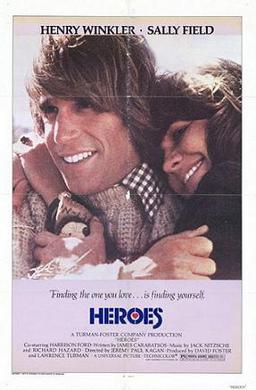
Film Review: Heroes (dir by Jeremy Kagan)


The 1977 film, Heroes, tells the story of Jack Dunne (a young Henry Winkler).

Jack spent four years fighting in Vietnam.  Since returning to America, he has struggled to adjust to civilian life.  Though he’s mentally blocked out much of what happened in Vietnam, he’s haunted by nightmares,  When we first meet him, he’s a patient at a mental health facility in New York City.  He has big plans, though.  He wants to open up a worm farm in Eureka, California.  He’s convinced that he can make a ton of money selling worms to fisherman and he wants all of the old members of his unit to join him in the venture.  After Jack escapes from the hospital, he boards a bus heading for California.

He also meets Carol (Sally Field), who is supposed to be getting married in four days but who has decided to board a bus and take an impromptu vacation instead.  When Carol is told that the bus is already full and she’ll have to wait for the next one, Jack bribes the ticket agent to get Carol on the bus.  Once on the bus, Jack makes himself into a nuisance, continually bothering the driver (Val Avery) and embarrassing Carol.  (In the film’s defense, it’s later established that Jack isn’t just being a jerk for fun.  The driver’s uniform makes Jack nervous.  That said, it’s hard not to feel bad for the driver, who is just doing his stressful job to the best of his ability.)  Carol and Jack do eventually strike a tentative friendship.  They’re linked by the fact that they’re both trying to escape from something.

At a diner, Jack tells her that he served in Vietnam.

“I protested the war,” Carol says.

“I fought it,” he replies.

Carol eventually joins with Jack in his quest to track down the three people who he expects to go into business with.  One of them is missing.  One of them never returned home from the war.  And the third, Ken (Harrison Ford), is living in a trailer and raising rabbits for a living.  Ken is also a stock car racer, though he eventually admits that he rarely wins.  In fact, he seems to spend most of his time drinking and shooting off the M16 that he keeps in his car’s trunk.  Meeting Ken sends Jack spiraling into depression but, with Carol’s help, Jack is finally starts to come to terms with the reality of what happened to him and his friends in Vietnam.

Heroes was one of the first films to sympathetically portray the plight of Vietnam veterans struggling to adjust to life back in the United States and it certainly deserves a lot of credit for its good intentions.  (Indeed, it’s implied that a part of Carol’s concern from Jack comes from her own guilt over how the anti-war movement treated the returning soldiers.)  That said, the film itself is an awkward mix of drama and comedy.  The first half of the film, in which Henry Winkler comes across like he’s doing a manic Al Pacino impersonation, is especially uneven.  Winkler and Field are both naturally likable enough that the film remains watchable but, during the first half of the film, most viewers will never buy their relationship for a second.  It’s hard to believe that the driver wouldn’t have kicked Jack off the bus as soon as he started to cause trouble and the other passengers often seem to be unrealistically charmed by Jack’s behavior.  If I’m on a crowded bus and some dude insists on walking up and down the aisle and taunting the driver, I’m probably going to get off at the first stop and refuse to get back on.  Traveling with a bunch of strangers is already nerve-wracking enough without having to deal with all of that.

Not surprisingly, things improve once Harrison Ford shows up.  This was one of Ford’s last character parts before he was cast as Han Solo in Star Wars.  (Heroes, however, was released after Star Wars, which explains why Ford is mentioned prominently in the trailer despite having a relatively small role.)  Ford gives a strong performance as the amiable but ultimately self-destructive Ken.  Ford plays Ken as someone whose quick smile is a cover for the fact that his entire life is a mess.  Whereas Jack wears his emotions on his sleeve (and Winkler never stops projecting those emotions), Ken is someone who has repressed his anger and his sadness and Ford gives an internalized and controlled performance.  Perhaps not coincidentally, Winkler calms down a bit when he’s acting opposite Ford and, as a result, his own performance starts to improve.

After the meeting with Ken, Jack starts to realize that it’s not going to be as easy to start his business as he thought.  Jack starts to come down from his manic high and, even more importantly, Henry Winkler stops overacting and instead, starts to dig into the sadness at the heart of Jack’s life.  During its second half, the film finally settles on being a drama and Heroes becomes a much stronger story as a result.  Even Jack and Carol’s relationship seems to make more sense during the second half of the film.  Things end on a note of cautious optimism, which also acknowledging that life can never go back to what it was before the war.

Today, if anyone watches Heroes, it’s probably going to be for Harrison Ford.  (I imagine the presence of Harrison Ford is the reason why it’s currently available on Netflix.)  It’s a bit of an uneven film, one that feels as if it should have been stronger than it actually was.  Still, it’s a worthwhile time capsule of 1977 and America’s struggle to come to terms with the Vietnam War.  Today, we’re still struggling to come to terms with what happened in Iraq and with the botched withdrawal from Afghanistan and, again, it seems like the country is too busy trying to move on to take the time to take care of its veterans.  It’s sad that so many people only seem to care about the soldiers who fight in popular wars.  Heroes was a plea to America not to forget its veterans.  It’s a plea that still needs to be heard.

Horror on TV: Friday the 13th: The Series 1.23 “Badge of Honor” (dir by Michelle Manning)


On tonight’s episode of Friday the 13th, Val Avery plays an angry cop who uses an antique sheriff’s badge to get revenge on the mobster who put his wife in a coma.  The mobster is played by David Proval, who later played RIchie Aprile during the second season of The Sopranos.  (You might remember Janice shooting him in the chest.)

This episode was directed by Michelle Mannings who, while working as an executive at Paramount, produced both Sixteen Candles and The Breakfast Club!

This episode originally aired on July 9th, 1988.

https://youtu.be/nfXWM2JWtOw


Film Review: Firehouse (1973, directed by Alex March)


Firefighter Shelly Forsythe (Richard Roundtree) has just been assigned to a new firehouse and, from the minute he shows up, it’s trouble.  Not only is he resented for taking the place of a popular (if now dead) firefighter but he’s also the first black to have ever been assigned to that firehouse.  Led by angry racist Skip Ryerson (Vince Edwards), the other firemen immediately distrust Forsythe and subject him to a grueling hazing.  However, Forsythe is determined to prove that he’s just as good as any white firefighter and refuses to be driven out.  While the firehouse simmers with racial tensions, a gang of arsonists is setting buildings on fire.

Firehouse does not have much of a plot but what little it does have, it deals with in a brisk 72 minutes.  Forsythe shows up for his first day.  Everyone hazes him.  Forsythe gets mad.  There’s a big fire.  And then the movie ends, without resolving much.  Ryerson is still a racist and Forsythe is still mad at almost everyone in the firehouse.  The characters are all paper thin and most of the fire fighting scenes are made up of grainy stock footage.  What does make the film interesting is the way that it handles the causal racism of almost every white character.  Ryerson, for instance, comes across as being an unrepentant racist but the film suggests that this is mostly due to him being too stubborn to change his ways and that Ryerson’s not that bad once you get to know him.  When Andrew Duggan’s fire chief instructs Forsythe not to take any of the constant racial remarks personally, Firehouse portrays it as if Duggan is giving good and reasonable advice.  The mentality was typical for 1973 but wouldn’t fly today.

One reason why Firehouse ends so abruptly is because it was a pilot for a television series.  At the time Firehouse aired, it had been only two years since Roundtree starred as John Shaft and NBC hoped that to recapture that magic on a weekly basis.  However, it would take another year before the Firehouse television series went into production and, by that time, Roundtree had left the project.  In fact, with the exception of Richard Jaeckel, no one who appeared in the pilot went on to appear in the short-lived TV series.

The DVD of Firehouse is infamous for featuring a picture of Fred Williamson on the cover, in which Williamson is smoking a cigar and wearing a fireman’s helmet.  Williamson does not appear anywhere in Firehouse and I can only imagine how many people have sat through Firehouse expecting to see a Fred Williamson blaxploitation film, just to discover that it was actually a Richard Roundtree television pilot.  Firehouse probably would have been better if it had starred Fred Williamson.  Roundtree’s good but sometimes, you just need The Hammer.

That’s Blaxploitation! 13: BLACK CAESAR (AIP 1973)


gary loggins's avatarcracked rear viewer

1972’s blockbuster smash THE GODFATHER began an onslaught of gangster movies released to your neighborhood theaters and drive-ins trying to capitalize on that film’s success. American-International Pictures was right in the thick of it, and since Blaxploitation was all the rage at the time, why not combine the two hottest genres? Producer/director/genius Larry Cohen already had a script written for Sammy Davis Jr., but when Sammy backed out, AIP Boss of Bosses Samuel Z. Arkoff signed Fred “The Hammer” Williamson to star as the Godfather of Harlem, BLACK CAESAR.

BLACK CAESAR is a semi-remake of the 1932 classic LITTLE CAESAR starring Edward G. Robinson, updated for the Blaxploitation/Grindhouse crowd and spun around on it’s head by Larry Cohen. You already know how much I enjoy Cohen’s work, and the auteur doesn’t fail to deliver the goods with this one. Casting the charismatic former NFL star Williamson was a bonus, and…

View original post 358 more words