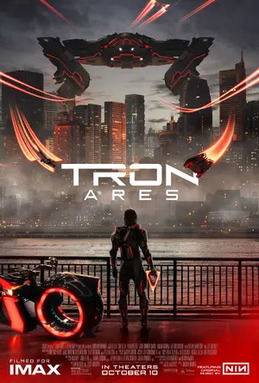
Tron Ares (dir. by Joachim Rønning)


Tron Ares is this year’s Spawn for me. 

For those unaware (and I really should write about Spawn one of these days), I saw Spawn with a friend when it first came out. I loved it, walking out the theatre and raving about it. Over pizza, my friend explained in great detail the many ways it actually sucked. Even Michael Jai White hated it. 

With my expectations being lower than they ever were for anything, Tron Ares surprised me. I leaned forward in my seat. I chuckled, and bobbed my head to the music and stayed until all of the credits were done. It could have done many things much better than it chose to do, but given the distance in time between Legacy and the choices for where the story could go, it’s not the worst film in the world. It’s not like Tron as an entire franchise was ever that deep with its storytelling (with the clear exception being Tron Uprising, of course). It brings some new elements to the overall tale that I didn’t even consider. Imagine what the writers could have done if they started working on this right after Legacy. With 15 years gone, it’s hard to get actors together for a project.

Both Trent Reznor and Atticus Ross are Executive Producers on Tron Ares. They threw money at this. They even have cameos in the film. At best, Tron Ares is the coolest looking Nine Inch Nails feature length music video to have ever existed since perhaps The Perfect Drug. The music compliments the film exactly as Daft Punk’s did for Legacy and Wendy Carlos’ did for the original. The sights are dazzling and the sounds are sharp. The music isn’t so much the subtle Reznor/Ross we’ve had with Bones and All, or the weirdness of Teenage Mutant Ninja Turtles: Mutant Mayhem. This is loud and kind of booming. We finally get light cycles in the real world (which isn’t giving anything away that wasn’t already in the trailers). In that sense, it’s a win on a few levels. 

If it’s a deep story with characters you’ll root for and possibly worry about, however, Tron Ares is not that film. You’re probably better off with either One Battle After Another or Weapons, both of which are equally good. I will say that what Tron Ares lacks in story, it does make up for with some generous fan service moments. There are tons of references to both Tron and Legacy if you pay attention, even if the story itself veers off tangent. I felt it handled this so much better than Legacy ever did. You can’t say the other films weren’t considered in making this. It’s not that far from another Disney project, F/X’ and Hulu’s Alien: Earth in some ways. 

In the years after Tron Legacy, there have been many changes. Encom encounters some competition in the form of the Dillinger Corporation, lead by genius Julian Dillinger (Evan Peters, X-Men: Days of Future Past) and his mother, Elizabeth (Gillian Anderson, The X-Files). Kevin Flynn’s (Jeff Bridges, The Big Lebowski) dream of crossing the digital frontier has become a race to see who can make their digital assets a reality. Dillinger’s newest, greatest program is Ares (Jared Leto, Morbius), who is fully versed in various fighting techniques and security protocols. What does this mean for life in The Grid, the universe inside the machine? Can Ares be trusted, or controlled, for that matter?

Acting-wise, everyone has a job to do. To his credit, Leto is not bad in this. It’s not robotic, but it’s not quite the second coming of Jordan Catalano (if anyone even recalls who that is). It’s not like the script, written by Jesse Wigutow (Daredevil: Born Again) and David DiGilio (The Terminal List & The Terminal List: Dark Wolf) calls for his character to have a great depth of emotion. Greta Lee (Past Lives) and Evan Peters do most of the work, along with Jodie Turner-Smith, who seemed to have the most fun. Anderson also does a good job, but again, there’s not a whole lot to work with. 

Tron Ares hovers right above the Incident mark for me. It could have been so much better than what it was, and who knows how long the visuals will stay with me. Yet, just like the films before it, it’s rescued by a score that may be remembered more than the film itself in the years to come. I don’t know if I’d go back out to see this, but would happily catch it once it comes to digital. 
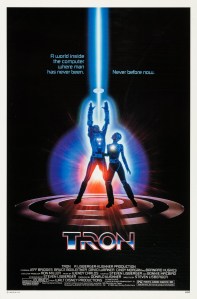
Tron (dir. by Steven Lisberger)


Many years ago in Southern Oregon, I had a conversation with friends about some of our favorite films growing up. Movies like The Goonies, The Dark Crystal, Watership Down and The Secret of Nimh were all on the list, as well as Disney’s Tron. In our excitement for all these movies, we ended up renting the films from a local video store to relive our childhood. While the nostalgia was nice, we all ended falling asleep halfway through Tron, despite our love for it.

I guess one’s enjoyment of Tron is based on how it’s viewed. I caught the film two years ago at the Museum of the Moving Image, in 70MM. The first thing that caught my attention was the film grain. I’ve grown so used to the clarity of digital film presented in 4K that I couldn’t help but catch the little flicks and “cigarette burns” in at the start. This was life before digital, and it was beautiful to revisit. In a theatre, the film’s 96 minutes blazed by for me. The early 1980s was basically made up of bike rides and video arcades. The little boedga on the corner of my block back home even had a few arcade machines in the front of the store in the first half of the 80s. The Bodega’s still there, the arcade’s now a deli/hot meal area. Times can and do change.

Tron is the story of Kevin Flynn (Jeff Bridges, Bad Times at the El Royale), a former employee at Encom, a major computing and videogame company. Encom’s made some wonderful strides in technology as of late, by 1980’s standards. Encom performs special matter tests in a specialized lab, while the programmers grind away code in their cubicles. All of their work is overseen by the Master Control Program, an operating system of sorts. Granted, the workforce at Encom isn’t too pleased about having the MCP monitor their applications. Alan Bradley (Bruce Boxleitner, Kuffs) and Lori Baines (Cindy Morgan, Caddyshack) also have programs and projects of their own that are being culled. Alan’s program, Tron (also played by Boxleitner) is of particular interest to the MCP, as it acts an a security threat that could bring some serious problems. Kevin tries to hack his way into Encom with the use of a program he created called Clu (also Bridges), but the MCP and the Senior Vice President of Encom, Ed Dillinger (David Warner, The Omen, Teenage Mutant Ninja Turtles II: The Secret of the Ooze) keep Flynn at bay. When Alan and Lori discover what Flynn’s up to, they confront him at his arcade, where he explains that he was the actual creator of Encom’s top games. He only needs the data as proof. This leads to the team breaking into Encom, where the MCP digitizes Flynn and brings him into the computer world. Can Flynn escape and help liberate the programs enslaved by the MCP and its henchman, Sark (both also played by Warner)? Can Flynn find the proof to exonerate him? And just who is this Tron fellow, anyway?

The plot for Tron inside the machine becomes a bit theological. The programs believe in the Users, and that they were each created for a particular purpose. From Ram (Dan Shor, Bill & Ted’s Excellent Adventure) being an Actuarial Program to Tron being a defense against the MCP, it’s kind of interesting once Flynn shows up. As a User, he doesn’t have much more power than a program, save that he can’t really be derezzed and that he can mimic the neon glow of anyone he touched. I always thought they could have given him something cooler to do, though for 1982, repurposing machines does have some benefits. The story slows down a bit in the middle, feeling like it’s somewhat unsure of itself, but picks up in the final act with Tron vs. Sark and the MVP. Though Flynn is important to the outcome, he’s more like Big Trouble in Little China’s Jack Burton, kind of just watching this happen around him. He does have his moments, though.

When I was little, my dad owned a Commodore 64 and a Floppy Disk Drive. He would regularly pick up magazines like Byte! to catch up on new innovations. In most of these magazines, they’d have a program that you could enter in at home to create various effects like making a balloon fly across your screen. Those programs were usually written over a number of pages with hundreds of lines of code. For Tron, there were 3 teams dedicated for the Visual Effects. According to the behind the scenes documentary on the disc, Information International Inc., known as Triple-I, was brought in to handle the major work along with Mathematic Applications Group Inc. (MAGI), who director Steven Lisberger worked for at one point early in his career. Digital Effects of New York handled some of the responsible for some of the original CGI work used in Michael Crichton’s Westworld (considered one of the first CGI movie uses ever) and it’s sequel, Futureworld. For the time, the effects were groundbreaking. Mind you, most of this was all before we ever hit the 8-bit era of Nintendo, the Commodore Amiga or even the high resolution arcade games of Sega’s heyday like Space Harrier, Outrun or Afterburner. In an actual arcade in 1982 had games like Q-Bert or Dig Dug with the kind of graphics you’d never see on home systems.

Kevin Flynn (Jeff Bridges) and others (including a young Michael Dudikoff to his right) watch Tron fight for the users. This would inspire Dudikoff to become an American Ninja.

The designs for the look and feel of the computer world came from Lisberger himself, with a bit of assistance from both futurist Syd Mead and legendary artist Jean “Mobius” Giraud. Both men were extremely popular. Mead was the equivalent of Apple’s former Chief Design Officer Jony Ive, having created the “V’ger” model for Star Trek:The Motion Picture. Ironically, Mead’s work (both on the set design and the flying cars) would be seen by audiences watching Ridley Scott’s Blade Runner just a month shy of Tron’s release. Having worked on Alien years prior, Giraud helped to design and inspire both the clothing and some of the vehicles, such as the weird cradle for Dumont (Bernard Hughes, The Lost Boys) and the Light Cycles.

Jean "Mobius" Giraud's sketches for Dumont in Tron.

A film dealing with computers needed a composer familiar with electronic music.It seemed fitting that Wendy Carlos(A Clockwork Orange, The Shining) took on the challenge. Having built a computer at 14, Carlos’ love for music over the years lead her (with Robert Moog) to help develop the Moog synthesizer system. The Moog would go on to be used by Kraftwerk, Giorgio Mororder, Nine Inch Nails, The Prodigy Daft Punk and even J Dilla, among others. The Tron Soundtrack was a mix of orchestra, choir and electronic music. Although the sound may not be as dark and digital as Daft Punk’s score for Tron: Legacy, I felt it worked for the time and moves well with the film. In addition to Carlos’ score, Journey wrote the song “Only Solutions” for the film, which also happens to be a line uttered by Kevin Flynn.

Overall, Tron is one of those movies I can happily rewatch without much in the way of expectation. I enjoy it for its place in Sci-Fi cinema, and the memories it awakens. I don’t think Disney ever fully recognized the full potential of where they could take the story, though the animated Tron: Uprising was a great part of the saga. I’m just hoping Tron: Ares doesn’t stray too far from the fold.

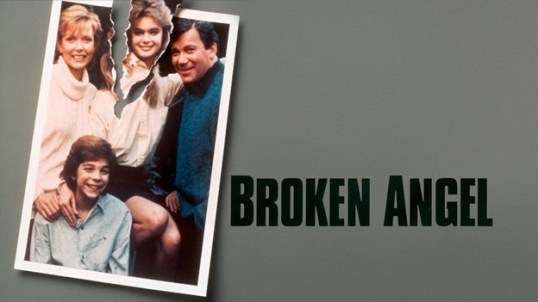
Retro Television Review: Broken Angel (dir by Richard T. Heffron)


Welcome to Retro Television Reviews, a feature where we review some of our favorite and least favorite shows of the past!  On Sundays, I will be reviewing the made-for-television movies that used to be a primetime mainstay.  Today’s film is 1988’s Broken Angel!  It  can be viewed on YouTube.

Chuck Coburn (William Shatner) has a nice house in the suburbs, a nice job, a nice car, and a nice Bruins jacket.  He’s hoping that he can once against have a nice marriage with his wife (Susan Blakely), despite the fact that she cheated on him and she still thinks that he spends too much time at work.

Chuck is proud of his teenage daughter, Jaime (Erika Eleniak).  Jaime seems like the perfect suburban and angelic teenager.  But then Jaime goes to prom and her best friend, Jenny (Amy Lynne), is gunned down in front of her.  Jaime runs from the scene and vanishes.  As Chuck searches for his daughter, he is stunned discover that Jaime, Jenny, and their boyfriends were all a part of a gang!  His perfect daughter was smoking weed, doing cocaine, selling crack, and taking part in rumbles with a rival Asian gang.  Even worse, Jaime’s gang was called …. LFN!

LFN?  That stands for Live For Now.  The Live For Now Gang.  Whenever we see the members of the gang preparing to get into a fight with another gang, they all chant, “LFN!  LFN!”  LFN is a gang of white suburban teenagers and they look just as dorky as they sound.  I mean, I think it would be bad enough to discover that your child is in a gang but discovering they were in a dorky gang would probably make it even worse.

The majority of Broken Angel is made up of scenes of Chuck searching the mean streets of Los Angeles.  He partners with a social worker (Roxann Dawson) who is herself a former gang member.  Chuck discovers that his daughter’s street name was — *snicker* — Shadow.  He also befriend a member of the LFN’s rival Asian gang and tries to encourage her to go straight.  This leads to scene in which he is attacked by Al Leong.  Somehow, middle-aged William Shatner manages to beat up Al Leong.  That, in itself, is worth the cost of admission.

Broken Angel deals with a serious issue but it does so in such an overwrought and melodramatic fashion that most viewers will be moved not to tears but to laughter.  In Broken Angel, William Shatner gave the type of overly dramatic and self-serious performance that he routinely pokes fun at today.  If you’re one of those people who enjoys listening as Shatner emphasize random syllables and takes meaningly pauses, this movie will give you a lot to enjoy.  In every scene, Shatner seems to be saying, “Notice me, Emmy voters!  Notice me!”  Of course, it wouldn’t be until Shatner learned how to laugh at himself that the Emmy voters would finally notice him.

The film ends on an abrupt note but with the promise of better days ahead.  Just remember — keep an eye out for the LFN!

What Lisa Watched Last Night: The Super Bowl Half-Time Show


As I type this, it is a little after midnight which means that technically, I did watch the Super Bowl Half-Time Show last night.

Why Was I Watching It?

To be honest, this was the first Super Bowl I’ve ever actually seen.  I’m not totally sure but I think this was also the first time that I’ve ever actually seen an entire football game.  I wasn’t planning on watching the Super Bowl.  As a matter of fact, I had already turned down an invitation to go to a super bowl party at my sister Megan’s precisely because I had decided I had no interest in watching the game.  I also turned down an invitation to go watch the game with Jeff’s family.  Instead, I thought I’d simply take advantage of everyone else watching the game by spending all of Sunday on a nice, big shopping spree.  However, about two hours into that spree, my asthma started to act up so I came home early, turned on the TV, and there was the game.  So, I left the game on while I did some online shopping (I nearly bought this until I noticed that it cost $725!) and then once I got onto twitter, everyone was talking about the game so I continued to watch the game and I ended up having so much fun commenting on it that I ended up watching the entire thing.  I do have to admit that I was, for the most part, completely and totally lost as to what was going on but no matter.  I had fun.

Anyway, once I started kinda watching the game, I realized there was no way I couldn’t watch the Super Bowl Half-Time Show. 

What’s It About?

Apparently, every year, some other band plays the Super Bowl during half-time.  This year, the band turned out to be the Black-Eyed Peas.  I have something of a girlcrush on Fergie.  Or at least I did until I saw the half-time show.

What Worked?

Uhmm…maybe this would work better if we start with what didn’t work.

What Didn’t Work?

Pretty much the entire show.  The Black Eyed Peas have been performing this exact same show for a few hundred years now and they could pretty much do it in their sleep which is what they appeared to be doing here. 

However, just saying that the Black Eyed Peas looked bored — well, that doesn’t begin to explain why this show inspired thousands of people to stare at their TV and scream, “Turn it off, turn it off, turn it off!” like George C. Scott in Hardcore.  It’s not just that the show was bad — it was that it was bad in so many different ways and, in each case, it stretched the boundaries of what had previously been considered to be a believable level of failure.

Hence, Will.i.am not only appeared to have been replaced by a robot but he appeared to have been replaced by a robot that was actually Cartman underneath a cardboard box.  Fergie — who, in the past, I felt never got enough credit (her performance in Nine was one of the few exciting moments in that film) — was not only pitchy but actually sounded like she was auditioning for American Idol.  The two other Black-Eyed Peas were — well, who really cares about them?

Then you had the dancers in the neon costumes who all looked like they had wandered off of the set of Tron.  And, seriously, do we really want to be reminded of Tron at this point?

And then, just when you thought things couldn’t get any worse, Usher showed up.  “Look,” I said to my cat, “Usher’s still alive.”  “Meow,” the cat replied.  Usher sang a few notes that pretty much evaporated in the stadium and then jumped in the air and did the splits.  Which I guess would have been impressive except for the fact that he’s Usher and guys aren’t supposed to be able to do the splits like that.

I’m sure I could come up with a few more things that didn’t work but, quite frankly, I think my mind is repressing them right now.

What Worked?

Twitter.  In the nearly two years that I’ve been on twitter, I have never seen everyone as united as they were in their general ridicule of the Super Bowl halftime show.  So, in a strange way, the Black Eyed Peas brought the world together for about 15 minutes.

Here’s a few of my own tweets from the Half-Time Show:

Uhmm…is the half-time show a tribute to Tron? Where’s Jeff Bridges?

lol, Fergie couldn’t wait to get away from the rest of the Black Eyed Peas.

The Black-Eyed Peas are reminding me of that Stop Smoking Act from that episode of South Park.

The reason the crowd is cheering is b/c they can’t hear the Black Eyed Peas. That stadium is huge.

Oh good. I was just thinking that only Usher could save the half-time show.

And so, sadly, ends my girlcrush on Fergie.

Oh My God!  Just Like Me! Moments

I can’t sing that well either.

Lessons Learned

The Black Eyed Peas are about to reach that point where they end up with a reality show on VH1.


Film Review: Tron: Legacy (directed by Joseph Kosinski)


As we were sitting in one of the theaters at the AMC Valley View, waiting for Tron: Legacy, I leaned over to Jeff, placed my head on his shoulder, and told him that he should feel very special.

“Why’s that?” he asked.

“Because there’s like a hundred guys in this theater and you’re the only one here with a girl.”

And it was true!  The theater was full of guys who all looked like Jesse Eisenberg but there were literally only three or four other girls in the audience and I think they were all together.

Now, one thing I’ve always wondered — why are guys so scared to sit next to each other in the movies?  Seriously, there were all these little Jesse Eisenberg-looking guys out in the audience but each one had to have an empty seat on either side of him.  Yet, it was obvious that they all knew each other because they were loudly shouting comments to each other through the entire film and, once the movie was over, they all left together.  So, guys, sorry but it was a group date regardless of how many empty seats there were between you.

So, that’s one of two things I learned from seeing Tron: Legacy: boys who look like Jesse Eisenberg are homophobic.

What else did I learn?  Well, whenever the hero of Tron: Legacy started fighting or talking about fighting or driving too fast, Jeff would go, “Let’s do this — LEROY JENKINS!”  And I was like, “Who the frickin frack is Leroy Jenkins!?”  Anyway, after the movie, Jeff showed me this video on Youtube.  So, now I kinda know who Leroy Jenkins is.

Anyway, if I seem like I’m talking about everything but Tron: Legacy that’s because Tron: Legacy really didn’t make much of an impression on me. 

Tron: Legacy is a sequel.  The original film was called Tron and I’ve never seen it but I have seen the You Have 0 Friends episode of South Park and Jeff says that’s close enough. 

Tron: Legacy is one of those movies that are mostly made to show off what can be done with CGI and the CGI is impressive in this film for about fifteen minutes.  Then, after those 15 minutes, the CGI starts to get repetitive (I mean, there’s only so many times I can be impressed by the big orange space ships coming up over the horizon) and now you’re going to have to pay attention to things like plot and acting and that’s when everything pretty much falls apart.

Anyway, the plot of Tron: Legacy goes something like this: Sam Flynn (Garrett Hedlund) is the son of Kevin Flynn (Jeff Bridges) who is apparently some sort of video game guru who vanishes when Sam is 7.  20 years later, Sam is an angry young man who rides a motorcycle and posts silly Youtube videos of his dog and somehow he ends up getting sucked into a really old computer where he discovers the Matrix.

And wow, is the Matrix boring.  There’s like these gladiator style games going on and all the citizens are actually computer programs and they’re ruled over by CLU (also played by Jeff Bridges) and everyone keeps calling Sam a “user” and then there’s this club that’s ruled over by a Castor (Michael Sheen) who is portrayed as being extremely fey and treacherous which I guess is meant to show that even computer programs can be homophobic. 

Anyway, Sam is tossed into one of the gladiator games and then he’s rescued by a program named Quorra (Olivia Wilde) and it turns out that Quorra lives offgrid with Sam’s father!  It seems that Kevin has been trapped in this world for the past 20 years and now Sam only has a few hours left to get out and Kevin wants to make sure Quorra gets out as well and this is important because Quorra has some sort of digital DNA that’ll end all world suffering but CLU wants to kills Quorra because she’s “an imperfection” and…

Oh, who cares?  Well, the filmmakers apparently because this is an amazingly talky film.  For all the emphasis put on the CGI and the endless stream of action sequences (Sam gets into either a fight or a chase every 10 minutes or so), this is a really verbose film.  Once Sam finds his father, all of the action suddenly halts as the audience is subjected to a seemingly endless monologue that is designed to explain how CLU was created, why CLU looks like a young, sexy Jeff Bridges, and how Quorra can synthesize religion and science and philosophy.  The dialogue brings up all these intellectual and philosophical questions but why?  It’s all very shallow, like listening to someone who just finished an Intro. To Philosophy class trying to explain the work of Jean-Paul Sartre.  (“Hell is other people!  Shit, man…”)  I mean, the explanations make little to no sense yet they keep going on and on!  It’s one thing to make a movie with a nonsensical plot.  It’s another thing to not only continually call attention to that fact but do so in a way that is so humorless and so lacking in any self-awareness that the plot goes from being silly to stupid to borderline offensive.

Anyway, I know this review has been pretty negative so far so instead of dwelling on everything that didn’t work in this movie, I’m going to mention some good things about Tron: Legacy.

Let’s see — well,  I think I may have a girlcrush on Olivia Wilde now.  She kicks ass with style and bring a sly sense of humor to her role.  Unfortunately, she has next to no chemistry with either Bridges or Hedlund.

As CLU, Jeff Bridges is made up to look young and sexy and is obviously being filmed through a lens that has been coated with vaseline.

It’s always nice to see one of my favorite actors, Michael Sheen.  Even though his role here is kind of a waste of his talents, at least he’s not playing Tony Blair again.

Speaking of Michael Sheen, Tron: Legacy might not be a good film but it’s still more entertaining than Frost/Nixon.

Some of the CGI is cool in a “Hey!  Look!  CGI!” sorta way.

However, the best thing about Tron: Legacy is the original score by Daft Punk.  Seriously, this might be the best film score of the year.  The score is a mixture of electronic and orchestral music and it has a perfect sort of other worldliness to it.  To a large extent, the music provides the emotional highs and lows that the rest of the film fails to supply. 

My final verdict on Tron: Legacy: Skip the film, buy the soundtrack.