Days of Paranoia: Serpico (dir by Sidney Lumet)


In 1973’s Serpico, Al Pacino plays a cop who doesn’t look like a cop.

Indeed, that’s kind of the start of Frank Serpico’s problems.  He’s a New York cop who doesn’t fit the stereotype.  When we see him graduating from the Academy, he’s clean-shaven and wearing a standard patrolman uniform and he definitely looks like a new cop, someone who is young and enthusiastic and eager to keep the streets safe.  However, Serpico is an outsider at heart.  The rest of the cops have their homes in the suburbs, where they spend all of their time with their cop buddies and where they go also go out of their way not to actually live among the people that they police.  Serpico has an apartment in Greenwich Village and, as a plainclothes detective, he dresses like a civilian.  He has a beard.  He has long hair.  He has a succession of girlfriends who don’t have much in common with the stereotypical (and there’s that word again) cop’s wife.  Serpico is an outsider and he likes it that way.  In a world and a career that demands a certain amount of conformity, Frank Serpico is determined to do things his own way.

However, the real reason why Serpico is distrusted is because he refuses to take bribes.  While he’s willing to silently accompany his fellow officers while they collect their payoffs from not only the people that they’re supposed to be arresting but also from the storeowners that they’re meant to be protecting, Serpico refuses to take a cut.  Serpico understands that the small, everyday corruption is a way of forcing his silence.  The corruption may help the cops to bond as a unit but it also ensures that no one is going to talk.  Serpico’s refusal to take part makes him untrustworthy in the eyes of his fellow cops.

Serpico and Bob Blair (Tony Roberts), a politically-connected detective, both turn whistleblower but it turns out that getting people to listen to the truth is not as easy as Serpico thought it would be.  The Mayor’s office doesn’t want to deal with the political fallout of a police conspiracy.  Serpico finds himself growing more and more paranoid, perhaps with good reason.  When words gets out that Serpico has attempted to turn into a whistleblower, his fellow cops start to turn on him and, during a drug bust, Serpico finds himself deserted and in danger.

Serpico opens with its title character being rushed to the hospital after having been shot in the face.  This actually happened to the real Serpico as well.  What the film leaves out is that hundreds of New York cops showed up at the hospital, offering to donate blood during Serpico’s surgery.  That’s left out of the film, which at times can be more than a little heavy-handed in its portrayal of Serpico as an honest cop surrounded by nonstop corruption.  Filmed just three years after Serpico testified before New York’s Knapp Commission (which was the five-man panel assigned to investigate police corruption in the city), Serpico the movie can sometimes seem a bit too eager to idealize its title character.  (Vincent J. Cannato’s excellent look at the mayorship of John V. Lindsay, The Ungovernable City, presents far more nuanced look at the NYPD corruption scandals of the early 70s and Serpico’s role as a whistleblower.)  Director Sidney Lumet later expressed some dissatisfaction with the film and even made other films about police corruption — The Prince of the City, Q & A, Night Falls On Manhattan — that attempted to take a less heavy-handed approach to the subject.

That said, as a film, Serpico works as a thriller and as a portrait of a man who, because he refuses to compromise his ideals, finds himself isolated and paranoid.  Al Pacino, fresh from playing the tightly-controlled Michael Corleone in The Godfather, gives an intense, emotional, and charismatic performance as Serpico.  (One can see why the image of a bearded, hippie-ish Pacino was so popular in the 1970s.)  Sidney Lumet brings the streets of New York to vibrant and dangerous life and he surrounds Pacino with an excellent supporting cast, all of whom bring an authentic grit to their roles.  Serpico may not be a totally accurate piece of history but it is a good work of entertainment, one that works as a time capsule of New York in the 70s and as a portrait of bureaucratic corruption.  It’s also the film in which Al Pacino announced that he wasn’t just a good character actor.  He was also a movie star.

October Hacks: Popcorn (dir by Mark Herrier and Alan Ormsby)


The 1991 film, Popcorn, tells the story of what happens when an experimental film goes wrong.

In the late 60s, a freaked-out hippie named Lanyard Gates directed a short film called PossessorPossessor featured footage of him apparently preparing to sacrifice a woman on an altar.  Gates declined to film a third act conclusion to the film.  Instead, he murdered his family on stage and in front of a terrified audience.  The resulting panic caused a fire to break out, killing almost everyone at the Dreamland Theater.  As a result, Possessor has become a legendary film, one that is believed lost.  Of course, it’s not lost, as a group of film students and their professor find out over the course of Popcorn.

Years later, one of those film students, an aspiring screenwriter named Maggie (Jill Schoelen), has been having disturbing nightmares about being caught in a fire and being pursued by a madman.  When she sees Possessor, she realizes that much of the imagery in her dreams comes from the film.  When Maggie attempts to talk to her mother about all of this, Suzanne (Dee Wallace) denies knowing anything about Possessor or Lanyard Gates but it’s not hard to tell that she’s lying.

Still, Maggie does have other things to worry about.  Her school’s film department has been hit by budget cuts and neither she nor her classmates will be able to make their student films unless they raise some money.  One of the students, Toby (Tom Villard), suggests holding a fundraiser at the Dreamland Theater, where they could show old movies and even recreate some of the old gimmicks that were used to promote those movies.  Professor Davis (Tony Roberts) thinks that is a great idea!  Why, he could even control the giant, remote-controlled bug that was used to promote Mosquito!

Filmed in Jamaica (and featuring a somewhat random performance by a reggae band), Popcorn was originally offered to director Bob Clark.  However, Clark didn’t want to return to the horror genre so, instead, it was Clark’s frequent collaborator, Alan Ormsby, who was hired to direct the film.  Reportedly, Ormsby was replaced a few weeks into filming by Mark Herrier, with the assumption being that the producers felt that Ormsby was spending too much time on filming the three fake movies that are screened during the fund raiser.  Those films are Mosquito, The Attack of the Electrified Man, and a dubbed Japanese film called The Stench.  In the film’s credits, Ormsby is credited with directing the three fake film while Mark Herrier is credited with directing the “modern” scenes.

Perhaps not surprisingly, the three fake film are actually the best thing about Popcorn.  If Alan Ormsby was taking a lot of time to shoot the fake films, it obviously paid off because all three of them perfectly capture the feel of the era when they were supposedly shot and all of them are filled with the type of details that only a true fan of old horror movies would think to include.  Mosquito is a giant bug film that feels as if it could have come straight from 1957.  The Amazing Electrified Man feels like one of the films that poor Lon Chaney Jr. would have found himself starring in after leaving Universal.  And The Stench is the perfect import — slow-moving, a bit pompous, and terribly dubbed.

As for the rest of Popcorn, it’s a well-made slasher film.  Mark Herrier did a good job directing the “modern” scenes, with a scene in which the killer’s face seems to literally melt after he kisses one of his victims being a definite creepy highlight.  The kills are reasonably creative and, in one case involving electrocution, rather disturbing.  Jill Schoelen is a likable heroine, Derek Rydall is cute as her hapless boyfriend, and Tom Villard’s uninhibited performance gives the film a much-needed jolt of energy.  Though the old films may be the highlight of Popcorn, the “modern” scenes hold up as well.

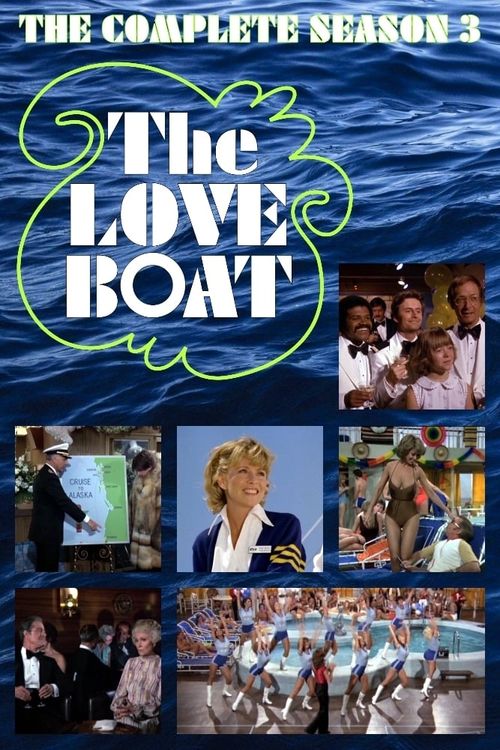
Retro Television Reviews: The Love Boat 3.1 and 3.2 “The Alaskan Wedding Cruise: Carol and Doug’s Story/Peter and Alicia’s Story/Julie’s Story/Buddy and Portia’s Story”


Welcome to Retro Television Reviews, a feature where we review some of our favorite and least favorite shows of the past!  On Wednesdays, I will be reviewing the original Love Boat, which aired on ABC from 1977 to 1986!  The series can be streamed on Paramount Plus!

The Love Boat sets sail for season 3!

Episode 3.1 and 3.2 “The Alaskan Wedding Cruise: Carol and Doug’s Story/Peter and Alicia’s Story/Julie’s Story/Buddy and Portia’s Story”

(Dir by Roger Duchowny, originally aired on September 15th, 1979)

The third season of The Love Boat starts with a special voyage to Alaska and a two-hour running time.  It’s double the guest stars, double the melodrama, double the goofiness, and double the romance!  The opening also features new clips for Doc, Gopher, and Julie.  Whereas the first two seasons introduced Doc listening to his own heartbeat, the third season opening features him laughing while leaning against a railing.  Gopher’s new opening credit features him looking wistfully out at the ocean and it’s a much more mature look for him.  As for Julie, she’s still smiling and perky but she’s let her hair grow out.  If the first two seasons of The Love Boat featured Julie looking like the star of the high school drama department, she looks more like the most popular cheerleader now.  As for the Captain, he continues to salute the camera and Isaac continues to do his signature pointing.

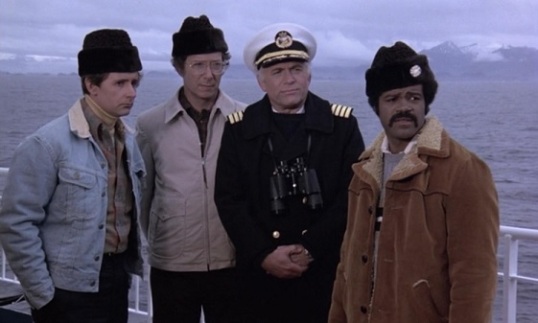
The episode opens in Canada. The boat is docked in Vancouver, where it has been rented out by a huge and wealthy wedding party.  The boat will be sailing to Alaska.  Isaac has been reading everything that he can find about Alaska and he spends most of the episode sharing trivia about the state’s history.  Gopher, preparing for Alaska’s cold weather, buys a gigantic coat.  Meanwhile, Doc Bricker makes jokes about his ex-wives and Capt. Stubing tries to keep everything professional.  (“You’re not going to the North Pole!” he snaps at Gopher when he sees the size of his new fur coat.)

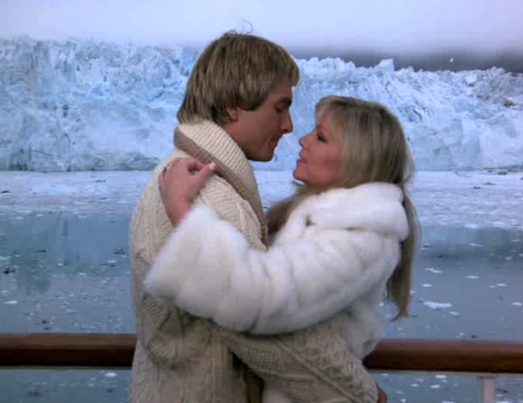
As for Julie, her mind is elsewhere.  Alaska is where Jack (Tony Roberts) lives.  Who is Jack?  During the second season, he was a passenger who fell in love with Julie and who asked Julie to marry him.  She knows that she’s going to see Jack in Alaska and she’s going to give him an answer as far as his proposal is concerned.  (If you don’t remember Jack asking Julie to marry him, don’t feel bad.  I had forgotten about it, too.  Fortunately, the first hour of this episode is full of flashbacks to Jack’s previous episode.)  Is Julie ready to settle down?  While Julie tries to make up her mind, she also has to deal with the romantic intentions of the wedding party’s dorky best man (Donny Most).

As for the wedding party, Carol (Lisa Hartman) and Doug (Mark Harmon, sporting a truly unfortunate haircut) are looking forward to getting married, even though Doug’s ex-girlfriend (Caren Kaye) is also on the boat and determined to win Doug back.  If that means jumping out a cake while wearing a bikini, she’ll do it.  Doug is more concerned about the fact that his estranged, alcoholic father, Peter (Ray Milland) had turned up on the cruise despite having not been invited to or even informed about the wedding.  Peter has stopped drinking and is trying to make peace with his son and his ex-wife, Alicia (Eleanor Parker).  What Doug and Alicia do not know is that Peter is terminally ill.  And what neither Doug nor Peter knows is that Alicia is on the verge of filing for bankruptcy.

Meanwhile, Carol’s plain-spoken grandfather (Lorne Greene) feels uncomfortable with all of the rich folks but then he meets Doug’s equally plain-spoken aunt (Audra Lindley).  Could we be heading for a double wedding?  It is The Love Boat, after all!

There aren’t really any big surprises on this episode but it’s likable nonetheless.  For this episode, the crew and the cast actually sailed to Alaska and all the action was filmed during an actual cruise.  The scenery is gorgeous, even if it’s obvious that the cast was frequently freezing while filming their scenes.  By this point, the show’s regulars had their chemistry down perfectly and all of the 3rd season premiere’s guest stars are well-selected.  I especially liked the performances of Lorne Greene, Audra Lindley, the great Ray Milland, and Tony Roberts.  Julie and Jack’s reunion was far more touching that I think anyone would expect from a show like The Love Boat, with Tony Roberts playing the role of Jack so well that the viewer really did believe that, under different circumstances, he and Julie truly would have had a wonderful life together.  This was a great way to start the third season.

Retro Television Reviews: The Love Boat 2.14 “Julie Falls Hard / Double Wedding / The Dummies”


Welcome to Retro Television Reviews, a feature where we review some of our favorite and least favorite shows of the past!  On Wednesdays, I will be reviewing the original Love Boat, which aired on ABC from 1977 to 1986!  The series can be streamed on Paramount Plus!

Welcome aboard.  Don’t expect much from your cruise this week.

Episode 2.14 “Julie Falls Hard / Double Wedding / The Dummies”

(Dir by Bob Claver, originally aired on December 16th, 1978)

Agck!  It’s the most horrifying episode in the history of the Love Boat!

Your eyes do not deceive you.  There are indeed two ventriloquists on this week’s cruise.  Married entertainers Patti Harmon (Ruth Buzzi) and Michael Harmon (Sid Caesar) have been hired to amuse the ship’s passengers.  Unfortunately, they’ve recently separated.  Patti thinks that Michael is incapable of expressing his emotions unless he’s carrying around his dummy.  And it turns out that she’s right because Michael really does carry that dummy around with him everywhere and he has frequent conversations with it.  Even when Michael inevitably apologizes for being a bad husband and asks Patti for another chance, he has to use the dummy to do it.

Seriously, it’s creepy!  I mean, everything works out in the end.  Michael and Patti decide to give their marriage a second chance and their dummies end up kissing as well.  But seriously, ventriloquist dummys are just weird.  Have you seen that episode of The Twilight Zone where the guy tries to switch one dummy out for another so the original dummy gets mad and destroys his replacement?  Have you seen the classic Anthony Hopkins film, Magic?  CREEPY!

Of course, this episode features not just the scariest story in Love Boat history.  It also features the stupidest.  Two twins (Cyb Barnstable and Trish Barnstable) board the cruise with their fiancés (played by David Nelson and Fred Travelena).  No one can tell the twins apart!  Not even Isaac!

Anyway, the twins worry that they might be making a mistake because it seems like each one is marrying a man with the opposite personality.  The twin who likes to stay up late is engaged to the man who goes to bed early.  The twin who likes to be responsible and level-headed is engaged to man who is wild and unpredictable.  So, when the twins disembark the boat so that they can get married in Mexico, they decide to switch places on their wedding day.  But then when the twins return to the boat with their new husbands, they decide that they made a mistake so they switch back.  They can do that because they’re twins!  Seriously, that’s the entire story.

Bleh!  This was so stupid.  Even writing about it was painful.

Finally, Julie’s in love!

Jack Chenault (Tony Roberts) is taking the cruise with his two young daughters and, when he sees Julie, it’s love at first sight.  The daughters wants their Dad to marry Julie as well.  One of the daughters is played by a very young Melora Hardin, who would grow up to play Jan Levinson on The Office.

After knowing Julie for one day, Michael announces that he’s in love with her and he wants her to come live with him in Alaska.  Julie is tempted but ultimately, she can’t leave her life on the boat behind.  Jack is heart-broken but Julie promises to see him the next time that she’s in Alaska.  So, I imagine we will never hear about Jack again.

This third storyline wasn’t bad.  Especially when compared to the other two, it was actually sweet and rather touching.  It helps that Tony Roberts gave a convincing performance Jack.  That said, asking someone to marry you after only knowing them for one day?  Unless you’re a young king looking to legitimize the Treaty of Troyes, that’s never a good idea.

This week’s cruise was not a good one.  Hopefully, next week’s will be less scary and less dumb.

Film Review: The Taking of Pelham One Two Three (dir by Joseph Sargent)


Welcome to New York in the 1970s!  While the intellectuals flock to the latest Woody Allen movie and the wealthy throw radical chic parties in Manhattan and disturbed young men drive taxis at night and pray for a real flood to clear away all the vermin, most of the city’s citizens are just trying to make it through the day.  For many of them, that means spending an hour or two riding the subway.  In some ways, the subway is the great equalizer.  The minute that you sit down on a filthy train car, it doesn’t matter how old you are or how you vote or the color of your skin.  All that matter is finding a way to avoid making eye contact with anyone else.

Four men, all wearing obvious disguised, board the downtown Pelham 1-2-3 train.  They all look suspicious but, this being New York, no one wants to make eye contact.  Everyone just wants to reach their next stop.  The men — who are known as Mr. Blue (Robert Shaw), Mr. Green (Martin Balsam), Mr. Grey (Hector Elizondo), and Mr. Brown (Earl Hindman) — have other plans.  Revealing that they’re armed, they take the 18 passengers of the first car hostage.  Their leader, Mr. Blue, has a simple demand.  He wants a million dollars to be delivered to the car within an hour.  If the money’s late, he will kill one hostage every minute, until he receives what he wants.

While the cold-stricken mayor (Lee Wallace) tries to figure out how to 1) raise a million dollars and 2) handle the situation without losing any potential votes in his reelection campaign, Lt. Zach Garber (Walter Matthau) communicates with Mr. Blue via radio.  With Mr. Blue underground and Zach above ground, the two of them establish a cautious rapport.  Robert Shaw plays Blue as being efficient, polite, but ruthless while Walter Matthau plays Garber with his usual rumpled but intelligent style.  As embodied by Matthau, Garber is New York City in human form while Shaw is perfectly cast as the outsider who, for at least an hour or two, has managed to bring the city to its knees.

Even though the original The Taking of Pelham One Two Three is often described as being a Walter Matthau film or a Robert Shaw film, the film’s main character actually is the city of New York City.  The film portrays the city as being chaotic, angry, and unpredictable but, at the same time, also resilient and strong.  Yes, Garber may spend a lot of time bickering with his co-workers but, in the end, he and Lt. Rico Patrone (Jerry Stiller, another great New York figure) work together to do what has to be done to resolve the situation.  For all the time that’s spent on how Mr. Blue and his compatriots take that train hostage, just as much time is spent focusing on how the police, the politicians, and the Transit Authority react to what’s happened.  Not having any firsthand knowledge of the New York subway system (beyond being told not to use it when I was in NYC a few years ago), I can’t say whether or not the film is realistic but what’s important is that it feels realistic.  Even though the film is full of familiar character actors, it still seems as if you’re just watching a bunch of New Yorkers having a very long day.  Though guns are fired and there is a runway train, The Taking of Pelham One Two Three takes a refreshingly low-key approach to its story.  There’s no huge action set pieces.  The film’s classic final shot hinges not on Garber’s marksmanship but instead on his ability to remember the small details.

The Taking of Pelham One Two Three is one of my favorite heist movies.  It’s well-acted.  It’s got an interesting plot.  It’s got a few moments of unexpected humor.  Robert Shaw is a great (and, at times, almost compelling) villain while Walter Matthau and Jerry Stiller make for a great detective team.  The great Martin Balsam also turns in a wonderful turn and, even though he’s playing a bad guy, it’s hard not to sympathize him.  You need only see his apartment to understand why exactly he felt the city of New York owed him more than it had given him.  Best of all, The Taking of Pelham One Two Tree is a tribute to a great American city.  The Taking of Pelham One Two Three celebrates New York City in all of its rude, messy, and brilliant glory.

Lisa Reviews An Oscar Winner: Annie Hall (dir by Woody Allen)


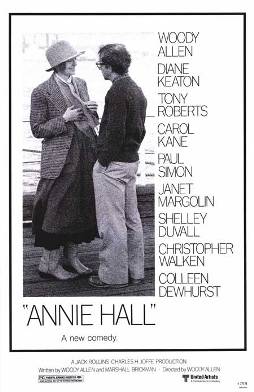
anniehallposterYou take a risk when you review a Woody Allen film, even an acknowledged, Best Picture-winning classic like 1977’s Annie Hall.  Do you address the accusations that have been made about him?  Do you ignore them and hope that they won’t be the Elephant in the Room, stomping through your review?  Do you try to justify reviewing (or, in some cases, even watching) Allen’s film?  Or do you just let the work speak for itself?

I love Annie Hall.  Quite frankly, I like a lot of Woody Allen’s films, even though I understand why his work is an acquired taste for quite a few other people.  I’ll address the elephant in the room in a paragraph or two but you know what?  I watched Annie Hall last night and I want to mention a few reasons why I enjoy this film.

First off, Annie Hall features one of Christopher Walken’s first (and best) performances.  He only has a few lines but he makes quite an impression.  He plays Duane, the brother of Annie Hall (Diane Keaton).  When Annie’s boyfriend, Alvy Singer (Woody Allen), is visiting the Hall family, Duane invites Alvy into his bedroom and tells him that, whenever he’s driving, he fantasizes about intentionally swerving into incoming traffoc.  In the very next scene, Duane is driving an oblivious Annie and a terrified Alvy to the airport.  It’s a wonderfully funny moment.  (If you keep your eyes open, you’ll notice that Annie’s apartment is full of pictures of Duane and his thousand yard stare.)

Secondly, this film also features an early role for Jeff Goldblum.  He only has one line — “I forgot my mantra” but my God, he does amazing things with that line.

Third, when Alvy and his agent, Rob (Tony Roberts), are driving through Los Angeles, they pass a theater.  According to the marquee, the theater is showing House of Exorcism, a Mario Bava film.  That’s right: Italian horror in a Woody Allen film.  How glorious is that?

Fourth, Annie Hall is an extremely dated film.  It was made in 1977 and, as to be expected about a film directed and written by a stand up comedian, it’s full of references that were probably hilariously on target then but rather obscure now.  As well, like almost all Woody Allen films, it’s a very New York film.  Alvy is an intellectual, left-wing Jew who suspects that everyone he sees is an anti-Semite and who is dating an aspiring actress and singer who hails from middle America.  (During the scene where Alvy meets her family, he immediately pegs Grammy Hall as a “classic Jew hater.”)  The film is very much told from Alvy’s point of view, which means jokes about New York periodicals and a flashback to an Adlai Stevenson rally.  That being said, I’m a Texas girl who was born long after Annie Hall was first released and I still enjoy the film because it’s a film that captures some universal truths about human relationships.

The first time I watched Annie Hall, I was 17 and I saw a lot of myself in Annie.  While I wouldn’t be caught dead wearing some of her outfits, I knew what it was like to be insecure.  I knew what it was like to be nervous.  I know what it was like to worry about being smart enough.  And, like Annie, I eventually learned that independence was the key to happiness.  Annie Hall has stood the test of time because both Annie and Alvy are relatable while still remaining wonderfully unique and neurotic individuals.

(If ever a film has been a ode to the joy of being neurotic, it’s Annie Hall.)

Fifth, I love the scene where Alvy asks a random couple of the street how they make their relationship work.  “I’m totally shallow and have no original thoughts,” the woman replies.  “And I’m the exact same way,” her husband cheerfully adds.

Sixth, I’m going to assume that Paul Simon was primarily playing himself.

Seventh, there are just so many great scenes.  Like when Alvy deals with a rude cop by ripping up his license.  And then, there’s that lobster scene.  And that moment when Alvy comes over to Annie’s apartment to kill a “spider the size of a buick.”  (Judging by the number of times Alvy has to hit the spider with that tennis racket, I assume buick’s are pretty big.)  There’s the two scenes of Annie singing, one when she’s still insecure and can’t compete with the sound of plates smashing around here and the other when she’s developed the confidence to dominate and control both the stage and the audience.  There’s the scenes where Alvy breaks the fourth wall and get advise from random people on the streets of New York.  And what about when Annie starts laughing while telling the horrible story of how her uncle died at the post office?  Or what about when Alvy tries to avoid having sex with his first wife by discussing the JFK assassination?  Or when we literally see Annie mentally check out of making love to Alvy?  Or how about the split-screen therapy sessions?  Or the sudden moment when Annie and Alvy become cartoon characters?  Or the scene with the pretentious blowhard at the movies?

(As a Southern girl, I have to admit that it’s always strange to me to hear Alvy and Annie talking about “waiting on line” at the movies.  Down here, we say “in line,” which makes a lot more sense.  Since a line is just a crowd of people standing in a certain order, saying that you’re “on line,” is the same as saying your standing on someone’s head.  You get in a crowd, not on them.  Whenever I hear someone from up north talking about “waiting on line,” I assume they must be bidding for something on Ebay.)

I like Annie Hall and I always will.  As for the accusations against Woody Allen, they don’t keep me from enjoying his better films because:

  1. I’ve always been a big believer that art can and should be judged separately from the artist.
  2. Having read what both sides have said about Woody Allen and the accusations that have been made against him, I don’t think he did it.

Obviously, some are going to disagree with me on both those points.  So be it.  Everyone has to make their own choice.  For me, though, what’s important is that Annie Hall is a film that I’ve loved since the first time I saw it and I’ll continue to love it.