Embracing the Melodrama Part II #100: Pearl Harbor (dir by Michael Bay)


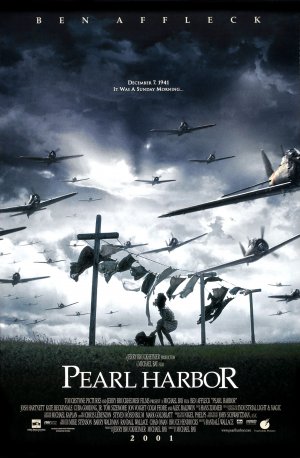
Pearl_harbor_movie_poster

“And then all this happened…”

Nurse Evelyn Johnson (Kate Beckinsale) in Pearl Harbor (2001)

The “this” that Evelyn Johnson is referring to is the Japanese attack on Pearl Harbor.  You know, the date will live in infamy.  The attack that caused the United States to enter World War II and, as a result, eventually led to collapse of the Axis Powers.  The attack that left over 2,000 men died and 1,178 wounded.  That attack.

In the 2001 film Pearl Harbor, that attack is just one of the many complications in the romance between Danny (Ben Affleck), his best friend Rafe (Josh Hartnett), and Evelyn (Kate Beckinsale).  The other complications include Danny briefly being listed as dead, Danny being dyslexic before anyone knew what dyslexia was (and yet, later, he’s still seen reading and writing letters with absolutely no trouble, almost as if the filmmakers forgot they had made such a big deal about him not being able to do so), and the fact that Rafe really, really likes Evelyn.  Of course, the main complication to their romance is that this is a Michael Bay film and he won’t stop moving the camera long enough for anyone to have a genuine emotion.

I imagine that Pearl Harbor was an attempt to duplicate the success of Titanic, by setting an extremely predictable love story against the backdrop of a real-life historical tragedy.  Say what you will about Titanic (and there are certain lines in that film that, when I rehear them today, make me cringe), Leonardo DiCaprio and Kate Winslet had genuine chemistry.  None of that chemistry is present in Pearl Harbor.  You don’t believe, for a second, that Ben Affleck and Josh Hartnett are lifelong friends.  You don’t believe that Kate Beckinsale is torn between the two of them.  Instead, you just feel like you’re watching three actors who are struggling to give a performance when they’re being directed by a director who is more interested in blowing people up than in getting to know them.

Continuing the Titanic comparison, Pearl Harbor‘s script absolutely sucks.  Along with that line about “all this” happening, there’s also a scene where Franklin D. Roosevelt (Jon Voight) reacts to his cabinet’s skepticism by rising to his feet and announcing that if he, a man famously crippled by polio and confined to a wheelchair, can stand up, then America can win a war.

I’ve actually been to Pearl Harbor in Hawaii.  I have gone to the USS Arizona Memorial.  I have stood and stared down at the remains of the ship resting below the surface of the ocean.  It’s an awe-inspiring and humbling site, one that leaves you very aware that over a thousand men lost their lives when the Arizona sank.

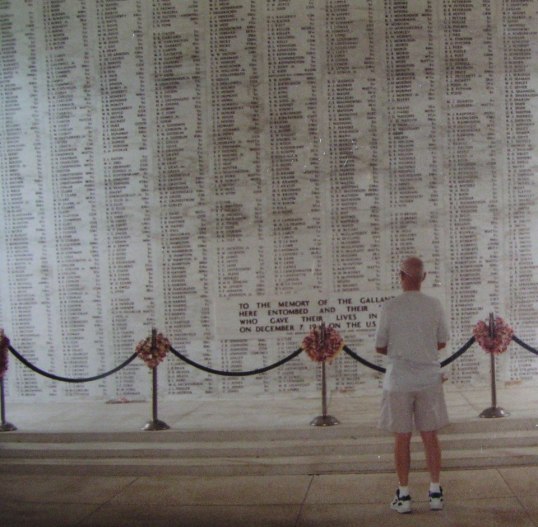
I have also seen the wall which lists the name of everyone who was killed during the attack on Pearl Harbor and until you’ve actually been there and you’ve seen it with your own eyes, you really can’t understand just how overwhelming it all is.  The picture below was taken by my sister, Erin.

Pearl Harbor 2003If you want to pay tribute to those who lost their lives at Pearl Harbor, going to the Arizona Memorial is a good start.  But avoid Michael Bay’s Pearl Harbor at all costs.

Scenes I Love: Gladiator


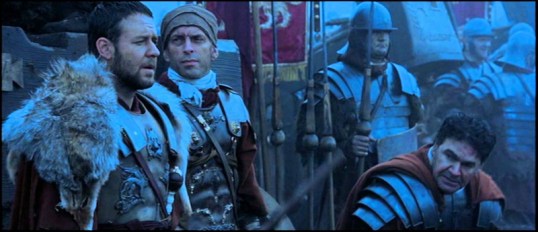
GladiatorBattle

“ROMA VICTOR!”

While Lisa Marie watches Ben-Hur on TCM I decided to revisit one of my favorite films to start of the new millenium. This was a film that helped resurrect sword and sandals epic that had burnt out during the late 60’s. From the late 50’s and throughout most of the 1960’s we had such classic epics as Spartacus, Quo Vadis and Ben-Hur. Then we have the Italian-produced peplum films which ranged from memorable to awful.

In 2000, Ridley Scott released the film that would finally win Russell Crowe an Oscar for Best Actor (one he should’ve won for The Insider in the previous year). Gladiator was a return to the old-school epic-scale filmmaking that we hadn’t seen in decades and audiences ate it all up as it won in the box-office and charmed critics.

I wasn’t sure about Gladiator leading up to it’s release, but I was always up for some hacking and slashing in my entertainment. What changed my mind from just being interested to buying fully into the film was when I first saw it and the opening scene which I dub the Battle of Germania. This opening sequence appealed to my sense of adventure as a viewer and also as a student of history (especially military history). While the scene itself wasn’t as accurate as I would’ve liked it got enough of how the Roman Legions fought as an army correct that I was able to forgive Sir Ridley for some dramatic flourishes that wasn’t historically accurate.

In this scene we see the Legions form up in square ranks with their recognizable scutum (Roman shield) into their typical shield wall formation. There are also the auxiliries acting as long-range support such as archers, catapults and ballista (though the last two were rarely, if ever used outside of sieges). Then there were the Roman cavalry led by Maximus himself (a unit seen less as an elite formation as we see later in the Medieval era). Scott was able to combine all these elements and create a scene that probably was as close as we’d get to seeing how war was waged between the Roman Empire and the so-called barbarian hordes of Germania.

I think this scene would’ve been perfect if the Roman Legion formations remained cohesive and just meat-grinded their enemy in front instead of breaking apart and turning the fight into a free-for-all. Other than that misstep this scene was what I loved about Gladiator.

Quickie Review: The Church aka La Chiesa (dir. by Michele Soavi)


The Italian horror cinema scene has always been dominated by such names as Mario Bava, Dario Argento and Lucio Fulci. Their films became Italy’s contribution to horror cinema and one cannot find a fan of the genre who don’t hold these three gentlemen in high regard. Other names of the Italian horror scene were not as well-known beyond the most hardcore horror fans and some just don’t deserve to be in the same company as the previously mentioned trio. One filmmaker who should be part of their company is one Michele Soavi. He rose through the ranks as an actor at first before moving on to becoming assistant directors for mentors such as Joe D’Amato and Dario Argento. The latter would become a major influence in Soavi’s work and would help produce some of his films. One of those Argento would end up producing for Soavi is the 1989 supernatural horror film, The Church (known in Italy as La Chiesa).

The Church wasn’t one of Soavi’s best films, but it was still one of the better horror films to come out of Italy during the waning years of the 80’s when Italian horror began a slow decline. Starring a very young Asia Argento (hard to believe that a career which began with reports of nepotism would turn out to be a successful one in and out of Italy) and an Italian-American actor named Tomas Arana (people would know him best as the ambitious Quintus in Ridley Scott’s Gladiator), the film starts off with a cohort of Teutonic Knights who destroy and kill a town suspected of witchcraft. The bodies of all killed soon get dumped into a mass grave and sealed with a huge metal cross and prayers to keep the evil that was done from ever coming out.

The beginning does have a somewhat ambiguous tone to it as we the audience don’t know if the villagers were indeed evil. Soavi definitely leaves that up in the air until the final third of the film kicks in and most of the horror scenes appear to satisfy gore fans. The knights destroying the village was well-staged and executed with some cool kill-scenes and effects.

It’s the middle reel where the film slowed down to the point that could lose the more casual horror fan. We get the usual non-believer researcer (Arana) who stumbles upon the ancient cross sealing the mass grave beneath the church that had been built over it down the centuries. Even this researcher and another knows that they should leave it alone, but being the scientists one of them proceeds to unseal the find with the reasoning that pursuit of knowledge should triumph over supersitition. Thus, the church becomes the scene of demonic possessions of various individuals. First, the initial researcher who opens unseals the cross then the parents of Asia Argento’s character before moving on to churchgoers who become trapped in the church after some demonic force seals all exits.

The rest of the film once that church seals itself is one person either getting killed by those possessed by the demons escaping from the sealed grave or someone getting possessed. This third act actually has a touch of Fulci’s nightmarish-style and less of Argento’s more dream-like quality. There’s a beautiful scene of Tomas Aranas’ character made-up to be some verdigrised-bronze angel statue, wings and all, embracing a very naked young woman that looked straight out of a Luis Royo painting. Another scene where regular Soavi actor Barbara Cupisti was shown in sexual congress with a demonic being that should give more than a few people nightmares despite being framed and shot in a beautiful manner.

The final nightmare scene of beauty which pushes The Church over into Fulci territory is when a mass of naked, muddied bodies of all those possessed entwine and writhe to form the likeness of a demon’s head. This sequence alone was worth watching through the much slower middle section of this film and Soavi’s eye for staging and lighting the scene made it look like something out of the pages of Dante Alighieri’s Divine Comedy.

One could say that The Church just didn’t live up to the usual quality one expected out of a Michele Soavi film after a he made the excellent giallo-slasher film Stage Fright just two years prior. This second full-lenght feature by Soavi showed him still honing his talent as a filmmaker which would finally culminate five years later in one of the best Italian horror films and one of the best films in the zombie subgenre with his Dellamorte Dellamore. Plus, even when he’s not on top of his craft like with The Church it is still worth a watch and better than the stuff released by his contemporaries like Bruno Mattei.