Summer School (1987, directed by Carl Reiner)


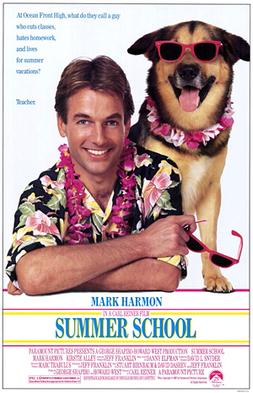
Summer School was the movie that made flunking out look like fun.

Freddy Shoop (Mark Harmon) is a relaxed, fun-loving gym teacher who is looking forward to spend his summer in Hawaii until he’s assigned to spend the summer teaching remedial English in summer school.  (His girlfriend goes to Hawaii without him.)  Freddy’s not happy about giving up his summer and he’s prepared to just spend his days taking his students to the beach, the amusement park, and the zoo.  But when he finds out that he’s going to lose his job unless his students pass the big test at the end of the summer, he gets serious and discovers what teaching is supposed to be all about.

When I was growing up, Summer School seemed to be on television all the time.  If it wasn’t on HBO, it was on one of the local stations, usually right before summer began.  The summer school kids seemed to be having too much fun for kids stuck in school.  I don’t think my classmates in Baltimore would have been as happy about losing their summer as the students in this film.  Everyone who has seen this film remembers Dave and Chainsaw (Gary Riley and Dean Cameron) making jokes and showing everyone The Texas Chainsaw Massacre.  They also remember Anna-Maria (Fabiana Udenio), the Italian exchange student who took summer school to work on her English.  They remember Freddy letting one of his students move in with him, which doesn’t seem like a good idea even if she was played by Courtney Thorne-Smith.  Myself, I remember Robin Bishop, the teacher next door, who was played by an extremely sexy Kirstie Alley.  (This was one of the many 80s films in which Kirstie Alley made being uptight seem sexy.)  Of course, Robin was dating the snobbish principal who was trying to get Freddy Shoop fired.

I’m not going to sit here and say that Summer School is a great film.  It’s a dumb comedy with an uplifting message about what a good teacher can accomplish.  However, Summer School is a very likable film, an enjoyable 80s teen romp that suggests summer school was the place to be in the late 80s.  Mark Harmon, Kirstie Alley, and all the students give good performances.  How many future horror nerds were inspired by Dave and Chainsaw?  Legendary nice guy Carl Reiner directed and the movie itself is amiable and amusing enough to be watchable.

Film Review: Kelly’s Heroes (dir by Brian G. Hutton)


1970’s Kelly’s Heroes takes place in France during the Second World War.  The American army is moving through the country, liberating it town-by-town.  Private Kelly (Clint Eastwood) is a former lieutenant who was busted down in rank after leading a disastrous raid on the wrong hill.  (It was the fault of the generals but Lt. Kelly was set up as a scapegoat.)  When Kelly learns that the Germans are hiding a huge amount of gold in an occupied town, he gathers together a team of weary soldiers, misfits all, and plans to go AWOL to steal the gold for themselves.

Kelly’s Heroes was one of the big budget studio films that Eastwood made after finding stardom in Europe with Sergio Leone’s Spaghetti westerns.  This is very much an ensemble film, in the vein of The Dirty Dozen.  Indeed, Eastwood’s co-star, Telly Savalas, was in The Dirty Dozen.  Here, Savalas plays Big Joe, the sergeant who isn’t sure that he wants to put his men in danger for gold that may or may not exist.  Don Rickles plays Crapshoot who is …. well, imagine Don Rickles in the middle of World War II and you have a pretty good idea of who Crapshoot is.  Stuart Margolin, Harry Dean Stanton, Perry Lopez, Gavin MacLeod shows up as soldiers.  Carroll O’Connor plays the bombastic general who mistakes Kelly’s attempts to go AWOL for a brilliant tactical maneuver,  Like all of the senior officers in this film, O’Connor’s general is a buffoon.  Kelly’s Heroes was made during the Vietnam War and, much like Patton (released the same year), it attempts to appeal to both the establishment and the counterculture by making the heroes soldiers but their bosses jerks.

And that brings us to Donald Sutherland, who plays a tank commander named Oddball.  You may not have know this but apparently, there were hippies in the 40s!  Actually, I don’t think that’s true but there’s really no other way to describe Oddball than as a Hollywood hippie.  He’s a blissed-out, spacey guy who thinks nothing of accidnetally driving his tank through a building.  The films ask us to believe that the long-haired and bearded Oddball is a World War II tank commander and Sutherland is such a likable presence that it’s temping to just go with it.  Oddball was obviously included to bring in “the kids” but he does generate some needed laughs.  This is a very long movie and the comedic moments are appreciated.

Kelly’s Heroes is two-and-a-half hours long and it definitely could have been shorter.  Director Brian Hutton allows some scenes to drag on for a bit too long and he sometimes struggles to balance the moments of comedy with the moments of violent drama (quite a few character dies) but he does get good performances from his ensemble.  Eastwood’s taciturn acting style is nicely matched with Savalas’s more expressive style and it’s hard not smile at Don Rickles, insulting everyone as if they were guests at Joe Gallo’s birthday party.  The film, at times, doesn’t seem to know if it wants to be a satire or a straight heist film but the cast keep things watchable.  Eastwood even gets to show a few hints of the dry sense of humor that always hid behind the perpetually bad mood that often seemed to hang over him in his early films.  Whatever flaws the film may have, it was a box office success.  One year after this release of Kelly’s Heroes, Eastwood would make history as Dirty Harry.

Icarus File No. 17: Che! (dir by Richard Fleischer)


Che Guevara!

By most accounts, Che Guevara epitomized the excesses and the hypocrisies of the extreme Left.  He spoke of the class struggle while remaining an elitist himself.  He oversaw thousands of executions and advocated for authoritarian rule.  In his writings, he frequently revealed himself to be a racist and a misogynist.  By arguing that the Russians should be allowed to bring nuclear missiles to Cuba, he brought the world to the brink of destruction.  However, he also died relatively young and he looked good on a t-shirt.  Decades after he was executed by the Bolivian Army in 1967 (or was it the CIA?), he remains an icon for college students and champagne socialists everywhere.

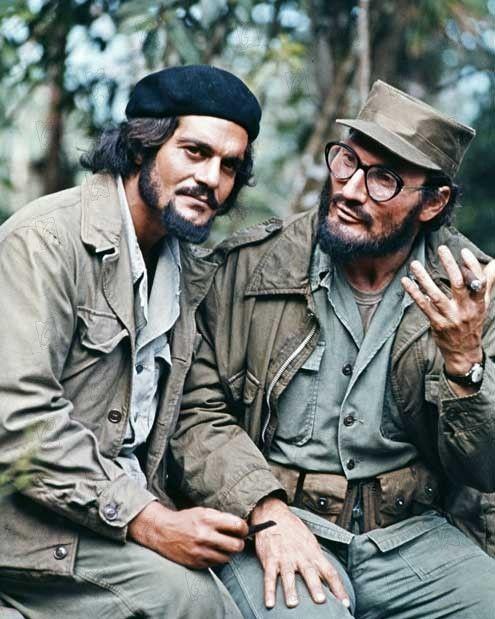
The film about Che! was released in 1969, two years after his death.  Starring the Egyptian actor Omar Sharif as Che Guevara, Che! opens with Guevara already a martyr and then quickly gives way to flashbacks.  Various actors pretending to be Cuban appear and speak directly to the audience, debating Che Guevara’s legacy.  Some describe him as being a violent thug who killed anyone who displeased him.  Others describe him as a visionary doctor who sacrificed his comfortable existence for the people.  It’s a rather conventional opening and one that hints that Che! is going to try to have it both ways as far as Che’s legacy is concerned.  But it’s still effective enough.  A montage of soldiers and rebels creates the proper feeling of a society on the verge of collapse.

And then Jack Palance shows up.

Palance first appears creeping his way through the Cuban jungle with a group of soldiers behind him.  Palance is chomping on a cigar and he wears the intense look of a man on a mission.  My initial reaction was that Palance was playing one of the CIA agents who sent to Cuba to try to assassinate Fidel Castro or to set up the Bay of Pigs invasion.  I kept waiting for him to look at the camera and launch into a monologue about why, for the safety of America, he had been dispatched the topple Cuba’s communist government.  Imagine my shock when Omar Sharif called Palance, “Fidel.”

Yes, that’s right.  Jack Palance plays Fidel Castro!  As miscast as the suave Omar Sharif is as Che Guevara, nothing can prepare one for seeing Jack Palance playing Fidel Castro.  Needless to say, there is nothing remotely Cuban or even Spanish about Jack Palance.  He delivers his lines in his trademark terse Jack Palance voice, without even bothering to try any sort of accent.  (And, needless to say, both he and Sharif speak English through the entire film.)  Anyone who has ever seen a picture of a young Fidel Castro knows that, while he shared a family resemblance with Justin Trudeau, he looked nothing like Jack Palance.  Eventually, Palance puts on a fake beard that makes him look even less like Castro.  When one of our narrators mentions that Castro was a great speaker, the film cuts to a scene of Palance spitting out communist slogans with a noted lack of enthusiasm.  When Castro takes control of Cuba, Palance looks slightly amused with himself.  When Che accused Castro of selling out the revolution, Palance looks bored.  It’s a remarkably bad piece of casting.  Seeing Palance as Castro feels like seeing John Wayne as Genghis Khan.  Thank goodness Hollywood never tried anything that silly, right?  Anyway….

As for the rest of the film, it hits all the expected notes.  The film was made in the very political year of 1969, a time when the New Left was ascendant and many considered Che Guevara to be a hero.  However, since this was a studio production, Che! tries to appeal to both college radicals and their parents by taking a “both sides” approach to Che Guevara.  Here’s Che teaching an illiterate farmer how to read.  Here’s Che overseeing a bunch of dissidents being executed.  Here’s Che getting angry at Castro for not being properly enthusiastic about housing Russian nuclear missiles.  Here’s Che talking about a moral revolution.  Here’s Che trying to start an unwanted war in Bolivia.  Here’s Che talking to Sid Haig — hey, Sid Haig’s in this film!

Like so many mainstream political films of the 60s and today, Che! tries to be political without actually taking any firm positions.  One is tempted to say that is the film’s downfall.  Of course, the film’s real downfall is casting Jack Palance as Fidel Castro.

There’s no way to recover from that.

Late Night Retro Television Review: CHiPs 2.16 “Pressure Point”


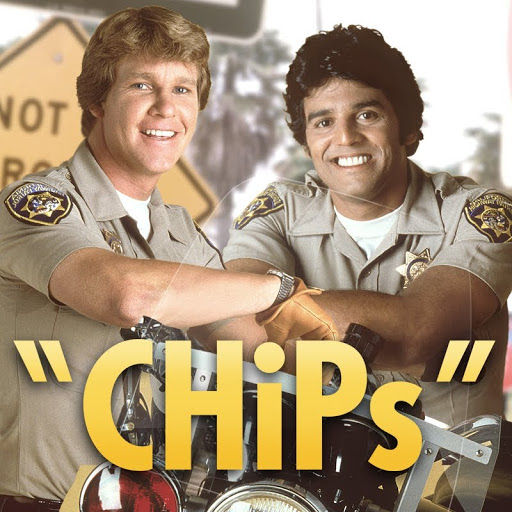
Welcome to Late Night Retro Television Reviews, a feature where we review some of our favorite and least favorite shows of the past!  On Mondays, I will be reviewing CHiPs, which ran on NBC from 1977 to 1983.  The entire show is currently streaming on Freevee!

This week’s episode is a change-of-pace as Ponch and Baker get off their motorcycles and go undercover!

Episode 2.16 “Pressure Point”

(Dir by Phil Bondelli, originally aired on January 20th, 1979)

The limousine of wealthy industrialist Arthur Forbinger (Rudy Vallee) is ambushed by three cars and a motorcycle.  The motorcyclist shatters both the back and the front driver’s side window and tosses an envelope into the backseat.  Forbinger orders his driver to chase the motorcycle.

Ponch and Baker, enjoying a leisurely patrol through Beverly Hills, spot the limo speeding down the street and they decide to pursue it.  When Forbinger finally tells his driver to pull over, Ponch and Baker demands to know why Forbinger was putting lives at risk.  Forbinger lies and says that he was late to a meeting.  In reality, Forbinger has just opened the envelope and discovered pictures of his granddaughter, Chris (Mary Crosby).  The implication is that whoever broke his window can also get to Chris.

Despite Forbinger’s attempts at deflection, Ponch, Baker, and Cahill soon figure out what actually happened.  Thinking that Forbinger is perhaps being targeted by a private security firm that scares rich people into hiring its guards, Getraer tells Ponch and Baker to get off their motorcycles because they’re going undercover.  Ponch will pretend to be a diplomat from Argentina and Baker will be his driver.

Ponch is overjoyed to at the chance to pretend to be rich.  He’s even happier when he meets Chris.  Oh, that Ponch!

This episode was weird.  It just doesn’t feel right for Ponch and Baker to not be on their motorcycles and the episode spent so much time with Forbinger and Chris that I found myself wondering if it was meant to be some sort of backdoor pilot for a primetime soap opera about the Forbinger family.  Despite featuring quite a few chase scenes and a few dramatic crashes, this didn’t feel like an episode of CHiPs at all.  Is there really a point to the show without the motorcycles?

The other problem with this episode was that the performance of Rudy Vallee …. well, it wasn’t good.  I know that Rudy was a show business veteran when he did this episode and that he had been around for a while but he still gives a rather flat and lifeless performance.  He delivers his lines as if reading them off of a cue card.  (For all I know, he was reading them off of a cue card.)  As for the rest of the guest cast, Mary Crosby is stuck with a nothing role while Guy Stockwell and Tom Troupe are a bit too obviously sinister as the duplicitous security men.

This episode went for a change of pace but it just didn’t work.  Sorry, Highway Patrol.

Night Gallery 1.4 “Make Me Laugh/Clean Kills And Other Trophies”


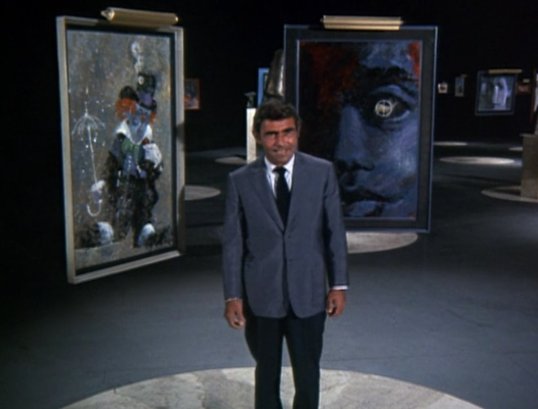
The fourth episode of Night Gallery originally aired on January 6th, 1971.  It was the first episode of the new year and it continued to open with Rod Serling walking through a most curious museum, inviting us to take a look at the macabre paintings on display and consider the stories behind them.

This episode featured two stories.

Make Me Laugh (dir. by Steven Spielberg, written by Rod Serling)

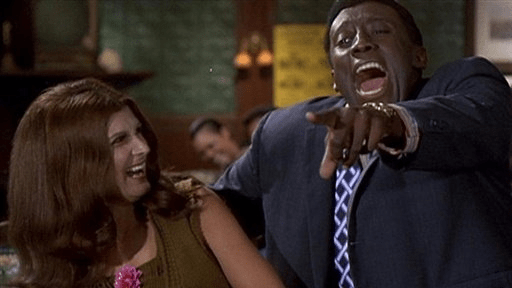
Jackie Slater (Godfrey Cambridge) is a comedian who can’t make anyone laugh.  He’s just been fired from his latest job and even his loyal agent (Tom Bosley) is suggesting that it might be time to throw in the proverbial towel.  While Jackie drowns his sorrows at a bar, he’s approached by a man named Catterje (Jackie Vernon).  Chatterje explains that he can cast miracles but, because he’s not very good at his job, the miracles often have unintended consequences.  “I don’t care!”  Jackie says, “I’ll take the risk!”  Jackie wants people to laugh at him.  Jackie gets his wish but it turns out that he should have listened to Chatterje’s warning.

This segment was directed by Steven Spielberg, back when he was just starting his career and he was largely working in television.  Spielberg also directed Eyes, which was a highlight of the Night Gallery pilot.  Unfortunately, his direction of Make Me Laugh is a bit less successful than his work on Eyes.  Spielberg’s direction features none of the inspired touches that made Eyes so successful.  Part of the problem may be that this story takes place in the word of comedy and comedy has never been a topic for which Spielberg has shown much affinity.

Make Me Laugh does feature a good lead performance from Godfrey Cambridge.  Otherwise, this segment is largely forgettable.

Cleans Kills And Other Trophies (dir by Walter Doniger, written by Rod Serling)

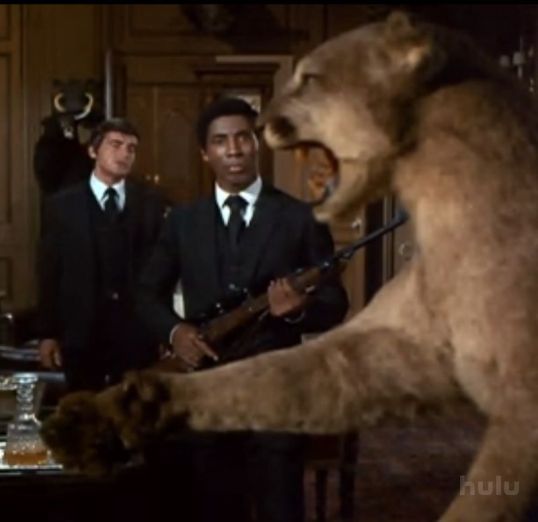
Raymond Massey plays Col. Archie Dittman, a wealthy racist who is obsessed with hunting and killing.  He even has a study full of the mounted heads of all of the animals that he’s killed.  Archie’s son, Archie, Jr. (Barry Brown), has just graduated from college and has no interest in hunting.  Col. Dittman demands that his son go on a hunt or risk being disinherited.  What the colonel fails to take into consideration is that both his bloodlust and his racism has offended his butler (Herbert Jefferson, Jr.) and that his butler has a magic-related revenge in mind.

Clean Kills and Other Trophies is hardly subtle but it does create and maintain a properly ominous atmopshere.  Raymond Massey gives a wonderfully villainous performance and it’s hard not to be amused by the fact that his son is wearing a peace signal prominently on his lapel, as if the segment’s director took one look at it and said, “What’s one thing that we can do to make the themes of this segment even more heavy-handed?”  The segment ends on a note that is so entertainingly over-the-top that it’s hard not to love it.

This episode was uneven.  Make Me Laugh does’t quite work but Cleans Kills and other Trophies is good enough to make up for the disappointing segment that precedes it.

Previous Night Gallery Reviews:

  1. The Pilot
  2. The Dead Man/The Housekeeper
  3. Room With A View/The Little Black Bag/The Nature of the Enemy
  4. The House/Certain Shadows on the Wall