Lisa Marie Reviews An Oscar Nominee: Apocalypse Now (dir by Francis Ford Coppola)


1979’s Apocalypse Now reimagines the Vietnam War as pop art.

Jim Morrison sings The End in the background as slow-motion helicopters pass in front of a lush jungle.  The jungle erupts into flame while in a dingy hotel room, Captain Benjamin Willard (Martin Sheen) gets drunks, practices his karate moves, and smashes a mirror before collapsing to the floor in tears.  The next morning, the hung-over and bandaged Willard ends up at a U.S. military base where he has a nice lunch with Lt. General Corman (G.D. Spradlin) and Col. Lucas (Harrison Ford) and a nearly silent man wearing an undone tie.  Willard is asked if it’s true that he assassinated an enemy colonel.  Willard replies that he did not and that the operation was classified, proving that he can both lie and follow military protocol.  Willard is told that a Col. Walter Kurtz (Marlon Brando) has gone rogue and his mission is to go into Cambodia and terminate his command with “extreme” prejudice.  It’s a famous scene that features G.D. Spradlin delivering a brilliant monologue about good and evil and yet it’s often missed that Willard is getting his orders from Roger Corman and George Lucas.

(Roger Corman was the mentor of director Francis Ford Coppola while the pre-Star Wars George Lucas was Coppola’s business partner.  Indeed, Apocalypse Now was originally somewhat improbably planned to be a George Lucas film.)

Up the river, Willard heads on a patrol boat that is populated with characters who could have come out of an old World War II service drama.  Chief (Albert Hall) is tough and no-nonsense.  Lance (Sam Bottoms) is the goofy comic relief who likes to surf.  Clean (Laurence Fishburne) is the kid who is obviously doomed from the minute we first see him.  Chef (Fredric Forrest) is the overage, tightly-wound soldier who just wants to find mangoes in the jungle and who worries that, if he dies in a bad place, his soul won’t be able to find Heaven.  The Rolling Stones are heard on the boat’s radio.  Soldiers on the other patrol boats moon the boat and toss incendiary devices on the roof.  It’s like a frat prank war in the middle of a war.

Colonel Bill Kilgore (Robert Duvall) is a badass calvary officer whose helicopter raids are legendary amongst the enemy and a dedicated surfer who tries to turn every night into the equivalent of an AIP Beach Party film.  He’s a brilliant warrior who speaks with Malibu accent (“Charlie don’t surf!”) and who doesn’t flinch when a bomb goes off near him.  “I love the smell a napalm in the morning,” he says and, for a few moments, you really wish the film would just abandon Willard so we could spend more time with Kilgore.  “Some day this war is going to end,” he says with a reassuring nod, showing a non-neurotic attitude that is the opposite of Kurtz’s.  Willard says that he could tell Kilgore was going to get through the war without even a scratch and it’s true.  Kilgore doesn’t try to rationalize or understand things.  He just accepts the reality and adjusts.  He’s a true surfer.

The film grows progressively more surreal the closer the boat heads up the river and gets closer to Cambodia.  A USO show turns violent as soldiers go crazy at the sight of the Playboy Bunnies, dressed in denim outfits and cowboy hats and twirling cap guns like the love interest in a John Wayne western.  A visit to a bridge that is built every day and blown up every night is a neon-lit, beautiful nightmare.  Who’s the commanding officer?  No one knows and no one cares.

The closer Willard gets to Kurtz, the stranger the world gets.  Fog covers the jungles.  A tiger leaps out of nowhere.  Dennis Hopper shows up as a photojournalist who rambles as if Billy from Easy Rider headed over to Vietnam instead of going to Mardi Gras.  Scott Glenn stands silently in front of a temple, surrounded by dead bodies that feel as if they could have been brought over from an Italian cannibal film.  Kurtz, when he shows up, is an overweight, bald behemoth who talks in riddles and who hardly seem to be the fearsome warrior that he’s been described as being.  “The horror, the horror,” he says at one point in one of the few moments that links Apocalypse Now to its inspiration, Joseph Conrad’s Heart of Darkness.

Directed by near-communist Francis Ford Coppola and written by the unapologetically right-wing John Milius, Apocalypse Now is actually less about the reality of Vietnam and more about how the images of the war shaped pop culture the world over.  It’s a reminder that Vietnam was known for being the first television war and that counterculture was not just made up of dropouts but also of writers, actors, and directors.  Kurtz may say that Willard’s been sent by grocery store clerks but actually, he’s been sent by the B-movie producers who first employed and mentored the directors and the actors who would eventually become the mainstays of the New Hollywood.  The film subverts many classic war film cliches but, at the same time, it stays true to others.  Clean dying while listening to a tape recording of his mother telling him not to get shot and to come home safe is the type of manipulative, heart-tugging moment that could have appeared in any number of World War II-era films.  And while Coppola has always said the film was meant to be anti-war, Col. Kilgore remains the most compelling character.  Most viewers would probably happily ride along with Kilgore while he flies over Vietnam and plays Wagner.  The striking images of Vietnam — the jungle, the explosions, the helicopters flying through the air — stay in the mind far more than the piles of dead bodies that appear in the background.

It’s a big, messy, and ultimately overwhelming film and, while watching it, it’s hard not to get the feeling that Coppola wasn’t totally sure what he was really trying to say.  It’s a glorious mess, full of stunning visuals, haunting music, and perhaps the best performance of Robert Duvall’s legendary career.  The film is too touched with genius to not be watchable but how one reacts overall to the film will probably depend on which version you see.

The original version, which was released in 1979 and was nominated for Best Picture, is relentless with its emphasis on getting up the river and finding Kurtz.  Willard obsesses on Kurtz and really doesn’t have much to do with the other people on the boat.  It gives the story some much-needed narrative momentum but it also makes Kurtz into such a legendary badass that it’s hard not to be disappointed when Willard actually meets him.  You’re left to wonder how, if Kurtz has been living in the jungle and fighting a brutal and never-ending guerilla war against the communists, he’s managed to gain so much weight.  Brando, who reportedly showed up on set unprepared and spent days improvising dialogue, gives a bizarre performance and it’s hard to view the Kurtz we meet as being the Kurtz we’ve heard about.  As strong as the film is, it’s hard not to be let down by who Kurtz ultimately turns out to be.

In 2001 and 2019, Coppola released two more versions of the film, Redux and The Final Cut.  These versions re-inserted a good deal of footage that was edited out of the original cut.  Most of that footage deals with Willard dealing with the crew on the boat and it’s easy to see why it was cut.  The scenes of Willard bonding with the crew feel out of character for both Willard and the rest of the crew.  A scene where Willard arranges for Clean, Lance, and Chef to spend time with the Playboy bunnies seems to go on forever and features some truly unfortunate acting.  Worst of all, Redux totally ruins Kilgore’s “I love the smell of napalm in the morning” monologue by having Willard suddenly steal his surf board.  Again, it’s out of character for Willard and it actually feels a bit disrespectful to Duvall’s performance to suddenly turn Kilgore into a buffoon.

But then there are moments that do work.  I actually like the lengthy French Plantation scene.  By the time Willard, Lance, and Chef stumble into the plantation,  the journey upriver has gotten so surreal that it makes a strange sort of sense that they would run into a large French family arguing politics while a clown tries to keep everyone distracted.  The new versions of the film are undeniably disjointed but they also shift the focus off of finding Kurtz and place it more on Willard discovering how weird things are getting in Vietnam.  As such, it’s less of a disappointment when Kurtz actually shows up.  Much as with the French Plantation scene, the journey has become so weird that Kurtz being overweight and pretentious feels somehow appropriate.

What all the versions of the film have in common is that they’re all essentially a neon-lit dream of pop cultural horror.  Is Apocalypse Now a horror film?  Critic Kim Newman argued that it owed a lot to the genre.  Certainly, that’s the case when Willard reaches the temple and finds himself surrounded by corpses and and detached heads.  Even before that, though, there are elements of horror.  The enemy is always unseen in the jungle and, when they attack, they do so quickly and without mercy.  In a scene that could almost have come from a Herzog film, the boat is attacked with toy arrows until suddenly, out of nowhere, someone throws a very real spear.  Until he’s revealed, Kurtz is a ghostly figure and Willard is the witch hunter, sent to root him out of his lair and set his followers on fire.  If the post-60s American horror genre was shaped by the images coming out of Vietnam then Apocalypse Now definitely deserves to be considered, at the very least, horror-adjacent.

Apocalypse Now was controversial when it was released.  (It’s troubled production had been the talk of Hollywood for years before Coppola finally finished his film.)  It was nominated for Best Picture but lost to the far more conventional Kramer vs Kramer.  Robert Duvall was the film’s sole acting nominee but he lost the award to Melvyn Douglas’s turn in Being There.  Douglas was very good in Being There and I imagine giving him the Oscar was also seen as a way of honoring his entire career.  That said, Duvall’s performance was amazing.  In his relatively brief screen time, Duvall somehow managed to take over and ground one of the most unruly films ever made.  The Oscar definitely should have gone to him.

As for the film itself, all three versions, flaws and all, are classics.  It’s a film that proves that genius can be found in even the messiest of productions.

Horror on the Lens: Night of the Ghouls (dir by Edward D. Wood, Jr.)


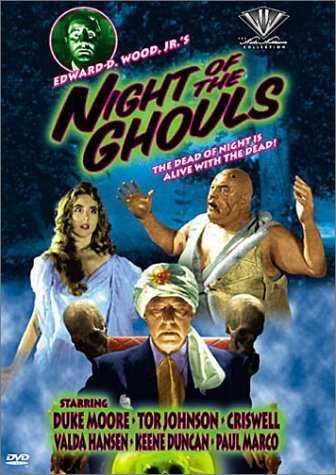
GhoulsdvdToday we celebrate Ed Wood’s 100th birthday with his sequel to Bride of the Monsters.  In Night of the Ghouls, con man Dr. Alcula (Kenne Duncan) moves into Bela Lugosi’s old mansion and pretends to talk to the dead.  What Alcula doesn’t realize is that the house is actually haunted (by Tor Johnson’s Lobo, among others) and real ghosts don’t appreciate pretend ghosts.

What can you say about a film like of Night of the Ghouls?  It’s an Ed Wood film, with all that suggests.  However, how can you resist a film that starts with Criswell sitting up in his coffin and providing commentary?

The role of Dr. Alcula was originally written for Bela Lugosi.  After Lugosi’s death, veteran actor and longtime Wood friend Kenne Duncan got the role instead.  Also of note, Wood appears twice in this film.  Not only does his picture appear on a wanted poster in the police station but Wood also plays one of the ghouls.

Horror on the Lens: Plan 9 From Outer Space (dir by Edward D. Wood, Jr.)


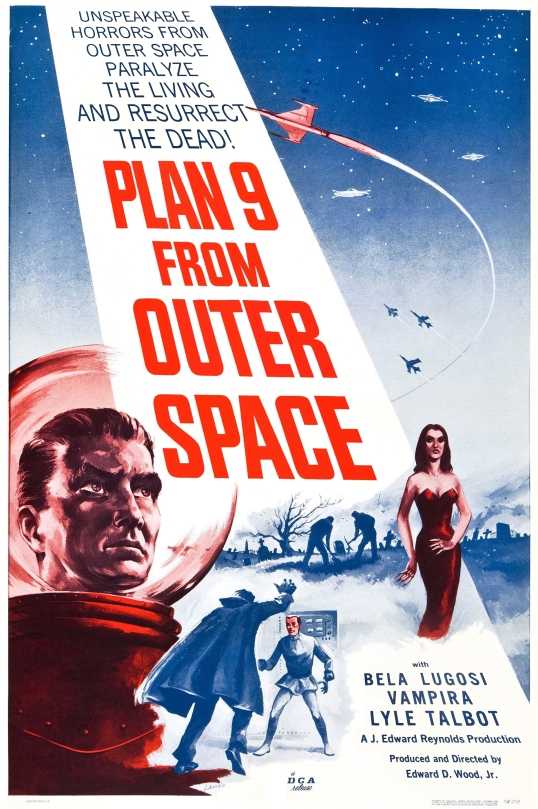
Viewing Plan 9 From Outer Space during October is a bit of a tradition around these parts and here at the Shattered Lens, we’re all about tradition.  And since the 100th anniversary of the birth of Ed Wood, Jr. is just a five days away, it just seems appropriate to watch his best-known film.

Speaking of tradition, this 1959 sci-fi/horror flick is traditionally cited as the worst film ever made but I don’t quite agree.  For one thing, the film is way too low-budget to be fairly judged against other big budget fiascoes.  If I have to watch a bad movie, I’ll always go for the low budget, independent feature as opposed to the big studio production.  To attack Ed Wood for making a bad film is to let every other bad filmmaker off the hook.  Ed Wood had his problems but he also had a lot of ambition and a lot of determination and, eventually, a lot of addictions.  One thing that is often forgotten by those who mock Ed Wood is that he drank himself to death and died living in squalor.  The least we can do is cut the tragic figure some slack.

Plan 9 From Outer Space is a ludicrous film but it’s also a surprisingly ambitious one and it’s got an anti-war, anti-military message so all of you folks who have hopped down the progressive rabbit hole over the past few years should have a new appreciation for this film.  I mean, do you want the government to blow up a Solarnite bomb?  DO YOU!?

Also, Gregory Walcott actually did a pretty good job in the lead role.  He was one of the few members of the cast to have a mainstream film career after Plan 9.

Finally, Plan 9 is a tribute to one man’s determination to bring his vision to life.  Ed Wood tried and refused to surrender and made a film with a message that he believed in and, for that, he deserves to be remembered.

Now, sit back, and enjoy a little Halloween tradition.  Take it away, Criswell!

Can you prove it didn’t happen?

WELL, CAN YOU!?

Love On The Lens: The Amy Fisher Story (dir by Andy Tennant)


Poor Mary Jo Buttafuoco!

As seen in the 1993 made-for-tv movie, The Amy Fisher Story, Mary Jo (Laurie Paton) was just a normal Long Island housewife.  She was married to an auto mechanic named Joey (Anthony John Denison).  She had a family and a nice house and a seemingly perfect life.  But, one day, a teenage girl named Amy Fisher (played by a young Drew Barrymoe) showed up at her front door and claimed that her younger sister was having an affair with Joey.  When Mary Jo accused Amy of lying and then said she was going to call her husband, Amy pulled a gun and shot Mary Jo in the head.  That Mary Jo survived, albeit with partial facial paralysis, was a miracle.

The Amy Fisher Story was the third of the movies to be based on the true story of Amy Fisher and her affair with Joey Buttafuoco.  If Casualties of Love portrayed Amy as being an obsessed stalker who targeted a saintly man and if Amy Fisher: My Story portrayed Amy as a vulnerable teen who was groomed by a sleazy older man, The Amy Fisher Story suggests that perhaps the truth was somewhere in between.  As played by Drew Barrymore, Amy Fisher is immature, unstable, and self-destructive even before she meets Joey Buttafuoco.  As played by Anthony John Denison, Joey is a cocky and arrogant womanizer who grooms a teenage girl and leads her to believe that the only thing keeping them from being truly together is the fact that he has a wife.  (If Casualties portrayed Joey as being a dumb, salt-of-the-Earth type of guy and Amy Fisher: My Story portrayed him as being coldly manipulative and cruel, The Amy Fisher Story portrays him as being a self-centered idiot who did whatever he felt like doing without thinking about any possible consequences.)  Of all the performers who played Amy and Joey, Drew Barrymore and Anthony John Denison are the most convincing.  On the one hand, that lends a credibility to this film’s version of the events that led to the shooting of Mary Jo.  On the other hand, it also means that neither of the main characters is particularly likable.

The film instead tries to make a hero out of a reporter named Amy Pagnozzi (Harley Jane Kozak), who finds herself assigned to follow the Amy Fisher story when she would much rather be reporting on the upcoming presidential election.  Pagnozzi pops up throughout the story, commenting on the media feeding frenzy and generally acting annoyed by the whole thing.  The problem with this approach is that, for all of Pagnozzi’s condemnation of the country’s tabloid mentality, she’s still a part of the monster.  It’s hard to have sympathy for someone complaining about how a story is covered when they’re the one doing the covering.

Interestingly, for a film that condemns that way the story was covered, The Amy Fisher Story is probably the most tabloid-y of the three films.  Every sordid detail — from Amy and Joey’s motel meetings to Amy’s work as an escort to her subsequent dalliance with a gym owner — is provided in artfully filmed detail.  The result is a film that can feel a bit over-the-top but that’s exactly the right approach to take when it comes to a story like this.  When you’re making a movie about a suburban teenage escort who shoots her boyfriend’s wife, there’s really not much need or room for subtlety.  The Amy Fisher Story works because it fully embraces the melodrama and it features a performance from Drew Barrymore that remind us that, back before she became a permanently cheerful talk show host, Drew was a force of pure chaos.

When it comes to the story of the Fishers and the Buttafuocos, this is the film to see.

Late Night Retro Television Review: Monsters 1.9 “Pool Sharks”


Welcome to Late Night Retro Television Reviews, a feature where we review some of our favorite and least favorite shows of the past! On Wednesdays, I will be reviewing Monsters, which aired in syndication from 1988 to 1991. The entire show is streaming on Tubi.

This week, the stakes are huge when two people play a game of pool.

Episode 1.9 “Pool Sharks”

(Dir by Alan Kingsberg, originally aired on December 17th, 1988)

Gabe (Tom Mason) steps into a run-down bar, carrying a pool cue with him.  There’s only three other people in the bar, a bartender (Page Johnson), a nervous man named Lester (Irving Metzman), and a beautiful woman in a black dress who is named Natasha (Rebecca Downs).  Natasha is easily beating Lester in a game of pool.  Gabe says that he wants the next game.

Both Gabe and Natasha are pool hustlers and neither one makes much of an effort to hide it.  Natasha makes a bet.  If Gabe wins their game, Natasha will give him money.  If Natasha wins, Gabe will …. well, Natasha doesn’t really make it clear what Natasha will win, beyond indicating that Gabe will enjoy it.  As Natasha later explains, the bet is less important than getting Gabe to accept it.  As Natasha puts it, accepting the bet is the same as inviting her in.

As the game progresses, it becomes clear that Gabe did not just randomly walk into the bar.  He specifically tracked down Natasha and he’s not surprised when Natasha mentions that she has to be in bed before the sun rises.  Nor is he particularly surprised to discover that Lester is actually Natasha’s servant.  As they play, Natasha uses her eyes and a flash of her thigh to try to hypnotize Gabe.  Gabe, meanwhile, makes sure that she sees the cross that is hanging around his neck.

Now, as you probably already guessed (and I guess this is a SPOILER if you’re planning on watching this episode on Tubi), Natasha is no ordinary pool hustler.  She’s a vampire, one who feasts upon the men who lose to her in a game of pool.  One of Natasha’s more recent victims was Gabe’s brother.  Gabe came to the pool hall looking for revenge but the only way that he’ll be able to get it is if he beats Natasha at pool.  That might not be easy, as Natasha has magic powers.  But Gabe has a cross so this pool game becomes a battle between the profane and the sacred.

I really enjoyed this episode.  Even though it was fairly obvious from the start that Natasha was a vampire (she was even called “Countess” by Lester at one point), the episode was full of sultry and ominous atmosphere.  Tom Mason and Rebecca Downs were both perfectly cast as the rival players and there was a definite undercurrent of sexual tension to their conversations, one that brought a whole new layer to the show’s revenge plot.  Past episodes of Monsters have struggled when it comes to finding an appropriate way to end each week’s story.  This episode, I’m happy to say, had a perfect and very satisfying ending.  This was a good and enjoyable episode, one that felt almost as if it could have been a mini-episode of True Blood.

Next week’s episode features a bed that eats people!  Woo hoo!

Horror on The Lens: Plan 9 From Outer Space (dir by Edward D. Wood, Jr.)


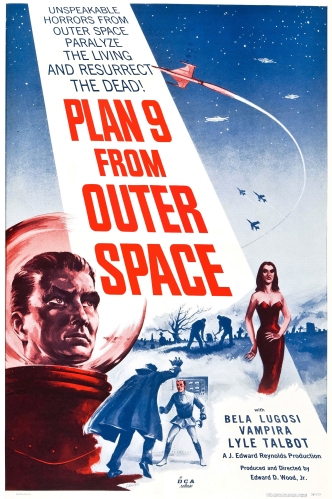
Plan_9_Alternative_posterWatching Plan 9 From Outer Space is a bit of a Halloween tradition around the Shattered Lens Bunker and, if you know anything about me, you know that I’m all about tradition!

First released back in 1959 and directed by the infamous Ed Wood, Plan 9 From Outer Space is often described as being one of the worst films ever made.  Well, every year, I take it upon myself to defend Plan 9 From Outer Space by pointing out that 1) as opposed to a truly terrible film like Man Of Steel, Plan 9 From Outer Space was made with next to no money, 2) Gregory Walcott does a fairly good job in the lead role, and 3) the film, at the very least, does seem to be sincere in its attempt to promote world peace.  Add to that, the film is way too much fun to watch for it to be truly the worst film ever made.

So, seriously, can we at least give Ed Wood the amount of respect that we usually give to Tommy Wiseau?

Enjoy Plan 9 From Outer Space!  And remember — can you prove it didn’t happen?

http://www.youtube.com/watch?v=l5DZhDH8eew