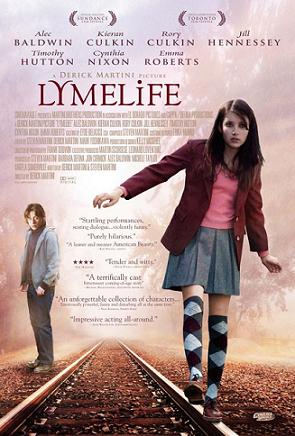
Lymelife is an odd but occasionally effective indie film from 2008. Taking place in 1979, the film tells the story of two brothers living on Long Island. The older brother, Jimmy Bartlett (Kieran Culkin) has recently graduated from high school and is preparing to enter the army. (We hear that he’s going to be shipped off to fight in a war against Argentina, which is odd because, to the best of my knowledge, the U.S. has never been at war with Argentina.) The younger brother is 15 year-old Scott (Rory Culkin), a gentle boy who loves Star Wars and who is doted on by his overprotective mother, Brenda (Jill Hennessy). Scott’s relationship with his father, Mickey (Alec Baldwin), is far less positive with Mickey feeling that his youngest son is weak and Scott resenting the fact that Mickey is always cheating on Brenda.
As the film opens, a recent outbreak of Lyme Disease has got everyone in a panic. Brenda, in particular, is terrified that Scott is going to get bitten by a tick and refuses to let him go outside unless every inch of his skin is covered and protected. Causing Brenda even more panic is the fact that their neighbor, Charlie Bragg (Timothy Hutton), has contracted the disease and has lost his job as a result. Now, he spends all of his time either outside trying to hunt deer or hiding down in his basement. His wife (Cynthia Nixon) is forced to take a job from Mickey in order to support the family and soon, she and Mickey are having an affair.
In fact, the only person who doesn’t completely shun Charlie is Scott, though this is largely because Scott has, for years, had a crush on Charlie’s daughter, Adrianna (Emma Roberts). Adrianna finally starts to return Scott’s affection but then Charlie discovers the truth about his wife’s job with Mickey and things … well, things do not end happily.
Lymelife is a strange film, one that at times almost plays like a parody of a typical indie film. This is one of those films where a lot of things happen but you’re not always quite sure why they happened and ultimately, it’s hard not to feel like the film is essentially a collection of loosely related scenes, all looking for a stronger narrative. But, with all that in mind, I still like Lymelife. Director Derik Martini brings such an intense and humanistic touch to the film’s dangerously quirky storyline and it’s such an obviously personal film that it becomes fascinating in its own way. Not surprisingly, both Alec Baldwin and Jill Hennessy overact in their roles (and considering that they have the most melodramatic lines, that’s not always a good thing) but, fortunately, Timothy Hutton, Emma Roberts, and the Culkin Brothers all give excellent performances.
Plus, the film’s ending is absolutely haunting, largely because of the wise use of the song Running Out Of Empty, which can be heard below.
For the past seven days, I’ve been reviewing — in chronological order — fifty of the most memorable melodramas ever filmed. We started with a silent film from 1916 and now, we have reached the 80s. What better way to kick off the decade than by taking a look at the 1980 Best Picture winner, Ordinary People?
Directed by Robert Redford, Ordinary People tells the story of the upper middle class Jarrett family. On the surface, the Jarretts appear to be the perfect family. Calvin Jarrett (Donald Sutherland) has a successful career. Beth (Mary Tyler Moore) keeps a perfect home and appears to be the ideal suburban matriarch. However, one summer, their oldest son drowns in a sailing accident and their youngest son, sensitive Conrad (Timothy Hutton), attempts to commit suicide. After spending four months in a psychiatric hospital, Conrad come back home and the family struggles to put their lives back together. Even though he starts to see a therapist (Judd Hirsch) and starts dating his classmate Jeannine (Elizabeth McGovern), Conrad still struggles with his feelings of guilt over having survived. Beth’s struggle to maintain a facade of normalcy leads to several fights between her and Conrad with Calvin trapped in the middle.
Among my fellow film bloggers, there’s always going to be a very vocal group that is going to hate Ordinary People because it won the Oscar for best picture over challenging black-and-white films directed by Martin Scorsese (Raging Bull) and David Lynch (The Elephant Man). They always tend to complain that Ordinary People is a conventional film that tells a conventional story and that it was directed by a very conventional director. More than once, I’ve seen an online film critic refer to Ordinary People as being a “big budget Lifetime movie.”
Well, you know what?
I love Lifetime. Lifetime is the best network on television and to me, a big budget Lifetime movie would be the best Lifetime movie of all. And, at the risk of alienating all of my film-loving friends, if I had to choose between watching Raging Bull and Ordinary People, I’m going to pick Ordinary People every time. Raging Bull is visually stunning and features great performances but it’s also two hours spent watching an incredibly unlikable human being beating the crap out of anyone who is foolish enough to love him. Ordinary People may essentially look like a TV show but it’s also about characters that you can understand and that, as the film progresses, you grow to truly care about.
Yes, I do wish that the character of Beth had been given more of a chance to talk about her feelings and it’s hard not to feel that Ordinary People places too much blame on the mother. But, even so, the film still ends with vague — if unlikely — hope that Beth will eventually be able to move past her anger and reconnect with her family. The film may be hard on Beth but it never gives up on her. That’s what distinguishes Ordinary People for me. In many ways, it’s a very sad film. It’s a film that was specifically designed to make you cry and I certainly shed a few tears while I watched it. But, even with its somewhat ambiguous ending, Ordinary People is also a very optimistic movie. It’s a movie that says that, as much pain as we may have in our life,we can recover and life can go on and it’s okay to be sad and its also okay to be happy.
And that’s an important lesson to learn.
(That said, if I had been alive and an Academy voter in 1981, I would have voted for The Elephant Man.)
And, for all you Oscar lovers out there, here are clips of Timothy Hutton and Robert Redford winning Oscars for their work on Ordinary People.
Last night, I watched the “Lifetime world premiere” of the 2008 horror film, The Alphabet Killer.
Why Was I Watching It?
Because I was, okay? Don’t judge me!
Actually, I was watching for 2 reasons:
1) Being the kinda morbid girly girl that I am, my love of a good Lifetime movie is almost equalled by my love for reading about unsolved murders. A little while ago, I was going through my copy of Michael Newton’s Encyclopedia of Unsolved Crimes and I happened to come across the Alphabet Murders. In the early 70s, three young girls were murdered in New York. Each of the girls’ first and last names started with the same letter and each body was found in a town that started with the same letter as the girls’ name. Now, this kinda freaked me out because, if I ever decided to use my mom’s maiden name, then my name would be (Lisa) Marie Marchi. That, of course, would make me a potential victim — especially when you consider that the town of McKinney, Texas is within driving distance. I mean, seriously. File that under things that make you go “Agck!”
2) When I first saw the commercials for the Alphabet Killer (which was advertised as being a “Lifetime world premiere!” even though the film wasn’t originally made for the Lifetime network), I immediately assumed that it had to be one of those terrible Ulli Lommel true crime films. And I was all like, “Really? Ulli Lommel is now a member of the Lifetime family? This, I have to see!” Well, turns out that he’s not and, quite frankly, thank goodness for that. This Alphabet Killer was directed by the director of Wrong Turn, Rob Schmidt.
What’s It About
There’s a serial killer on the loose and fortunately, Detective Eliza Dushku is on the case. Less fortunately, Detective Dushku is already dealing with adult onset schizophrenia…
What Worked
The idea of a schizophrenic detective trying to catch a serial killer is a pretty clever one and director Rob Schmidt did a fairly good job making the audience wonder how much of what we’re watching is a real and how much is just the product of the detective’s psychosis. Eliza Dushku, who kicks ass in general because she was Faith the Vampire Slayer, gives an excellent performance. I had a hard time, at first, believing she was a cop but I did believe her as a schizophrenic and yes, that is meant as a compliment.
As well, the entire cast did a pretty good job, particularly Cary Elwes and Timothy Hutton. Both of them brought some interesting layers of complexity to thinly written characters.
The scenes where the dead would literally confront Eliza Dushku were well done, even though I’ve seen the same scene in countless other horror films.
While I was watching the Alphabet Killer, I had the house to myself because my sister Erin had gone into Arlington for the Rangers game. When I was about halfway through the film (I was watching it off of my DVR), Dallas got hit with the storm of the century. Seriously. It started raining around one in the morning and at 1:10, the power went off. The TV (and the movie) flicked off with a sharp THRACK and the entire house was plunged into darkness. My bedroom was suddenly pitch black and I found myself feeling very vulnerable lying in bed in only my beloved Pirates t-shirt and panties. All I could hear was the sound of rain and hail pounding against the house while somewhere in the distance, sirens wailed. After the first flash of lightning briefly illuminated my shadowy bedroom, I started to count. I had barely started to form the word, “Two…” when a deafening explosion of thunder caused not only the house to shake but me to have to catch my breath. Suddenly, I heard a wailing meow and another flash of lightning briefly revealed my cat Doc sitting in my doorway. Stumbling through the darkness, I managed to get Doc and carry him back to my bed with me. I sat there with him, fully knowing that even though I was trying to protect him, he probably thought he was protecting me. (Or, more likely seeing as how he’s a cat, claiming me as his territory.) Suddenly, a terrible thought entered my mind: “Did I remember to lock the front door? Or the back door?” Was I hearing the wind and rain pounding against my house or was I hearing the Alphabet Killer stumbling around downstairs? Finally, after half an hour of this, the lights finally came back on and I could breathe again. I slowly made my way downstairs (Doc, of course, stayed up in my room and went to sleep) and discovered that I had indeed locked all the doors before the storm. So yay me!
Now that I was fully freaked out, I went ahead and watched the rest of the Alphabet Killer. I’m not sure if it was the movie that kept my uneasy or if it was the storm. All I know is that it worked. (The rain, by the way, mysteriously ended as soon as the movie did.)
What Didn’t Work
This is another one of those films where the idea behind it is actually more clever than the way that the idea is actually executed. Once you get passed the idea that Dushku is schizophrenic, you realize that the film itself is actually pretty predictable. If you can identify the killer from the minute he first appears on screen, then you might not be that smart. Just saying.
Needless to say, The Alphabet Killer has next to nothing to do with the actual case. Normally, this wouldn’t be a big deal because that’s the grindhouse way, right? But in this case, the truth is so interesting that it’s a shame that it was pretty much just shoved over to the side. If there isn’t one already, somebody needs to do one of those hour-long, basic cable documentaries about the Alphabet murders. And Bill Kurtis needs to host it.
“OMG! Just Like Me!” Moments
Honestly, if I was tracking a serial killer, I’d probably do it in much the same way as Eliza Dushku does in this film. By that, I mean I’d probably be way too obsessive for my own good and I’d eventually end up strapped to a table somewhere. Seriously, I just don’t think I’m meant to hunt serial killers.
Lessons Learned
It’s good to be a Bowman and sometimes, storms can actually be scary.
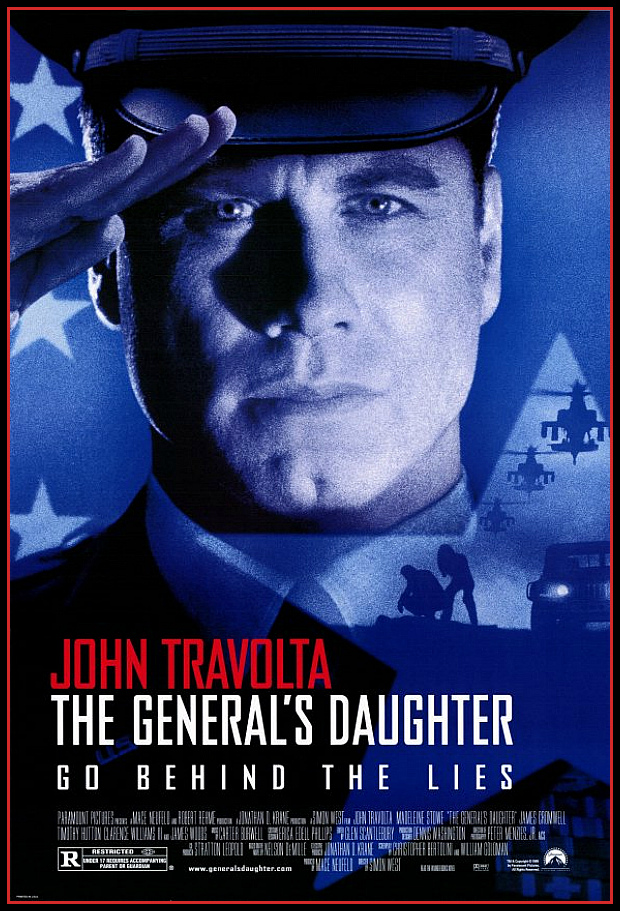
The time around the late 1990’s saw a slew of filmmakers who seemed to have been influenced by the filmmaking style of one Michael Bay. In 1998 one such film which had a certain Michael Bay look to it was the crime thriller The General’s Daughter by filmmaker Simon West (fresh off his success from the previous year’s Con-Air). This film adaptation of the Nelson DeMille novel of the same name starred John Travolta when he was still enjoying the second renaissance of his career brought on by his role in Pulp Fiction.
The General’s Daughter was pretty much a crime procedural wrapped around the secretive and insular world of military life. It has Chief Warrant Officer Paul Brenner (played by Travolta) of the Army’s CID investigating what seems to be the apparent rape and murder of a female officer who also happens to be the daughter of the base’s commandant and political-minded general. Brenner’s soon joined by another CID agent, Sara Sunhill (Madeleine Stowe), who must now navigate the insular world which makes up the officer ranks of the military. They find suspects cropping up faster than they could handle and the one prime suspect in base psychologist Col. Moore (James Wood in an over-the-top performance) has secrets about the victim that could jeopardize the lives and career of not just most of the officers on the base but the victim’s own father. This set-up and the basic understanding of the plot should make for a great thriller, but the by-the-numbers direction by Simon West and the over-the-top performances by too many of the characters in the film sinks The General’s Daughter before it could soar.
The story in of itself really has nothing to drag down the film. From the beginning the screenplay does a great job in tossing red herrings to keep the true murderer secret until the very end. It’s these red herrings which manages to bring out the ultimate reason as to the death of Capt. Elisabeth Campbell (Leslie Stefanson) and how a traumatic event in her past became the one major link which would lead to her death early in the film. It’s how these events were acted out which brings down the script. It’s been said that great performances could raise a mediocre script, but the same could be said for the opposite. Very average to bad performances could drag down a great script.
Travolta’s performance was good enough most of the time. He’s especially good when pouring on the Southern charm to try and gain an advantage over those he’s interacting with, but when he suddenly switches over to tough Army investigator that he goes from just beyond campy to over the line into full-blown camp. The same could be said for pretty much everyone in the film from Stowe’s character who manages to just stand around doing nothing but act as a sort of “gal Friday” for Travolta’s character until the very end when she suddenly becomes a crack investigator to help move the plot along. Clarence Williams III really hams it up as the base general’s right-hand man and one would wonder if he realized he wasn’t actually in a grindhouse or exploitation film when it was time to act.
Despite the performances dragging the film down I must admit that The General’s Daughter was quite watchable and entertaining to a certain level. It’s the film’s inadequacies which also makes it quite a disposable fare that should’ve been more. One wonders how the film would be done today with a different set of actors and a filmmaker who knew the nuances of how to navigate around a thriller. Until the inevitable remake from Hollywood gets greenlit (the way things get remade now it’s bound to happen) it’s this version of The General’s Daughter that’d be on record and it’s a film that has too many bad performances for a great screenplay to overcome. A film that ultimately remains mildly entertaining but forgettable in the end.

 Through the Shattered Lens