Retro Television Review: Fantasy Island 7.5 “Roarke’s Sacrifice/The Butler’s Affair”


Welcome to Retro Television Reviews, a feature where we review some of our favorite and least favorite shows of the past!  On Tuesdays, I will be reviewing the original Fantasy Island, which ran on ABC from 1977 to 1984.  Unfortunately, the show has been removed from most streaming sites.  Fortunately, I’ve got nearly every episode on my DVR.

This week, Roarke is haunted by a past love.

Episode 7.5 “Roarke’s Sacrifice/The Butler’s Affair”

(Dir by Cliff Bole, originally aired on November 12th, 1983)

This is an odd episode.  Both of the stories deal with love.  In one of them, Lee Meriwether plays a woman who is in love with her butler, Efrem Zimbalist, Jr.  She comes to Fantasy Island with a group of friends, all of whom are very judgmental about the idea of Meriwether dating a member of the help.  Mr. Roarke deals with the situation by threatening to reveal all of their secrets.  He explains that he does a thorough background check on everyone who comes to Fantasy Island.  I’m not sure if I buy that because some really bad folks have come to the Island.  Anyway, this story ends with Zimbalist starting to loosen up and Meriwether saying that she was going to continue to train him to be her boyfriend once they returned to the mainland.  I’m not sure if this is so much a love story as much as it’s a “I want to have sex with someone who I pay so they can’t ever say no” story.

The other story is a bit more interesting.  Julie Mars (Cyd Charisse, who I adore) is a dancer who walks with a cane.  It turns out that she and Roarke have been in love for years and the implication is that Roarke spent time with her off of the Island.  This is really a big deal.  It goes against everything that has always been implied about Roarke in the past.  Roarke never leaves the Island, that’s what we believed.  It turns out we were wrong.  He’s not only left the Island before but he’s fallen in love.  Julie’s fantasy is to be able to dance again.  Roarke grants her fantasy and Edmond Rome (Cesar Romero) wants to puts her in a show.  Roarke knows that the only way Julie can continue to dance is if she forgets the love that she has for Roarke.  That doesn’t quite make sense but Roarke just goes with it.  She leaves the Island, acting as if Roarke is just a friendly acquaintance as opposed to being the love of her life.

That was sad!  What made it especially sad is that Roarke doesn’t really have anyone to talk about all of this.  Tattoo was close enough to being an equal that Roarke could open up to him.  Lawrence is just a butler.  Some people confide in their butler.  Some people — as seen in this very episode — fall in love with their butler.  Roarke, however, is lost without Tattoo.

Poor Roarke!

Retro Television Review: The Love Boat 4.8 “The Baby Alarm/Tell Her She’s Great/Matchmaker, Matchmaker Times Two”


Welcome to Retro Television Reviews, a feature where we review some of our favorite and least favorite shows of the past!  On Wednesdays, I will be reviewing the original Love Boat, which aired on ABC from 1977 to 1986!  The series can be streamed on Paramount Plus!

This week …. stuff happens!

Episode 4.8 “The Baby Alarm/Tell Her She’s Great/Matchmaker, Matchmaker Times Two”

(Dir by Ray Austin, originally aired on November 29th, 1980)

This episode opens with Doc, Gopher, and Julie all angry with Isaac.  Apparently, while they were on shore leave, they went to see a church production of MacBeth, one that starred Isaac’s Aunt Tanya (Isabel Sanford) as Lady MacBeth.  Apparently, the play was terrible and Aunt Tanya was even worse and somehow this is Isaac’s fault.

(Myself, I’m more confused by the idea of a church doing a production of MacBeth.)

Isaac, however, has one more favor to ask.  Aunt Tanya is going to be a passenger on the next cruise, along with her husband, Charles (Mel Stewart).  Isaac begs everyone to tell Tanya that she was great in the play.  Everyone acts as if this is the most difficult thing that they’ve ever been asked to do but they finally agree.  Even Captain Stubing agrees, even though he wasn’t at the play.

(Again, I’m confused as to why everyone is so upset over having to be polite to Isaac’s aunt.  Were they all planning on throwing tomatoes at her and booing when she boarded the ship?)

All of the praise goes to Aunt Tanya’s head and, halfway through the cruise, she decides to leave her husband and go to Hollywood to be a star.  Isaac finally has to tell Tanya that she’s not a good actress and that he had to beg his co-workers to be nice to her.  Good Lord, how bad could she have been?  The important thing, though, is that, by crushing Tanya’s dreams and confidence, Isaac is able to save the marriage.

Speaking of marriage, Mr. and Mrs. Clark (Troy Donahue and Terry Moore) think that it would be great if their son, Brett (Lorenzo Lamas, who looks nothing like either Troy Donahue or Terry Moore), married his friend-since-childhood, Cathy Cummings (Melissa Sue Anderson).  Cathy’s parents (Farley Granger and Joan Lorring) agree!  Brett and Cathy get so annoyed with all of the matchmaking going on that they decide to pretend that they’re sleeping together just to freak out their parents.  And it works, despite the fact that the parents wanted them to get together in the first place.  I guess the parents expected them to hold off on having sex until after the wedding.  Get with the times, you boomers!  Anyway, having fake sex causes Cathy and Brett to fall in love so I guess there will be real sex in the future …. but only after they say, “I do!”  Dumb as this storyline was, Lorenzo Lamas and Melissa Sue Anderson were really cute together.

Finally, Cynthia Bowden (Susan Howard) boards the boat with her adorable baby.  The baby has a sixth sense.  If he cries, Cynthia knows that any nearby man is no good.  For instance, no good Gig Wayburn (Stan Sells) is only interested in one thing and the baby cries as soon as he enters the cabin.  Good, baby!  Fortunately, when the baby’s father, Bill (John Reilly), shows up on the boat, the baby doesn’t cry at all and it leads to a happy reunion between him and Cynthia.

This week’s episode was pretty bland and I actually found myself struggling to remember much about it while writing up this review.  Some cruises are like that, I guess.

Oh well….

….

….

….

….

Personally, I think I’d make a kickass Lady MacBeth.

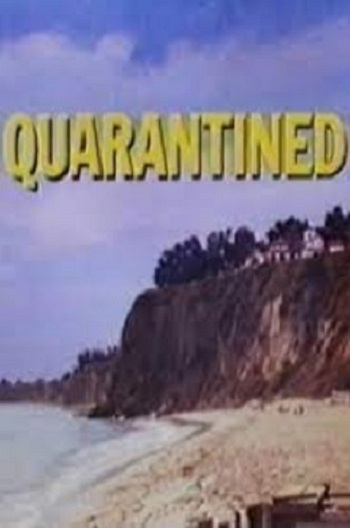
Retro Television Reviews: Quarantined (dir by Leo Penn)


Welcome to Retro Television Reviews, a feature where we review some of our favorite and least favorite shows of the past! On Sundays, I will be reviewing the made-for-television movies that used to be a primetime mainstay. Today’s film is 1970’s Quarantined! It can be viewed on YouTube!

The John C. Bedford Clinic sits atop a cliff overlooking the ocean.  Though it may be a small hospital, it’s also widely respected.  The clinic was started by John Bedford (John Dehner) and the majority of its employees are related to him.  His three sons — Larry (Gary Collins), Bud (Gordon Pinset), and Tom (Dan Ferrone) — are all doctors and they all work at the clinic.  Bud’s wife, Margaret (Susan Howard), is a psychologist and she also works at the clinic, encouraging the older patients not to give up hope in their twilight years.  John Bedford is a stern taskmaster and his youngest son, Tom, resents always having his father and his older brothers staring over his shoulder.  John and Larry explain that they are simply treating Tom the way that they would treat any new doctor.  Tom isn’t so sure.

When the Bedfords aren’t hanging out in the tasteful ranch house that sits next to the clinic, they’re checking on their patients.  As Quarantined opens, they’ve got quite a few to deal with.  The most famous is Ginny Pepper (Sharon Farrell), a film star who has come to the clinic because she’s been suffering from back pain.  Larry quickly diagnoses her as suffering from kidney failure and announces that she’s going to need to get an immediate transplant.  Ginny is not happy to hear that and spends most of her time trying to make both Larry and Nurse Nelson (Virginia Gregg) miserable.  Of course, it eventually turns out that Ginny’s not so bad.

Meanwhile, Margaret attempts to cheer up a dying old man named Mr. Berryman (Sam Jaffe) and an eccentric man named Wilbur Mott (Wally Cox) hangs out in the hospital hallway.  Martha (Terry Moore) and Lloyd Atkinson (Madison Arnold) are at the hospital to visit their son, Jimmy (Mitch Vogel).  Unfortunately, while in Jimmy’s hospital room, Lloyd suddenly collapses and subsequently dies.  John takes one look at Lloyd and announces that Lloyd might have Cholera and, as a result, no one can leave or enter the hospital until the test results come back.

In other words, the John C. Bedford Clinic is …. QUARANTINED!

If you’re thinking this sounds a little bit dull …. well, you’re not wrong.  Quarantined has a 73-minute running time and a large cast but it really does just feel like an episode of a not particularly interesting medical drama.  It wouldn’t surprise me to discover that this movie was actually meant to serve as a pilot for a show that would have followed day-to-day life at the clinic.  Each member of the Bedford family is given a hint of characterization, just enough to suggest what type of situations they would get involved in on a weekly basis.  Larry was the straight shooter who was dedicated to saving lives.  Bud was the well-meaning middle child while Margaret was the one who encouraged the men to talk about their feelings.  Tom was the idealistic but impulsive youngest child.  John was the wise patriarch.  They’re all kind of boring.

The same can be said of Quarantined as a movie.  As directed by Leo “Father of Sean” Penn, the movie promises a lot of drama but it never really delivers and there’s something rather annoying about how casually John announces that no one is allowed to leave the clinic.  He even calls the police and has them set up road blocks around the clinic.  On the one hand, John is doing the right thing.  No one wants a cholera epidemic.  On the other hand, everyone’s so quick to accept that idea of John being a benign dictator that …. well, one can only imagine what a pain in the ass the Bedfords would have been during the COVID era.

As far as I know, there was never a TV show about the Bedford family and their clinic on a cliff.  Personally, I’m okay with that.  

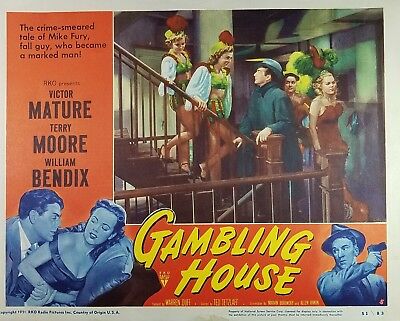
An Offer You Can Refuse #10: Gambling House (dir by Ted Tetzlaff)


The 1950 film noir, Gambling House, begins with the aftermath of a murder.

A man’s been gunned down in an illegal gambling house.  The murderer is gangster named Joe Farrow (William Bendix) but Farrow has no intention of going to prison.  Fortunately, another gambler was wounded during the shoot out.  Marc Fury (Victor Mature) will survive his injury but he might not survive being a witness.  However, Farrow sends his gunmen to make Fury an offer.  If Fury agrees to take the rap for the shooting, he’ll not only live but Farrow will pay him a good deal of money.  Fury agrees because …. well, what else is he going to do?

Fury is arrested for the murder.  He pleads self-defense and he’s acquitted at the trial.  So far, so good, right?  However, there’s always a complication.  First off, there’s the fact that Farrow wasn’t exactly being honest when he promised to pay Fury.  Farrow has no intention of giving Fury any money.  In fact, now that Fury has been acquitted and the case is officially closed, it might be more convenient just to have Fury killed.

The other problem is that Fury’s trial brings him to the attention of the Immigration and Naturalization Service.  The INS takes a look at Fury’s record and they discover that he’s not Marc Fury at all!  (I know, it’s a shock.  Who would think that a name like Marc Fury would be fake?)  It turns out that his original name was Marc Furiotta and he was born in Italy.  His family came to the U.S. when Marc was a child.  Marc always assumed that he was a citizen but it turns out that his parents were never naturalized and therefore, Marc is in the country illegally!  INS wants to deport him.  Marc wants to stay in the United States.

Fortunately, Marc will have a chance to try to convince a judge to let him stay in the United States, despite his lengthy criminal record.  Until his hearing (or until he makes bail), he’ll be detained at Ellis Island.  Marc soon finds himself stuck on Ellis Island, presumably right underneath the base of the Statue of Liberty.  (I know the Statue of Liberty isn’t actually on Ellis Island but the imagery just got stuck in my head while I was writing this review and I’ll be damned if I’m going to take it out.)  He’s surrounded by earnest immigrants who can’t wait to become American citizens and that awakens his own patriotic feelings.  He also meets a social worker named Lynn (Terry Moore) and he falls in love with her.  When he appears before the judge, he explains that he can’t put into words why he wants to stay in America.  He just know that he does.   Awwww, what a wonderful story …. oh wait.  He’s still got Joe Farrow trying to kill him, doesn’t he?

Gambling House is an odd film.  Actually, it’s something like three different films at once.  On the one hand, it’s a low-budget film noir, with menacing tough guys and a morally ambiguous hero and an outwardly respectable villain who is actually a member of the mob.  On the other hand, it’s an earnest legal drama about an immigrant who comes to love his adoptive country.  And then, on the other hand (that’s right, this movie has three hands), it’s a romcom where cynical Marc ends up falling for idealistic Lynn.

That’s a lot for one, low-budget 90-minute film to carry on its shoulder and sadly, Gambling House struggles to balance all of its different elements.  It gets off to a good start, with Victor Mature delivering all of his lines with a scornful disdainful for anyone who looks at him.  And the scenes with William Bendix as the mob boss are effective.  But none of those scenes seem to belong in the same movie with Marc waiting on Ellis Island and Lynn explaining why she wants to help people become citizens.  In the end, this is a film about many things but none of those things are really explored in that much depth.

Though this is a adequately directed and acted film and this is one scene, in which Marc looks at the New York skyline from the holding cell in Ellis Island, that achieves a certain visual poetry, this is still an offer that you can refuse.

Previous Offers You Can’t (or Can) Refuse:

  1. The Public Enemy
  2. Scarface
  3. The Purple Gang
  4. The Gang That Could’t Shoot Straight
  5. The Happening
  6. King of the Roaring Twenties: The Story of Arnold Rothstein 
  7. The Roaring Twenties
  8. Force of Evil
  9. Rob the Mob

Smash-Up On Interstate 5 (1976, directed by John Llewellyn Moxey)


Smash-Up On Interstate 5 begins with ominous shots of a crowded California interstate.  It’s the 4th of July weekend and old people are returning home, young people are looking for a party, and Sergeant Sam Marcum (Robert Conrad) of the California Highway Patrol is looking for a killer.  When one car swerves into the next lane and hits another, it leads to a chain reaction as hundreds of cars, trucks, and one motorcycle crash into each other.  While the vehicles crash, we see the people inside of them.  There’s Buddy Ebsen!  There’s Vera Miles!  There’s Sue Lyon (of Lolita fame) on the back of a motorcycle!  In a voice-over, Sam tells us that the accident will be classified as being due to “mechanical failure” and that 14 people are going to die as a result.  He might be one of them.

Smash-Up On Interstate 5 is a 70s disaster film so, after the pile-up, the movie flashed back 48 hours and we get to know everyone whose lives are going to eventually collide on Interstate 5.  Erica (Vera Miles) is recently divorced and trying to get back into the dating scene.  Albert (Buddy Ebsen) is trying to bring some joy to his terminally ill wife’s final days.  Lee (Scott Jacoby) and Penny (Bonnie Ebsen) are the hippies who are trying to get to Big Sur without getting arrested.  Burnsey (Sue Lyon) loves her biker boyfriend.  Some of them will survive the pile-up.  Some of them will not.

Smash-Up On Interstate 5 is an above average made-for-TV movie.  It’s got a notable cast and the movie does a good job of mixing together’s everyone’s subplots.  For instance, Burnsey and a group of bikers show up in the background of several scenes and harass Erica at one point long before the crash on the interstate.  It’s only a 100-minute film so the film doesn’t go into too much detail about everyone’s past but we learn just enough to make everyone stand out.  The crash itself is intense, even when seen today.  Made before the days of CGI, this is a film where the stunt crew definitely earned their paycheck.

Tommy Lee Jones plays a patrolman who is also Sam’s brother-in-law.  I was surprised when I first saw him but as soon as I saw the strained smile and heard the accent, I knew it was him.  Jones’s role is small and probably could have been played by anyone but the mere presence of Tommy Lee Jones definitely makes this film cooler than it would have been otherwise.

One final note: This film was directed by the made-for-TV horror specialist, John Llewellyn Moxey.  Be sure to read Gary Loggins’s tribute to this often underrated director.

Beautiful Dreamer: MIGHTY JOE YOUNG (RKO 1949)


gary loggins's avatarcracked rear viewer

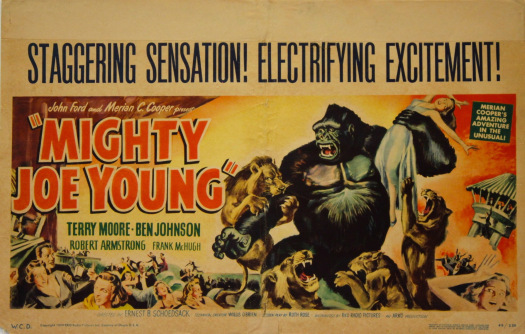
The folks who brought you KING KONG – producer Merian C. Cooper, director Ernest Shoedsack, writer Ruth Rose, animator Willis O’Brien – returned sixteen years later to the giant ape theme with MIGHTY JOE YOUNG, a classic fantasy that can stand on its own. Though the film usually gets lumped into the horror genre, it’s more a fable than a fright fest, a beautifully made flight of fancy for children of all ages, and one of my personal favorites.

In deepest darkest Africa, little Jill Young buys a cute baby gorilla from the natives. Twelve years later, impresario Max O’Hara, along with rodeo wrangler Gregg and his crew, travel to The Dark Continent in search of exotic animal acts for a new show he’s producing, when they come face to face with the now 12 foot tall, 2,000 pound gargantua, affectionately called Joe by a grown Jill. She’s the only…

View original post 677 more words

My Christmas Present to You: THE GREAT RUPERT Complete Movie (Eagle-Lion 1950)


gary loggins's avatarcracked rear viewer

rupert1

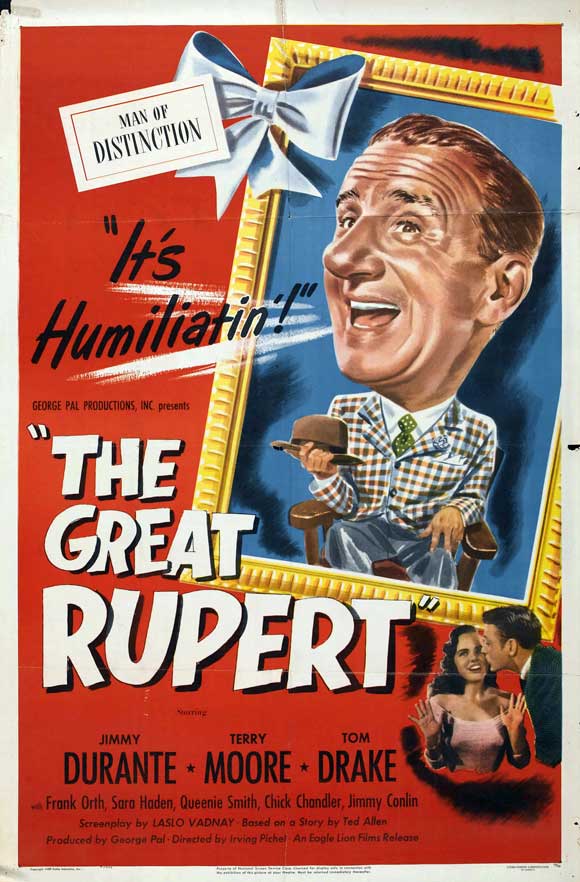
THE GREAT RUPERT is one those movies I used to catch frequently on my local public access channel; it seems like it’s been in public domain forever. Producer George Pal uses his Puppetoon magic to animate Rupert, a plucky dancing squirrel who’s “almost human” forced to forage for himself when his trainer is evicted for not paying his rent. A homeless, penniless family of circus performers, the Amendolas, move in by fast-talking landlord Dingle’s son Pete, who falls head-over-heels for daughter Rosalinda.

rupert2

The miserly Mr. Dingle keeps his cash stashed in a hole in the wall, which is where Rupert stashes his nuts. When Mrs. Amendola starts praying for a miracle, Rupert starts tossing the worthless (to him) moolah out of his hidey-hole, and she believes it’s “money from heaven”. Soon the town begins to gossip about where the Amendolas are getting all this loot, and the local cops, IRS, and FBI…

View original post 89 more words

Embracing The Melodrama #13: Peyton Place (dir by Mark Robson)


Poster - Peyton Place_04

“Just remember: men can see much better than they can think. Believe me, a low-cut neckline does more for a girl’s future than the entire Britannica encyclopedia.” — Betty (Terry Moore), speaking the truth in Peyton Place (1957)

Sex!  Sin!  Secrets!  Scandal!  It’s just another day in the life of Peyton Place, the most sordid little town this side of Kings Row!  It’s also the setting of the 1957 best picture nominee, Peyton Place.

Peyton Place is a seemingly idyllic little village in New England.  The town is divided by railroad tracks and how your fellow townspeople views you literally depends on which side of the tracks you live on.  As the film itself shows us, the right side of tracks features pretty houses and primly dressed starlets.  The wrong side of the tracks features shacks and a bunch of people who look like the ancestors of the cast of Winter’s Bone.  The difference in appearance is not particularly subtle (but then again, the same thing could be said for the entire film) but, regardless of which side of the tracks live on, chances are that you’re keeping a few secrets from the rest of the town.

On the right side of the tracks, you can find Constance McKenzie (played by Lana Turner, who is just about as convincing as a New England matron as you would expect a glamorous Hollywood star to be), a dress shop owner who is so prim and proper that she literally flies into a rage when she comes across her daughter kissing a boy.  Could it be the Constance’s repression is the result of her once having been a rich man’s mistress?  And will the new high school principal, the progressive and rather dull Mr. Rossi (Lee Phillips), still love her despite her sordid past?

Constance’s daughter is Allison (Diane Varsi) and poor Allison just can not understand why her mother is so overprotective.  Will Allison ever find true love with the painfully shy Norman Page (Russ Tamblyn) or will she be forced to settle for someone like the rich and irresponsible Rodney Harrington (Barry Coe)?

Rodney, for his part, is in love with Betty (Terry Moore), a girl from the wrong sides of the tracks.  Rodney’s father (Leon Ames) is the richest man in town and makes it clear that he will not allow his son to marry someone with a “reputation.”  Will Rodney get a chance to redeem himself by going off to fight in World War II?

And what will happen when Rodney and Betty go skinny dipping and are spotted by a local town gossip who promptly mistakes them for Norman and Allison?  Reputations are at stake here!

Meanwhile, over on the bad side of the tracks, Lucas Cross (Arthur Kennedy) sits in his shack and drinks and thinks about how the world has failed him.  His long-suffering wife (Betty Field) works as housekeeper for the McKenzie family.  Meanwhile, his abused daughter Selena (Hope Lange, giving the film’s best performance) is Allison’s best friend.  When Lucas’s attempt to rape Selena leads to a violent death, the sins and hypocrisy of Peyton Place are revealed to everyone.

Peyton Place is a big, long  movie, full of overdramatic characters, overheated dialogue, and over-the-top plotting and, for that reason, I absolutely love it!  Apparently, the film was quite controversial in its day and the scenes where Arthur Kennedy attacks Hope Lange still have the power to disturb.  However, the main reason why I enjoy Petyon Place is because anything that could happen in Peyton Place does happen in Peyton Place.

Seriously, how can you not love a film this sordid and melodramatic?