4 Shots From 4 Films is just what it says it is, 4 shots from 4 of our favorite films. As opposed to the reviews and recaps that we usually post, 4 Shots From 4 Films lets the visuals do the talking.
Today, we pay tribute to the TSL’s favorite British studio with….
4 Shots From 4 Hammer Films
The Plague of the Zombies (1966, dir by John Gilling)
Frankenstein Created Woman (1967, dir by Terence Fisher)
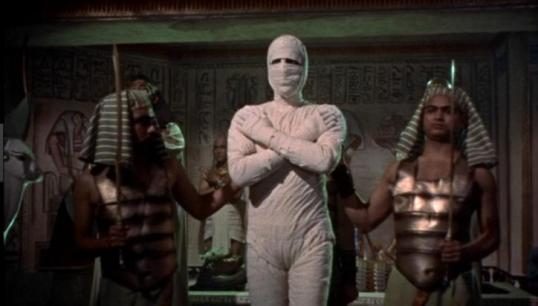
The Mummy’s Shroud (1967, dir by John Gilling)
The Satanic Rites of Dracula (1973, dir by Alan Gibson)
4 Shots from 4 Films is just what it says it is, 4 shots from 4 of our favorite films. As opposed to the reviews and recaps that we usually post, 4 Shots from 4 Films lets the visuals do the talking!
Today is Peter Cushing’s birthday! This edition of 4 Shots From 4 Films is dedicated to him, his memory, and his career!
If you love horror films, you have to love Hammer Films, the British studio that was responsible for some of the best horror films of the 50s, 60s, and 70s. It was Hammer who brought Dracula, Frankenstein, and the Mummy back to life and who introduced a splash of color to the formerly black and white world of horror. It was Hammer that first brought horror together with pop art. And, of course, it was Hammer that made stars out of actors like Christopher Lee and Peter Cushing.
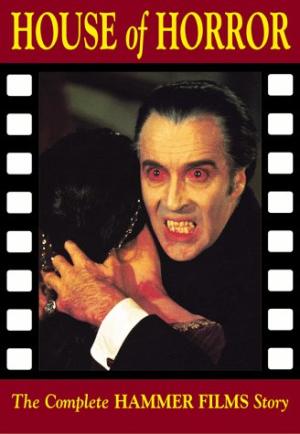
House of Horror was originally published in 1973, as a tribute to Hammer in its waning days. The copy that I own is a revised edition, one that was published in 2000. I found it at Recycled Books in Denton, Texas. (That was quite a shopping trip, by the way. Not only did I buy House of Horror but I also bought A Taste of Blood: The Films of Herschell Gordon Lewis.)
Anyway, if you’re a fan of Hammer Films, then this is one of those books that you simply have to own. Not only does it contain interviews with the big four of Hammer (Peter Cushing, Christopher Lee, Terence Fisher, and Michael Carreras) but it also provides a in-depth analysis of Hammer’s Dracula series, its Frankenstein series, and its lesser known science fiction productions.
At the end of the book, there are biographies of some of the members of Hammer’s stock company. There’s also not only a full list of every film that Hammer ever produced but even a list of Hammer project that never reached the filming stage. If, as I am, you’re obsessed with film trivia, this book is a must have.
4 Shots From 4 Films is just what it says it is, 4 shots from 4 of our favorite films. As opposed to the reviews and recaps that we usually post, 4 Shots From 4 Films is all about letting the visuals do the talking.
This October, I am going to be using our 4 Shots From 4 Films feature to pay tribute to some of my favorite horror directors, in alphabetical order! That’s right, we’re going from Argento to Zombie in one month!
Today’s director: one of the masters of Hammer horror, Terence Fisher!
4 Shots From 4 Films
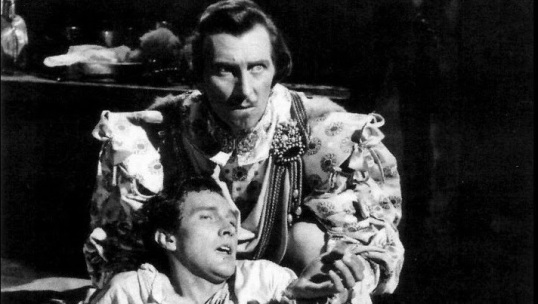
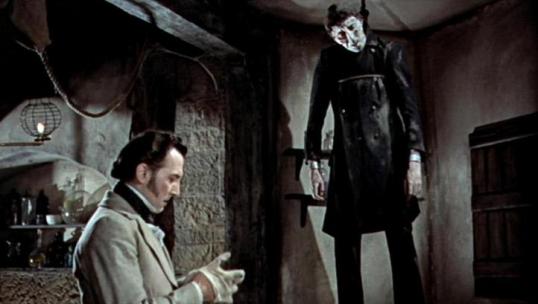
The Curse of Frankenstein (1957, dir by Terence Fisher)
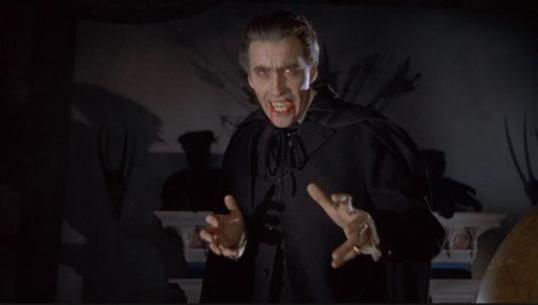
The Horror of Dracula (1958, dir by Terence Fisher)
Satan worship was all over the big screen back in 1968. There was ROSEMARY’S BABY of course, that Oscar-winning fright fest from Roman Polanski and William Castle. WITCHFINDER GENERAL found Vincent Price on the hunt for daughters of the devil, while CURSE OF THE CRIMSON ALTAR boasted an all-star horror cast of Boris Karloff, Christopher Lee, Barbara Steele, and Michael Gough. Lee starred in a Hammer tale of satanism that year titled THE DEVIL’S BRIDE, as an occult expert pitted against a cult led by Charles Gray. That’s right- it’s Dracula vs Blofeld in a battle for souls!
Sir Christopher’s on the side of the angels for a change as the Duc de Richleau, who along with army buddy Rex Van Ryn, find their late chum’s son Simon Aron. Simon’s been “meddling with black magic” in a coven of devil worshippers led by Mocata, an adept Satanist. They manage to spirit Simon away…
Last year, Gary reviewed the first of the Hammer Frankenstein films, The Curse of Frankenstein.For today’s horror film review, I’m going to take a look at the second movie in Hammer’s Frankenstein series, 1958’s The Revenge of Frankenstein!
The Revenge of Frankenstein opens where The Curse of Frankenstein ended. The monster (played by Christopher Lee in the first film) has been destroyed and Baron Frankenstein (Peter Cushing) has been sentenced to be executed for the monster’s crimes. However, the Baron escapes the guillotine. Instead, he arranges for a priest to be beheaded in his place. Working under the name Dr. Stein, the Baron escapes to another village and, after several years, re-establishes himself as a wealthy and respected doctor. While most of his patients are rich, Dr. Stein also helps the poor and the disabled. By all accounts, he’s doing wonderful work but he’s also deliberately enigmatic, refusing to join the local doctors council.
Right from the beginning, we’re reminded of just how different Hammer’s Baron Frankenstein was from Universal’s version of the good doctor. In the Universal films, Dr. Frankenstein — regardless of whether the doctor in question was Henry, Wolf, or Ludwig — was always portrayed as being misguided but ultimately noble. If any of the Universal Frankensteins had been sentenced to death, it’s probable that they would have put on a stoic face, walked to the guillotine, and allow their head to roll. In fact, they would have felt so responsible for the actions of the Monster that they probably would feel it was their moral duty to allow themselves to be executed.
That’s not the case when it comes to Hammer’s Baron Frankenstein. Baron Frankenstein feels no guilt over what the Monster has done. Go the guillotine? No way! Baron Frankenstein is determined to create life and if creating life means that other, lesser mortals end up dead … well, so be it. As opposed to the Universal Frankensteins, who all developed god complexes after the success of their experiment, Baron Frankenstein has his god complex from the beginning. And if Baron Frankenstein is a god, why shouldn’t a priest be sacrificed for the good of the Baron’s work?
Anyway, Dr. FrankenStein and his assistant, Dr. Kleve (Francis Matthews) are determined to once again bring the dead back to life. This time, the plan involves transplanting the brain of hunchback Karl (Oscar Quitak) into a physically strong body (played by Michael Gwynn). Dr. Kleve is worried that a brain transplant could lead to unforseen complications. For instance, one of Dr. Stein’s chimpanzees reacts to being given an orangutan’s brain by turning into a cannibal. However, Stein tells Dr. Kleve not to worry about it. After all, what could go wrong?
Well, a lot goes wrong. It’s a Frankenstein movie, after all.
I have to admit that, while I love Hammer’s Dracula films, I’ve never been a huge fan of their take on Frankenstein. While Peter Cushing always makes for a wonderfully compelling and often chillingly evil Baron Frankenstein, the majority of the Hammer Frankenstein films always seem to move way too slowly. Whenever I watch one of them, I always find myself growing rather impatient with the endless scenes of grave robbery and body stitching. “HURRY UP AND BRING THAT DAMN THING TO LIFE!” I’ll find myself shouting.
However, I was actually pleasantly surprised by how well The Revenge of Frankenstein holds up. That Cushing would give an excellent performance as Baron Frankenstein is to be expected. But really, the entire film is well-acted and both Oscar Quitak and Michael Gwynn give poignant performances as Frankenstein’s latest experiment. It’s a visually vibrant and nicely paced horror film, one that never drags like some of the later Hammer Frankenstein films.
The Curse of Frankenstein and The Revenge of Frankenstein make for a great double feature, especially in October!
This October, I’m going to be doing something a little bit different with my contribution to 4 Shots From 4 Films. I’m going to be taking a little chronological tour of the history of horror cinema, moving from decade to decade.
Today, we reach the end of the 50s and the rise of British horror.
4 Shots From 4 Films
Night of the Demon (1957, dir by Jacques Tourneur)
The Curse of Frankenstein (1957, dir by Terence Fisher)
Hammer Films Ltd. knew they were on to something with the release of 1957’s THE CURSE OF FRANKENSTEIN. The Gothic horror was box office gold on both sides of the Atlantic, and Hammer wasted no time finding a follow up. Reuniting CURSE OF FRANKENSTEIN costars Peter Cushing and Christopher Lee with director Terence Fisher, the company set its sights on giving the full Eastmancolor treatment to Bram Stoker’s immortal Count Dracula.
When Britain’s Hammer Films began in the early 1930’s they were just another movie production company. After finding some success with the 1955 sci-fi adaptation THE QUARTERMASS EXPERIMENT, they chose to make a Gothic horror based on Mary Shelley’s classic 1818 novel about a man obsessed with creating artificial life. FRANKENSTEIN had been filmed many times before, most notably Universal’s 1931 version that brought eternal fame to Boris Karloff. This time however, the producers shot in vibrant color, with blood and body parts on gory display. Tame stuff compared to today’s anything goes horrors, but in the fifties it was considered quite shocking.
Peter Cushing and Christopher Lee had appeared in two films before, Lawrence Olivier’s 1948 HAMLET and John Huston’s 1952 MOULIN ROUGE, though not as a team. Once CURSE OF FRANKENSTEIN was unleashed upon the public, they were paired another nineteen times, making Cushing and Lee terror’s all-time tandem. HORROR OF DRACULA came next, with…
“My master is dead but he left instructions that the house should always be ready for visitors.”
“Who was your master?”
“His name was Count Dracula…”
— A snatch of dialogue from Dracula, Prince of Darkness (1966)
Dracula, Prince of Darkness is notable for many reasons.
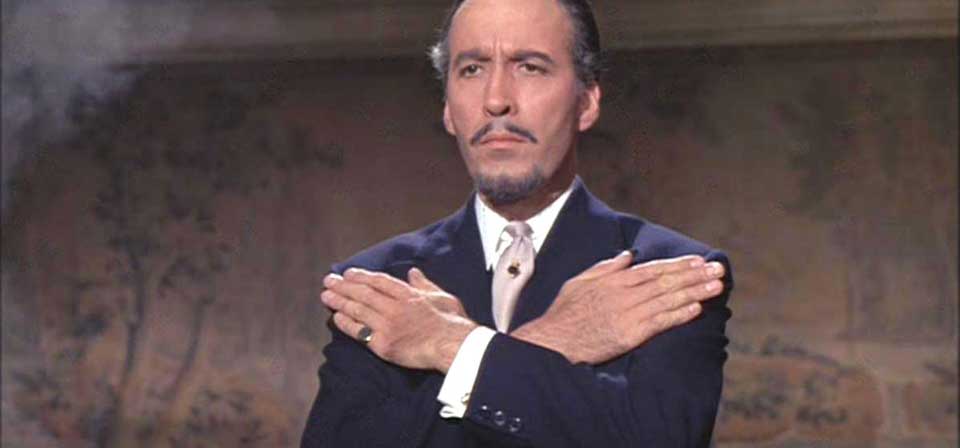
First off, this movie marked Christopher Lee’s return to the role that he played 8 years earlier in The Horror of Dracula. After being forced to make one Dracula film without Dracula, Hammer Films was finally able to make a direct sequel to The Horror of Dracula.
As a result of Lee returning, this was also the first of the Hammer Draculas to feature the previously destroyed Lord of the Vampires being revived through a splash of blood. This was a plot element that all subsequent films in the series would feature and, to a certain extent, you have to admire Hammer’s efforts maintain some form of continuity. Whereas it would have been easy enough to just have Dracula show up with no explanation as to why he’s back, the Hammer films at least tried to make sure everything followed some sort of identifiable logic. (Or, at least they did until Dracula A.D. 1972 but we’ll get to that movie later…)
This was the first Dracula film not to feature (with the exception of the footage from Horror of Dracula that opens the film) Peter Cushing in the role of Van Helsing. And while the film probably would have been improved by the presence of Cushing, the film does come up with a more than adequate substitute in the form of Andrew Keir’s Father Sandor. Whereas Cushing’s Van Helsing always seemed to be a rather rational vampire hunter, Keir brings a truly demented energy to the role.
And finally, Dracula, Prince of Darkness is probably best remembered for being the Dracula film in which Dracula does not speak. He does hiss a few times but, for the most part, Dracula is silent throughout this entire film and, instead, relies on his servants Klove (Philip Latham) and Ludwig (Thorley Walters) to do most of the talking.
Why Dracula doesn’t speak is a matter of debate. Christopher Lee has claimed that he refused to say any of the dialogue that had been written Dracula while screenwriter Jimmy Sangster wrote, in his autobiography, that Dracula was specifically written to be a silent role. (Or, as Sangster put it, “Vampires don’t chat.”)
Regardless of why Dracula is silent, it actually works quite well. Sangster’s right. Vampires don’t chat and Christopher Lee’s haughty Dracula would be the least likely of all to make small talk. Dracula’s silence both reminds us of the contempt with which he views the living and it also plays up the animalistic aspects of the character. It helps, of course, that Christopher Lee is one of those actors who can do more with one dismissive glare than most actors could do with 20 pages of the most florid and overwritten dialogue.
As for the film itself, it serves as a reminder that the only thing that need happen for evil to be triumphant is for stupid tourists to take a holiday in Transylvania. Ignoring the warnings of practically everyone else on the planet, the Kents — Alan (Charles Tingwell) and wife Helen (Barbara Shelley) and Charles (Francis Matthews) and wife Diana (Suzan Farmer) — spend the night at Dracula’s castle. Dracula’s servant, Klove, murders Alan and drains his blood over Dracula’s ashes. Soon, Helen is a vampire, Diana has been selected to be Dracula’s latest bride, and it’s up to Sandor and Charles to save everyone’s soul.
Dracula, Prince of Darkness is a lot of fun. It’s full of all the usual Hammer touches — melodramatic dialogue, ornate castles, pretty costumes, plentiful gore, unfriendly villagers, and not-quite-brilliant heroes — and, best of all, it’s got Christopher Lee proving that Dracula doesn’t need to speak to be frightening. Subsequent films in the Hammer Dracula series would grow increasingly uneven but Dracula, Prince of Darkness is a worthy entry.









 Through the Shattered Lens