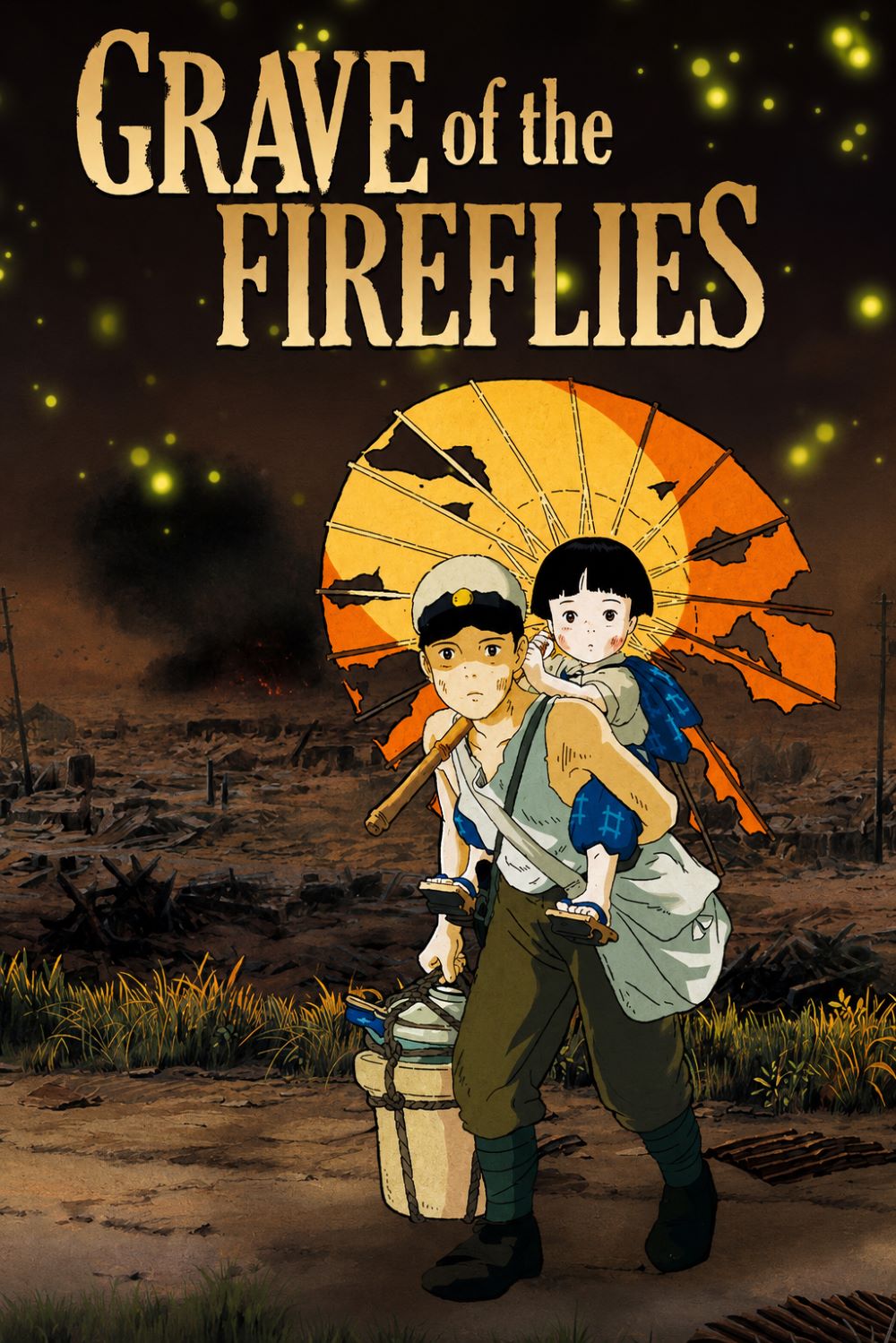
“Why do fireflies have to die so soon?” — Setsuko
There are films that entertain, films that impress, and then there are films that simply break you. Grave of the Fireflies, directed by Isao Takahata and released by Studio Ghibli in 1988, belongs firmly to that final category. It is one of the most devastating pieces of cinema ever committed to screen — animated or otherwise — and its power has not dimmed a single watt in the decades since its release. If anything, it has only grown heavier with time, which says something quietly terrible about the state of the world we keep building and destroying.
The film is an adaptation of a semi-autobiographical short story of the same name written by Akiyuki Nosaka, first published in 1967. Nosaka drew directly from his own traumatic experience as a child survivor of the American firebombing of Kobe and Nishinomiya during the final months of World War II. He lost his adopted younger sister, Keiko, to malnutrition during that period, and spent much of the rest of his life consumed by guilt over her death — guilt that he transformed into literature as a form of personal penance. The story, and by extension Takahata’s film, is not simply a war narrative. It is a confession. That emotional honesty is what gives Grave of the Fireflies its extraordinary moral weight and separates it from more conventional wartime dramas.
The story follows two siblings—fourteen-year-old Seita and his four-year-old sister Setsuko—who are left to fend for themselves in the ruins of wartime Japan after their mother is killed in an air raid. Their father is away serving in the Imperial Navy, and the children initially take refuge with a distant aunt whose cold pragmatism and growing resentment become as suffocating as the war itself. Eventually, Seita takes Setsuko, and the two retreat to a small abandoned shelter near a lake, where they attempt to survive on dwindling resources. What follows is a story of extraordinary love between two children set against the backdrop of a society collapsing under the weight of its own catastrophic choices. Takahata makes no political speeches; he does not need to. The tragedy unfolds with quiet, terrible inevitability, and the film’s opening scene—in which we learn from the outset that Seita does not survive—ensures that every fleeting moment of joy between the siblings is shadowed by grief already lodged in our chests.
It is worth pausing on the animation itself, because Grave of the Fireflies is a masterwork of the form. Takahata consistently pushed back against the notion that animation was a lesser medium suited only to fantasy or comedy, and here he uses it to render the physical reality of war with extraordinary specificity: the blistering heat of an air raid reflected in Setsuko’s wide eyes, the sickly pallor of a malnourished child’s skin, the gentle glow of fireflies against the blue-black darkness of a summer night. Studio Ghibli’s artists create a version of wartime Japan that feels tactile and achingly real, and the deliberate contrast between the natural beauty of the countryside and the devastation wrought by human violence is one of the film’s most quietly devastating achievements. The fireflies themselves—insects that glow brilliantly for a short time and then die—function as one of cinema’s most elegantly constructed symbols, one the film earns rather than imposes.
Grave of the Fireflies occupies a unique and important place in the history of how anime has been received in the West. For decades, Western audiences and critics tended to treat animation as a genre rather than a medium—something inherently juvenile, made for children, and incapable of the emotional or artistic range associated with live-action film. Anime, with its distinct visual language, was often doubly dismissed as too foreign, too strange, or too cartoonish. The arrival of Studio Ghibli films in Western markets—and Grave of the Fireflies in particular—fundamentally challenged that assumption. Here was an animated film that dealt with death, starvation, grief, and moral ambiguity with more unflinching honesty than most of Hollywood’s prestigious war dramas. Roger Ebert, who gave the film four stars, famously described it as one of the greatest war films ever made—a statement that helped elevate not just the film but animation’s broader cultural status. Grave of the Fireflies helped pave the way for deeper Western critical engagement with anime as a serious art form, a conversation that continued through works like Akira, Ghost in the Shell, Neon Genesis Evangelion, and Spirited Away, and persists into the present era of global anime fandom. Without Takahata’s film insisting on animation’s capacity for genuine tragedy, that shift might have taken far longer.
The film also complicates some of the West’s more self-flattering narratives about World War II. Grave of the Fireflies does not engage with questions of who started the war or who was morally right; it simply shows two Japanese children dying slowly in the wreckage of American bombing campaigns and asks the viewer to sit with that reality. This is not a film that endorses Japanese imperialism or absolves the government whose war Seita and Setsuko ultimately suffer from. Instead, it refuses to let civilian suffering disappear behind the abstractions of historical victory. That refusal has made it an uncomfortable but essential work in discussions about the human cost of war.
One cannot watch Grave of the Fireflies today and remain complacent about the news cycles documenting conflicts around the world. The images of starving children in Gaza, orphaned families in Ukraine, and displaced populations in Sudan are a visceral, real-world echo of Seita and Setsuko’s plight. The film acts as a powerful antidote to the desensitization that can occur in a world numb to constant tragedy. When we scroll past headlines or see statistics of casualties, we are abstracting suffering. The film refuses to let us do that. The reality of malnutrition and starvation is put on screen in a way that feels almost too intimate to watch, from Setsuko’s distended belly to the sores that form on her skin. The film forces a confrontation with the fact that war’s “collateral damage” is not a number, but millions of individual, human stories—stories of children robbed of their childhood, their innocence, and ultimately, their lives, just like Setsuko and Seita. The cyclical nature of conflict means that for every generation, there is a new set of children living out this same tragedy, and the film’s refusal to offer easy catharsis or redemption makes it an enduring, uncomfortable mirror.
Grave of the Fireflies is not an easy film to recommend in the conventional sense. It is not something one watches for enjoyment, and it offers no catharsis in the traditional Hollywood mold—no heroic sacrifice redeemed, no peace restored, no comforting resolution. What it offers instead is something rarer and more valuable: witness. It is a film that confronts the true cost of war and refuses to look away, doing so through animation with a grace and rigor that should permanently dispel any lingering notion that the medium cannot carry the full weight of human experience. Nearly four decades after its release, Grave of the Fireflies remains one of the most important films ever made—a eulogy for two children, and by extension, for every child the world has failed to protect.
Anime You Should Be Watching
- Gakuen Utopia Manabi Straight
- Chōjin Densetsu Urotsukidōji
- School Days
- Higurashi no Naku Koro ni
- Toradora!
- Aria
- Azumanga Daioh
- Bible Black
- Puella Magi Madoka Magica
- Black Lagoon
- Ika Musume
- High School DxD
- Bakemonogatari
- Sailor Moon
- Princess Tutu
- Another
- Hellsing Ultimate
- Sword Art Online
- Wolf Children Ame and Yuki
- Toaru Kagaku no Railgun
- Nichijō
- Redline
- Gakkou Gurashi (School Live)
- Gate: Thus the Japanese Self-Defense Force Fought in Their Land
- Hinamatsuri
- Asobi Asobase
- Zombie Land Saga
- Monster
- Farming Life In Another World (Isekai Nonbiri Nouka)
- Perfect Blue
- Shiki
- Angel of Darkness (Injū Kyōshi)
- Blood: The Last Vampire
- Akira
- Space Battleship Yamato (Uchū Senkan Yamato)
- Macross Plus
- Ninja Scroll (Jūbē Ninpūchō)
- Tokyo Godfathers (Tōkyō Goddofāzāzu)
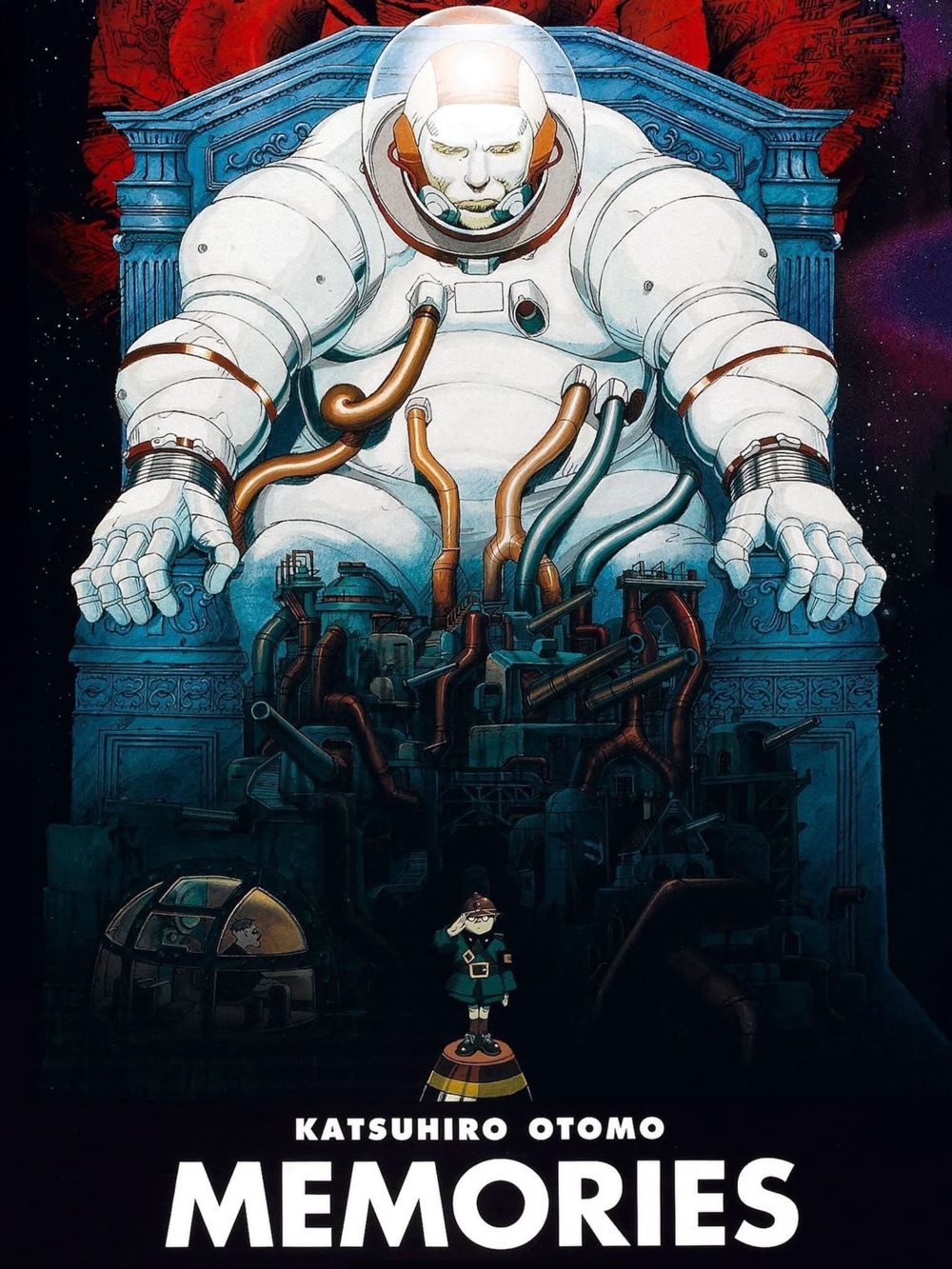
- Memories
- That Time I Got Reincarnated as a Slime (Tensei Shitara Suraimu Datta Ken)
- Spy x Family
- Record Of Lodoss War (Rōdosu-tō Senki)
- Berserk (Kenpū Denki Berserk)
- Jin-Roh
- Made In Abyss (Meido in Abisu)
- Legend of the Galactic Heroes (Ginga Eiyū Densetsu)
- Nausicaä of the Valley of the Wind
- May I Ask for One Final Thing? (Saigo ni Hitotsu dake Onegai Shitemo Yoroshī Deshō ka)
- Initial D (Inisharu Dī)
- Vinland Saga (Vinrando Saga)