Lisa Cleans Out Her DVR: Hemingway’s Adventures Of A Young Man (dir by Martin Ritt)


(Lisa is currently in the process of cleaning out her DVR!  It’s going to take a while.  She recorded this 1962 literary adaptation off of FXM on January 30th!)

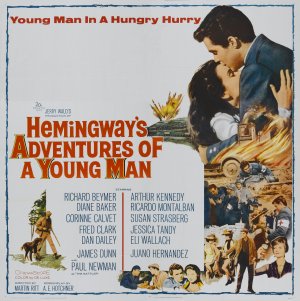
Hemingway’s Adventures Of A Young Man is one of those films that you just know was made specifically to win Oscars.  It’s a big prestige production, complete with a historical setting, an epic scope and big, all-star cast.  That most of those stars appear in relatively small roles was undoubtedly meant to evidence of the film’s importance.

“Look!” the film seems to shout at times, “This is such an important film that even Paul Newman was willing to stop by for a day’s work!”

The film is based on ten short stories by Ernest Hemingway and, loosely, A Farewell to Arms.  The stories all dealt with the early life of Nick Adams, who was a literary stand-in for Hemingway.  Since the Nick Adams stories were autobiographical (and, for that matter, so was A Farewell to Arms), the film can also be viewed as biopic.  Richard Beymer (who, a year earlier, had starred in West Side Story and who is currently playing Ben Horne on Twin Peaks) may be playing Nick Adams but the film leaves little doubt that he was actually meant to be playing Ernest Hemingway.

The film opens with Nick hunting with his father, Dr. Harold Adams (Arthur Kennedy).  He is present when his father travels to an Indian camp and helps to deliver a baby.  He respects his father but Nick wants to see the world and the film follows him as he explores America, working odd jobs and meeting colorful characters along the way.  Paul Newman shows up as a punch-drunk boxer and proceeds to overact to such an extent that he reminded me of Eric Roberts appearing in a Lifetime film.  Nick meets rich men, poor men, and everything in between.  He works as a journalist.  He works as a porter.  Eventually, when World War I breaks out, Nick enlists in the Italian army and the film turns into the 100th adaptation of A Farewell to Arms.

And really, I think it would have been an enjoyable film if it had been directed by someone like Otto Preminger, George Stevens, or maybe even Elia Kazan.  These are directors who would have embraced both the pulpy potential of the Nick Adams stories and the soapy melodrama of the war scenes.  A showman like Preminger would have had no fear of going totally and completely over the top and that’s the approach that this material needed.  Instead, Hemingway’s Adventures Of A Young Man was directed, in a painfully earnest style, by Martin Ritt.  Ritt tries to imitate Hemingway’s famously understated style with his understated direction but, cinematically, it’s just not very interesting.  Ritt portrays everything very seriously and very literally and, in the end, his direction is more than a little dull.

Sadly, the same can be said for Richard Beymer’s performance in the lead role.  Beymer comes across as being the nice guy who everyone says you should marry because he’ll be able to get a good and stable job and he’ll probably never go to jail.  Two months ago, when I watched and reviewed Twin Peaks, I really loved Beymer’s performance as Ben Horne.  He just seemed to be having so much fun being bad.  Unfortunately, in Hemingway’s Adventures Of A Young Man, he never seemed to be having any fun at all.  No wonder he temporarily put his film career on hold so that he could fully devote himself to working as a civil rights activist.

In the end, this is a movie that’s a lot more fun to look at than to actually watch.  Visually, the film is frequently quite pretty in an early 1960s prestige movie so sort of way.  And there are some good performances.  Eli Wallach, Ricardo Montalban, Susan Strasberg, Arthur Kennedy — there’s a whole host of performers doing memorable supporting work.  Unfortunately, even with all that in mind, this well-intentioned film largely falls flat.

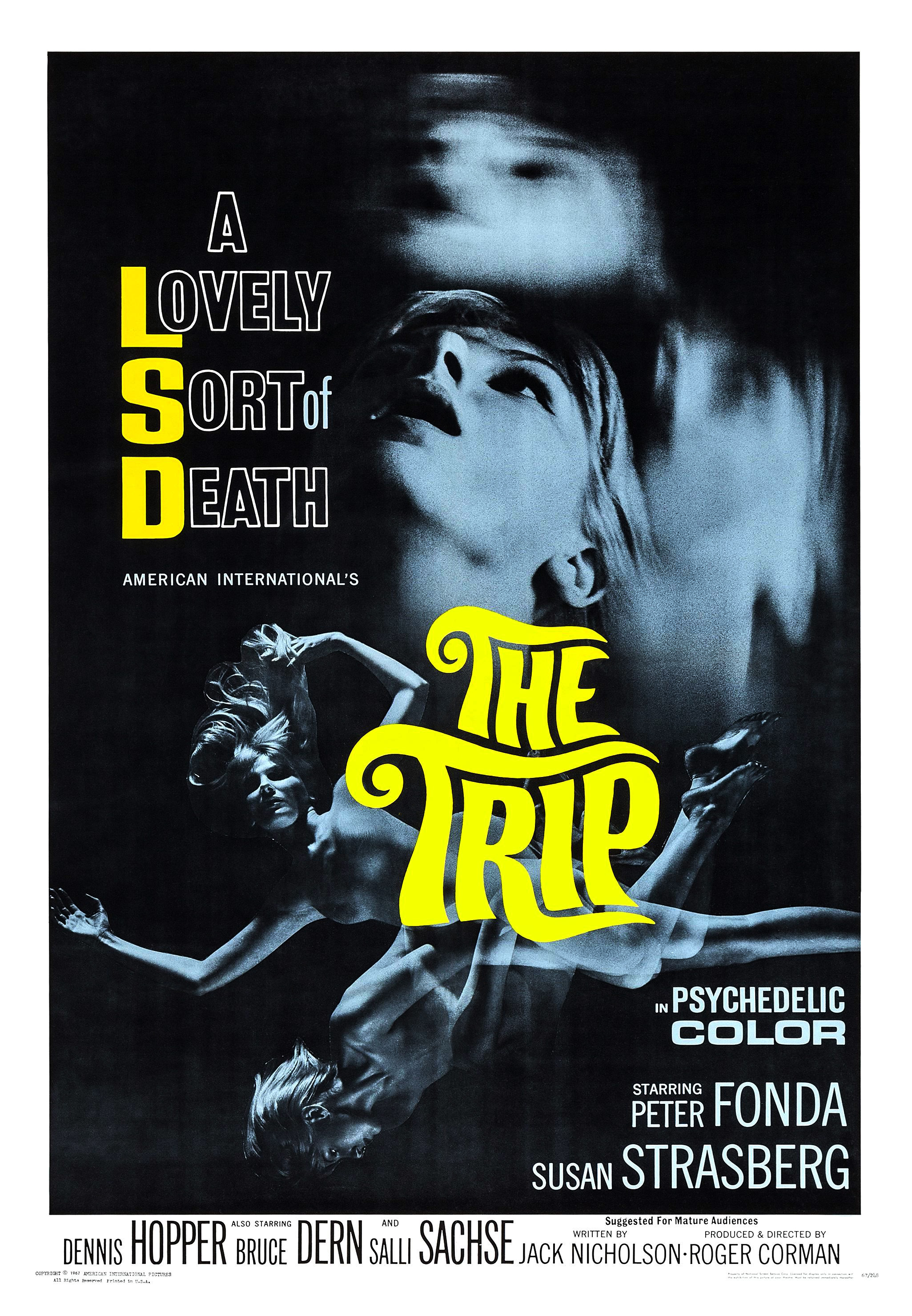
Roger Corman’s Electric Kool-Aid Tangerine Dream: THE TRIP (AIP 1967)


gary loggins's avatarcracked rear viewer

“You are about to be involved in a most unusual motion picture experience. It deals fictionally with the hallucinogenic drug LSD. Today, the extensive use in black market production of this and other so-called ‘mind bending’ chemicals are of great concern to medical and civil authorities…. This picture represents a shocking commentary on a prevalent trend of our time and one that must be of great concern to us all.” – Disclaimer at the beginning of 1967’s THE TRIP

trip1

“Tune in, turn on, drop out”, exhorted 60’s acid guru Timothy Leary. The hippie generation’s fascination with having a psychedelic experience was a craze ripe for exploitation picking, and leave it to Roger Corman to create the first drug movie, THE TRIP. Released during the peak of the Summer of Love, THE TRIP was a box office success. Most critics of the era had no clue what to make of it, but the youth…

View original post 511 more words

The Movie That Nearly Killed The Godfather: The Brotherhood (1968, directed by Martin Ritt)


Brotherhood_1968Once upon a time, Paramount Pictures released a movie about an Italian-American organized crime family.

It was a self-styled epic that used the Mafia as a metaphor for both business and politics.  The movie mixed scenes of violent death with family and community ceremonies.   The main mafioso was played by a famous actor who was a big box office draw in the 1950s and another character, a war hero who was initially reluctant to get involved in the family business, was played by an up-and-coming young actor.   The majority of the movie took place in New York but there were several scenes that were set in Sicily.

It may sound like The Godfather but actually, it was The Brotherhood, a film that flopped so badly that Paramount executives nearly passed on the chance to make a movie out of Mario Puzo’s bestselling novel.  According to Peter Biskind’s The Godfather Companion, Francis Ford Coppola frequently cited The Brotherhood as being exactly the type of movie that he did not want to make while he was directing The Godfather.

Kirk Douglas, who both produced and starred, plays Frank Ginetta.  Frank, an old-fashioned and honorable mobster, is hiding out in Sicily with his wife, Ida (Irene Pappas).  Frank knows that a rival gangster, Jim Egan (Murray Hamilton), has put a price on his head.  When Frank’s brother, Vinnie (Alex Cord), shows up in Palermo, Frank is overjoyed at first.  But Ida reminds him, “They’re going to send someone.”

Most of the film is taken up with flashback to Frank and Vinnie’s old life in New York.  When Vinnie returns from serving in the army, he marries Emma Bertolo (Susan Strasberg), the daughter of Don Bertolo (Luther Adler who, as a stage actor and director, served as an early mentor to the future Don Corleone, Marlon Brando).  Frank grew up idolizing their Sicilian father and, at first, he is happy when Vinnie announces that he wants to enter the “family business.”  But then Vinnie starts to side with non-Sicilian gangsters like Egan and Sol Levin (Alan Hewitt).

The scenes in Sicily work the best, with Frank unsure as to whether or not Vinnie has arrived to visit or to murder him.  But the scenes in New York are such a mess that it took me a while to realize that they were even supposed to be flashbacks.  It is hard to keep track of how much time has passed from scene to scene and Alex Cord and Kirk Douglas are two of the most unlikely brothers imaginable.

The main problem with The Brotherhood is that it is impossible to watch it without thinking about The Godfather.  The Brotherhood has much in common with The Godfather but it has none of its authenticity and does not come close to matching its epic scale.  Kirk Douglas tries his best and puts a lot of effort into talking with his hands but he is miscast from the moment he first appears.  Robert Evans once said that he chose Coppola to direct The Godfather because he wanted to “smell the pasta.”  The Brotherhood was directed by Martin Ritt and you never smell the pasta.

The Brotherhood is an interesting footnote in the history of The Godfather but ultimately, it’s an offer you can refuse.

1374000145_4

Cleaning Out The DVR: Picnic (dir by Joshua Logan)


Original_movie_poster_for_the_film_Picnic

Tonight, I continued to clean out the DVR by watching the 1955 film Picnic.

Now, Picnic is kind of a strange film.  It’s one of those films from 50s that takes place in a small town where everyone is obsessed with sex but, since it’s the 1950s, nobody can just come out and say that they’re talking about sex.  So, instead, all of the dialogue is very discreet.  For instance, when Madge Owen (Kim Novak) talks to her mother, Flo (Betty Owens), about her date with her boyfriend, Alan (Cliff Robertson), Madge confesses that they spent the night kissing.  Flo asks if Madge if they have done anything more than kiss but, of course, she never comes straight out and says what “more” would be.  The audience knows what she’s talking about but it’s as if the world would actually end if anyone actually uttered the word.  “Oh mom!”  an embarrassed Madge says before confirming that she and Alan haven’t done anything more than kiss.

Flo desperately wants Madge to marry Alan because Alan is rich and his father owns the town’s grain elevator.  Marrying Alan would allow Flo to move up in the town’s strict social hierarchy.  However, Madge isn’t sure that she loves Alan.  Certainly, Alan seems to be a good man with a good future but he’s not a romantic.  Instead, he is someone who has his entire life already mapped out for him.

On Labor Day, a stranger comes to town.  His name is Hal Carter and he shows up riding on a freight train.  He’s come into town to see his old friend, Alan.  It turns out that Hal and Alan went to college together and were members of the same fraternity.  Hal was a star football player but he eventually flunked out of school and has spent the last few years drifting around the country.  However, Hal is now ready to settle down and he wonders if his old roommate Alan can get him a job at the grain elevator.

Now, here’s the strange part.  Hal is played by William Holden.  When he made Picnic, William Holden was 38 years old and looked closer to being 45.  (By contrast, Cliff Robertson, in the role of his former college roommate, was 32 and looked like he was 25.)  Hal spends a lot of time talking about his traumatic childhood and how he is finally ready to settle down and start acting like an adult.  In short, Hal talks like a 30 year-old but he looks like he’s nearly 50.  It’s odd to watch.  But even beyond the age issue, William Holden was an actor who always came across as being both confident and cynical.  Hal is a secret romantic with a deep streak of insecurity.  As great an actor as he may have been, William Holden is so thoroughly miscast here that it actually becomes fascinating to watch.  It brings a whole new subtext to the film as you find yourself wondering why no one is town finds it strange that a middle-aged man is still struggling to deal with his childhood.  When all the town’s young women ogle that shirtless Hal, it’s as if he’s wandered into a town populated only by teenagers with daddy issues.

(Paul Newman played the role of Hal in a Broadway production of Picnic.  And really, that’s who the ideal Hal would have been, a young Paul Newman.)

The majority of the film takes place at the town’s Labor Day picnic, where almost every woman in town is driven to distraction by the sight of Hal dancing.  Even the spinster teacher, Rosemary (Rosalind Russell), is so turned on by Hal’s masculinity that she makes a pass at him and accidentally rips his shirt.  Of course, some of Rosemary’s behavior is due to the fact that she’s drunk.  Her date, the befuddled Howard Bevans (Arthur O’Connell), made the mistake of being whiskey to the picnic.

Hal also dances with Madge’s 13 year-old sister, Millie (Susan Strasberg).  I have to admit that, even though I related strongly to Madge, Millie was my favorite character in the film.  Millie wears glasses and can recite Shakespeare from memory.  She knows that everyone around her is full of it and she’s willing to call them on it.  Of course, Millie herself ends up with a crush on Hal and it’s a dream for her when she finally gets to dance with him.

(Strasberg was 17 years old but is believable as a 13 year-old.  At the same time, since Hal appears to be nearly 50, his sudden closeness to Millie carries an icky, if unintentional, subtext.)

But then Madge suddenly appears, wearing a pink dress and literally emerging from the black night.  She starts to sway to the music.  As she slowly approaches Hal, he forgets about Millie and soon is dancing with Madge.  It’s actually a rather striking scene, one that so full of dream-like sensuality that it almost seems more like it was directed by surrealist David Lynch as opposed to the usually workmanlike Joshua Logan.

(In the video below, the scene freezes about 12 seconds in, before starting up again at the 16 second mark.  This is a glitch with the upload and is not present in the actual film.)

Needless to say, a drifter can’t just come into town and steal his ex-roommate’s girlfriend without drama following.  Picnic starts out as a slightly overheated examination of small town morality and then, after about an hour, it goes the full melodrama route, complete with police chases, stolen cars, a fist fight in an ornate mansion, and a lot of big speeches about the importance of love.  Needless to say, it’s all a lot of fun.

Picnic was nominated for best picture of the year.  However, it lost to the far more low-key Marty.

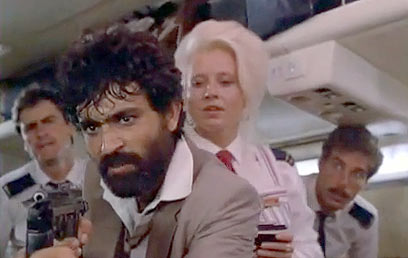
A Death-Defying Quickie With Lisa Marie: Rollercoaster (dir by James Goldstone)


Recently, despite my longstanding fear of heights and my refusal to ever ride one in real life, I watched a film called Rollercoaster.  First released in 1977, Rollercoaster recently made its debut on TCM.  I was hesitant about watching it but then Robert Osborne assured me that it was an entertaining film and, seriously, who can say no to Robert Osborne?

An unnamed bomber (Timothy Bottoms) is going from amusement park to amusement park and blowing up roller coasters.  He wants money and, even more importantly, he wants the money to be delivered to him by safety inspector Harry Caulder (George Segal).  Will the FBI back off long enough for Harry to deal with the bomber?  Will the bomber ever smile?  Finally, will Harry be able to save the day while, at the same time, trying to quit smoking and bond with his daughter?

Roller Coaster is about 30 minutes too long and it’s never quite as exciting as it should be.  My mind kept wandering during the climax, which is not a good thing when the film is supposed to be a race against time.  However, at the same time, when taken on its own dated terms, Roller Coaster is a lot of fun.  Even if director James Goldstone (who also directed the far more surreal Brother John) struggles a bit with keeping the action moving at a steady pace, he still directs with a good eye for detail and gets good performances out of the majority of the film’s cast.

Since I best know George Segal for playing cantankerous father figures on about a thousand different sitcoms, it took me a few minutes to get used to the idea that he was the main character here.  While Segal does have several funny lines in Rollercoaster, he is also totally convincing and likable as the film’s hero.  Timothy Bottoms is equally convincing as the unnamed bomber.  The fact that we learn little about the bomber’s motivations or background just serve to make Bottoms’s cold performance all the more chilling.

As for the supporting cast, Henry Fonda is the biggest distraction, snarling his way through his role as Segal’s jerk of a boss.  Oddly enough, Fonda showed up in a lot of disaster films in the 70s, usually playing authority figures and usually only appearing in two or three scenes.  Whenever Henry Fonda shows up in a film like this, overacting and looking somewhat humiliated, it’s best just to close your eyes and think of 12 Angry Men and then realize that even great actors sometimes just needed a paycheck.  Richard Widmark is far more convincing, playing the stuffy FBI agent who doesn’t have much use for George Segal.  Finally, for those of you who enjoy spotting future Oscar nominees in unlikely roles, 13 year-old Helen Hunt makes her film debut here as Segal’s daughter, who just wants to ride the rollercoaster one time.

Ultimately, the best recommendation that I can give to Rollercoaster is to say that it’s a quintessentially 70s films and hence, it’s a piece of history.  Not only is the film full of 70s fashion, 70s hair, and 70s stereotypes (just check out the long-haired teenagers joking about getting high while unknowingly sitting on top of a bomb) but the film also features a performance from a band called Sparks that is so 70s that the cast of Dazed and Confused might as well have been watching them in the audience and going, “Alright, alright, alright…”

(I have to admit that I had never heard of Sparks before I saw this film.  I looked them up on Wikipedia and I discovered that not only is the band still performing but that the lead singer claims that appearing in Rollercoaster was the band’s biggest regret.  Personally, I think he’s being too hard on both the band and the film.  Sure, they seem painfully out-of-place but I dare anyone to get the borderline annoying sound of “Big Boy” out of their head.)

For those of us who were born a few decades too late to experience it firsthand, Rollercoaster is our chance to spend two hours living in the 70s.