With this year’s Sundance Film Festival getting underway in Colorado, I’m going to be spending the next two weeks looking at some films that caused a stir at previous Sundance Film Festivals. Today, I’m taking a look at the 2018’s Searching.
Searching tells the story of David Kim (John Cho) and his daughter, Margot (Michelle La).
David thinks that he has a close relationship with his daughter but, in reality, they’ve been drifting apart ever since David’s wife died two years earlier. Now, Margot is away at college and David is alone at home. They still communicate, of course. They message each other on Facebook. They Skype. David sill sends Margot money for her piano lessons.
And yet, even if he can’t bring himself to fully admit it, David knows that they’re not as close as they once were. Their conversations are often awkward and he doesn’t really know much about the friends that Margot has made at college. Too often, he finds himself starting to ask her about what’s really going on in her life, just to then erase the message before sending. One night, when Margot tells David that she’s going to a friend’s house for a study group, he has no reason not to believe her. It’s not until Margot fails to return from studying that David is forced to confront how little he actually knows about his daughter’s life.
As a film, Searching is set almost entirely on smartphones and computer screens. Considering that the movie could have just as easily been called Unfriended 3: Searching, this is a surprisingly good and emotionally resonant film. We watch as David helplessly sends out messages to his daughters, messages that are destined to be unanswered. We watch as David looks at old pictures and videos of the family he once had, searching for some sort of answer hidden in the past. And, as we watch all of this, we come to realize that David is not just searching for his daughter’s whereabouts. Instead, in a world dominated by social media, he’s also searching for a human connection, for something more than just a tweet or a cryptic status update.
Of course, the film does occasionally threaten to take its format just a bit too far. Sometimes, you really do find yourself wishing that David would just get offline and go outside and look for his daughter. (Actually, he does do that but, because of the film’s narrative structure, we don’t really get to witness it.) By the time David is having nightly FaceTime sessions with the detective (Debra Messing) assigned to his daughter’s case, you can be excused for fearing that the film’s style is going to end up collapsing in on itself.
Fortunately, Searching is held together by the lead performance of John Cho. Whenever Searching threatens to veer into self-parody, Cho is there to bring it back on track. Before this film came out, I guess Cho was probably best known for appearing in the Star Trek movies. Searching made him the first Asian-American to headline a mainstream thriller in Hollywood and Cho gives such a sympathetic and compelling performance that you’re willing to excuse whatever flaws might be present in the film’s narrative. Because he’s played by John Cho, you want David to find his daughter. You want him to find that for which he’s searching.
With this year’s Sundance Film Festival getting underway in Colorado, I’m going to be spending the next two weeks looking at some films that caused a stir at previous Sundance Film Festivals. Today, I’m taking a look at the 2018 documentary, Three Identical Strangers.
It’s generally agreed that last year was a great year for documentaries. Between RBG, Would You Like To Be My Neighbor?, and Free Solo cleaning up at the box office, 2018 was the year that proved the audiences were willing to pay money to see reality captured on film. For me, there was no better documentary released last year than Three Identical Strangers.
Three Identical Strangers starts out like a Hallmark movie and then slowly turns into a horror movie. In New York, in the early 1980s, three young men who have previously never met discover that they’re triplets. At first, they’re a media sensation. Young, handsome, and charismatic, Edward Galland, David Kellman, and Robert Shafran become instantly celebrities. We watch archival footage of them appearing on a talk show and talking about how they discovered each other and everything that they have in common. They all smoke the same brand of cigarette. They all tend to have the same fashion sense and interests. All three of them smile while announcing that they’re single and they like women, which causes the audience to break into applause.
It was the 80s and we’re told that meant sex, drugs, and rock and roll. There are the three brothers at a club. There they are walking down the streets of New York, with three huge grins on their faces. There they are making a cameo appearance in a film with Madonna. Soon, they’re opening up a restaurant together, they’re getting married, and they’re starting families of their own….
And yet, as we watch all of this happy footage, we’re also watching present-day interviews with David Kellman and Robert Shafran. It’s impossible not to notice that, in the present, both of them speak in voices tinged with weariness. In the present day interviews, neither one of the brothers smile. Both of them have their guard up. To put it simply, neither one of them appears to be particularly happy.
It’s also impossible not to notice that Edward Galland, who is frequently described as having been the most charismatic of the triplets, is nowhere to be seen.
While the three triplets are becoming celebrities, the families that adopted them are wondering why they never knew about the other brothers. All three of the brothers were adopted through the same adoption agency and, interestingly, all three of them were put into families that had just recently adopted a daughter as well. One brother was given to an upper class family while another was adopted by a middle class family and finally, the third brother was given to a lower class family. It quickly becomes clear that this was not a coincidence.
Instead, the three brothers were a part of a social experiment, one designed to see how growing up at different economic levels would effect them. And, as quickly becomes clear, Edward, David, and Robert weren’t the only part of that experiment. Under the direction of psychologists Viola W. Bernard and Peter B. Neubauer, several sets of twins and triplets were separated for the exact same reason….
To say anything else about this haunting documentary would run the risk of spoiling it. It’s a thought-provoking film, as well as a rather disturbing one. Watching the film, it’s impossible not to mourn for the childhoods that the brothers lost. At the same time, you do find yourself wondering if all of the triplets’s subsequent problems can be blamed on the experiment or if they would have happened even if they all had been raised in the same family? The documentary leaves the answer to that question ambiguous. Much like the triplets, the audience is left wondering what could have been.
Oddly, Three Identical Strangers was not nominated for the Best Documentary Feature Oscar. Well, that’s the Academy’s loss because this film was the best documentary of a very good year.
With this year’s Sundance Film Festival getting underway in Colorado, I’m going to be spending the next two weeks looking at some films that caused a stir at previous Sundances. Today, I’m taking a look at 2018’s The Tale.
The Tale is all about memory.
Jennifer Fox (Laura Dern) is, as her mother (Ellen Burstyn) often reminds her, nearly fifty years old and childless. She’s been engaged to the sensitive Martin (Common) for three years but she’s in no hurry to get married. As for children — well, she decided a long time ago that she didn’t want to have children. Jennifer is a documentarian and a teacher. She not only records real life but she also teaches others how to do the same thing. She makes films that, in the decades to come, will be used by future students of history who want to know what it was like to live in the late 20th and early 21st Century. And yet, it’s her own history that Jennifer has never come to terms with.
When her mother comes across a school essay that a 13 year-old Jennifer once wrote about her relationship with her riding instructor, Mrs. G (Elizabeth Debicki), and her running coach, Bill (Jason Ritter), Jennifer dismisses her concerns. As Jennifer explains it to Martin, her mother is just upset because Jennifer once had a boyfriend who was “older.” Of course, that older boyfriend was in his 40s. What’s obvious to everyone but Jennifer is that her coach took advantage of and raped her. Jennifer, however, refuses to accept that. She refers to the coach as being her “lover” and, more than a few times, she attempts to dismiss the whole topic by shrugging and saying, “It was the 70s.”
It’s not that Jennifer doesn’t realize the truth about what actually happened. Laura Dern gives a fiercely intelligent performance as Jennifer, one that slowly and deliberately peels away at the layers of defensive protection that Jennifer has spent the past 35 years developing. Jennifer knows what happened but she’s allowed her memory to cloud the reality of it, largely because that’s the only way that she could deal with the aftereffects of Bill’s sexual abuse. When Jennifer thinks back to the summer that she spent with Mrs. G and Bill, she first sees herself as she was when she was 15 years old, curious and headstrong. It’s only when Jennifer looks at a photograph that was taken that summer that she sees starts to see herself as she really was, an introverted and vulnerable 13 year-old (played by Isabelle Nelisse) who was groomed and abused by two predators.
As Jennifer investigates her past and finally begins to understand what really happened over the course of that summer, her memories begin to change. Hazily-remembered conversations take on new meaning and she begins to understand that terrible truth between the looks that were often exchanged between Bill and Mrs. G. At times, the older Jennifer finds herself interrogating her memories of Bill, Mrs. G, and even her younger self. She demands to know how they could have done what they did and their answers leave you wondering whether you’re hearing what they would really say or if your just hearing what Jennifer would hope they would say. When Jennifer talks to others who were around that summer, she’s shocked to learn that she wasn’t the only one who Bill abused and her insistence that she was Bill’s lover (as opposed to his victim) sounds more and more hollow. When Jennifer finally does track down some of her abusers, you wonder if their somewhat confused reactions are due to guilt or if it’s possible that there were so many victims that they don’t even remember what they did to Jenny Fox. And if they do remember, they seem to be either horrifically ignorant or curelly unconcerned about the consequences of their actions.
It’s a brave and powerful film, one that is made all the more disturbing by the fact that director and screenwriter Jennifer Fox is telling her own story. At least year’s Sundance Film Festival, it premiered to acclaim and controversy. There was also some surprise when, instead of securing a theatrical release, the film was instead sold to HBO. At the time, there was a lot of concern that the film’s power would somehow be diluted as a result of playing on television as opposed to a big screen. However, in hindsight, the small screen — with its unavoidable vulnerability — was the perfect place for this uncompromising and emotionally raw film.
The Tale is not an easy film to watch but it is an important one. It’s a film for anyone who has ever struggled to come to terms with the past. It’s both a reminder that you’re not alone and a warning to not ignore or laugh off your suspicions. It’s also a good example of the type of film that probably would never have been discovered if not for Sundance. There’s a lot of legitimate criticism that one can direct towards the Sundance Film Festival but occasionally, it does do what it’s supposed to do.
Compared to previous years, the buzz around this year’s Sundance Film Festival has felt pretty subdued. There haven’t been any headlines about any huge distribution deals. I haven’t seen many articles declaring that “Next year’s Oscar race has already begun at Sundance!” this year.
That said, Sundance remains the first big event of the film year. Even if the coverage was unusually subdued this year, it still appears that there were some intriguing films at this year’s festival. Myself, I’m definitely planning on making the time to see Burden, Blaze, Lizzie, Colette, Eighth Grade, and The Tale.
On Saturday night, the following films won awards at the Sundance Film Festival:
U.S. DRAMATIC COMPETITION
Grand Jury Prize: “The Miseducation of Cameron Post”
Audience Award: “Burden”
Directing: Sara Colangelo, “The Kindergarten Teacher”
Waldo Salt Screenwriting Award: Christina Choe, “Nancy”
Special Jury Award for Outstanding First Feature: Reinaldo Marcus Green, “Monsters and Men”
Special Jury Award for Excellence in Filmmaking: “I Think We’re Alone Now”
Special Jury Award for Acting: Benjamin Dickey, “Blaze”
U.S. DOCUMENTARY COMPETITION
Grand Jury Prize: “Kailash”
Directing: Alexandria Bombach, “On Her Shoulders”
Audience Award: “The Sentence”
Special Jury Award for Social Impact: “Crime + Punishment”
Special Jury Award for Creative Vision: “Hale County This Morning, This Evening”
Special Jury Award for Breakthrough Filmmaking: “Minding the Gap”
Special Jury Award for Storytelling: “Three Identical Strangers”
The Sundance Film Festival is currently taking place in Utah so, for this week, I’m reviewing films that either premiered, won awards at, or otherwise made a splash at Sundance! Today, I take a look at 1992’s Reservoir Dogs, which premiered at that year’s Sundance Film Festival.
Technically, I guess I’m obligated to start this review with a spoiler alert. Though, seriously, is there anyone out there who hasn’t seen Reservoir Dogs? I guess that there may be. But surely, even if you haven’t seen it, you know everything that happens in the movie. You know about the Like A Virgin conversation at the start of the movie. You know about the ear scene. You’ve seen countless parodies of that scene where the cast walks down the street in slow motion. I find it hard to believe that there are people who don’t know everything about this film but still, I guess it’s always a possibility.
Reservoir Dogs is a challenging film to review, though not because it’s overly complicated or difficult to follow. Instead, the problem is that it’s hard to know what’s left to say about Reservoir Dogs. Just about every crime film that has come out in my lifetime has owed an obvious debt to Reservoir Dogs. It’s the film that launched the directorial career of Quentin Tarantino. It’s also features one of the greatest acting ensembles in the history of American film: Harvey Keitel, Tim Roth, Michael Madsen, Steve Buscemi, Chris Penn, Kirk Baltz, and Lawrence Tierney. Tierney’s presence was especially important. By appearing in the film, the veteran tough guy actor passed on the torch of hard-boiled crime to a new generation.
At its most basic, Reservoir Dogs is a heist film. It employs the type of jumbled timeline that has become a Tarantino trademark. The film starts with a group of 8 criminals eating breakfast and preparing to rob a jewelry store. Then it jumps forward to immediately after the crime, with Mr. Orange (Tim Roth) shot in the gut and Mr. White (Harvey Keitel) desperately trying to get them both to the safety of a warehouse. That’s where they are joined by Mr. Pink (Steve Buscemi). Mr. Pink is convinced that they were set up. He rants about being a professional. He asks if Mr. White had to shoot anyone during his escape.
“A few cops,” Mr. White says.
“No real people?” Mr. Pink replies.
Eventually, Mr. Blonde (Michael Madsen) shows up. We already know, from the film’s first scene, that Mr. Blonde strongly feels that everyone should tip their waitress. After he arrives at the warehouse, we discover that he also likes good music and torturing hostages. Meanwhile, the robbery’s mastermind, Joe Cabot (Lawrence Tierney) and his son, Eddie (Chris Penn), are also on their way to the warehouse. Neither one is happy about how things are going.
And while all this goes on, Mr. Orange continues to bleed in the background…
Reservoir Dogs is known for being a violent film and, even though the movie is 26 years old, some of the violence can still catch you off-guard and make you flinch. The scene where Mr. Blonde chops off the cop’s ear is still not easy to watch. However, the scene that always freaks me out is when Mr. White starts shooting at a police car and the windshield is suddenly smeared with blood. Mr. White is one of the film’s more sympathetic characters but he doesn’t hesitate to kill.
Of course, I think it could also be argued that Reservoir Dogs is actually as close as Tarantino has come to making a film that condemns violence. Not counting the flashbacks, the story largely plays out in real time, which means that we basically spend the entire movie watching and listening as Mr. Orange slowly bleeds to death in front of us.
I rewatched Reservoir Dogs for this review and I have to say that I was really surprised to see how well the film holds up. I was honestly expecting to be a little bit bored with it, just because I’d already seen it multiple times and I knew who the cop would turn out to be. I already had all of the film’s great lines memorized. But, as soon as the film started with everyone arguing about Like A Virgin and whether or not to tip their waitress, I was sucked back into Tarantino’s world. Once again, I found myself laughing at Steve Buscemi’s brilliant delivery of the line: “Why am I Mr. Pink?” I was enthralled all over again by Tim Roth’s nervous intensity and Harvey Keitel’s weary integrity. Even Michael Madsen’s psycho routine felt fresh, despite the fact that he’s played numerous cool-as-ice psychos over the course of his career. Even the way Chris Penn told the story about Lady E still made me laugh.
(To be honest, the line that makes me laugh the most in Reservoir Dogs — and don’t ask me why because I’m not sure of the exact reason — is when the unseen cop who is heard to say, “Yeah, give me the bearclaw,” while following Eddie’s car.)
It’s just a cool movie. How can you resist this?
What happen at the end of the film? Well, we all know the basics. (And here’s where that probably unnecessary spoiler alert comes into play.) Mr. White kills Joe and Eddie, all to protect Mr. Orange. Mr. Pink runs from the warehouse. The seriously wounded Mr. White cradles the dying Orange in his arms. Orange confesses to being a cop. Mr. White lets out a wail of both physical and emotional pain. The police enter the warehouse and order Mr. White to drop his gun. Mr. White shoots Orange in the head and is then gunned down by the police.
But what happened to Mr. Pink?
That’s a serious question because Mr. Pink is my favorite member of this band of robbers. (He gets all the best lines, probably because Tarantino was planning on playing the role himself before Steve Buscemi auditioned.) A lot of people will tell you that they can hear Mr. Pink being arrested outside of the warehouse, shortly before the cops come in and kill Mr. White. And yes, I realize that, in at least one draft of the script, that’s exactly what happened.
Well, I don’t care. We don’t actually see Mr. Pink getting arrested. We don’t hear him getting shot. As far as I’m concerned, Mr. Pink made it out of there alive and managed to escape with the diamonds. The police may have yelled at him to stop but, in the end, they were too busy killing Mr. White to keep an eye on him. Mr. Pink escaped and is currently living on the beach somewhere. As a result of selling the diamonds, he’s now financially comfortable but he still doesn’t tip his waitress. That’s just the way Mr. Pink is.
Finally, one little bit of trivia: Reservoir Dogs may have premiered at the 1992 Sundance Film Festival but it didn’t win any awards at the end of it. Instead, the big winner that year was a comedy called In The Soup. The star of that film? Steve Buscemi.
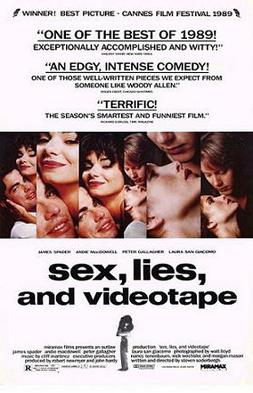
The Sundance Film Festival is currently taking place in Utah so, for this week, I’m reviewing films that either premiered, won awards at, or otherwise made a splash at Sundance! Today, I take a look at 1989’s sex, lies, and videotape, which won both the Audience Award at the 1989 Sundance Film Festival and the Palme d’Or at Cannes!
The directorial debut of Steven Soderbergh, sex, lies, and videotape is considered by many to be one of the most important independent American films ever made. Not only was it a success at the box office and nominated for an Oscar but it also won the Palme d’Or at Cannes. According to Peter Biskind’s Down and Dirty Pictures, the success of sex, lies, and videotape is what convinced Hollywood that independent films could be big business. The marketing of the film would set the template for almost every independent release that followed.
(One person who was definitely not a fan of sex, lies, and videotape was director Spike Lee. When Lee’s Do The Right Thing lost the Palme to Soderbergh’s film, Lee was informed that the Canne jury felt Lee’s film wasn’t “socially responsible.” “What’s so socially responsible about a pervert filming women!?” Lee reportedly responded.)
sex, lies, and videotape tells the story of four people in Baton Rouge, Louisiana.
Ann (Andie MacDowell) has a nice house, a successful husband, and an absolutely miserable marriage. When the film opens, she’s having a session with her therapist (Ron Vawter) and talking about how unfulfilled she feels. When the therapist asks her questions about her sex life, Ann laughs nervously. She says that she likes sex but she doesn’t like to think about it. She says she doesn’t see what the big deal is. Later, she reveals that she’s never had an orgasm.
John (Peter Gallagher) is Ann’s husband. He’s a lawyer. He’s also a materialistic jerk and … well, that’s pretty much the sum total of John’s entire personality.
Cynthia (Laura San Giacomo) is John’s mistress. She’s a bartender at a rather sleazy little establishment, where she apparently spends all of her time listening to a local drunk (Steven Brill) do a Marlon Brando impersonation. She is uninhibited and fiercely sexual. She’s the opposite of Ann, which is why John likes her. Of course, she’s also Ann’s sister. Cynthia and Ann have a strained relationship. Ann describes Cynthia as being “loud.” Cynthia views Anne as being judgmental. Secretly, both wish that they could be more like the other.
And then there’s Graham (James Spader). Graham was John’s friend in college, though it’s difficult to understand why. Graham has recently returned to Baton Rouge and John, without talking to Ann, has invited Graham to visit them. Graham is apparently a drifter. (Ann describes him as being “arty.”) While Ann is helping him find an apartment, Graham informs her that he’s impotent. He can’t get an erection if anyone else in the room.
Ann subsequently discovers that Graham deals with his impotence by videotaping women discussing their sex lives. The video camera allows Graham to keep his distance and not get emotionally involved. (Of course, it also serves as a metaphor for directing a movie.) Ann is freaked out by all of Graham’s tapes. Cynthia is intrigued. And John … well, John’s just a jerk.
sex, lies, and videotape is a film that’s largely saved by its cast. Graham is a role that literally only James Spader could make intriguing. Meanwhile, Peter Gallagher actually manages to bring some charm to John, who is the least developed character and who gets all of the script’s worst lines. That said, the film really belongs to MacDowell and San Giacomo, who are totally believable as sisters and who, again, bring some needed depth to characters that, as written, could have been reduced to being mere clichés. (In the scenes between MacDowell and San Giacomo, it was less about what they said than how they said it.)
As I already stated, this was Steven Soderbergh’s feature debut. Soderbergh was 26 years old when he made this. Seen today, it’s an uneven but ultimately intriguing film. There are a few scenes where Soderbergh’s inexperience as a filmmaker comes through. For instance, John is written as being such a complete heel (and, in his final scene, he wears a ludicrous bow tie that practically screams, “EVIL,”) that it occasionally throws the film off-balance. You never believe that Graham would have been his friend, nor do you believe that Ann would have spent years putting up with his crap. The film’s final scene between Cynthia and Ann also feels a bit rushed and perfunctory. That said, this film shows that, from the start, Soderbergh was good with actors. Visually, Soderbergh takes a low-key approach and allows the cast to be the center of attention. It’s an actor’s film and Soderbergh wisely gets out of their way. In particular, Spader and San Giacomo have a way of making the most heavy-handed dialogue sound totally and completely natural.
It’s hard to imagine Soderbergh directing something like sex, lies, and videotape today. If the film were made today, Soderbergh wouldn’t be able to resist the temptation to use overexposed film stock and to give cameos to George Clooney as Ann’s therapist and Matt Damon as the drunk. sex, lies, and videotape is a film that Soderbergh could only have made when he was young and still struggling to make his voice heard. It’s a flawed by intriguing film. If just for its historical significance, it’s a film that every lover of independent cinema should see at least once.
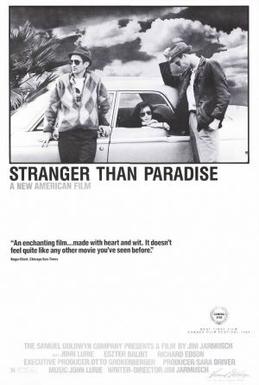
The Sundance Film Festival is currently taking place in Utah so, for this week, I’m reviewing films that either premiered, won awards at, or otherwise made a splash at Sundance! Today, I take a look at 1984’s Stranger Than Paradise, which won the Special Jury Prize at the 1985 Sundance Film Festival.
‘You know it’s funny. You come to someplace new, and everything looks just the same.’
— Eddie in Stranger Than Paradise (1984)
Stranger Than Paradise tells the story of three friends.
Willie (John Lurie) lives in a small apartment in New York City’s Lower East Side. He likes to go to the movies. He likes to watch TV. He likes to gamble, putting bets on horses and cheating at poker. He was apparently born in Hungary, though he doesn’t speak with an accent and, whenever he has to deal with a relative, he always tells them, “Speak English.” When his best friend asks him about why he never mentioned that he was Hungarian, Willie replies that he’s just as American as anyone.
Eva (Eszter Balint) is Willie’s cousin. She’s travels to America from Budapest. The plan is for her to live with her Aunt Lotte (Cecillia Stark) in Cleveland but, because Lotte is in the hospital, she begins her life in America by spending ten days in Willie’s cramped apartment. Eva enjoys the music of Screamin’ Jay Hawkins. When she’s walking to Willie’s apartment, I Put A Spell On You blares from the large tape player that she always carries with her.
And then there’s Eddie (Richard Edson). Eddie may not be too smart but he’s always smiling and easy-going. Unlike the somewhat churlish Willie, Eddie always seems to be enjoying himself. When Eddie first meets Eva, most viewers will probably expect them to eventually become a couple. That doesn’t happen, of course. That’s not the type of film that this is.
The first thing you notice about Stranger Than Paradise is the look of the film. As one might expect from a film that reportedly had a budget of $10,000, the film looks cheap but there’s a beauty in that cheapness. The harsh black-and-white magnifies every detail of the film’s locations. When we watch Eva walking through New York City, the street may look desolate but it’s an exquisite desolation.
Directing his second film, Jim Jarmusch shoots nearly the entire film in single long takes and refuses to indulge in any of the usual tricks that movies often use to force an audience to identify with its main characters. The camera rarely moves and every scene ends with a blackout. It’s a technique that casts the audience as observers. Willie, Eva, and Eddie may all be outsiders but, while watching the film, so is the audience. Willie, Eva, and Eddie win us over because of the charm of the actors playing them and the deadpan humor of their dialogue but, at the same time, the film never lets us forget that we’re merely watching their lives unfold.
The humor in Stranger Than Paradise comes less from what these characters do and more from what they don’t do. When Eva arrives in New York, Willie never offers to show her around. There’s no trip to Broadway or the Statue of Liberty or anything else that we, as an audience, have been conditioned to expect whenever a stranger comes to New York for the first time. Instead, Willie and Eva sit in Willie’s apartment and watch TV. When Eddie asks Eva if she wants to join him and Willie at the movies, Willie tells Eva to stay in the apartment and not go outside. Eva eventually wins Willie over by shoplifting dinner.
During the film’s second act, Willie and Eddie decided to visit Eva in Cleveland, despite not being sure where Cleveland is. They ask one random guy standing on a street corner how to get there. “I’m waiting for a bus,” the guy snarls back. Later, as they drive drown a highway, Eddie asks Willie if they’re in Ohio yet. “I think we’re in Pennsylvania,” Willie replies. When they finally do get to Ohio, it turns out to be a frozen wasteland. After meeting up with Eva, Willie and Eddie spend most of their vacation watching TV with Lotte. Eventually, they visit Lake Erie. It’s frozen but Eva, Willie, and Eddie still dutifully stand at the railing and stare down at it while a freezing wind howls around them.
Eventually, all three of them end up in Florida. Instead of visiting Walt Disney World or Miami, they end up sitting in a cheap motel room. Eva goes to the beach, which — when shot in black-and-white — looks just as desolate as Ohio in winter. Eventually, all three of them stumble into money but that’s just a set up for the film’s final joke…
It’s a deliberately slow-moving film but it’s never less than watchable. Lurie, Edson, and Balint all give such wonderfully deadpan performances that they’re a joy to watch even when they aren’t actually doing anything. Stranger Than Paradise was Jim Jarmusch’s second film and also one of the first independent American films to receive widespread attention and acclaim. (The National Society of Film Critics named it the best film of the year.) 34 years after it was first released, the film is an idiosyncratic joy to behold and definitely one that needs to watched by anyone who loves cinema.
The Sundance Film Festival is currently taking place in Utah so, for this week, I’m reviewing films that either premiered, won awards at, or otherwise made a splash at Sundance! Today, I take a look at 2006’s Alpha Dog, which premiered, out of competition, at Sundance.
Sometimes, I suspect that I may be the only person who actually likes this movie.
Alpha Dog is a film about a group of stupid people who end up doing a terrible thing. Johnny Truelove (Emile Hirsch) is a 20 year-old living in Los Angeles. His father, Sonny (Bruce Willis) and his godfather, Cosmo (Harry Dean Stanton), are both mob-connected and keep Johnny supplied with the drugs that Johnny then sells to his friends. It’s a pretty good deal for Johnny. He’s got a nice house and a group of friends who are willing to literally do anything for him. Johnny, after all, is the one who has the money.
When Johnny’s former best friend, Jake Mazursky (Ben Foster), fails to pay a drug debt, things quickly escalate. When Johnny refuses to accept even a partial payment, Jake responds by breaking into Johnny’s house and vandalizing the place. (Just what exactly Jake does, I’m not going to go into because it’s nasty. Seriously, burn that house down…) Johnny decides that the best way to force Jake to pay up is to kidnap Jake’s younger brother, Zack (Anton Yelchin, who is heartbreakingly good in this film).
It quickly turns out that Zack doesn’t mind being kidnapped. Everyone tells Zack not to worry about anything and that he’ll be set free as soon as Jake pays his debt. Zack decides to just enjoy his weekend. Since Johnny is better at ordering people to commit crimes than committing them himself, he tells his friend, Frankie (Justin Timberlake), to keep an eye on Zack.
And so it goes from there. While Johnny leaves town, Frankie introduces Zack to all of his friends. Everyone laughs about how Zack is “stolen boy.” Zack’s going to parties and having a good time. However, Johnny returns and reveals that he’s been doing some thinking, as well as talking to his lawyer. Regardless of whether Zack’s enjoying himself, both Johnny and Frankie could go to prison for kidnapping him. Frankie argues that Zack won’t tell anyone about what happened. Maybe they could just pay him off. Johnny thinks it might be easier to just have him killed. Frankie’s not a murderer but what about Elvis Schmidt (Shawn Hatosy)? Elvis is a loser who desperately wants to be a part of Johnny’s crew and he owes Johnny almost as much money as Jake does. How far would Elvis be willing to go?
(While this plays out, the film keeps a running tally of everyone who witnesses Zack not only being kidnapped but also held hostage. In the end, there were at least 32 witnesses but none of them said a word.)
Alpha Dog is based on the true story of Jesse James Hollywood and the murder of 15 year-old Nicholas Markowitz. Hollywood spent five years as a fugitive from justice, hiding out in Brazil and reportedly being protected by his wealthy family. He was arrested shortly before the Sundance premiere of Alpha Dog. Since it was filmed before Hollywood’s arrest and subsequent conviction, Alpha Dog changed his name to Johnny Truelove. Johnny Truelove is a good name but it’s nowhere near as memorable as Jesse James Hollywood.
Alpha Dog sticks close to the facts of the case, providing a disturbing portrait of a group of aimless wannabe gangsters who, insulated by money and privilege, ended up getting in over their heads and committing a terrible crime. Emile Hirsch gives one of his best performances as the sociopathic Johnny Truelove while Ben Foster is both frightening and, at times, sympathetic as Jake. Justin Timberlake is compelling as he wrestles with his conscience while Shawn Hatosy is properly loathsome as the type of idiot that everyone knows but wish they didn’t. The dearly missed Anton Yelchin is heartbreaking and poignant as Zack. And finally, there’s Harry Dean Stanton. Stanton doesn’t say a lot in this movie. Often times, he’s just hovering in the background. The moment when he reveals his true self is one of the best in the movie.
As I said, I sometimes feel as if I’m the only person who likes this movie. It got mixed reviews when it was released and, in the years since, it rarely seems to ever get mentioned in a positive context. Personally, I think it’s a well-done portrait of privilege, stupidity, and the lengths to which people will go to avoid taking a stand. In the end, no one escapes punishment but it’s the rich guy who, at the very least, gets to spend at least a few years enjoying his freedom in Brazil.
The Sundance Film Festival is currently taking place in Utah so, for this week, I’m reviewing films that either premiered, won awards at, or otherwise made a splash at Sundance! Today, I take a look at 2017’s The Big Sick.
Until the very end, I had hope.
I really and truly believed that The Big Sick, a charming comedy that premiered at Sundance last year and which was one of the best reviewed films of the summer, would manage to pick up an Oscar nod for best picture. I was actually expecting it would get three nominations, best picture, best original screenplay, and best supporting actress for Holly Hunter. I knew that the film wasn’t really flashy enough to pick up a best director nomination for Michael Showalter. And I knew that, despite giving a really good performance, Ray Romano would probably not be nominated for best supporting actor because … well, because he’s Ray Romano and he’ll always be thought of as being primarily a sitcom actor.
It’s true that, as a romantic comedy, The Big Sick would not have been a “traditional” nominee. But, honestly, the Oscars haven’t been traditional for a while. If the Oscars were still traditional, Mad Max: Fury Road would not have been nominated. Not only was The Big Sick critically acclaimed but it’s story — about a Pakistani comedian getting to know his American girlfriend’s parents — seemed tailor-made for the current cultural moment. The film got some attention during the precursor season, mostly for Holly Hunter. It picked up a best ensemble nomination from SAG. The AFI and the PGA both named it one of the best of the year.
But then, this morning, the Oscar nominations were announced. The Big Sick was nominated for best original screenplay and that was it. Not even Holly Hunter was nominated. And again, I don’t buy the whole “it wasn’t a traditional Oscar film” argument. Neither was Get Out. I would happily trade The Post for The Big Sick.
In The Big Sick, Kumail Nanjiani plays a version of himself. Zoe Kazan plays Emily Gardner, a version of Nanjiani’s wife, Emily V. Gordon. (Nanjiani and Gordon wrote the screenplay, which is based on their life.) Kumail is a stand-up comedian in Chicago. His parents are devout Muslims and want Kumail to marry a Pakistani girl. Kumail isn’t sure what he believes and is more comfortable watching Night of the Living Dead than praying. The first half of the film deals with Kumail and Emily’s relationship and they’re an adorable couple. You really do what them to stay together. Unfortunately, they don’t. When Emily discovers that Kumail hasn’t told his parents about her and that he isn’t sure their relationship can survive their cultural differences, Emily breaks up with him.
A few weeks later, Kumail learns that Emily is in the hospital. She’s in a medically induced coma, with an infection creeping towards her heart. Kumail goes to the hospital, where he meets Emily’s parents, Beth (Holly Hunter) and Terry (Ray Romano). It’s awkward, at first. But as they wait for word from the doctor, it becomes obvious that all three of them have at least one thing in common. They all love Emily and want her to wake up.
The Big Sick is a sweet-natured comedy about love, dating, culture clashes, and health care. It’s a pleasant and heartfelt film. There’s only one negative character in the entire film, a heckler who interrupts Kumail during his act and who, in one of the film’s best scenes, get a verbal beatdown from Beth. Perhaps if the film had a little more melodrama, it would have picked up that best picture nomination. But it wouldn’t have been as good a movie.
The Big Sick works because it rings true. You care about Kumail and Emily and, as the film progresses, you care about Terry and Beth as well. All four of the lead actors — Nanjiani, Kazan, Hunter, and Romano — gives excellent performances and, with the help of a genuinely witty script, create truly unforgettable characters. It’s a sweet movie and it’ll probably be remembered longer than some of the film that were nominated in its place.
(The Sundance Film Festival is currently taking place in Utah. This week, I am reviewing films that premiered at and/or received a prize at Sundance. Tonight, I take a look at the 2013 film, Blue Caprice.)
When we first meet Lee (Tequan Richmond), he is fifteen years old and living in poverty in Antigua. One morning, he watches as his mother gets in a car with a strange man. Before she goes, she tells Lee that she has no choice but to leave and that she will return. Lee says nothing as his mother is driven away.
Lee’s mother doesn’t return. Lee spends his time sitting in an empty house. He wanders through the nearby woods. Sometimes, he goes to a nearby town and walks around aimlessly. It’s in that town where he first sees John (Isaiah Washington). John is an American who is living on the island with his three children. John spots Lee watching him and soon, Lee is eating dinner at John’s house. John’s children ask if Lee is going to be living with them. John says that he doesn’t know. They ask if they can see their mother. John explains that, if they see their mother, they’ll no longer be able to spend time with him.
Months later, John and Lee are in Tacoma, Washington. The children are back with their mother. John tells Lee that America is full of lies. He says that all women lie. He says that the army lied to him. John says that he just wants to get his children back. John tells everyone that they meet that Lee is his son. John says that he loves Lee but, when John visits an old girlfriend, he has no hesitation about telling Lee to go walk around for a while. Lee ends up staring at the speaker at a fast food drive-through in amazement. “Do you have cheap burgers?” he asks.
John and Lee keep moving and eventually end up living with an old army friend of John’s. Ray (Tim Blake Nelson) is a good-natured redneck. He enjoys playing video games, smoking weed, and shooting guns. When Lee shoots one of Ray’s guns, Ray declares Lee to be a natural. John stares at the gun in Lee’s hand.
When he’s not trying to track down his ex-wife and children, John trains Lee. He ties Lee up and abandons him in the woods, forcing Lee to figure out how to escape. (“DAD!” Lee shouts as John walks away from him.) He gives Lee a sniper manual to study. He explains to Lee that the first step to destroying society is to make people panic. He says that it’s important to kill random people. After killing a man, they’ll kill a woman. After killing a woman, they’ll kill a child. No one will feel safe. When Lee shows reluctance about John’s plans, John demands to know if Lee loves him…
Blue Caprice is based on a true story. In 2002, John Muhammad and Lee Malvo shot 27 people in Maryland, Virginia, and Washington, D.C., killing 17 of them. The title of the film comes from the car that Muhammad and Malvo lived in during their shooting spree. Significantly, throughout the film, John and Lee are referred to only by their first names. Though the film may have been inspired by their actual crimes, Blue Caprice never claims to be an exact recreation of what happened. Instead, the film speculates about how John was able to turn a directionless teenager into a killer.
It makes for a chilling film. Isaiah Washington plays John as being a chameleon, a man who is so empty on the inside that he’s become very good at fooling people into believing that he’s whatever they want him to be. John is the type who can spend the morning plotting to overthrow the government, the afternoon trying to fool a school principal into telling him where his children are now living, and the evening grilling burgers and laughing with the neighbors. The film leaves no doubt to John’s evil but it’s attitude towards Lee is more ambiguous. Tequan Richmond captures the transformation of Lee from being a withdrawn teenager to a cold-blooded killer. Was Lee capable of being a killer before he met John or was he transformed by the older man? That’s the question that both the film and the audience struggles with.
Blue Caprice got good reviews when it played at the 2013 Sundance Film Festival, thought it was ultimately overshadowed by Fruitvale Station. It’s a disturbing film and not an optimistic one, which is perhaps why, post-Sundance, it never received quite as much attention as it deserved. It may not be a pleasant film to watch but it is one that definitely leaves an impression.




 Through the Shattered Lens