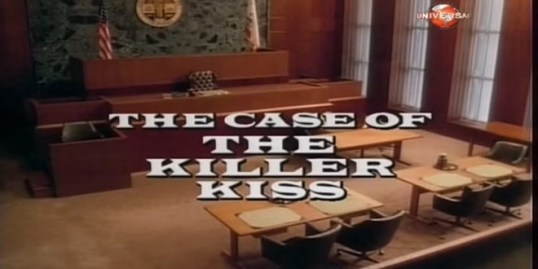
On the set of a popular soap opera, actor Mark Stanton (Sean Kanan) dies after he films a kiss with co-star Kris Buckner (Genie Francis). Kris is accused of intentionally poisoning Mark to get back at him for trying to force her off the show but Kris says she’s innocent. Fortunately, Kris is the goddaughter of Perry Mason (Raymond Burr).
This movie was the last time that Raymond Burr played Perry Mason and it actually aired a few weeks after his death. There are scenes that are hard to watch because it is clear that Burr was not doing well during filming. He rarely stands and when he does, he still leans against the table for support. He’s still great when he’s asking questions and making objections but physically, it’s obvious that he was struggling. He still lights whenever he’s talking to Della, though. The best scenes in the movie are just Raymond Burr and Barbara Hale being Perry and Della. Their affection for each other shines through in every scene. The mystery is routine but the guest cast is full of daytime drama royalty like Stuart Damon, Linda Dano, and Genie Francis.
As I said when I started reviewing these movies at the start of the month, my Aunt Kate loved watching these movies. I know she watched them when they first aired and later, when they started re-airing them on Hallmark or MeTV, she loved rewatching them even though she already knew who the murderer was going to be. I would watch with her sometimes. We agreed that Perry and Della were in love and that Paul Drake, Jr. was Della’s son, even if he didn’t know it.
Rewatching all of the movies this month, what struck me is that most of them are still a lot of fun. Sure, there’s a few clunkers. But the majority of the 27 Perry Mason films are still entertaining to watch. Raymond Burr as Perry Mason and Barbara Hale as Della Street? Nobody did it better.
Welcome to Retro Television Reviews, a feature where we review some of our favorite and least favorite shows of the past! On Tuesdays, I will be reviewing the original Fantasy Island, which ran on ABC from 1977 to 1984. The show is once again on Tubi!
It’s time for our second-to-last trip to the Island.
Episode 7.21 “Bojangles And The Dancer/Deuces Wild”
(Dir by Bob Sweeney, originally aired on May 12th, 1984)
Sisters Audrey and Judy Jennings (played, of course, by Audrey and Judy Landers) come to the Island because they’re sick of men only appreciating their bodies as opposed to their other talents. They end up meeting a hotelier named Rex Reinhardt (Stuart Whitman) who, after some poorly-defined drama involving his duplicitous chief of security (John Ericson), ends up opening a resort with the two of them. Fans of the James Bond franchise will be happy to see Walter Gotell, who played the head of the KGB opposite Roger Moore in several films, cast as a writer who romances one of the sisters.
It’s kind of a sad fantasy when you consider that this is the second-to-last episode of the original Fantasy Island and the best they could do for this story were the Landers sisters and Stuart Whitman. Not only were the guest stars not particularly inspiring but the fantasy itself didn’t really make much sense.
As for the other fantasy, it does feature a big-name guest star. Sammy Davis, Jr. plays the legendary dancer, Bojangles! Now, admittedly, Sammy doesn’t look particularly healthy in this particular episode. Reportedly, by the time the 80s rolled around, all of the smoking, drinking, and drug-taking had finally started to catch up with him. But, even while obviously ill, Sammy Davis Jr. still had the undeniable charisma of a natural-born star. The fantasy is nothing special. Joe Wilson (Glynn Turman) goes into the past so that he can dance with Bojangles. However, Sammy Davis Jr. lights up the story. He shares a wonderfully-acted scene with Ricardo Montalban, two old showbiz pros sharing what may have been a final moment together.
So, this trip to the Island was a mixed bag. Neither fantasy was particularly compelling and Tattoo’s absence was very much felt. (Lawrence, I’ve noticed, tends to be rather judgmental of the guests which is something Tattoo never was.) But at least Sammy Davis Jr. was there to add some life to the proceedings.
Welcome to Retro Television Reviews, a feature where we review some of our favorite and least favorite shows of the past! On Tuesdays, I will be reviewing the original Fantasy Island, which ran on ABC from 1977 to 1984. Unfortunately, the show has been removed from most streaming sites. Fortunately, I’ve got nearly every episode on my DVR.
Welcome to the sixth season of Fantasy Island!
Episode 6.1 “Curse of the Moreaus/My Man Friday”
(Dir by Bob Sweeney, originally aired on October 16th, 1982)
A new season has begun and the fifth season’s Julie experiment is officially over. Mr. Roarke is back and Tattoo is once again his only assistant. Julie is not only missing but she’s not even mentioned in this episode. Personally, I think Julie went to college on the mainland or maybe she married Gopher from the Love Boat. Either way, Julie is gone and Fantasy Island is back to normal.
This week’s fantasies both felt familiar. It was another haunted house fantasy and another “secretary-becomes-the-boss fantasy.” After spending nearly ten years as a secretary at an ad agency, Linda Whitney (Pamela Hensley) has watched as her stupid boss, Ed Turner (Avery Schrieber) has taken credit for all of her ideas and as everyone has gotten promoted but her. Linda wants to be an executive and fortunately, Mr. Roarke knows the president of her company. Linda has received a promotion to the executive suite. She has 48 hours to prove herself or she’ll be “demoted” back to secretary.
(Demoted is in scare quotes because, right out of college, I worked as an administrative assistant and let me just say that a good assistant is the most important person in any office.)
What’s odd about this fantasy is that Mr. Roarke arranges for Linda’s office to be transported to Fantasy Island. But all of Linda’s co-workers are transported to the Island as well. In fact, the entire building seems to now be on Fantasy Island. I mean, at this point, we all know that Mr. Roarke can pretty much do anything but even this seems a bit extreme for a fantasy that is clearly established as not being something that’s just happening in Linda’s head. Mr. Roarke is somehow transporting office buildings now. Were Linda’s co-workers given any warning before being transported to the Island?
It’s not easy being an executive. Her old boss wants her to fail. All of her former secretarial colleagues want her to fail. Can Linda get land the big account? Sure, she can. Luckily, she has a male secretary named Jack Friday (James Houghton) to help out! By the end of the episode, Linda has come to realize that she treated the handsome Jack almost as poorly and objectified Jack almost as much Ed Turner did to her. Then again, Jack does introduce himself by saying that he likes working for women because they have “better legs.” All that said, I liked the fantasy. I liked that Linda kept her promotion. I liked that she worked with Jack without falling in love with him. I like that she left the Island on her own, satisfied with her new career.
As for the other fantasy, Jack Moreau (Stuart Whitman) is haunted by nightmares in which he kills his wife, Kathy (Barbara Rush). Agck! It turns out that Moreau men are cursed. They murder their wives on their 50th birthday. Jack failed to mention this to Kathy when they got married. That’s probably grounds for divorce. Anyway, Mr. Roarke sends them to spend Jack’s birthday weekend in the Moreau plantation, where they are watched by a mysterious servant (Raymond St. Jacques) who seems to be all about driving Jack to murder his wife. Fortunately, Jack does not murder his wife. Kathy tells Jack that she loves him and the curse is broken. Hey, that was easy! That said, I enjoyed this fantasy. The Fantasy Island haunted house stories always have a lot of atmosphere to them. They’re fun to watch.
This was a good start of the season. It was nice to see Tattoo and Roarke joking again. Tattoo points out that a good boss needs good people working for him and Tattoo’s absolutely right.
Welcome to Retro Television Reviews, a feature where we review some of our favorite and least favorite shows of the past! On Tuesdays, I will be reviewing the original Fantasy Island, which ran on ABC from 1977 to 1984. Almost the entire show is currently streaming on Daily Motion, YouTube, Plex, and a host of other sites.
It’s time for another trip to the Island!
Episode 5.4 “The Last Cowboy/The Lady and the Monster”
(Dir by Don Chaffey, originally aired on October 31st, 1981)
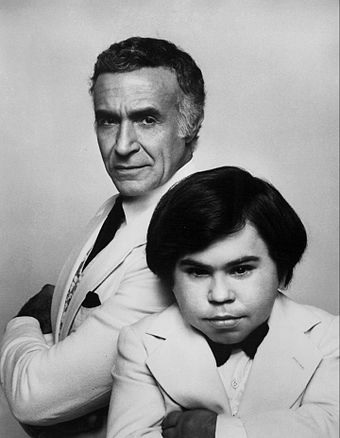
For the second week in a row, Tattoo is notably absent in this episode. He is seen in the stock footage that opens each episode of FantasyIsland. Shortly afterwards, his pre-recorded voice is briefly heard when Mr. Roarke explains to Julie that Tattoo has been turned invisible so that he can help with the fantasy of another guest who is also invisible. Seriously, that’s the excuse that the show goes with. Tattoo is “there” but he can’t be seen. I can only imagine what was going on behind-the-scenes with Herve Villechaize. It’s easy to assume that Villechaize was holding out for more money but, to be honest, it’s almost too easy to assume that. It’s also possible that Villechaize may have just asked for some time off to pursue his career as a singer.
As for the fantasies, the better of the two featured Lynda Day George as scientist Carla Frankenstein, who comes to the island because she wants to clear her ancestor’s reputation for being mad. Fortunately, the castle of Baron Frankenstein just happens to be on the Island! In the castle, Carla finds evidence that, rather than trying to bring the dead back to life, the Baron was instead working on ways to extend the average lifespan. She also discovers that the Baron’s monster (played by veteran character actor William Smith) is still living in the castle!
The Monster is a dignified old soul who has been mistreated every time that he’s left the Castle. Carla befriends him but again, the Monster is forced to confront the pettiness of the outside world when a corporate spy (Ken Swofford) tries to take both Carla and Julie hostage. After Carla and Julia are rescued, the Monster retreats to the Castle but Carla promises that she will not only return to see him but that she will also continue her ancestor’s research. In fact, her company is going to build a lab on the Island and presumably employ the one or two Islanders who aren’t already employed by Mr. Roarke.
This was a Halloween episode so a Frankenstein fantasy feels appropriate. William Smith played the role of the Monster with a wounded dignity that was actually quite touching. His lonely existence was quite sad and I was actually glad when Roarke suggested that he and Julie would, from now on, be joining the Monster for dinner.
As for the other fantasy, Joe Campbell (Stuart Whitman) is yet another city slicker who wants to be a cowboy. Joe thinks that Roarke is going to send him to the old west, as he has done for so many other people with the exact same fantasy. Instead, Roarke gets all technical and says that Joe’s specific fantasy was to be a cowboy and not to travel to the old west. Joe finds himself working as a hired hand on a modern-day ranch. Once Joe stops whining (and it takes a while), he falls in love with widow Margaret Blair (Diane Baker), becomes a surrogate father to Jimmy Blair (Jimmy Baio), and he chasess off an evil biker (Robert Tessier). In the end, Joe asks for permission to remain at the ranch and Fantasy Island. Roarke agrees, probably so Joe can potentially replace Julie if she ever asks for a raise like Tattoo did.
This fantasy felt a bit too familiar. It’s always weird how Roarke will arbitrarily decide to be strict with some guests while letting others do whatever they want.
Welcome to Retro Television Reviews, a feature where we review some of our favorite and least favorite shows of the past! On Tuesdays, I will be reviewing the original Fantasy Island, which ran on ABC from 1977 to 1984. Almost the entire show is currently streaming on Daily Motion.
This week, Mr. Roarke is almost too clever for his own good.
Episode 4.16 “Chorus Girl/Surrogate Father”
(Dir by Richard Benedict, originally aired on February 21st, 1981)
Weird episode, this week.
Our first story features John Saxon, playing the role of Evan Watkins. Evan is a compulsive gambler and his fantasy is to make one huge score. Accompanying Evan is his young daughter, Amy (Nicole Eggert). Her fantasy is for Evan to give up gambling and start acting like a real father. On the Island, Evan and Amy meet Margo (Rosemary Forsyth), a social worker whose fantasy is to really make a difference in the life of someone who is in trouble. Basically, Mr. Roarke takes all three fantasies and just crams them together.
So, Evan does win big but then some gangsters show up, searching for him. And Amy does get her wish but not before Evan nearly abandons his family. And Margo, after some initial hesitation, falls in love with Evan and leaves the Island with him and Amy. It all works out but it still seems dangerous to mix together a bunch of fantasies like that. If one thing had gone wrong, Roarke would have been left with three unhappy customers instead of just one.
This fantasy was pretty predictable but it did give Herve Villechaize a chance to actually do something more than just stand around and ask Mr. Roarke questions. The scene where Tattoo comforts Amy by explaining that her father may be a man on the outside but is still just a scared child on the inside was wonderfully acted by Villechaize and rather sweet. Villechaize was notoriously difficult on the set of Fantasy Island and was reportedly always on the verge of being fired for his behavior but, in this scene, he demonstrates why he was so important to the show. Mr. Roarke may be the owner of Fantasy Island but Tattoo is the heart.
The second fantasy is kind of creepy. Sheila Richards (Lisa Hartman) has been deaf since birth. She was raised by Franklin Adams (Stuart Whitman), who taught her how to dance. Unfortunately, Sheila can only dance by watching Franklin’s hand signals. Franklin’s fantasy is for Sheila to be able to hear for a weekend so she can audition for a world-famous choreographer. Franklin also wants to tell Sheila that he’s in love with her.
There’s a few problems here. Franklin is in his 50s while Sheila is in her 20s and has basically been dependent on him for her entire life. Franklin wants Sheila to hear him when he says, “I love you!” but he also goes to the Island with the knowledge that, at the end of the weekend, Sheila will again lose her hearing. It seems a bit cruel on Franklin’s part to put Sheila through all that when 1) he knows sign language and 2) Sheila can read lips. There’s nothing stopping Franklin from telling her how he feels.
The other problem is that the episode doesn’t seem to understand that there are many dancers who are hearing-impaired. Because they learn the choreography and can feel the vibrations of the music, they are fully capable of dancing without being dependent on someone signing to the them from the audience. One does not need to hear the music to be able to dance to it. Instead, one just has to be able to keep time and remember the choreography.
Anyway, as you can probably guess, Sheila falls in love with the world-famous choreographer, leaving Franklin heart-broken. However, at the end of the episode, Mr. Roarke introduces Franklin to a teenage girl who lives on the Island. Roarke explains that she’s deaf and asks Franklin to look after her while she goes to school in New York. Franklin agrees with a quickness that is a bit …. icky.
This whole fantasy felt like a mess, from Franklin’s oddly-conceived fantasy to the fact that Lisa Hartman was in no way convincing as someone who can’t hear. Whether Sheila can hear or not, the one thing that remains consistent is Hartman’s overacting. Even the usually reliable Ricardo Montalban seems to be annoyed by the whole fantasy.
This was a weird trip to the Island. What will next week’s journey reveal?
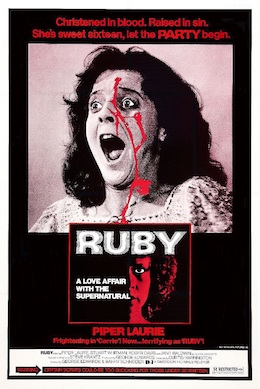
The 1977 film, Ruby, opens with a scene set in 1935. The Great Depression is still raging and the only people making money are industrialists like Joseph P. Kennedy and gangsters like Lucky Luciano and Frank Costello. In the Florida swamps, gangster Nicky Rocco (Sal Vecchio) is betrayed by both his gang and his pregnant girlfriend, Ruby (Piper Laurie). As Nicky’s bullet-ridden body sinks into the bayou, Ruby goes into labor and gives birth to Leslie.
16 years later, Ruby owns her own drive-in. The theater employs several members of the old gang and Ruby is herself married to one of Nicky’s former partners, the crippled and blinded Jake Miller (Fred Kohler, Jr.). Ruby’s lover is another former member of the gang, Vince Kemper (Stuart Whitman). Leslie, meanwhile, is now 16 years old and has never spoken a word in her life. Ruby laments that she never made it as a lounge singer but she does a good job running the theater and it seems to be a popular place to see movies. She’s even able to show Attack of the 50 Feet Woman, even though that film came out in 1958 and Ruby is set in 1951. That’s the power of having mob-connections, I guess.
When strange things start to happen at the theater, it could just be a case of Ruby having bad luck and the former gangsters that she’s hired not being particularly good at their jobs. Or maybe it has something to do with the fact that Nicky swore to get revenge on everyone with his dying breath. One employee is found hanging in a projection booth. Another is found hanging from a tree. Another is left in a cold drink machine and the lady who puts in a quarter to get a cup of tea instead gets a cup of blood. While Ruby might be in denial about the fact that her business is obviously cursed, Vince realizes that something has to be done so he brings a psychic/exorcist named Paul Keller (Roger Davis, who also provides some narration at the start of the film).
Of course, it’s not just ghosts that Ruby and the gang have to worry about. Leslie is acting strange as well! At one point, Leslie even speaks but it’s not with her voice. It’s with Nicky’s voice! Leslie has been possessed and soon, Nicky himself is appearing on the drive-in’s screens and repeating, “I love you, I love you.”
Ruby is a real mess of a film, one that attempts to rip-off The Exorcist while tossing a bit of Carrie in as well. Director Curtis Harrington plays up the campier aspects of the story and Piper Laurie gives a scenery-chewing performance that suggests that she realized it was pointless to try to take anything about Ruby seriously. Stuart Whitman plays Vince as being the most well-meaning but also the most clueless man in Florida while poor Roger Davis is stuck with the most earnest role in the film and, as such, gets the unenviable task of trying to explain what’s going on in a rational manner. There’s nothing rational about Ruby, which goes from being a film about gangsters to being a film about ghosts to being a film about possession without even stopping to catch its breath. It’s a deeply silly film but one gets the feeling that it was made to be silly. Ruby works as long as you just accept the weirdness of what you’re watching while you’re watching it and you don’t give it too much thought afterwards.
Demonoid has a great title and it had a good one sheet but don’t be fooled. The sword-wielding devil is barely in the move and the women at his feet may have appeared on the cover of every heavy metal album in the 80s but they’re not in the movie.
Exploring a recently uncovered tomb in Mexico, Jennifer (Samantha Eggar) and Mark Baines (Roy Jenson) are intrigued by a number of bodies that are missing their left hand. Their guide explains that, centuries ago, men, women, and children were sacrificed to the Devil by having their left hands cut off. When Mark and Jennifer discover a casket with a severed hand, they decide to take it back to the hotel with them. Of course, the hand is not dead. It springs from its casket and possesses Mark. This leads to Mark fleeing back to the United States, trying to find a way to get rid of his possessed hand. Unfortunately, the hand has a mind of its own and, even after Mark ends up getting set on fire, the hand continues to live and possess one person after another. Jennifer teams up with Father Cunningham (Stuart Whitman), trying to bring an end to the hand’s reign of terror and giving the audience a chance to wonder how these two actors went from being Oscar nominees to co-starring in Demonoid.
Demonoid is a strange film that starts out as a leisurely travelogue of Mexico and then suddenly turn into a cinematic Grand Guignol, with person after person trying to figure out how to chop off their left hand without doing permanent damage to themselves. Because the hand is immortal, it has no problem trying to kill whoever it is currently attached to, which leads to not only several scenes of actors fighting with themselves but also several detached hands running across the screen. A detached but moving hand is creepy the first time you see it but it becomes progressively less so the more time that you spend with it. The plot is ridiculous enough to be initially intriguing but ultimately, Demonoid is a handsy bore.
Welcome to Retro Television Reviews, a new feature where we review some of our favorite and least favorite shows of the past! On Fridays, I will be reviewing The Master, which ran on NBC from January to August of 1984. The show can be found on Tubi!
This week, Lee Van Cleef gets a chance to show off what he can do!
Episode 1.7 “Juggernaut”
(Dir by Gordon Hessler, originally aired on March 16th, 1984)
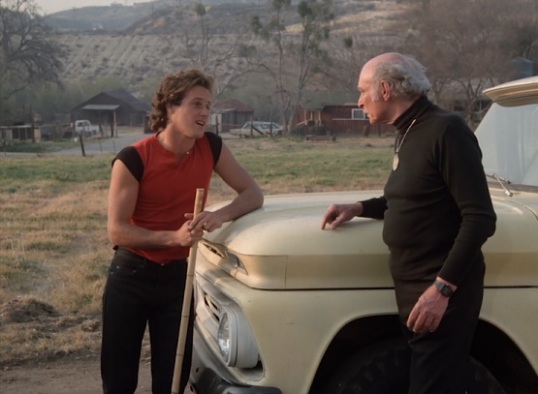
This week’s episode of The Master opens with Max’s totally groovy van driving across what appears to be farmland. Judging from the mountains in the background, it appears that they are back in California. (If they did mention their specific location during this episode, I missed it.) Last week, as you may remember, Max and McAllister were looking for McAllister’s daughter in Louisiana. Now, they’re apparently just hanging out in California again. It’s odd that McAllister left behind his life in Japan so that he could come to America to find his daughter but, now that he’s actually in America, there doesn’t really seem to be any sense of urgency when it comes to actually tracking her down.
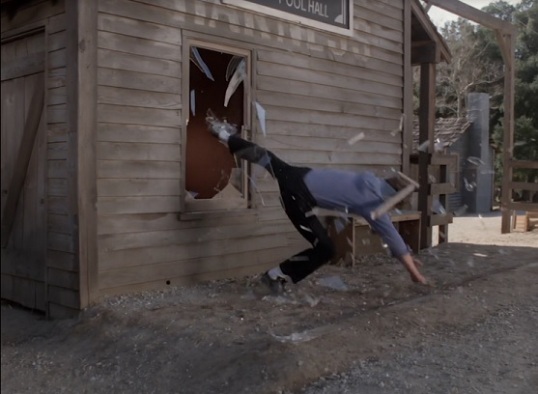
Inside the van, McAllister informs Max that he’s concerned about the way that Max is always losing his temper and starting fights. Max promises that there will be no more unprovoked fights on his part. When they stop in front of a local bar, Max says he’s going to get a beer but he also promises McAllister that he will not be getting tossed through the bar’s window.
Five minutes later:
Now, in all fairness, it isn’t totally Max’s fault that he got thrown through that window. Max went in the bar and saw Alan Kane (veteran TV and movie bad guy William Smith) harassing Cat Sinclair (Tara Buckman). When Max told Alan to back off, Alan challenged Max to a fight. Max was forced to explain that he’s not allowed to fight. Cat rolled her eyes and then Alan tossed Max through the window. Seeing that his protegee is in trouble, McAllister enters the bar, beats up Alan, and saves Max and Cat.
Even though Cat is not impressed with Max’s refusal to fight, she still gets in his van and allows him to give her a ride home. It turns out that Cat and her mother, Maggie (Diana Muldaur), are farmers but an evil land baron named Hellman (Stuart Whitman) is trying to intimidate them off their land. Alan works for Hellman and, because of him and his thugs, none of the farmers have been able to get their crops to market.
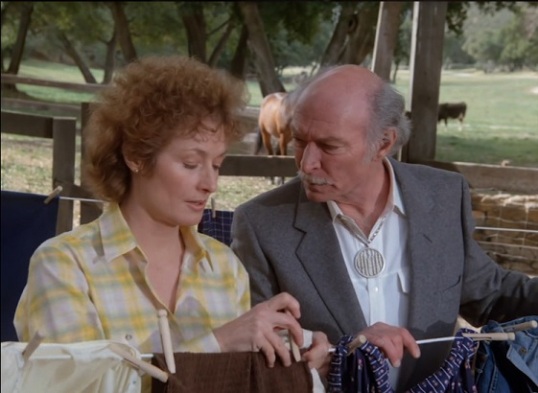
Both Cat and Maggie refuse to accept any help from Max and McAllister so our heroes get back in their totally happening van and try to leave town. However, when one of Hellman’s truckers runs the love van off the road, the engine is damaged and the local mechanic informs Max that it will take 48 hours to fix it. Stranded in town, Max searches for proof that Hellman’s trucker was the one who ran them off the road. Meanwhile, McAllister returns to the farm and, turning on some of that Lee Van Cleef charm, proceeds to fall in love with Maggie.
If any of this sounds familiar, it’s because, with the exception of McAllister falling in love, it’s pretty much the same thing that happened in not only the first episode but also the third episode. Max and McAllister have an uncanny talent for randomly wandering into towns that are controlled by evil businessmen. Just as the first and third episodes featured Max giving impassioned speeches about the rights of the workers, this episode features McAllister giving a speech at a meeting in a barn.
While McAllister is giving his speech, Max is getting arrested for snooping around Hellman’s property. Fortunately, McAllister puts on a fake beard and breaks him out of jail. McAllister then directs the farmers to form a convoy and to work together to get their crops to market. Though Alan attempts to set off a bunch of explosives on the way, McAllister uses a cropduster to fool Alan into setting off the explosions early. Then, Lee Van Cleef’s stunt double beats up Hellman. McAllister and Max congratulate each other on a job well done.
Having saved the farmers and beaten up the bad guys, it’s time for Max and McAllister to once again continue their journey across America. McAllister may love Maggie but he still needs to (eventually) find his daughter so he gets in the Chevy van and waves goodbye.
As I said before, this episode felt very familiar. It’s probably not a good sign that, after just seven episodes, The Master was pretty much repeating itself. That said, the episode did feature the great William Smith playing yet another rural bully and Stuart Whitman always made for a convincing villain. With Max sidelined by McAllister’s demand that he stop fighting, Lee Van Cleef got his moment to shine in this episode. He was obviously frail, making it all the more obvious that his fight scenes involved a stunt man, but Van Cleef still got a chance to show off some of his old school movie star charisma.
Next week: The Master steals the Crown Jewels of the United Kingdom! …. sure, why not?
In the late 1970s, the Rev. Jim Jones was a very powerful man.
The leader of the California-based People’s Temple, Rev. Jones had made a name for himself as a civil right activist. As a minister, he made it a point to reach out to the poor and to communities of color. (It was said, largely by Jones, that he had been forced to leave his home state of Indiana by the Ku Klux Klan.) Local politicians eagerly sought not only Jones’s endorsement but also the donations that he could easily raise from the members of the People’s Temple. Though there were rumors that he was more of a cult leader than a traditional preacher, Jones was appointed chairman of the San Francisco Housing Authority. Everyone from Governor Jerry Brown to San Francisco Mayor George Moscone appeared with Jim Jones at campaign events. Among the national figures who regularly corresponded with Jim Jones were First Lady Rosalyn Carter and Vice President Walter Mondale.
Of course, what actually went on behind the closed doors of the People’s Temple was a bit of secret. Jones was a self-proclaimed communist who claimed to have had visions of an upcoming nuclear war between the U.S. and Russia. In his sermons, he often claimed that it would be necessary for both him and the rest of the People’s Temple to eventually leave the United States. Jones spoke of enemies that were trying to destroy him, like the reporters who investigated Jones’s claim of being a faith healer and who followed up on reports that Jones was sexually exploiting both the women and the men who followed him. Jones secretly started to make plans to leave the United States in 1973 but it would be another four years before he and a thousand of his followers arrived in Guyana. The People’s Temple Agricultural Project sat in the jungle, isolated from oversight. It was informally known as Jonestown.
Over the next year, Jonestown did not exactly thrive. Rev. Jones demanded that his people work hard and he also demanded that they spend several hours a day studying socialism and listening to him preach. Jones ran his commune like a dictator, refusing to allow anyone to leave (for their own safety, of course). Anyone who questioned him was accused of being an agent of the CIA. In the U.S, the families of Jonestown’s citizens became concerned and started to petition the government to do something about what was happening in Guyana. A few people who did manage to escape from Jonestown told stories of forced labor, suicide drills, rape, and torture. The People’s Temple claimed that those people were all lying and, because Jones still had his government connections, he was largely left alone.
Finally, in 1978, Congressman Leo Ryan, a Democrat who had a history of opposing the political establishment, flew down to Guyana so that he could see Jonestown for himself and also bring back anyone who wanted to leave. Despite the efforts of Jones to disguise the truth about life in Jonestown, several people did ask to leave the colony with Rep. Ryan. Jones sent his most loyal men to meet and open fire on Rep. Ryan’s entourage at a nearby airstrip. Rep. Ryan and four others were shot and killed, making Ryan the first Congressman to be assassinated since 1868. Nine others, including future Rep. Jackie Speier, were wounded in the attack.
Back at Jonestown, Jim Jones announced that his prophecy was coming true and that the imperialists would soon descend on Jonestown. Though 85 of Jones’s followers managed to escape into the jungle, the other 909 residents of Jonestown subsequently died. Though some showed signs of having been murdered by Jones’s followers, the majority committed suicide by drinking poisoned Flavor-Aid. Jim Jones shot himself in the head.
The world was horrified and the term “drinking the Kool-Aid” entered the discourse. And, of course, many filmmakers were inspired by the horrific events that happened in Jonestown. Ivan Rassimov, for instance, played a Jim Jones-style cult leader in Umberto Lenzi’s Eaten Alive. Meanwhile, Powers Boothe would win an Emmy for playing Jim Jones in a 1980 television miniseries called Guyana Tragedy.
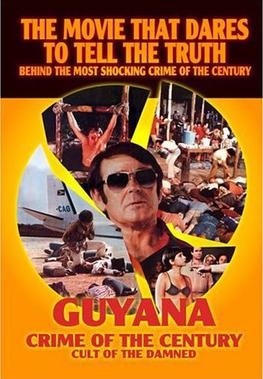
Guyana Tragedy is often described as being the definitive film about Jim Jones. However, a full year before Guyana Tragedy aired, the Mexican director, Rene Cardona Jr., was in theaters with his own version of the Jim Jones story. To anyone who is familiar with Cardona’s style of filmmaking, it’s perhaps not surprising that 1979’s Guyana: Crime of the Century did not win any awards.
Cardona’s film opens with a rather odd title card, explaining that, though the film is based on Jonestown, the names of certain characters “have been changed to protect the innocent.” But if you’re going to start the film by announcing that it’s about the biggest news story of the past year, what’s the point of changing anyone’s name? And for that matter, why is Jim Jones renamed James Johnson and his colony rechristened Johnsontown? Jones was hardly one of the innocents, not to mention that he was dead and in no position to sue when the film came was released. Why is Leo Ryan renamed Lee O’Brien, especially when the film portrays Ryan as being the type of hard-working and honest congressman that anyone would be happy to vote for?
The film opens with Rev. James “Johnson” (played by Stuart Whitman) giving a lengthy sermon about how it’s time for the congregation to move to Guyana, which he describes as being a Socialist paradise. Oddly, in the film, the People’s Temple is portrayed being largely white and upper middle class whereas, in reality, the opposite was true. Indeed, Jones specialized in exploiting communities that were largely marginalized by American society. One reason why Jones’s claim of government persecution was accepted by the members of his church is because the People’s Temple was made up of people who had very legitimate reasons for distrusting the American government.
A few scenes later, Johnson is ruling over “Johnsonville.” Since this is a Cardona film, the viewers are shown several scenes of people being tortured for displeasing Johnson. A child is covered in snakes. Another is shocked with electricity. A teenage boy and girl are forced to kneel naked in front of Johnson as he announce that their punishment for trying to run away is that they will be forced to have sex with someone of Johnson’s choosing. Once the torture and the nudity is out of the way, the film gets around to Congressman O’Brien (Gene Barry) traveling to the Johnsontown. Since the audience already knows what’s going to happen, the film becomes a rather icky game of waiting for O’Brien to announce that he’s ready to go back to the landing strip.
Because the film has been released under several different titles and with several different running times, Guyana: Crime of theCentury has gotten a reputation for being one of those films that was supposedly cut up by the censors. I’ve seen the original, uncut 108-minute version of Guyana and I can tell you that there’s nothing particularly shocking about it. Instead, it’s a painfully slow film that doesn’t really offer much insight into how Jim Jones led over 900 people to their deaths. While Gene Barry make for a convincing congressman, Stuart Whitman gives a stiff performance as the Reverend Johnson. There’s very little of the charisma that one would expect from a successful cult leader. One gets the feeling that Whitman largely made the film for the paycheck.
Of course, Whitman was hardly alone in that regard The film features a host of otherwise respectable actors, including Yvonne DeCarlo, Joseph Cotten, John Ireland, Robert DoQui, and Bradford Dillman. As well, Cardona regular Hugo Stiglitz appears as a photographer. (Stiglitz is perhaps best known for starring in Nightmare Cityand for lending his name to a character in Tarantino’s Inglourious Basterds.) Of the large cast, I appreciated the performances of Cotten and Ireland, who play Johnson’s amoral but well-connected attorneys. (The characters are based on the Temple’s real-life attornes, Charles Garry and Mark Lane. Lane also wrote the first JFK conspiracy book, Rush to Judgment.) I also liked Yvonne DeCarlo’s performance as the most devoted of Johnson’s followers. Even Bradford Dillman’s natural blandness was used to good effect as his character comes to represent the banality of evil when it comes time for him to start administering the Flavor-Aid. But those good performances still can not overcome the film’s slow pace and the fact that the film didn’t bring any new insight to the tragedy.
The film sticks fairly close to what is believed to have actually happened at Jonestown but, in the end, it barely even works as an example of shameless grindhouse filmmaking. It’s not even offensive enough to be enjoyable on a subversive level. Instead, it was just a quick attempt to make some money off of the crime of the century.
Welcome to Retro Television Reviews, a feature where we review some of our favorite and least favorite shows of the past! On Tuesdays, I will be reviewing the original Fantasy Island, which ran on ABC from 1977 to 1986. The entire show is currently streaming on Tubi!
This week, we’ve got a weird one!
Episode 2.19 “Spending Spree/The Hunted”
(Dir by George McCowan, originally aired on February 24th, 1979)
What a weird episode! This week, we have two fantasies, neither one of which belongs with the other.
The first fantasy is this silly thing where two best friends win a shopping spree. In order to win a bigger prize, Sally Glover (Diana Canova) and Esther Bolling (Lola Falana) have to spend several thousand dollars in Fantasy Island’s shopping district.
(It’s always strange to me how some episodes present Fantasy Island as being a resort while others present it as being a thriving little nation with its own economy, culture, cities, and villages. If you’re a citizen of Fantasy Island who doesn’t work for Mr. Roarke, do you still call the place Fantasy Island or does it have a real name? Do you tell people, “I was born on Fantasy Island but then I came to mainland when I was 11 to study the culinary arts?” My hope is that the natives of Fantasy Island are called Fantasians.)
Sally and Esther are excited to spend their money but then Mr. Roarke adds a twist. They will be competing against each other. The first one to spend all of her money gets a prize. The other one gets nothing. If they both fail to spend all of their money, they both lose. So, of course, Sally and Esther go crazy competing against each other. In the end, though, they both realize that they would rather be friends than for one of them to be a loser.
That’s a nice message but I’m really not sure what their fantasy was to begin with. It seems like Mr. Roarke invited two lifelong friends to the Island and then decided to play games with them for his own amusement. In this episode, we get a return of the vaguely sinister Mr. Roarke who appeared in some of the early first season episodes.
Speaking of sinister, the other fantasy involves Stuart Whitman in the role of Charles Wesley, the world’s most famous big game hunter. (I assume he inherited the title after Darren McGavin died last season.) Whitman’s fantasy is to take part in a great adventure. So, Mr. Roarke hands Wesley a camera and tells him to “shoot a picture” of dictator General Lin Shun (James Shigeta). General Lin Shun rules the national of Chung Tu with an iron fist but he apparently spends all of his time at his compound of Fantasy Island.
Wesley gets the picture but also gets captured by Lin Shun’s men. Lin Shun explains that he will now hunt Wesley through the jungles of Fantasy Island. It’s like a game. In fact, you might call it The World’s Most Dangerous Game! Wesley learns what it’s like to be hunted. Fortunately, at the last minute, Col. Chen (Khigh Dhiegh), the general’s aide, turns against Lin Shun and arrests him. Interestingly enough, it appears that Mr. Roarke is the one who told the colonel to arrest Lin Shun and take over the nation of Chung Tu. Charles Wesley tosses away his rifle and swears that he’ll never hunt again but I’m more interested in the fact that Mr. Roarke has apparently taken over another country.
Like I said, this was a weird episode. The shopping spree stuff didn’t really seem to fit in with Stuart Whitman desperately running through the jungle. This episode also found Mr. Roarke in an uncommonly manipulative and foul mood. This episode left me wondering just what exactly is going on behind the scenes of the resort.





 Through the Shattered Lens