Retro Television Review: Law and Order 6.13 “Charm City” and Homicide 4.11 “For God And Country”


Welcome to Retro Television Reviews, a feature where we review some of our favorite and least favorite shows of the past!  On Sundays, I will be reviewing Homicide: Life On The Street, which aired from 1993 to 1999, on NBC!  It  can be viewed on Peacock.
This week, Homicide crosses over with Law & Order.

Law & Order 6.13 “Charm City”

(Dir by Ed Sherin, originally aired on February 7th, 1996)

Homicide 4.11 “For God and Country”

(Dir by Ed Sherin, originally aired on February 9th, 1996)

This week, we have a two-part cross-over between Law & Order and Homicide.

On Law & Order, things start in New York City.  A chemical attack on a subway train leaves 20 people dead.  Because the train was specifically heading into Harlem and all of the victims were black, it is suspected that the attack was racially motivated.  In Baltimore, Frank Pembleton and Tim Bayliss hear about the attack and are reminded of a similar attack on a black church, which occurred five years prior.  Pembleton was the primary on the church attack.  He and Bayliss head to New York City, where they meet and quickly get on the nerves of Detectives Lennie Briscoe (Jerry Orbach) and Rey Curtis (Benjamin Bratt).

Pembleton’s investigation uncovers that a man from Baltimore, Brian Egan (Kevin Geer), not only had access to the chemicals used in both attacks but also that’s he currently in New York.  When Briscoe and Curtis arrest Egan and fail to get him to confess, Pembleton asks for permission to interrogate him.  Pembleton, being Pembleton, rather easily gets Egan to confess to having committed the church bombing.  However, before getting the confession, Pembleton pretends not to hear Egan say that he no longer wants to continue talking.  In typical Law & Order (if not Homicide) fashion, the confession is tossed out.

Jack McCoy (Sam Waterston) and Claire Kincaid (Jill Hennessy) still get their conviction.  (And Claire gets an admirer in the form of Tim Bayliss.)  However, it’s obvious that Egan was not working alone.  Egan says that he will never name names.

That changes when his wife is murdered and his teenage son goes missing.  Homicide opens with Bayliss investigating the poisoning of Egan’s wife.  He and Pembleton eventually track down Egan’s son and they get him to admit that he saw his uncle, former NSA agent Col. Alexander Rausch (J.K. Simmons), murder his mother.  Because Brian Egan has said that he’ll only reveal the truth of the conspiracy if his son is brought to New York, Briscoe and Curtis show up in Baltimore.

While Curtis, Bayliss, and Pembleton track down Colonel Rausch, Briscoe hangs out with Munch.  Their friendly banter goes south as soon as Briscoe mentions that he once knew a Gwen Munch in New York.  Gwen is John Munch’s ex-wife and John is not happy when he finds out that Briscoe slept with Gwen.  John Munch spends the rest of the episode drinking heavily.  Stanley Bolander would not approve.

As for Col. Rausch, he is captured and he turns out to be a smug snake.  (He’s played by J.K. Simmons, after all.)  Pembleton wants to see Rausch prosecuted for the church bombing and he especially wants to see racist Rausch publicly humiliated.  New York, however, wants to prosecute him for the subway attack.  Claire comes down to Baltimore and gets a judge to agree that Rausch should first be sent to New York.

Rausch doesn’t care.  He has a heart condition so he simply stops taking his heart pills and then drops dead while waiting for the train to take him to the Big Apple.  The episodes ends with Pembleton sobbing as he realizes Rausch will never be humiliated at a trial.  The New York cops shrug and say, “Sorry, Frank.”

I enjoyed this crossover quite a bit.  It was interesting to see two police dramas, each with a very different style, come together to tell one big story.  As Homicide always celebrated the lengths that Pembleton would go to get a confession in the Box, it was amusing to see what would actually happen to one of those confessions if it was brought to court.  Jack McCoy is not at all amused by Pembleton’s tactics.  Meanwhile, Briscoe, Curtis, and Claire was allowed to loosen up a bit when they went to Homicide and I enjoyed watching them shed their “just-the-facts” personas.  If the Law & Order episode was ultimately superior to the the Homicide episode, that’s just because the Law & Order episode featured an actual mystery to be solved whereas the Homicide episode occasionally felt as if it was padded out a bit.  On Homicide, it was obvious that Colonel Rausch was guilty and, from the minute he started to cough during the interrogation, it was easy to guess what his ultimate fate would be.

(I also have to say that it was interesting to compare this episode of Law & Order to watch Law & Order has become today.  How this show went from featuring McCoy confidently doing his job to Nolan Price essentially begging his co-counsel, on a weekly basis, to actually do her job is something that is worth considering.)

Overall, this was a good crossover.  For those who want to watch it, the Law & Order episode is available on Hulu and Disney+ while Homicide can be found on Peacock and Tubi.
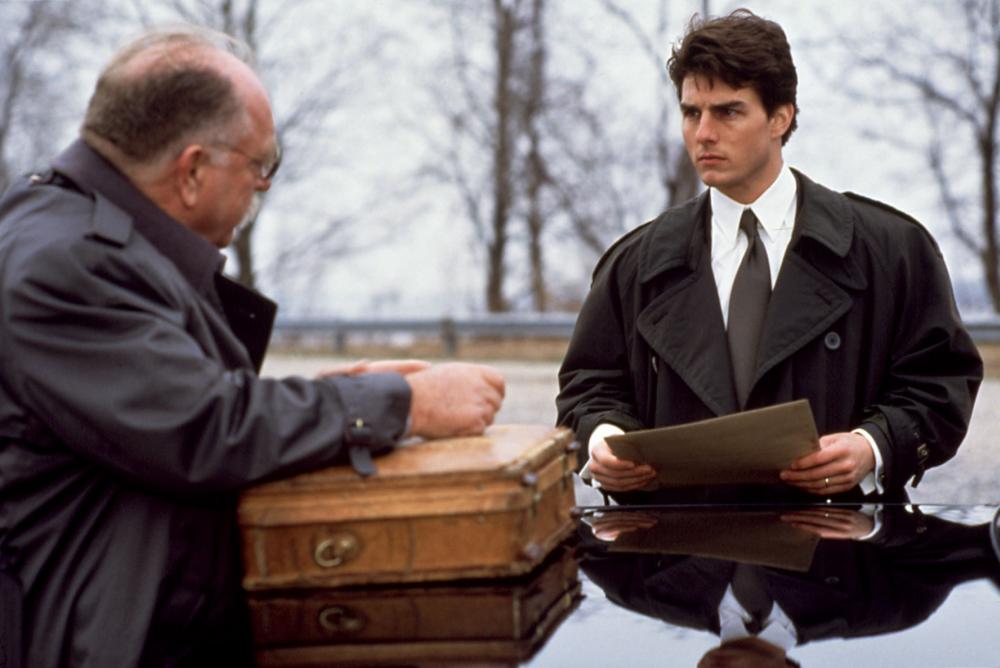
Brad reviews THE FIRM (1993), starring Tom Cruise!


In honor of Tom Cruise’s 63rd birthday, I decided to watch THE FIRM, which is based on the 1991 novel from author John Grisham. Cruise stars as the brilliant Harvard law graduate Mitch McBride, who convinces his wife Abby (Jeanne Tripplehorn) to move to Memphis, TN, so he can join the prestigious Memphis law firm of Bendini, Lambert & Locke. With the help of his veteran mentor Avery Tolar (Gene Hackman), Mitch seems to be excelling at his job, and everything is just so perfect. Unfortunately, the good times don’t last as Mitch starts to notice some suspicious stuff going on with the firm, beginning with the mysterious deaths of two of his fellow attorneys. He’s soon approached by FBI agents, led by Wayne Tarrance (Ed Harris), who tell him that there are nefarious deeds taking place at the firm, including the laundering of money for the Chicago mob. When Mitch starts questioning the activities of the firm, he finds himself the subject of blackmail and intimidation from the firm’s security officer William Devasher (Wilford Brimley) because the firm will do anything to protect its secrets. Mitch is soon caught between betraying his corrupt employers, who are threatening to kill him, and the FBI, who is pressuring him to expose the firm’s criminal activities. Not wanting to lose his life, go to jail, or get disbarred, Mitch devises an extremely risky plan to outsmart the firm and the FBI, but is even he brilliant enough to pull this one off?!

Back in the early 90’s, it seemed that every other movie being released was adapted from a John Grisham novel, and the very first of those adaptations was THE FIRM in 1993. Extremely successful at the box office, THE FIRM grossed over $270 million worldwide, setting the stage for five new movies based on Grisham novels over the next five years. THE FIRM was not only financially successful, it’s also an extremely effective movie that showcases a 30-year-old Tom Cruise at his very best. Director Sydney Pollack crafted a creepy and paranoid thriller, using a slow-burn buildup that relies on Cruise’s ability to believably go from naïve and starstruck at the beginning, to scared and desperate during the middle portion of the film, and ultimately to resourceful and intelligent at the end, as he navigates the dangerous situations he finds himself in. It’s a dynamic, intense performance, and even with a huge supporting cast of excellent actors around him, Cruise dominates every frame of this film. Other performances that stand out to me are Jeanne Tripplehorn as Mitch’s wife Abby, Wilford Brimley as the firm’s enforcer, Gary Busey and Holly Hunter as a private investigator and his administrative assistant from Little Rock, and David Strathairn as Mitch’s jailbird brother in Arkansas. Gene Hackman is good in his role as Mitch’s corrupted mentor Avery Tolar, but his character is not one of my favorites from the legendary actor. His character has accepted his corruption and learned to cope with it over the years through alcohol and womanizing, just so he can keep making the money. He knows better and that’s the part that ultimately makes him the most pathetic. Ed Harris is also good in the film as the FBI Agent, but his character is kind of an asshole, and it’s fun to see Mitch outsmart him.

I also like the Memphis, Tennessee locations showcased in THE FIRM, locations that I’ve been to many times, such as Beale Street, Mud Island, and The Peabody Hotel. Early in the movie, Cruise’s character flips right along with the “Beale Street flippers,” popular Beale Street entertainers who perform nightly for tips. I’ve given them some of my cash over the years! And the chase sequence that starts at Mud Island and spills over into downtown Memphis is one of the most exciting parts of the movie. My home state of Arkansas even gets in on the action when Mitch meets FBI agent Wayne Tarrance at the Southland Greyhound Park located in West Memphis, Arkansas. The greyhound race track no longer exists at that location, as the final dog race was held on December 31, 2022. The site has now become the Southland Casino, one of three operating casinos in Arkansas, with the other two being the Oaklawn Casino in Hot Springs and The Saracen Casino in Pine Bluff. I also like the fact that the sleazy private investigator, played by Gary Busey, is from Little Rock, Arkansas. I commute to Little Rock daily to work at my accounting and tax firm, and it’s fun imagining that there could be an “Eddie Lomax” somewhere around here.

THE FIRM may not be a perfect film… some fat could have been trimmed out as it runs for over two and a half hours, a lot of time for a “thriller;” and while effective on paper, I also can’t help but wonder if the resolution would have worked quite as well in real life as it’s portrayed in the film. I still love the movie and consider it to be one of Tom Cruise’s best. I revisit it quite often, and I’m glad his birthday gave me another excuse to watch it again today!

When It Comes To Halloween, Should You Trust The IMDb?


Dr. Sam Loomis

Like a lot of people, I enjoy browsing the trivia sections of the IMDb.  While it’s true that a lot of the items are stuff like, “This movie features two people who appeared on a television series set in the Star Trek Universe!,” you still occasionally came across an interesting fact or two.

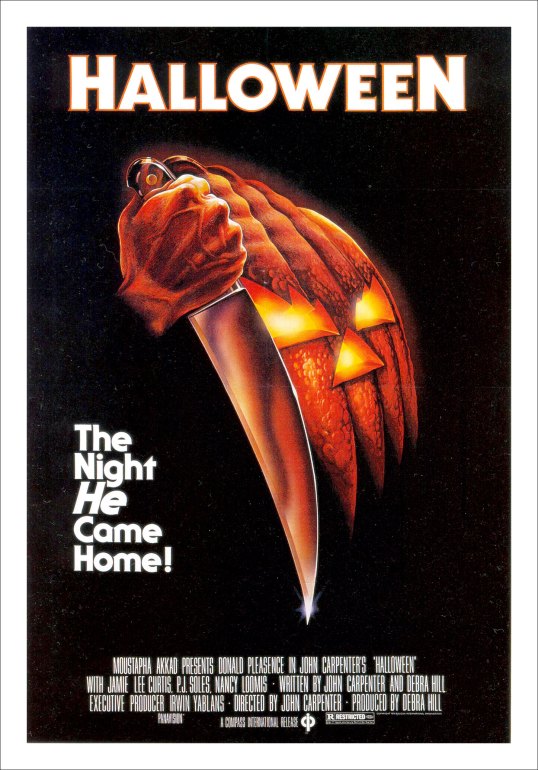
Of course, sometimes, you just come across something that makes so little sense that you can only assume that it was posted as a joke.  For instance, I was reading the IMDb’s trivia for the original 1978 Halloween and I came across this:

Peter O’Toole, Mel Brooks, Steven Hill, Walter Matthau, Jerry Van Dyke, Lawrence Tierney, Kirk Douglas, John Belushi, Lloyd Bridges, Abe Vigoda, Kris Kristofferson, Sterling Hayden, David Carradine, Dennis Hopper, Charles Napier, Yul Brynner and Edward Bunker were considered for the role of Dr. Sam Loomis.

Now, some of these names make sense.  Despite the fact that Sam Loomis became Donald Pleasence’s signature role, it is still possible to imagine other actors taking the role and perhaps bringing a less neurotic interpretation to the character.

Peter O’Toole as Dr. Loomis?  Okay, I can see that.

Kirk Douglas, Sterling Hayden, Charles Napier, Steve Hill, or Lloyd Bridges as Dr. Loomis?  Actually, I can imagine all of them grimacing through the role.

Walter Matthau?  Well, I guess if you wanted Dr. Loomis to be kind of schlubby….

Abe Vigoda?  Uhmmm, okay.

Dennis Hopper?  That would be interesting.

Mel Brooks?  What?  Wait….

John Belushi?  Okay, stop it!

Dr. Sam Loomis

My point is that I doubt any of these people were considered for the role of Dr. Loomis.  Both director John Carpenter and producer Debra Hill have said that they wanted to cast an English horror actor in the role, as a bit of an homage to the Hammer films of the 60s.  Christopher Lee was offered the role but turned it down, saying that he didn’t care for the script or the low salary.  (Lee later said this was one of the biggest mistakes of his career.)  Peter Cushing’s agent turned down the role, again because of the money.  It’s not clear whether Cushing himself ever saw the script.

To be honest, I could easily Peter Cushing in the role and I could see him making a brilliant Dr. Loomis.  But, ultimately, Donald Pleasence was the perfect (if not the first) choice for the role.  Of course, Pleasence nearly turned down the role as well.  Apparently, it was his daughter, Angela, who changed his mind.  She was an admirer of John Carpenter’s previous film, Assault on Precint 13.  Carpenter has said that he was originally intimidated by Donald Pleasence (the man had played Blofeld, after all) but that Pleasence turned out to be a professional and a gentleman.

Laurie Strode

Of course, Halloween is best known for being the first starring role of Jamie Lee Curtis.  Curtis was actually not Carpenter’s first choice for the role of Laurie Strode.  His first choice was an actress named Annie Lockhart, who was the daughter of June Lockhart.  Carpenter changed his mind when he learned that Jamie was the daughter of Janet Leigh.  Like any great showman, Carpenter understood the importance of publicity and he knew nothing would bring his horror movie more publicity then casting the daughter of the woman whose onscreen death in Psycho left moviegoers nervous about taking a shower.

There was also another future big name who came close to appearing in Halloween.  At the time that she was cast as Lynda, P.J. Soles was dating an up-and-coming actor from Texas named Dennis Quaid.  Quaid was offered the role of Lynda’s doomed boyfriend, Bob but he was already committed to another film.

Not considered for a role was Robert Englund, though the future Freddy Krueger still spent some time on set.  He was hired by Carpenter to help spread around the leaves that would make it appear as if his film was taking place in the October, even though it was filmed in May.

Robert Englund, making May look like October

Interestingly enough, Englund nearly wasn’t need for that job because Halloween was not originally envisioned as taking place on Halloween or any other specific holiday.  When producer Irwin Yablans and financier Moustapha Akkad originally approached Carpenter and Hill to make a movie for them about a psycho stalking three babysitters, they didn’t care when the film was set.  It was only after Carpenter and Hill wrote a script called The Babysitter Muders that it occurred to Yablans that setting the film during Halloween would be good from a marketing standpoint.  Plus Halloween made for a better title than The Babysitter Murders.

And, of course, the rest is history.  Carpenter’s film came to define Halloween and it still remains the standard by which every subsequent slasher movie has been judged.  Would that have happened if the film had been known as The Babysitter Murders and had starred John Belushi?

Sadly, we may never know.

Embracing The Melodrama Part III #8: The Boost (dir by Harold Becker)


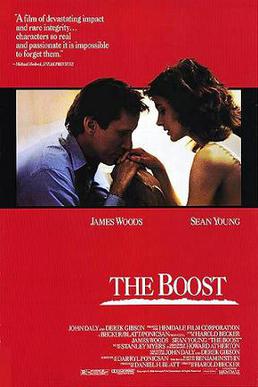
Seven days ago, we started embracing the melodrama with my review of No Down Payment, a look at lies and betrayal in suburbia.  Today, we conclude things with 1988’s The Boost, a look at lies, betrayal, and cocaine in California, with the emphasis on cocaine.

From the first minute we meet Lenny Brown (James Woods, at his nerviest best), we assume that he has to be high on something.  He’s a real estate broker and he’s one of those guys who always looks a little bit sleazy no matter how hard he tries otherwise.  His smile is just a little too quick.  He laughs a little bit too eagerly at his own jokes.  He talks constantly, an endless patter of self-serving compliments, nervous jokes, and self-affirming platitudes.  He’s a bundle of nerves but he’s also a brilliant salesman.  We may assume that he’s on coke when we first see him but actually, he doesn’t touch the stuff.  He barely drinks.

Of course, that changes when he’s hired by Max Sherman (Steven Hill).  Max is a philosophical businessman, the type who makes sure that everyone who works for him gets a nice house, a nice car, and several lectures about what’s important in life.  When Max first shows up, it’s tempting to dismiss him as just a self-important businessman but he actually turns out to be a nice guy.  He gives Lenny a ton of good advice.  Unfortunately, Lenny ignores almost all of it.

At first, life is good for Lenny and his wife, Linda (Sean Young).  Lenny is making tons of money, selling houses that can used as a tax shelter or something like that.  (I never understand how any of that stuff works.)  Lenny is making all sorts of new friends, like Joel Miller (John Kapelos) and his wife, Rochelle (Kelle Kerr).  Joel owns four car washes and he’s made a fortune off of them.  All of that money means that he can throw extravagant parties and take nice trips.  It also means that Joel has a never-ending supply of cocaine.  At first, Lenny turns down Joel’s offer of cocaine but eventually he gives in.  At the time, he says that he just needs a little boost.  Soon both Lenny and Linda are addicts.

Of course, nothing goes on forever.  The tax laws change and Max suddenly finds himself out-of-business.  Lenny and Linda lose their house.  They lose their expensive car.  They even lose their private plane.  They end up staying in a tiny apartment.  Lenny says that he can still sell anything and that they’ll be back on top in just a few months.  Of course, even while Lenny is saying this, his main concern is getting more cocaine…

Though dated, The Boost is an effective anti-drug film.  The scene where Lenny overdoses is absolutely harrowing.  Wisely, the film doesn’t deny the fact that cocaine is a lot of fun before you end up losing all of your money and having to move into a cheap apartment with shag carpeting.  It’s a bit like a coke-fueled Days of Wine and Roses, right down to an ending that finds one partner clean and one partner still in the throes of addiction.  James Woods gives a great performance as the self-destructive Lenny, as does Sean Young as his wife and partner in addiction.  And then there’s Steven Hill, providing the voice of gruff wisdom as Max Sherman.  When Max says that he feels that he’s been betrayed, Hill makes you feel as if the entire world has ended.

Speaking of endings, that’s it for this latest installment of Embracing the Melodrama.  I hope you enjoyed this mini-series of reviews and that you will always be willing to embrace the … well, you know.


In Memory of Steven Hill


Steven-Hill-As-Adam-Schiff-570x428

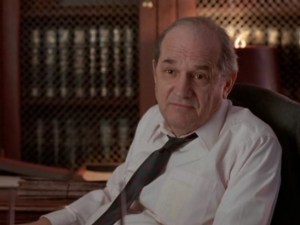
When I was younger, I was really proud of my Adam Schiff imitation.  I would sigh with resignation and then say, in my best weary, old man voice, “This case has got loser written all over it.  Take the deal, Jack.  Take the deal.”

Of course, I later discovered that every fan of Law & Order could do a perfect Adam Schiff impersonation.  Even in the 1990s, Law & Order was known for its high cast turnover but, for the first ten seasons, Steven Hill’s Adam Schiff would always be the show’s constant.  It didn’t matter if the main prosecutor was played by Michael Moriarty or Sam Waterston or if the senior detective was Jerry Orbach or (God help us) George Dzundza.  We always knew that the Adam Schiff would be the district attorney and that, 40 minutes into the show, he would order either Stone or McCoy to “take the deal.”

steven-hill1

Steven Hill played many roles before he was cast as Adam Schiff.  He was even the original lead on Mission Impossible, until he left the role because the show’s producers were not prepared to accommodate his adherence to the Sabbath.  After leaving Mission Impossible, he did not act for ten years and when he returned, he made a career out of playing no-nonsense authority figures.

But, for people my age, Steven Hill will always be Adam Schiff.  Hill brought gravitas to every line he spoke and, as New York’s veteran district attorney, Hill came to represent the type of unimpeachable integrity that we all wished we could see in real-life public officials.  For many of us, Steven Hill was Law & Order and the show never recovered after he retired from the role.

Steven Hill died earlier today, at the age of 94.  Thanks for the memories, Mr. Hill.  Thank you for bringing Adam Schiff and so many other characters to life.

enhanced-buzz-25474-1367268219-12