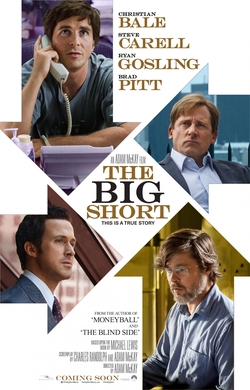
The Big Short is a film that is so critically acclaimed and that has been so passionately embraced by those who enjoyed it that it’s a bit intimidating to admit that it really didn’t do much for me. (It’s even more intimidating for me to admit that I nearly included it on my list of the 16 worst films of 2015.) It’s a big, angry movie and, even though it’s not really that good, it definitely taps into the zeitgeist. It captures the anger, the frustration, and the fears that people (including me) are feeling right now. It didn’t do much for me but I can understand why others have so passionately embraced it.
As for the film itself, it’s about the housing collapse and the financial crisis of 2008. The main characters are all people who realized that the economy was about to collapse and who managed to make a profit off of the crisis. For the most part, everyone gets at least two scenes where they get to rail about how angry they are that they’re making a profit off of other people’s misery. However, they all still collect their money at the end of the film.
For the most part, our main characters are the type of quirky eccentrics who always tend to pop up in ensemble films like this. They’re all played by recognizable actors and they all have an identifiable trait or two so we can keep them straight. For instance, Christian Bale has trouble relating to people socially, plays drums, and looks like he probably has terrible body odor. Steve Carell has a bad haircut and spends a lot of time yelling at people. He’s also haunted by the suicide of his brother and he’s married to Marisa Tomei but she only gets to appear in two scenes and doesn’t really do much because this is a film about menfolk, dagnabit. (I love Steve Carell but this is probably the least interesting performance that he’s ever given.) John Magaro and Finn Wittrock are two young investors and they especially get upset when they realize that the economy is about to collapse. Their mentor is played by Brad Pitt. Since this is an important film, Brad Pitt plays his role with his important actor beard.
And then there’s Ryan Gosling. Gosling plays a trader and he also narrates the film. And really, Gosling probably gives the best performance in the film, perhaps because his character is the only one who is actually allowed to enjoy making money. I think we’re supposed to be outraged when he brags about making money while people lose their houses but Gosling’s so charismatic and the character is so cheerful that it’s hard to dislike him.
(Of course, listening to Gosling’s narration, it’s impossible not to be reminded of The Wolf of Wall Street. And it’s appropriate because The Big Short is kind of like The Wolf of Wall Street for people who don’t want to have to deal with ambiguity or nuance.)
The film has gotten a lot of attention for Adam McKay’s direction, which is flashy and always watchable but, at the same time, also rather shallow. For the most part, McKay’s directorial tricks only served to remind me of other movies. The narration, of course, made me think about The Wolf of Wall Street. The scenes where characters look straight at the camera and say, “This isn’t the way it really happened,” only reminded me of how much more effective it was when the same thing happened in Michael Winterbottom’s 24 Hour Party People.
And then there’s the celebrity cameos. These are the scenes where a special guest celebrity is brought on screen to explain to us how Wall Street actually works. The first time, it’s Margot Robbie in a bubble bath and it works well because it admits the debt that The Big Short owes to Wolf of Wall Street. (Plus, it ends with Robbie telling the viewers to “fuck off,” which is probably what I would do if a huge group of strangers interrupted my bubble bath.) If McKay had limited himself to just doing it once, it would have been brilliant. But McKay drags out three more celebs and, with repeated use, the technique gets less and less interesting.
But I guess it’s debatable whether any of that matters. The Big Short taps into the way people are feeling now. It’s a zeitgeist film. People are rightfully angry and The Big Short is all about that anger. A decade from now, it’ll probably be as forgotten as Gabriel Over The White House. But for now, it’s definitely the film of the moment.
 Through the Shattered Lens