Éirinn go Brách!
And yes, I’ll be wearing green today!
Éirinn go Brách!
And yes, I’ll be wearing green today!

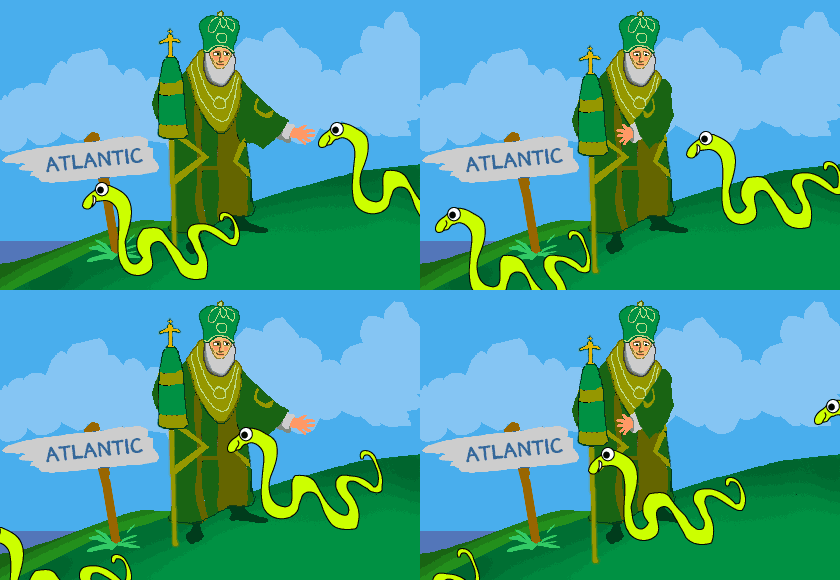
by Giovanni Battista Tiepolo
Happy St. Patrick’s Day!
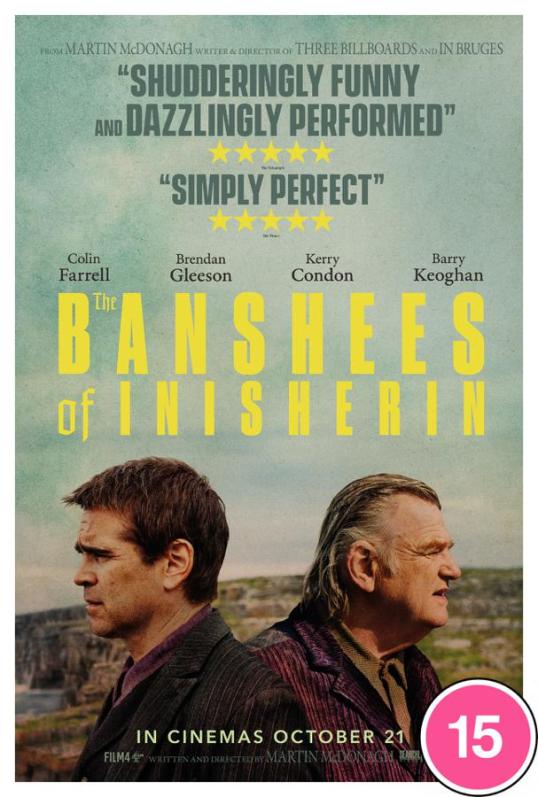
2022’s The Banshees of Inisherin takes place in 1923, near the end of the Irish Civil War.
On the fiction isle of Inisherin, the inhabitants are safe from the the fighting happening on the main land. Occasionally, they can hear the gunfire and the explosions coming from Ireland but, for the most part, they’re content to go about their lives the same as they always have. A few do dream of changing their routine. Young Dominic Kearney (Barry Keoghan) has a crush on Siobhán Súilleabháin (Kerry Condon), who herself occasionally entertains the idea of leaving Inisherin and seeking something better. But, for the most part, everyone is happy with doing the same thing over and over again. They know exactly when they will see each other. They know where everyone will be at any given moment of time. They know that Colm Doherty (Brendan Gleeson) will be playing his fiddle at the pub or sitting in his cottage with his dog. They know that every morning, he will have a drink with his best friend (and Siobhan’s brother), Padraic (Colin Farrell).
Except, one day, Colm abruptly tells Padraic that he no longer wants to be his friend.
Padraic has a difficult time understanding what Colm could possibly mean. He and Colm have always been friends. How can Colm suddenly no longer be his friend? Making things even more frustrating is that Colm refuses to explain what, if anything, Padraic has actually done to make Colm no longer want to be his friend. The closest thing to an explanation that Padraic gets is that Colm finds Padraic to be boring. Colm, who composes music and, at the very least, seems to spend a good deal of time in contemplation, is tired of Padraic’s jokes and his simple ambitions. He’s even tired of hearing about Padraic’s pet donkey, Jenny. In order to show how sincere he is in his desire to no longer speak to Padraic, Colm says that he will chop off one of his fingers every time that Padraic speaks to him. Padaic, who loves to talk and really doesn’t have anyone other than Colm and his sister to talk to, is shocked when fingers start to show up at his home. It only escalates from there.
It’s a darkly funny movie, which is no surprise considering that it was written and directed by Martin McDonagh. If anyone can make you smile while discussing mutilating himself, it’s Brendan Gleeson. At heart, though, The Banshees of Inisherin is a deadly serious film with the characters of Colm and Padraic obviously meant to represent more than just two friends who are no longer speaking. Colm, in his desire to have something more to his life than just his boring life in Inisherin, chops off his fingers and leaves you wondering how he will be able to play the fiddle that he loves so much. It seems counter-productive but once Colm says he’s going to do it, he has no choice but to follow through. The simple-minded but achingly sincere Padraic goes from simply being emotionally wounded to being vengeful over Colm’s rejection. It’s easy to see that Colm originally ended the friendship because he was depressed and feeling as if he had wasted his entire life on Inisherin. Unfortunately, by the time Colm and Padraic come to understand this very common emotion, they’re both too far gone to turn back. While Colm and Padraic go from being friends to sworn enemies, Dominic attempts to be more assertive and Siobhan dreams of perhaps the same thing that motivates Colm, an escape from Inisherin.
The Banshees of Inisherin is a well-acted and thought-provoking film, one that mixes serious of heart-rendering drama with scenes of dark comedy. Brendan Gleeson, Colin Farrell, Barry Keoghan, and Kerry Condon were all Oscar-nominated for their work here. It’s hard to believe that this was Gleeson’s first nomination. (Gleeson lost Supporting Actor to Ke Huy Quan for Everything Everywhere All At Once. I would argue that Gleeson should have been nominated for Best Actor and that he deserved the Oscar over The Whale‘s Brendan Fraser.) Farrell and Gleeson are believable as both lifelong friends and sudden enemies. Farrell delivers his lines with such earnest conviction that he actually brought tears to my eyes.
Despite having received 9 nominations, The Banshees of Inisherin didn’t win in any of its categories, not even for Best Original Screenplay. The Banshees of Inisherin lost Best Picture to Everything Everywhere All At Once, a true Oscar injustice.
When it comes to the Oscar race, there will often be a film that is anointed at the front runner just to falter once it’s actually released. It may be hard to believe now but, way back in 2013, almost every Oscar pundit spent the early part of the year predicting that George Clooney’s The Monuments Men would be a major contender. Martin Scorsese’s Silence suffered a similar fate in 2016. Sometimes, it’s because the films in question are truly flawed. The Monuments Men pretty much confirmed that Clooney’s directorial instincts were aggressively middlebrow. Sometimes, it’s because the film itself turns out to appeal to a very narrow audience. That was the case with Silence, one of the most Catholic films ever released by a major studio. Unfortunately, when these front runners falter, they tend to get hit by a backlash, with some critics and audience members seeming to take it personally that the film was not as much of a triumph as they were expecting.
That was certainly the case with Kenneth Branagh’s Belfast. Released in 2021, Belfast spent much of the year being touted as the obvious front runner for Best Picture. Seriously, how could the Academy resist it? Not only was the film in black-and-white but it was said to be Branagh’s most personal film. One of the best actors in the Western World, the man who had revived cinematic interest in Shakespeare, had now written and directed a film about his youth in Belfast. The film would deal with growing up as a protestant during the early days of the Troubles. Jamie Dornan and Caitriona Balfe where playing Branagh’s parents. The great Judi Dench and Ciaran Hinds were playing his grandparents. For all the acclaim that he had received over the years, Kenneth Branagh had yet to actually win an Oscar. Indeed, some felt that, pre-Belfast, it was a bit embarrassing that he had only been nominated for twice for his acting and once for his direction.
However, when Belfast came out, critics were complimentary but, at the same time, there was a slight undercurrent of disappointment in most of the reviews. Belfast was good, they seemed to be saying, but it wasn’t as good as they were expecting. Some members of Film Twitter was practically savage towards the film, as if Branagh had personally insulted them by making a nostalgic film about his childhood. Belfast received seven Oscar nominations but it was no longer the Oscar front runner. That role had been assumed by the technically impressive but emotionally remote The Power of the Dog.
Belfast has its flaws. Some scene works better than others, the ending is a bit overdone, and, for a film that was sold as being a memoir, some of the scenes do feel a bit familiar as if Branagh spent his childhood imitating moments from other coming-of-age films. That said, I liked Belfast and I don’t think it deserved all of the criticism that it received. Young Jude Hill did a wonderful job as Buddy, the Kenneth Branagh stand-in. Jamie Dornan proved that he was capable of more than one might have suspected based on his work in the Fifty Shades of Grey films. He and Caitriona Balfe were a compelling couple and the actors had such a strong chemistry that I found myself wishing that the film had been even more about their marriage. At this point, we take actresses like Judi Dench and actors like Ciaran Hinds for granted but both of them are truly wonderful in this film. At its best, Belfast captures the feeling of being young and not realizing that the world is basically collapsing around you. Buddy may be growing up in the shadow of The Troubles but, until the unrest literally comes into his home, he just wants to enjoy movies and have fun with his friends. Belfast is nostalgic and sometimes a bit predictable in its storytelling but it’s gorgeous to look at and the acting won me over.
In then end, the Academy honored neither Belfast nor The Power of the Dog for Best Picture but instead another film about family, the far more straight-forward CODA. Branagh, however, did win his first Oscar for Best Original Screenplay.
One thing that I’ve come to realize is that Irish-Americans (like myself) have been guilty of idealizing the Irish Republican Army in the past.
We tend to view the IRA as being freedom fighters, battling against the occupation and standing up against religious bigotry. The truth of the matter is that the IRA was a violent organization whose actions often made things even worse for the Catholics in Northern Ireland. While the IRA’s American supporters always tended to present the IRA as plotting actions against the British army, the truth of the matter is that many of the IRA’s victims were Irish citizens who were judged to either be collaborators or to not be properly enthused about the IRA in general. The popular excuse for the IRA’s terrorism is to say that the IRA usually called and gave advanced warning before a bomb went off but really, that’s kind of a weak excuse when you think about it. Really, the only thing that the IRA had going for it was that the British were often just as bad and even more heavy-handed when it came to dealing with the Irish.
In 1993’s In The Name of the Father, Daniel Day-Lewis plays Gerry Conlon, who is sent to London by his father, Giuseppe (Pete Postlethwaite), specifically to keep him from falling victim to the IRA. Of course, once Gerry arrives in London, he supports himself through burglaries and spends most of his time in a state of stoned bliss with his friends. It’s while Gerry is in London that an IRA bomb blows up a pub in Guildford. When Gerry later returns to Belfast, he is promptly arrested and accused of being one of the four people responsible for the bombing.
Gerry protests that he’s innocent and we know that he’s innocent. We know that, when the bomb was placed, Gerry was busy getting high with Paul Hill (John Lynch). Paul has also been arrested and the British police are determined to get a confessions out of both him and Gerry. The interrogation stretches for hours. Though exhausted, Gerry refuses to confess. Suddenly, Inspector Robert Dixon (Corin Redgrave) enters the room. He walks up to Gerry and whispers in his ear that if Gerry doesn’t confess, “I will kill your Da.”
It’s a shocking moment because the threat is delivered without a moment of hesitation on the part of Dixon. Dixon’s voice is so cold and so direct that, when I watched this film, I actually gasped at the line. An exhausted and terrified Gerry confesses. Soon, Gerry is thrown in prison. He’s joined by his sickly father, who has been accused of being a co-conspirator. At first, Gerry resigns himself to never being free again. He meets Joe (Don Baker), who says that he’s the one who set the bomb and that he confessed after Gerry, Giuseppe, Paul Hill, and the other members of the so-called Guildford Four had been given their life sentences. With Giuseppe’s health faltering, Gerry finally steps up and, with the help of an attorney (Emma Thompson), fights for his freedom.
In The Name of the Father is a powerful film, one that was based on a true story. Gerry and his father come to represent every victim of a biased justice system and an authoritarian-minded police force. Gerry starts the movie trapped between the two sides of the Troubles. The IRA doesn’t trust him because he’s not a bomb-thrower. The British distrust him because he’s Irish. Despite his innocence being obvious, Gerry finds himself sent to prison because letting him go would be viewed as a sign of weakness. Daniel Day-Lewis gives a passionate and charismatic performance as the impulsive and somewhat immature Gerry but the film’s heart really belongs to the late Pete Postlethwaite, playing a father who refuses to give up on either his freedom or his son.
In The Name of the Father received seven Oscar nominations, including Best Picture, Director, Actor, Supporting Actor, and Supporting Actress (for Emma Thompson). That was also the year of Schindler’s List, which took the Oscars for both Picture and Director. Daniel Day-Lewis lost to Philadelphia’s Tom Hanks while Postlethwaite lost to Tommy Lee Jones for The Fugitive and Thompson lost to Anna Paquin for The Piano. 1993 was a good year for movies and the Oscars, though I would have voted for Day-Lewis over Hanks.
First released in 2007, Once tells the story of two people who fall in love in Dublin.
Or maybe they don’t.
Really, it depends on how you look at it.
Guy (Glen Hansard) is the son of a man who owns a machine repair shop. He spends his days standing on a street corner in Dublin, playing his guitar and singing song that he’s written. Guy is polite and mild-mannered and probably the nicest guy you could ever expect to meet on a street corner. He’s also incredibly talented, singing his songs with an emotional intensity that demands you stop and listen. Guy is haunted by a lost love, a woman he dated but then broke up with. She now lives in London and Guy always wonders, “What if?”
Girl (Marketa Irglova) is originally from the Czech Republic. She sells flowers and magazines. She lives at home with her mother and her toddler. He husband is still back in their home country. Girl is a musician as well, though she had to leave her piano behind when she came to Ireland. She hears Guy singing and becomes intrigued. The fact that she needs her vacuum cleaner (her “hoover” as she puts it) repaired gives her an excuse to keep seeing Guy. Soon, they’re friends and they’re writing music and even recording a demo tape of their songs. If Guy goes to London, he wants to take the tape with him because the songs and the music express his emotions more eloquently than he can with just words.
Do Guy and Girl fall in love?
I believe that they they do but then again, I’m a born romantic and it’s hard not to get swept up in the chemistry that’s shared between Glen Hansard and Marketa Irglova. (They were a couple when they filmed Once and one need only watch them onscreen together to see why.) I think that Guy and Girl did fall in love, even if the film concludes without them physically acting on those feelings.
But it’s also possible that I’m wrong. Once is as much a celebration of friendship as it is a love story and it’s possible that Guy and Girl, despite their obvious attraction, never quite reached the point of falling love. It’s possible that they were utlimately just two close friends who loved creating music together.
Shot on the streets of Dublin on a low budget and featuring likable performances from a cast largely made up of nonprofessionals, Once is a truly special film. It was my favorite film of 2007 and it definitely has a place on my list of the top films of all time. The music, the location shooting, the chemistry between Hansard and Irglova, the extended sequence where Guy records his demo tape, all of them come together to create a truly unforgettable and ultimately very touching film. It’s a film that celebrates not just love and friendship but also the act of artistic expression. It’s film about creating something that will live forever and touch the souls of the people who hear it.
I’m not typically one to get involved in following the personal lives of celebrities. But I will admit that I was sincerely saddened when, in 2009, I heard that Hansard and Irglova had broken up. They seemed so perfect together but, then again, movies are movies and real life is real life. Once is truly a special movie and, in the end, that’s what truly matters.
4 Shots From 4 Films is just what it says it is, 4 shots from 4 of our favorite films. As opposed to the reviews and recaps that we usually post, 4 Shots From 4 Films lets the visuals do the talking!
It’s St. Patrick’s Day so it’s time for….
4 Shots From 4 Films About Ireland
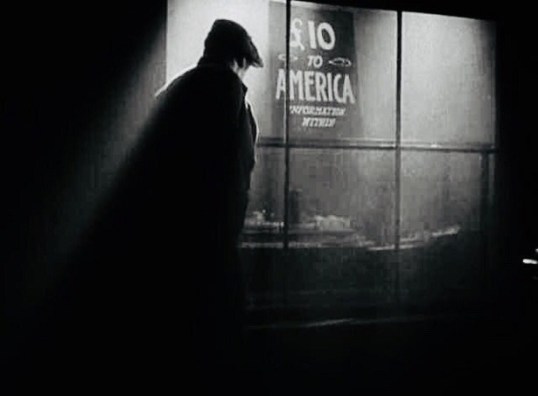
The Informer (1935, directed by John Ford. Cinematography by Joseph August)

The Quiet Man (1952, dir by John Ford, DP: Winston C. Hoch)
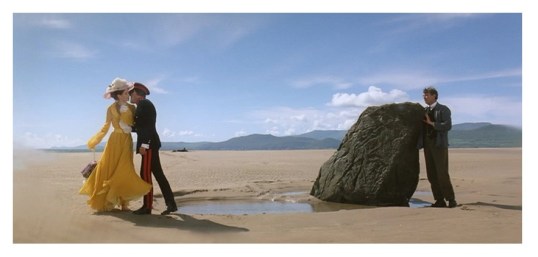
Ryan’s Daughter (1970, dir by David Lean, DP: Freddie Young)
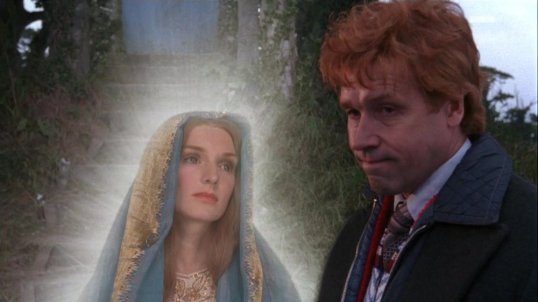
The Butcher Boy (1998, dir by Neil Jordan, DP: Adrian Biddle)
1996’s The Van opens with a depressed Bimbo Reeves (Donal O’Kelly) attempting to drink away his troubled thoughts. As he explains to his friend, Larry (Colm Meaney), he has been “made redundant.” After two decades of working at a Dublin bakery, he has lost his job and, it would appear, his reason for living.
Now, I have to stop right here and point out how disturbing that term sounds. “Made redundant,” sounds like the worst possible way to tell someone that they’re out a job. Admittedly, I don’t live in Ireland or in the UK. Perhaps if I did and if had grown up hearing the term, it wouldn’t disturb me quite so much. But, to my American ears, being told that you’re redundant feels like not only being stabbed but also then having the blade twisted. Not only are you out of a job but you’re also useless. You’re redundant. Here in America, we tell people that they’ve been “fired,” and that obviously carries some disturbing connotations with it as well. The original people to be fired were people who lost their jobs as a result of being burned at the stake. But somehow, going up in flames seems preferable to being told that you’re totally and completely useless.
Bimbo is depressed. Larry, who has a much more easy-going nature than his friend, tries to cheer him up. Afterall, Bimbo has his “redundancy check.” Bimbo and his wife, Maggie (Ger Ryan), purchase a food van and Bimbo decides to go into business for himself. He’ll sell food from his van. After refurbishing the van (which truly did look horrible when it was initially purchased), he’s ready to go into business with Larry as his only employee.
It seems like a good idea and, at first, the food van is a success. Ireland is doing well in the World Cup and it leads to a lot of hungry customers. Unfortunately, it also leads to conflict between Bimbo and Larry as they discover that being a boss and being an employee is a lot different than just being friends. In the end, the question becomes what is more important, the business or the friendship?
Based on a novel by Roddy Doyle, The Van is the third part of the Barrytown trilogy. Despite being named Larry in this film instead of Des, Colm Meaney is basically playing the same character that he played in The Commitments and The Snapper. (Though I’m not sure, I think the film’s opening “1990” title card is meant to let us know that The Van is actually a prequel to those two films.) It’s also the least engaging of the three films, largely because it doesn’t have the narrative momentum provided by the music in The Commitments or the pregnancy in The Snapper. Instead, it’s just a story of two friends who get on each other’s nerves. Donal O’Kelly doesn’t give a bad performance as Bimbo but he’s still overshadowed by Colm Meaney’s charismatic and larger-than-life Larry. As a result, there’s not much of a question as to which friend the audience will side with. Even though Bimbo’s complaints are often justified, we’re on Larry’s side all the way.
The Van is not a particularly memorable film but the message still comes through. Life goes on, in both Dublin and elsewhere.
Sharon Curley (Tina Kellegher) is 20 years old, a member of a large, working class Dublin family. Her father is Des Curley (Colm Meaney), plain-spoken, a bit old fashioned, but also someone who sincerely loves his family and works hard to give them the best that he can. Des is someone who brags about the fact that he hasn’t cried in over 20 years. Of course, when he says that, he means that he hasn’t cried sober. Crying drunk, especially while watching the World Cup, doesn’t count.
Speaking of drinking, one night out with her friends leads to Sharon finding herself pregnant. As Sharon is young and unmarried, the identity of the father becomes a subject of gossip in her close-knit neighborhood. At first, Sharon refuses to tell anyone who the father is. Eventually, she confesses that the father was a Spanish sailor who picked her up and gave her the greatest night of passion of her life. Of course, Sharon’s lying. The father is actually a rather unimpressive middle-aged man named George Burgess (Pat Laffan). George picked her up while she was inebriated. He’s the type of person who kept her panties after they had sex but expects to be thanked for not showing them to his friends. George reacts to the prospect of becoming a father by disappearing.
Sharon struggles, with both the gossip and the knowledge that her neighbors, people who she has known her entire life, are judging her for being pregnant and unmarried. Continually, she is asked, “Who are you having the baby for?,” as if she’s doing a favor for the man who knocked her up and then abandoned her. Sharon decides to keep the baby and even has a laugh at the thought of naming it Georgina. Des, at first, has a hard time understanding Sharon’s decision but eventually, he supports his daughter. He even reads all of the pamphlets on pregnancy and giving birth. When a young man at the hospital mentions that he’s waiting on the delivery of his third child, Des offers him a pamphlet on “family planning.”
Made for British television and released theatrically in 1993, The Snapper is based on a book by Roddy Doyle. The book was a sequel to The Commitments but, because 20th Century Fox owned the rights to The Commitments, the family’s name was changed for the film version of The Snapper. The Rabbittes became the Curleys and there’s certainly no mention of the fact that Sharon’s brother once managed a soul band. That said, Colm Meaney reprises his role as the befuddled but loving family patriarch. He and Tina Kellegher give performances in The Snapper that feel authentic and honest. Every laugh, every smile, and even every tear feels earned.
Much as The Commitments did with music, The Snapper uses a domestic drama, the type that has inspired countless glossy films, to examine the realities of being working class in 20th Century Dublin. With the tight-knit community full of judgment and not much support, Sharon learns who she can and cannot depend on but she also learns that’s she’s far stronger than anyone, including herself, knew. The Snapper is a wonderful snapshot of life.
First released in 1991 and based on a novel by Roddy Doyle, The Commitments is the story of a manager with a dream and a band with a chip on its collective shoulder.
Living in working class Dublin, Jimmy Rabbitte (Robert Arkins) dreams of managing a band. He’s a fan of old school soul and rock and roll music, the type that was played by black artists in the American South. Jimmy feels that the Irish have a special connection to that music because, as he explains it, “the Irish are the blacks of Europe.” (I think one could argue that the black people living in Europe are the blacks of Europe but we’ll go with it. I understand Jimmy’s argument, even if it is the sort of thing that would send social media into a tizzy if it were made today.) Jimmy puts an ad in the paper and discovers that there are a lot of aspiring musicians in Ireland and very few of them know much about soul music. Even Jimmy’s father (a delightful Colm Meaney) seems to believe that he could be a part of the band. In the end, Jimmy puts together the band himself, recruiting an unlikely collection of friends and barely know acquaintances. He finds a lead singer in the talented but unruly Deco Cuffe (Andrew Strong), a pianist in the religious Steven (Michael Aherne), a saxophonist in Dean Fay (Felim Gormley), a guitarist in Outspan Foster (Glen Hansard), and three back-up singers in Bernie (Bronagh Gallagher), Imelda (Angeline Ball), and Natalie (Maria Doyle). He also finds a mentor in trumpeter Joey “The Lips” Fagan (Johnny Murphy), an American who claims to have played with everyone who is anyone and who names the band The Commitments. They’re a working class band and one that doesn’t always mix well with each other. Deco’s gets on everyone’s nerves from the start but, as Dean puts it at the unemployment office, he’s much happier being a saxophonist on the dole than a plumber’s assistant on the dole.
There’s a raw energy to The Commitments, as both a film and a band. Both the film’s comedy and its music comes from a very real pain. No one in the film is rich. No one has been given much of a chance by British society. Deco may be obnoxious but he also epitomizes the wild spirt of someone who refuses to be tamed by society. Jimmy Rabbitte may occasionally be a bit in over his head but it’s hard not to admire his refusal to surrender. From the minute the band comes together, it’s obvious that they’re not going to last. Nearly every gig ends in disaster and Joey, despite his knowledge of soul, is a bit rigid in his demands of the band. When Dean improvises, Joey acts as if it’s the end of the world that Dean would rather play jazz than soul. Joey sees jazz as being elitist. Dean sees it as being a way to express his own artistic vision. The wonderful thing about The Commitments is that they’re both allowed to be right.
The band might not last but the film leaves you happy that they still had their moment. The Commitments is a film that feels alive, not just with artistic desire but with the anger of people who have been pushed to the side by the establishment. For a while, the band gives them a chance to express that anger and, afterwards, it’s gratifying to see that the majority of the members still carry the legacy of The Commitments with them, with some members continuing to pursue music and others returning to their everyday lives in Dublin. It’s a good film, one that celebrates both music and humanity.
 Through the Shattered Lens