An Offer You Can’t Refuse: The Last Gangster (dir by Edward Ludwig)


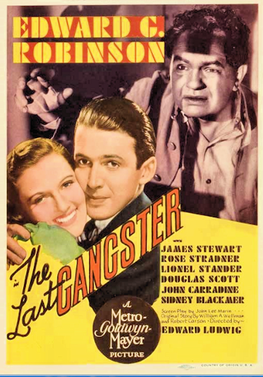
In 1937’s The Last Gangster, Edward G. Robinson plays Al Capone.

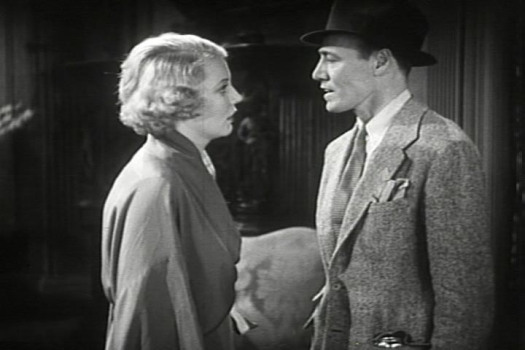
Well, actually, that’s not technically true.  The character he’s playing is named Joe Krozac.  However, Joe is a ruthless killer and gangster.  He’s made his fortune through smuggling alcohol during prohibition.  Despite his fearsome reputation, Joe is a family man who loves his wife Tayla (Rose Stradner) and who is overjoyed when he learns that she’s pregnant.  To top it all off, Joe is eventually arrested for and convicted of tax evasion.  He gets sent to Alcatraz, where he finds himself being bullied by another inmate (John Carradine) and waiting for his chance to regain his freedom.

In other words, Edward G. Robinson is playing Al Capone.

Krozac does eventually get out of prison but, by that point, Tayla has moved on.  She’s married Paul North (James Stewart), a former tabloid reporter who was so outraged by how his newspaper exploited Tayla’s grief that he resigned his position.  Joe Krozac’s son has grown up with the name Paul North, Jr. and he has no idea that his father is actually a notorious gangster.

Krozac wants to get his son back but his gang, now led by Curly (Lionel Stander), has other ideas.  They want Krozac to reveal where he hid the money that he made during his gangster days.  As well, an old rival (Alan Bazter) not only wants to get revenge on Krovac but also on Krovac’s son.  Joe Krovac, fresh out of prison, finds himself torn between getting his revenge on his wife and protecting his son.  This being a 30s gangster film, it leads to shoot-outs, car chases, and plenty of hardboiled dialogue.

Edward G. Robinson and Jimmy Stewart in the same movie, how could I n0t watch this!?  I was actually a bit disappointed to discover that, even though both Robinson and Stewart give their customarily fine performances, they don’t spend much time acting opposite each other.  Indeed, it sometimes seem like the two men are appearing in different pictures.

Robinson is appearing in one of the gangster films that made him famous.  (Indeed, the film’s opening credits feature footage that was lifted from some of Robinson’s previous films.)  He gives a tough and snarling performance but also one that suggests that, as bad as he is, he’s nowhere near as bad as the other gangsters that are working against him.  His gangster is ultimately redeemed by his love for his son, though the Production Code still insists that Joe Krozac has to pay for his life of crime.

Stewart, meanwhile, plays his typical romantic part, portraying Paul as being an incurable optimist, a happy go-getter who still has a sense of right-and-wrong and a conscience.  Stewart isn’t in much of the film.  This is definitely Robinson’s movie.  But still, there’s a genuine charm to the scenes in which Paul romances the distrustful Tayla.  Not even being forced to wear a silly mustache (which is the film’s way of letting us know that time has passed) can diminish Stewart’s natural charm.

If you like 30s gangster films, like I do, you should enjoy The Last Gangster.  I would have liked it a bit more if Robinson and Stewart had shared more scenes but regardless, this film features these two men doing what they did best.  This is an offer that you can’t refuse.
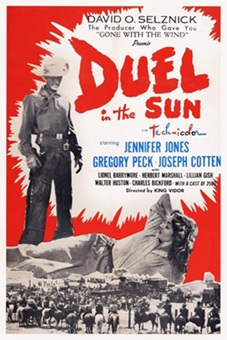
Duel In The Sun (1946, directed by King Vidor)


After her father is executed for killing her mother and her mother’s lover, “half-breed” Pearl Chavez (Jennifer Jones) is sent to live with her father’s second cousin, Laura Beth McCanles (Lillian Gish).  Laura is the wife of rancher, politician, and all-around racist Senator Jackson McCanles (Lionel Barrymore).  Worried that Pearl’s beauty and uninhibited manner will get her into trouble, Laura arranges for Pearl to meet with a minister known as The Sinkller (Walter Huston) who instructs Pearl on how to be a “good” girl.

Wanting to make Pearl bad and his, Lewton “Lewt” McCanles (Gregory Peck) becomes obsessed with Pearl and is soon forcing himself on her on a regular basis.  When the good McCanles brother, Jesse (Joseph Cotten), leaves the ranch despite being in love with Pearl, Pearl tries to find a good husband in the form of Sam Pierce (Charles Bickford).  Lewt responds by gunning Sam down and then goes on the run.  It all leads to an overwrought duel in the sun as the two doomed lovers take aim at each other.

Duel In The Sun is credited to veteran director King Vidor and there are a few shots of the western landscape that do feel typical of Vidor’s work.  However, Duel In The Sun’s true auteur was its producer, David O. Selznick.  Still looking to recapture his earlier success with Gone With The Wind and eager to make his future wife, Jennifer Jones, into an even bigger star than she was, Selznick obsessed over every detail of Duel In The Sun, pushing Vidor and a host of other directors (including Josef von Sternberg, William Dieterle, William Cameron Menzies, Otto Brower, and Sidney Franklin)  to make the film more steamy, more melodramatic, more violent, and more visually epic.  Reportedly, while Video was trying to shoot the film’s titular duel, he had to call cut several times when Selznick ran into the scene with a water bottle to spray more “sweat” onto Jones and Peck.  Today, the stiff Peck seems miscast as the black sheep of the family, the reserved Jones is even more miscast as a mestiza, and the plot is clearly too simplistic to carry the film’s epic ambitions.  A few impressive shots aside, Duel In The Sun is just boring,  In the 40s, though, the film’s relative openness about sex generated enough controversy to make Duel In The Sun into a box office hit.  It was one of the two top-grossing westerns of the 40s, beating out Red River, My Darling Clementine, Fort Apache, The Ox-Bow Incident, and several other films that were actually good.

Unlike Jones, Peck, and even usually reliable stalwart like Lionel Barrymore and Walter Huston, Joseph Cotten at least emerges from this film with his dignity intact.  Playing the good brother, Cotten gets to underplay while everyone else is overplaying and it turns out to be the right approach for him.  Surviving Duel In The Sun was no easy feat but Cotten pulled it off.

Lisa Marie Reviews An Oscar Nominee: In Old Chicago (dir by Henry King)


One of the ten films to be nominated for Best Picture of 1937, In Old Chicago tells the story of the O’Leary family.

When we first meet the O’Learys, they’re riding across the Illinois frontier in a covered wagon.  After patriarch Patrick O’Leary (J. Anthony Hughes) is killed in a freak accident, Hazel O’Leary (Alice Brady) decides to settle in the bustling town of Chicago.  Hazel and her three sons build a life for themselves in a poor, largely Irish neighborhood known as the Patch.  Hazel makes a living as a laundress and soon, her home is big enough for her to take in a cow named Daisy.  Better not put that lantern too close to Daisy, Mrs. O’Leary….

As for the O’Leary boys, they all build a life of their own in 19th century Chicago.

Free-spirited Dion (Tyrone Power) hangs out in the saloon owned by sinister Gil Warren (Brian Donlevy) and, to his mother’s consternation, he falls for a singer named Belle (Alice Faye).  Eventually, Dion and Belle open up their own saloon and go into competition with Warren.  Dion soon emerges as one of the leaders of the Patch, a rogue with a charming smile and zero ethics but a total love for his family.

The youngest, Bob (Tom Brown), falls in love with a German immigrant named Gretchen (June Storey).  Bob asks Gretchen to marry him while Mrs. O’Leary’s cow stares straight at camera.

Finally, the oldest of the O’Leary boys is Jack (Don Ameche).  Jack become a crusading lawyer and eventually, he runs for mayor on a reform ticket.  With Dion’s help, Jack is able to defeat Gil Warren.  But now that Jack is mayor, he immediately sets his sights on tearing down the Patch and, in his words, “starting over.”

In Old Chicago has a two-hour running time and a lot happens in those two hours.  Not only is there all the drama between the brothers but also there’s a handful of production numbers featuring Alice Faye.  (Considering that she’s performing at a saloon in the slums of Chicago, it’s impressive that Belle can put on such an elaborate show.)  Of course, anyone with a knowledge of history knows that every minute of In Old Chicago is building up to the moment when Mrs. O’Leary’s cow kicks over that lantern and all the wooden buildings in Chicago go up in flames.  In Old Chicago is an early disaster movie and, talented cast aside, the main reason that anyone will be watching will be for the recreation of the Great Chicago Fire.  As flames roar around them and cattle stampede through the streets, hundreds of extras run for their lives.  As Alice Brady, Tom Brown, and Alice Faye stare off to the horizon, the city of Chicago explodes in front of them.  Even today, the scenes of the city on fire are impressive.

As for the rest of the film, I enjoyed the melodramatic excess of it all.  The stars weren’t exactly the most dynamic actors of the 1930s but Tyrone Power and Don Ameche were both handsome and likable enough to carry the film and it’s easy to see why In Old Chicago was, at the time of its production, the most expensive film ever made.  It’s a big film, with ornate sets, hundreds of extras, and elaborate production numbers.  It’s entertaining, even though I did occasionally find myself growing impatient as I waited for the fire to finally start burning.

One thing this film is not is historically accurate.  Not only is it now generally agreed that Mrs. O’Leary’s cow was innocent of starting the fire but Mrs. O’Leary’s son was never mayor of Chicago.  It is true that Chicago caught fire in 1871 and that the mayor turned to General Philip Sheridan (played here by Sidney Blackmer) for help in both putting out the fire and keeping order in the streets.  For the most part, though, In Old Chicago is total fiction.  That didn’t bother me but then again, I don’t live in Chicago.

In Old Chicago was nominated for Best Picture of the Year but lost to The Life of Emile Zola.  However, Alice Brady won the Oscar for Best Supporting Actress.

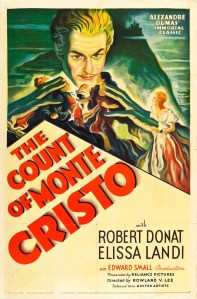
The Count of Monte Cristo (dir. by Roland V. Lee)


Note that this maybe a bit brief and off tangent. This may be one of the first reviews I’ve written for a film created well before my time. I won’t have as many movie references or personal anecdotes to add here.

I love the story of The Count of Monte Cristo. At the time of this writing, it can be found on both Amazon Prime and on Tubi.

Written in 1844 by Alexandre Dumas, it’s a tale of revenge and depending on which version you watch, there’s also a bit of redemption to it. Though it’s adapted numerous times on stage and screen, I’m familiar with 3 main movie versions. You have the modern 2002 version from Kevin Reynolds, starring Jim Caviezel, Henry Cavill and Guy Pearce. There’s the 1975 TV Movie (my personal favorite), directed by David Greene and starring Richard Chamberlain, Donald Pleasance, Tony Curtis and Kate Nelligan. And finally, we have the classic 1934 rendition, directed by Donald V. Lee and starring Robert Donat, Elissa Landi, Sidney Blackmer and Louis Calhern. Most audiences may know of the film from the references made of it in 2005’s V for Vendetta.

The Count of Monte Cristo is the story of Edmund Dantes (Robert Donat, The 39 Steps) , a sailor who has everything going for him. He’s the newly minted Captain of the Pharaon, a title bestowed to him after the original captain died during a voyage near the island of Elba. Before the original Captain passes, he gives Edmond a letter to be delivered to an individual who will make himself known. This promotion and the letter also draws the jealous eyes of the would be Captain Danglars (Raymond Walburn, Christmas in July). Edmond has the heart of the lovely Mercedes de Rosas (Elissa Landi, The Yellow Ticket), but not the affections of Mercedes’ Mother (Georgia Caine, Remember the Night), the Madame de Rosas. Together with Fernand Mondego (Sidney Blackmer, Rosemary’s Baby), they often try to convince Mercedes to find someone better.

During the party for his wedding, Edmond meets the letter’s recipient and makes the delivery. Shortly afterward, both this man and Edmond are arrested. We learn the man is the father of The King’s Magistrate, Renee de DeVillefort (Louis Calhern, Julius Caesar). Choosing to protect his father (now considered a Bonapartist), DeVillfort puts on the blame on Dantes. With Mondego and Danglars as co-conspirators, they send Dantes to the dreaded Chateau D’if, an Alcatraz-like prison on the sea. To make things worse, after Napoleon is defeated, Edmond’s captors list him as deceased and his name is struck from the prison record. Dantes spends nearly 15 years in the Chateau, falling out of everyone’s memory. During his time, he discovers and befriends the Abbe Faria (O.P. Heggie, Anne of Green Gables), another prisoner who teaches Dantes various topics of the world. The Abbe also shares the secret of the De Sparda Treasure, hidden away just off the island of Monte Cristo. Edmond eventually escapes the Chateau D’If, acquires the treasure and returns to the Paris as the mysterious Count of Monte Cristo.

The film has fine performances throughout, given the time frame. Donat’s Dantes is quite naive prior to the imprisonment, but as the Count, I felt he brought a lot of style and class to the character. It was much like watching an old serial of The Batman or The Shadow. Another major surprise (for me, anyway) was Sidney Blackmer as Mondego. I’ve only ever seen Blackmer as the old and strange Roman Castavet in Roman Polanski’s Rosemary Baby, so it was very interesting to see him in his prime. There’s a nice duel between Mondego and Dantes that showcased Blackmer’s athleticism as well as his acting. I also enjoyed Walburn’s Danglars, who felt like a weasel you’d find in a classic Disney animated film.

Visually, for a black and white film, there’s some good use of light and shadow here, particularly during the dimly lit scenes in the Chateau D’If and the face off between the Count and Mondego.

How Edmond chooses to face his enemies was interesting. A bit of scandal for one, greed for another and a full-on courtroom drama for a third. I thought the court case element was bit much, but given where the story was going, it made sense. Overall, The Count of Monte Cristo is a wonderful classic with great pacing throughout.

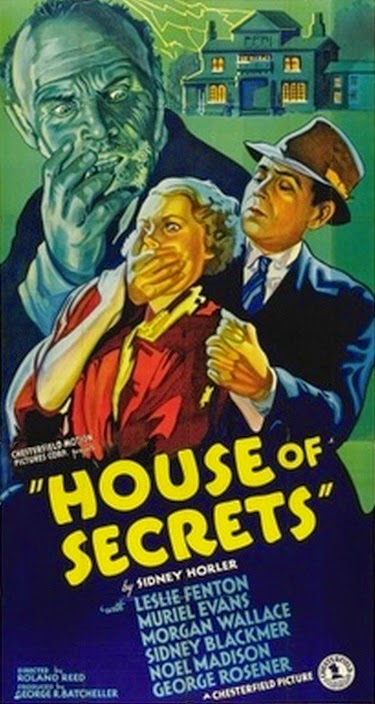
‘B’-ware, My Love: HOUSE OF SECRETS (Chesterfield 1936)


gary loggins's avatarcracked rear viewer


Do you like movies with gloomy old mansions, secret passageways, clutching hands behind curtains, bloodcurdling screams, and the like? How about we throw in some Chicago gangsters and a hidden pirate treasure? Then you may like HOUSE OF SECRETS, a ‘B’ mystery originally sold to audiences as a horror thriller. It’s no classic, to be sure, but it is an enjoyable little low-budget film produced by tiny independent Chesterfield Pictures, who specialized in this sort of thing, and featuring a better than average cast of Familiar Faces.

Aboard a ship bound for London, a young American woman is accosted by a cad who swears he saw her leaving a drug palace in Paris. Globetrotting but near penniless Barry Wilding defends her honor, but the mysterious blonde won’t reveal her name. Barry runs into his old friend Tom while in Jolly Olde England, a detective on the trail of a murderer…

View original post 388 more words

Horror on TV: Thriller 2.3 “The Premature Burial” (dir by Dougles Heyes)


In tonight’s episode of Thriller, Boris Karloff not only hosts but also stars!

An adaptation of the Edgar Allan Poe short story, this episode is about a man (Sidney Blackmer) who has very good reason to fear that he might end up being buried alive!  Karloff appears as his loyal physician, who might be Blackmer’s only hope to avoid being murdered by his wife and her lover.

Enjoy!

The Fabulous Forties #30: Cheers for Miss Bishop (dir by Tay Garnett)


cheers1

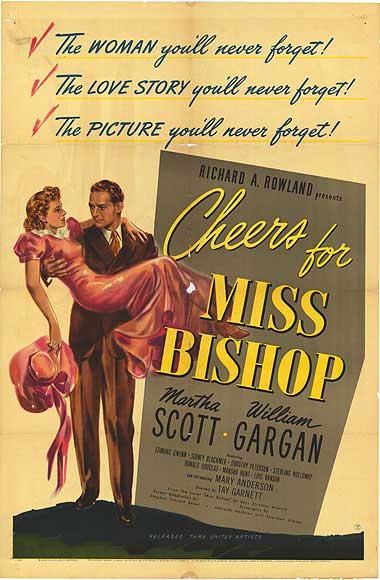
The 30th film in Mill Creek’s Fabulous Forties box set is the 1941 melodrama, Cheers For Miss Bishop.  Cheers For Miss Bishop is a bit like an Americanized version of Goodbye, Mr. Chips.  The story of Cheers For Miss Bishop, largely told via flashback, deals with a retired teacher who never quite got what she wanted out of life but still had a profound impact on all of her students.

The film opens with elderly Miss Bishop (played by Martha Scott) alone in her house.  The time is the 1930s and Miss Bishop is nearing retirement and somewhat bitter over ending her years having never married.  Prominent businessman Sam Peters (William Gargan) comes to the house and they start to recollect.  We flashback to the 1880s, when Miss Bishop was preparing to go to college and Sam was just the local grocery boy.  Sam was in love with Miss Bishop and, it’s suggested, that she loved him as well.  But she was determined to go to college whereas Sam was determined to go straight into business.

With the support of the kindly Prof. Corcoran (Edmund Gwenn, giving a performance that pretty much epitomizes what we mean when we call someone a kindly professor), Miss Bishop got a job teaching English at Midwestern College.  She was a popular teacher, one who not only inspired her students but who was also willing to stand up for them.  Eventually she met and became engaged to a local lawyer, Delbert Thompson (Don Douglas).  However, her heart was broken when Delbert ran off with another woman.  Years later, she fell in love with another professor (Sidney Blackmer), with the only problem being that he happened to be married.

But that’s not all that Miss Bishop had to deal with.  She also ended up adopting and raising Hope (Marsha Hunt) after Hope’s mother died in childbirth.  As she got older, she became frustrated when the younger college administrators demanded that she adapt with the times.  Miss Bishop also had to deal with her frequent romantic rival and cousin, the impulsive Amy (Mary Anderson).

Amy, I should mention, was my favorite character in Cheers For Miss Bishop, even though I don’t think that was the film’s intention.  Some of that is because Mary Anderson totally embraced the melodramatic potential of her character, often going totally over-the-top in a way that still seemed perfectly natural.  But there’s also the fact that Amy, as opposed to the often painfully inhibited Miss Bishop, had no boundaries.  She knew what she wanted and she went for it, without apology.  Amy may not have been a big role but she still dominated every scene that she appeared in.  Amy demanded attention and good for her!

That said, the title of the film is Cheers For Miss Bishop and not Cheers For Amy.  Ultimately, it’s a tribute to Miss Bishop and to teachers everywhere.  It’s an extremely predictable and sentimental film but it does what it does fairly well.  Occasionally, I got frustrated with Miss Bishop as a character (she was always so prim, proper, and respectable!  Plus, there’s a scene where she gives a student from North Carolina some trouble about his accent, saying that he needs to take her English class and, if you know how I feel about actors from up north trying too hard to sound like they’re from the South, you can imagine how I felt about that scene) but Martha Scott gave a good performance.  In the end, it’s a sweet little movie.  And you can watch it below!

Horror Film Review: Rosemary’s Baby (dir by Roman Polanski)


Rosemarys_baby_poster

“This is no dream!  This is really happening!”

— Rosemary Woodhouse (Mia Farrow) in Rosemary’s Baby (1968)

Yes, Rosemary, it is.

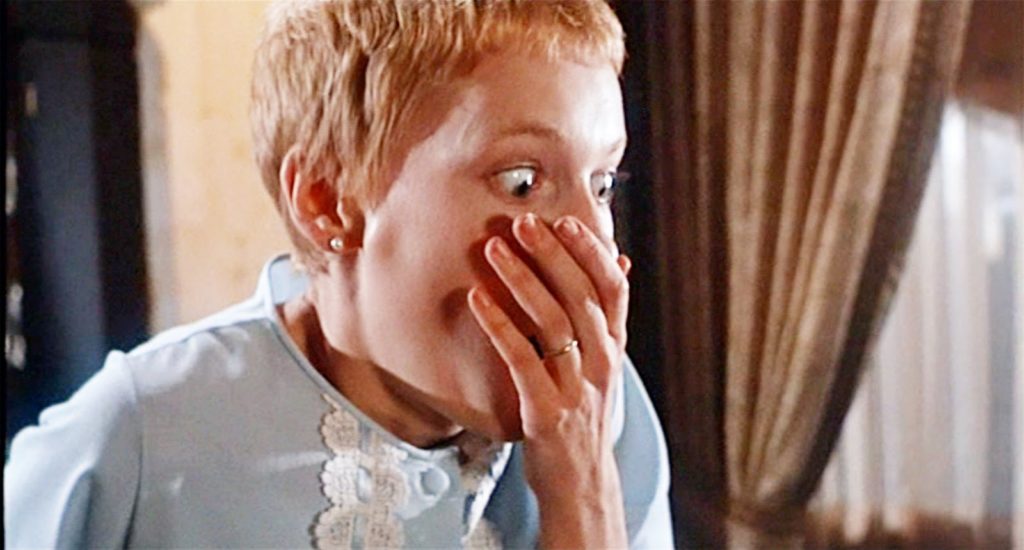
The classic 1968 horror movie Rosemary’s Baby is probably best remembered for a lengthy and wonderfully surreal “dream” sequence in which naive newlywed Rosemary Woodhouse (Mia Farrow) is raped by the Devil while a bunch of naked old people stand around her and chant.  At one point, she sees her husband, Guy (John Cassavetes), saying that she’s awake and that she knows what’s going on.  Their neighbor, Minnie Castevet (Ruth Gordon), tells him that Rosemary can’t hear anything and that it’s like she’s dead and then snaps at him, “Now, sing!”  It’s a great sequence, one of the greatest of Roman Polanski’s career, a perfect blending of horror and dark comedy.

For me, the most interesting part of that dream sequence comes at the start.  Rosemary envisions herself naked on a boat and, as she tries to cover herself, who is sitting next to her?  None other than John F. Kennedy!  Suddenly, Rosemary is wearing a bikini and she’s relaxing out on the deck with a glamorous group of people who I assume were meant to be Kennedy relatives.  As the boat leaves the dock, Rosemary sees that her friend and protector, Hutch (Maurice Evans), is standing on the dock.

“Isn’t Hutch coming with us?” Rosemary asks.

“Catholics only,” John F. Kennedy hisses in that famous accent, “I’m afraid we are bound by these prejudices.”

“I understand,” a dazed Rosemary replies.

And it’s a wonderful little moment, though I have to wonder if I’d react as strong if my own background wasn’t Irish Catholic.  But still, there’s something so wonderfully subversive about a bunch of elderly Satanists pretending to be the Kennedys.

And really, Rosemary’s Baby is a wonderfully subversive film.  I imagine it was even more subversive when it was first released back in 1968.  It’s been ripped off and imitated so many times that it has undoubtedly lost some of its impact.  (That’s one reason why I wish I had a time machine, so I could go back in the past and see it was truly like to see a classic film for the first time.)  But still, 47 years after it was initially released, Rosemary’s Baby is still a surprisingly effective horror film.

The film opens with newlyweds Rosemary and Guy moving into the Bramford, an exclusive New York apartment building.  Guy is an actor who, despite having appeared in two off-Broadway shows (one of which was entitled Nobody Likes An Albatross and really, that is so true) and a few motorcycle commercials, is still waiting for his big break.  There are hints that, before she married Guy, Rosemary had a very active and interesting life (when we briefly meet her old friends, they all seem to be a lot more exciting than boring old Guy) but, when we meet her, Rosemary appears to have happily settled into a life of domesticity.

Life at the Bramford is strange.  For one thing, Guy and Rosemary appear to be the only young people living in the entire building.  (There is a young woman named Terry but she ends up jumping out of a window.)  The Woodhouses befriend elderly Minnie Castevet and her husband, Roman (Sidney Blackmer.)  Roman claims to have traveled all over the world and embarrasses the Catholic Rosemary by criticizing the Pope.  Minnie, meanwhile, is the noisiest person in the world.  Guy makes fun of both of them and, yet, he still decides to spend his free time with Roman.

One day, Guy gets a role that he had previously lost.  Why?  Because another actor is struck by a sudden case of blindness.  Shortly afterward, Rosemary has her “dream.”  She wakes up and discovers that her body is covered with red scratches.  Guy claims that he had sex with her while she was asleep and promises to cut his fingernails.

Soon, Rosemary is pregnant but the Castevets insist that she use their doctor, the firm and sinister Dr. Saperstein (Ralph Bellamy, who just 8 year earlier had played FDR in Sunrise at Campobello).  Rosemary knows that something is wrong with the baby but she can’t get anyone to listen to her.  It all leads to one of the best and most iconic endings in the history of horror cinema.

Rosemary’s Baby is a classic of fear and paranoia and it holds up surprisingly well.  See it this October, whether you’re Catholic or not.

(However, do not see the needless 2014 remake.  Seriously, what the Hell was up with that?)

http://www.youtube.com/watch?v=PewtQsgN5uo

(By the way, is anyone else amazed that I made it through this entire review without making a single joke about either Ronan Farrow or Mia’s lame Sharknado live tweet?  I am shocked.)