Welcome to Retro Television Reviews, a feature where we review some of our favorite and least favorite shows of the past! On Saturdays, I will be reviewing The American Short Story, which ran semi-regularly on PBS in 1974 to 1981. The entire show can be purchased on Prime and found on YouTube and Tubi.
This week, we have an adaptation of Flannery O’Connor’s longest short story.
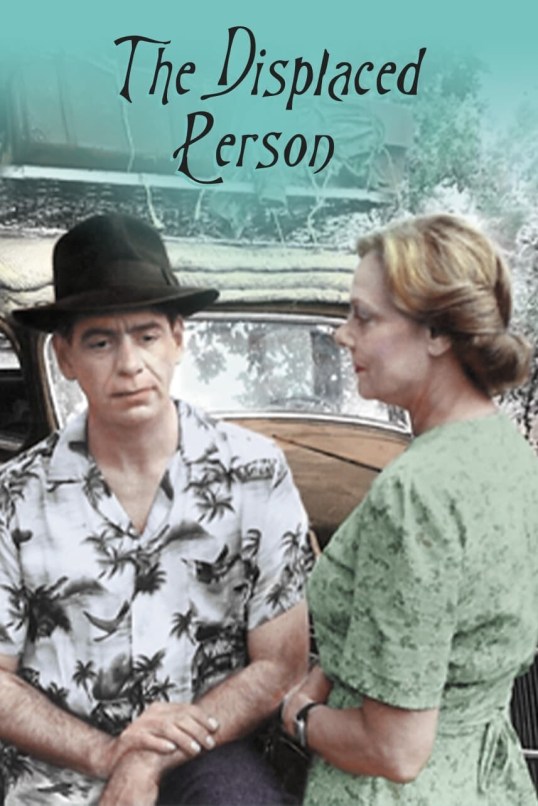
Episode #7: “The Displaced Person”
(Dir by Glenn Jordan, originally aired in 1977)
Life at a Georgia farm is thrown into turmoil when the farm’s owner, widow Mrs. McIntyre (Irene Worth), agrees to give a job to a Polish refugee named Mr. Guizac (Noam Yerushalmi). As World War II has just ended and Father Flynn (John Houseman) has assured Mrs. McIntyre that Guizac can drive a tractor, Mrs. McIntyre is happy to give Guizac a home in America. Less happy are the people who already work at the farm, most of whom see the hard-working Guizac as being a threat. Mrs. Shortley (Shirley Stoler) worries that her husband (Lane Smith) is going to lose his job to Guizac. Meanwhile, a young farmhand named Sulk (Samuel L. Jackson) enters into a business arrangement with Guizac, one that causes Mrs. McIntyre to change her opinion of Guizac. Needless to say, it all ends in tragedy.
This adaptation is based on a short story that Flannery O’Connor wrote after her own mother hired a family of Polish refugees to work at their family farm, Andalusia. This adaptation was actually filmed at Andalusia, only a few months after Flannery O’Connor’s death. The furniture seen in the house was O’Connor’s own furniture. The peacocks the drive Mrs. McIntyre crazy and which cause Father Flynn to have a religious epiphany are the same peacocks that roamed the farm when Flanney O’Connor lived there. The cemetery that Mrs. McIntyre visits is the O’Connor family cemetery. It brings a sense of authenticity to the film, one that is often missing from films made about the South.
The adaptation moves at a deliberate pace but it’s well-acted and it stays true to O’Connor’s aesthetic. Those who might complain that there are only two likable characters in the film — Mr. Guizac and Father Flynn — are missing the point of O’Connor’s story. Even Mrs. McIntyre, who initially seems to be trying to do the right thing, is blinded by the prejudices of race and class. Father Flynn never gives up on trying to redeem both Mrs. McIntyre and the rest of the world but one gets the feeling that he might be too late.
The cast is what truly makes this adaptation stand-out. Irene Worth, John Houseman, Lane Smith, Robert Earl Jones, they all give excellent performances. Samuel L. Jackson was very young when he appeared in TheDisplacedPerson but he already had the screen presence that has since made him famous. The best performance comes from Shirley Stoler, who plays Mrs. Shortley as being a master manipulator who, unfortunately, happens to be married to a worthless man. Mrs. Shortley does what she does to protect her husband. Mr. Shortley does what he does because he’s a loud mouth bigot. Everyone has their own reasons, to paraphrase Jean Renoir’s The Rules of the Game. In this story, those reasons lead to tragedy.
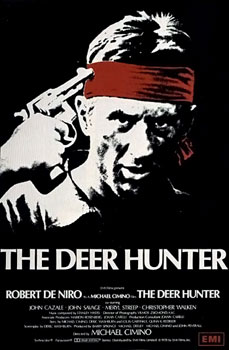
The Deer Hunter, which won the 1978 Oscar for Best Picture Of The Year, opens in a Pennsylvania steel mill.
Mike (Robert De Niro), Steve (John Savage), Nick (Chistopher Walken), Stan (John Cazale), and Axel (Chuck Aspegren, a real-life steel worker who was cast in this film after De Niro met him while doing research for his role) leave work and head straight to the local bar, where they are greeted by the bartender, John (George Dzundza). It’s obvious that these men have been friends for their entire lives. They’re like family. Everyone gives Stan a hard time but deep down, they love him. Axel is the prankster who keeps everyone in a good mood. Nick is the sensitive one who settles disputes. Steve is perhaps the most innocent, henpecked by his mother (Shirley Stoler) and engaged to marry the pregnant Angela (Rutanya Alda), even though Steve knows that he’s not actually the father. And Mike is their leader, a charismatic if sometimes overbearing father figure who lives his life by his own code of honor. The men are held together by their traditions. They hunt nearly every weekend. Mike says that it’s important to only use one shot to kill a deer. Nick, at one point, confesses that he doesn’t really understand why that’s important to Mike.
Steve and Angela get married at a raucous ceremony that is attended by the entire population of their small town. The community is proud that Nick, Steve, and Mike will all soon be shipping out to Vietnam. Nick asks his girlfriend, Linda (Meryl Streep), to marry him when he “gets back.” At the reception, Mike gets into a fight with a recently returned soldier who refuses to speak about his experiences overseas. Mike ends up running naked down a street while Nick chases him.
The Deer Hunter is a three-hour film, with the entirety of the first hour taken up with introducing us to the men and the tight-knit community that produced them. At times, that first hour can seem almost plotless. As much time is spent with those who aren’t going to Vietnam as with those who are. But, as the film progresses, we start to understand why the film’s director, Michael Cimino, spent so much time immersing the viewer in that community of steel workers. To understand who Nick, Mike, and Steve are going to become, it’s important to know where they came from. Only by spending time with that community can we understand what it’s like to lose the security of knowing where you belong.
If the first hour of the film plays out in an almost cinema verité manner, the next two hours feel like an increasingly surreal nightmare. (Indeed, there was a part of me that suspected that everything that happened after the wedding was just Michael’s drunken dream as he lay passed out in the middle of the street.) The film abruptly cuts from the beautiful mountains of Pennsylvania to the violent horror of Vietnam. A Viet Cong soldier blows up a group of hiding women and children. Michael appears out of nowhere to set the man on fire with a flame thrower. An army helicopter lands and, in a coincidence that strains credibility, Nick and Steve just happen to get out. Somehow, the three friends randomly meet each other again in Vietnam. Unfortunately, they are soon captured by the VC.
They are held prisoner in submerged bamboo cages. Occasionally, they are released and forced to play Russian Roulette. Mike once again becomes the leader, telling Steve and Nick to stay strong. Eventually, the three men do manage to escape but Steve loses his leg in the process and a traumatized Nick disappears in Saigon. Only Mike returns home.
The community seems to have changed in Mike’s absence. The once boisterous town is now quiet and cold. The banner reading “Welcome Home, Mike” almost seems to be mocking the fact that Mike no longer feels at home in his old world. Stan, Axel, and John try to pretend like nothing has changed. Mike falls in love with Linda while continuing to feel guilty for having abandoned Nick in Saigon. Steve, meanwhile, struggles to come to terms with being in a wheelchair and Nick is still playing Russian Roulette in seedy nightclubs. Crowds love to watch the blank-faced Nick risk his life.
Eventually, Mike realizes that Nick is still alive. Somehow, Mike ends up back in Saigon, just as the government is falling. Oddly, we don’t learn how Mike was able to return to Saigon. He’s just suddenly there. It’s the type of dream logic that dominates The Deer Hunter but somehow, it works. Mike searches for Nick but will he be able to save his friend?
The Deer Hunter was one of the first major films to take place in Vietnam. Among the pictures that The Deer Hunter defeated for Bet Picture was Coming Home, which was also about Vietnam but which took a far more conventional approach to its story than The Deer Hunter. Indeed, while Coming Home is rather predictable in its anti-war posture, The DeerHunter largely ignores the politics of Vietnam. Mike, Nick, and Steve are all traumatized by what they see in Vietnam. Mike is destroyed emotionally, Steve is destroyed physically, and Nick is destroyed mentally. At the same time, the VC are portrayed as being so cruel and sadistic that it’s hard not to feel that the film is suggesting that, even if we did ultimately lose the war, the Americans were on the correct side and trying to do the right thing. (Many critics of The Deer Hunter have pointed out that there are no records of American POWs being forced to play Russian Roulette. That’s true. There are however records of American POWs being forced to undergo savage torture that was just as potentially life-threatening. Regardless of what one thinks of America’s involvement in Vietnam, there’s no need to idealize the VC.) Released just a few years after the Fall of Saigon, The Deer Hunter was a controversial film and winner. (Of course, in retrospect, the film is actually quite brilliant in the way it appeals to both anti-war and pro-war viewers without actually taking a firm position itself.)
In the end, though, The Deer Hunter isn’t really about the reality of the war or the politics behind it. Instead, it’s a film about discovering that the world is far more complicated that you originally believed it to be. De Niro is a bit too old to be playing such a naive character but still, he does a good job of portraying Mike’s newfound sense of alienation from his former home. In Vietnam, everything he believed in was challenged and he returns home unsure of where he stands. While John, Axel, and Stan can continue to hunt as if nothing happened, Mike finds that he can no longer buy into his own philosophical BS about the importance of only using one shot. Everything that he once believed no longer seems important.
It’s a good film and a worthy winner, even if it does sometimes feel more like a happy accident than an actual cohesive work of art. The plot is often implausible but then again, the film takes place in a world gone mad so even the plot holes feel appropriate to the story being told. Christopher Walken won an Oscar for his haunting performance as Nick and John Savage should have been nominated alongside of him. This was Meryl Streep’s first major role and she gives a surprisingly naturalistic performance. During filming, Streep was living with John Cazale and she largely did the film to be near him. Cazale was dying of lung cancer and he is noticeably frail in this film. (I cringed whenever Mike hit Stan because Cazale was obviously not well in those scenes.) Cazale, one of the great character actors of the 70s, died shortly after filming wrapped. Cazale only appeared in five films and all of them were nominated for Best Picture. Three of them — The first two Godfathers and The Deer Hunter — won.
The Deer Hunter is a long, exhausting, overwhelming, and ultimately very moving film. Whatever flaws it may have, it earns its emotional finale. Though one can argue that some of the best films of 1978 were not even nominated (Days of Heaven comes to mind, as do more populist-minded films like Superman and Animal House), The Deer Hunter deserved its Oscar.
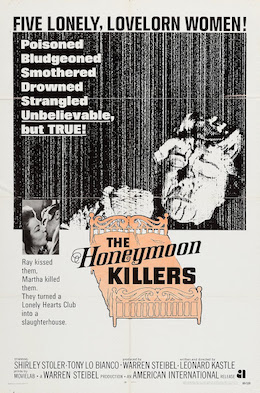
The 1970 film, The Honeymoon Killers, takes place in the late 40s. Martha Beck (Shirley Stoler) is an overweight nurse who lives in Alabama with her senile mother (Dortha Duckworth) and her best friend, Bunny (Doris Roberts). Knowing that Martha is lonely, Bunny signs Martha up for a “lonely hearts club,” which was basically the Tinder and Craig’s List of the pre-Internet age. Though Martha is initially reluctant, she soon starts to receive letters from a conman named Ray Fernandez (Tony Lo Bianco). Ray specializes in swindling the women who respond to his letters. After Ray travels to Alabama and tricks Martha into giving him a “loan,” Ray sends her a letter telling him that he can no longer correspond with her. Martha responds by getting Bunny to call Ray and tell him that she attempted suicide.
Recognizing Martha as a fellow con artist, Ray invites Martha to his home in New York. He shows her the pictures that he’s received from other women and reveals how he makes his money. Martha soon becomes Ray’s partner in crime, traveling across the country with Ray and meeting the women, most of whom are elderly, that Ray has corresponded with. Ray claims that his name is Charles Martin and that Martha is his sister. He also swears to Martha that he won’t sleep with any of the women while he’s swindling them. Even though Martha knows that Ray is a pathological liar, she chooses to believe him whenever he swears that he’s actually in love with her.
The first murder occurs when Martha realizes that one of Ray’s victims is determined to sleep with him. Martha gives her an overdose of sleeping pills and then Martha and Ray dump her on a bus, where she subsequently dies. More murders occur, usually due Martha and Ray making sloppy mistakes that reveal their actual plans to their victims. At first, Ray claims that he’s disgusted with killing and he says that Martha is the one who has to do it because she’s a nurse. But eventually, Ray shows his true colors.
When talking about The Honeymoon Killers, one has to start by mentioning that this film was nearly Martin Scorsese’s second feature film. (Fresh out of film school, Scorsese had previously turned a student film, Who’s That Knocking At My Door?, into his feature debut.) Scorsese was fired from the film because the film’s producers felt that he was taking too long to set up the shots and, according to Scorsese himself, he was only shooting master shots. That said, there are a few Scorsese-directed scenes to be found in The Honeymoon Killers and they’re pretty easy to spot. The film opens with a tracking shot of Shirley Stoler walking through her hospital and reprimanding two interns. I was not surprised to learn that was one of the Scorsese scenes. After Scorsese left the project, he was replaced by Leonard Kastle, who wrote the script. The Honeymoon Killers was both Kastle’s directorial debut and his swan song.
The film’s harsh and grainy black-and-white cinematography gives the film a documentary-style feel and while there are moments of dark humor, The Honeymoon Killers is overall a grim movie. It plays out like a creeping nightmare, one where the viewer knows that there’s something terrible waiting right around the corner. The bickering between Martha and Ray may occasionally inspire a chuckle, but there’s nothing funny about the murders and the film, to its credit, it totally on the side of Martha and Ray’s victims. Martha and Ray may look down upon them but the film itself portrays them as being lonely people who are struggling to adjust to a changing world. (In the role of the couple’s second victim, Mary Jane Highby is just heartbreaking.) Ray is a bit of ludicrous figure, with his swagger and his exagerated accent but he’s been able to get away with his crimes because people want him to be the charming gentleman that he claim to be. Even after Martha discovers who he really is, she still finds herself under the spell of Ray’s con.
Shirley Stoler and Tony Lo Bianco both give excellent performances as Martha and Ray, with Stoler especially doing a good job in the role of Martha. At first, it’s easy to feel sorry for Martha. At the start of the movie, she’s just as lonely as any of Ray’s victims. At the film progresses, Martha’s true self is revealed and yet, as soulless as she can be, her love for Ray is strangely sincere. As Ray, Tony Lo Bianco is all swagger and charm until he loses control of the situation and he reveals just how spineless he actually is.
The film presents Martha Beck and Ray Fernandez as a couple who became murderers after they found each other. In reality, it’s suspected that Ray Fernandez murdered at least one woman before he met Martha and it’s also been suggested that Martha killed a few patients while she was working as a nurse. Ray and Martha were both executed on the same day, going to electric chair on March 8th, 1951.
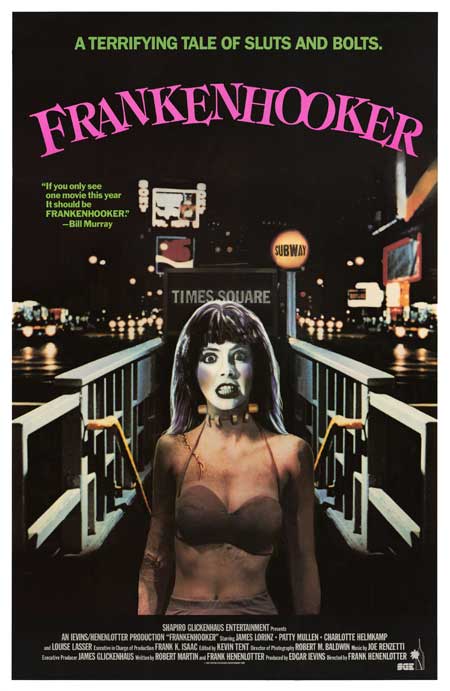
Wanna have a good time? Got any money? Then go pick up FRANKENHOOKER, Frank Henenlotter’s tacky tale of terror that sets Mary Shelley’s classic novel on its severed head and features an explosive (literally) combination of the goofy and the gruesome, with plenty of black comedy strewn among the body parts.
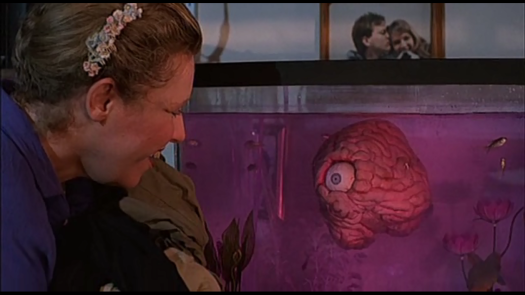
Jeffrey Franken’s fiancé Elizabeth Shelley is killed when the remote control lawnmower he invents runs her down, turning her into “one big jigsaw puzzle”. Saving Elizabeth’s head, Jeffrey vows to rebuild, probably after watching too many reruns of THE SIX MILLION DOLLAR MAN. Seems our boy, who’s a med school dropout now working for New Jersey Gas & Electric, likes to tinker around with mad science, as evidenced by the floating brain with one eyeball he keeps in a fish tank. His grand scheme involves rounding up hookers and getting them loaded on his latest invention, a deadly lethal…

 Through the Shattered Lens