The cliche view of Rob Zombie is that he is a shock rocker who branched out into horror filmmaking. With the song and the music video for Foxy, Foxy, Zombie shows that he is just as much a descendant of Lynard Skynard’s as he is of Alice Cooper’s. And though the video may not have the horror themes that most people expect from a Zombie production, the song itself was at least partially inspired by a Lon Chaney film, He Who Gets Slapped.
Yes, that is Sheri Moon Zombie showing up at the outdoor concert.
Have you ever wondered how Herman and Lily Munster came to live at 1313 Mockingbird Lane?
No?
That’s too bad, because Rob Zombie is going to tell you anyways.
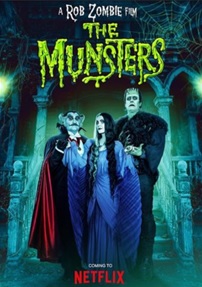
Rob Zombie’s The Munsters is a prequel to the 60s sitcom of the same name. It shows how Herman Munster (Jeff Daniel Phillips) came to be created, how he became a Rob Zombie-style rock star, and how he overcame the opposition of the Count (Daniel Roebuck) and married Lily (Sheri Moon Zombie). It also shows how Lily’s brother, Lester (Tomas Boykin), tricked Herman into signing over the deed for the Count’s castle in Transylvania. There’s not much of a plot but there was never much of a plot when it came to the original sitcom either. Just like the show that the movie is based on, The Munsters exists to show classic monsters making corny jokes and freaking out at the prospect of dealing with what the rest of the world considers to be normalcy. Unlike the multi-faceted Addams Family, The Munsters have always been a one-joke family.
There have always been elements of satire and subversive humor in everything that Rob Zombie has done, as both a musician and a director. Those who claim that Rob Zombie does not have a sense of humor are mistaken. However, the comedy in The Munsters is deliberately broad and vaudevillian, like the show on which the movie is based. As a director, Zombie doesn’t always seem to know how to best present that type of humor. The Munsters is the rare movie that would have benefitted from a laugh track because the jokes are definitely sitcom-level. They were designed to be followed by canned laughter. Zombie’s affection for the material and the characters come through and the deliberately artificial production and costume design actually works better than I was expecting but, at nearly two hours, The Munsters often feels directionless.
Jeff Daniel Phillips and Daniel Roebuck do adequate imitations of Fred Gwynne and Al Lewis, respectively, but its Sheri Moon Zombie who steals the show, bringing a lot of mischievous energy to Lily. Of the principle cast, Sheri Moon Zombie is the only one makes her character feel like something more than just a tribute to an old sitcom. The camera loves her and she convinces us that she loves Herman, no matter how childishly he behaves.
One final note: Sylvester McCoy — the seventh doctor, himself! — plays the Count’s assistant, Igor. McCoy doesn’t get to do much but it was still good to see him. Igor was the type of role that Tom Baker used to specialize in before he was cast as the Fourth Doctor. By casting McCoy as Igor, it almost felt as if Zombie was keeping the role in the family.
It’s Rob Zombie’s birthday so happy birthday, Rob and let’s all enjoy Living Dead Girl!
Myself, I’ve always assumed that this song was named after the classic Jean Rollin film, The Living Dead Girl. Admittedly, I haven’t been able to find any specific proof of that but I’m still going to choose to believe it. The song, after all, is full of references to films like Lady Frankenstein, Daughters of the Darkness, Last House On The Left, and at least one of the Dr. Goldfoot films. So why not borrow the title from Jean Rollin?
Living Dead Girl was the 2nd single to released off of Hellbilly Deluxe, which was Rob Zombie’s first solo album after originally coming to fame as the co-founder of White Zombie. White Zombie broke up around the same time that Living Dead Girl came out. Why did White Zombie break up? Nobody’s saying.
As for the video, it’s an homage to The Cabinet of Dr. Caligari, with Rob Zombie playing the Doctor and Sheri Moon Zombie playing the Living Dead Girl. The video does a pretty good job of capturing the feel of Caligari, which is one of the most effective of the old silent films. (I actually had a nightmare after I watched The Cabinet of Dr. Caligari for the first time. I dreamt that the doctor was trying to break into the house.)
Both Rob Zombie and Joseph Kahn are credited with co-directing this video. Kahn is an amazingly prolific video director who has done videos for just about everyone, including Britney Spears, Jennifer Lopez, The Chemical Brothers, and …. just about everyone!
Rob Zombie, of course, has gone on to direct several horror films. There’s a tendency among a certain snobbish type of horror fans to be dismissive of Zombie’s films but I’ve always felt that his film was undeniably effective and, if nothing else, they stayed true to his own vision. I mean yes, Halloween IIwas disappointing but 31 was better than many give it credit for being.
Are you scared of clowns? Sure, you are. All good people fear clowns. However, if you somehow do not find clowns to be frightening, you may change your mind after seeing Rob Zombie’s latest film, 31.
Of course, that’s assuming that you actually see 31. 31 is not a film for everyone. In fact, if you’re not a fan of Rob Zombie or his style of horror, you should probably stay miles away from 31. Bloody, intense, violent, and occasionally rather nihilistic, 31 is perhaps the Rob Zombiest of all the films that Rob Zombie has ever made.
However, if you’re a fan of extreme horror, you’ll appreciate 31. It may not always be easy to take but then again, that’s kind of the point.
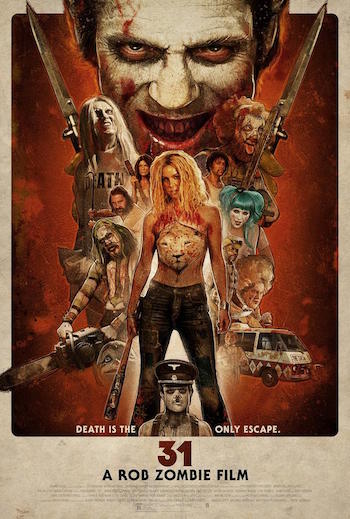
The film takes place in the 70s, which means that it has a really kickass soundtrack. A group of carnival workers are driving across the desert in a van when they are attacked and kidnapped. They find themselves in a dark building, being lectured by three people who are dressed like 18th century French aristocrats. The leader of the aristocrats (played by Malcolm McDowell) informs them that they are going to playing a game called 31. For the next twelve hours, they will be locked away in a maze. They will be hunted by five murderous clowns.
Yes, you read that right. Not just one murderous clowns — FIVE! (Even worse, a sixth bonus clown eventually joins the game.)
If they can survive for 12 hours, they win. What do they win? Other than freedom, the film is never particular clear on this point. The motives of the aristocrats remain a mystery for the majority of the film. Are they just sadists, are they perhaps devote fans of The Purge who were so disappointed with Election Year that they decided to recreate the second film on their own, or is there some bigger reason behind this game of 31? The film leaves the question for us to answer.
The rest of the film is a collection of progressively more violent fights between the carnival workers and the clowns. For the most part, the carnival workers are all likable and you don’t want to see any of them harmed. The clowns, meanwhile, are just about the freakiest collection of killers that you’ve ever seen. When one of them is cornered, he pathetically begs, “We’re all pawns! We don’t want to do this!” but you never quite believe him. The deadliest of the clowns is Doom-Head (Richard Brake) and his evil smirk will give you nightmares.
31 is an incredibly intense film and it’s definitely not for the faint of heart. Everything from the acting to the set design to the costumes to David Daniel’s stark cinematography comes together to make 31 into a harrowing horror film. If you can’t stand Zombie’s trademark mayhem, I would suggest avoiding 31. However, if you’re a fan of Zombie’s films, you’ll find 31 to be perhaps the purest distillation of his artistic vision.
The thing about praising Rob Zombie’s Halloween is that you’re then contractually obligated to talk about the 2009 sequel, Halloween II. While I certainly don’t have any trouble defending the first film, Halloween II is about as big a mess as I’ve ever seen.
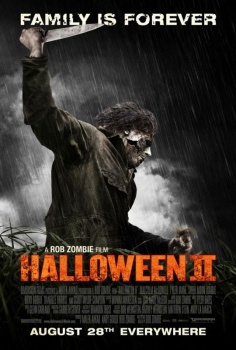
Much like the sequel to the original film,Halloween II opens with Laurie (Scout Taylor-Compton) being stalked in the hospital by her murderous older brother, Michael (Tyler Mane). And the hospital scenes are actually pretty good. Zombie makes good use of Nights in White Satin and the scenes of Michael chasing Laurie are genuinely suspenseful.
However, the film then jumps a year into the future and it’s all kind of annoying. Halloween II follows three separate storylines, all of which converge at the rushed conclusion.
My favorite storyline dealt with Dr. Loomis (again played by the brilliant Malcolm McDowell). Loomis has written a book about Michael and is now traveling the country, promoting himself as a true crime expert and dealing with people who think that he’s exploiting the whole tragedy for a quick buck. McDowell is perfect in these scenes, playing Dr. Loomis as a pompous man who secretly knows that he’s a fraud. “I was as much a victim as anyone,” he occasionally sputters. Perhaps the highlight of the film comes when he’s interviewed by a rather sarcastic Chris Hardwick and finds himself being ridiculed by Weird Al Yankovic (playing himself).
The second storyline features Annie (Danielle Harris) and Laurie struggling to get on with their lives. Laurie is now living with Annie and her father (Brad Dourif). As opposed to the virginal Laurie of the first Halloween, this Laurie is pissed off and out of control. On the one hand, I think Zombie deserves some credit for trying to deal with the PTSD that would obviously be the result of surviving being attacked by Michael Myers. On the other hand, to say that Laurie is never not pissed off would be an understatement. Scout Taylor-Compton does a good job playing her but, in Halloween II, a little Laurie Strode goes a long way. You can only watch someone rage at the world for so long before it starts to get boring.
And the third storyline, not surprisingly, is Michael still trying to track down and kill his sister. Michael continually sees visions of his dead mother (Sheri Moon Zombie), occasionally accompanied by a white horse, telling him, “It’s time.” (Eventually, Laurie starts to see the same thing.) Usually, if you come across someone online criticizing Halloween II, one of the first things that they’ll mention will be that white horse. To be honest, the white horse didn’t both me. I actually appreciated the surreal touch of Sheri Moon Zombie and a white horse appearing out of nowhere. But still, as opposed to first film, Michael is just boring in this film. The first film was memorable because it took the time to explore why Michael became who he became. In Halloween II, Michael’s just another killer in a mask. Leslie Vernon would have kicked his ass.
So, no, Halloween II does not really work. The story is too messy and, with the exception of Dr. Loomis, none of the characters are particularly interesting. I still stand by my claim that Rob Zombie is an underrated director but Halloween II is a definite misfire.
That’s the question that every horror fan has to ask themselves at some point. Needless to say, Zombie has a huge following and no one can doubt his love for the genre. And yet, despite that, it seems that Zombie’s detractors will always be as outspoken as his fans. His fans point out that Zombie makes movies that literally feel as if they’re filmed nightmares and that, as a committed horror fan, he’s willing to go further in his quest to shock you than most mainstream filmmakers. His detractors, meanwhile, tend to see Zombie as an excessive filmmaker who often uses an abundance of style to cover for a weak narrative.
Personally, I’m somewhere in the middle when it comes to Zombie. I think, as a storyteller, Rob Zombie does occasionally struggle to maintain a coherent narrative but, at the same time, I think his strengths as a director ultimately overcome his weaknesses. As a visual filmmaker, he’s a lot stronger than he’s often given credit for and I don’t think anyone would criticize the way that he uses music in his films. He may not be the strongest director of actors but he’s got a good eye for casting and he’s given work to some of our best character actors (Sid Haig, Malcolm McDowell, Brad Dourif, William Forsythe, and the late Karen Black, just to name a few). If his films are extremely graphic and bloody … well, that’s the current state of horror. If anything, I would argue that Zombie deserves credit for unapologetically embracing the mantle of being a 21st century grindhouse filmmaker.
That said, Rob Zombie’s films rarely seem to be as good on a second viewing as they were during the first. He’s one of those directors who comes at you strong that, to a certain extent, his films almost beat you into submission. During the first viewing of one of Zombie’s films, it’s not unusual to be overwhelmed by all the style and the music and the gore and the over-the-top characterizations. Even if you don’t like the film itself, it definitely makes an impression on you. It’s only on repeat viewing that you might start to notice that Zombie’s narratives are often rather clumsily slapped together. Several times, Zombie’s visual style seems to dictate the story as opposed to the other way around.
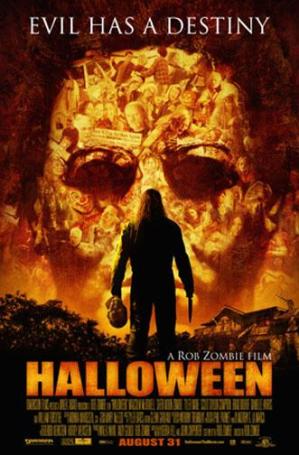
That was certainly the case with his 2007 remake of Halloween. While the film follows the same basic plot as John Carpenter’s original, it also spent a lot more time delving into the past of Michael Myers (Daeg Faerch as a child, Tyler Mane as an adult). It was obvious that Zombie was far more interested in Michael than in any of his victims. (Carpenter took the exact opposite approach, developing the characters of Annie, Laurie, and Linda and allowing Michael to remain a cipher.) As a result, the first half of the film deals with Michael and his dysfunctional childhood while only the second half features Michael escaping and returning to Haddonfield. Laurie, Annie, and Lynda are well-played by Scout Taylor-Compton, Danielle Harris, and Kristina Klebe but ultimately, they all remain rather generic.
The first time I saw Rob Zombie’s Halloween, I thought it was one of the most disturbing films that I had ever seen. I should clarify that I mean that in a good way. Zombie’s Michael was truly terrifying but, at the same time, Zombie portrayed him as a kid who never had a chance. Whereas Carpenter’s Michael started the film as a fresh-faced little boy dressed up like a clown and holding a bloody knife, Zombie’s Michael is born into a world of chaos and darkness. With his dysfunctional childhood, it was hard not to feel that Michael never had a chance. Feeling abandoned by both his family and, eventually, his therapist, Michael retreated into a world of pure anger and hate. Whereas John Carpenter’s Michael rarely seemed to be angry (instead he was just relentless), Zombie’s Michael is rage personified.
Unfortunately, Zombie’s Halloween spends so much time on Michael and his mother (Sheri Moon Zombie) and Dr. Loomis (Malcolm McDowell, perfectly cast) that it doesn’t leave much time for the night he came home. Essentially, the entirety of Carpenter’s original film is crammed into the film’s second half and, on repeat viewings, you can’t ignore how incredibly rushed it all feels. It’s obvious that Zombie’s heart was in the first half of the film. In the second half, he’s just going through the slasher movie motions.
Rob Zombie’s Halloween is definitely a flawed film. John Carpenter’s original remains the superior Halloween but, to be honest, I don’t think Rob Zombie would deny that. Zombie set out not to replace Carpenter’s Halloween but to tell a different version of the same story. When Zombie’s Halloween works, it really works. Flawed as it may be, Halloween proves that Rob Zombie is a talented filmmaker, albeit one with room to grow.
As for Halloween II … well, we’ll talk about that later…
 Through the Shattered Lens