The TSL’s Horror Grindhouse: Diary of the Dead (dir by George Romero)


I have to admit that I was a little bit hesitant about watching the 2007 film, Diary of the Dead.

It wasn’t that I don’t like zombie movies.  In fact, it was the complete opposite.  I love zombie films and Night of the Living Dead is one of my favorites.  George Romero, of course, went on to make several sequels to Night of the Living DeadDawn of the Dead, Day of the Dead, and Land of the Dead are certifiable horror classics.  However, I had heard mixed things about the two zombie films that Romero directed after Land of the Dead.  Seeing as how Diary of the Dead was Romero’s second-to-last film before he passed away in 2017, I was worried that I would watch the film and discover that I hated it.  I didn’t want experience anything that would tarnish Romero’s cinematic legacy.  It didn’t help my expectations that Diary of the Dead is a found footage film and the conventions of the found footage genre tend to get on my last nerve.

(Seriously, nothing makes me throw a shoe at a screen quicker than the sound of someone in a horror movie saying, “Are you filming this?”)

But you know what?

I did watch Diary of the Dead and it’s actually not bad.  It may not reach the heights of Romero’s other zombie films but it’s definitely a worthwhile companion piece.  It opens with news reports about the start of the zombie apocalypse, meaning that Diary of the Dead is meant to take place at roughly the same time as Night of the Living Dead.  (Never mind that Diary of the Dead is full of references to YouTube and blogs and other things that most people probably couldn’t even imagine when Night of the Living Dead first came out.)  A group of film students are in the woods, filming a terrible mummy movie when they first hear reports of the dead coming back to life.  Some say that there’s no way it could be true.  Others say that something must be happening but surely the dead aren’t actually coming back to life.  They soon discover that the dead have indeed returned.

We follow the students as they travel across Pennsylvania, trying to find a place that’s safe from the Dead and discovering that there’s literally no such place left in America.  Along the way, they also discover that the government has no intention of telling the people the truth about what’s happening.  In fact, a group of national guardsmen turn out to be just as dangerous as the zombies.  In their efforts to survive, the students are forced to rely on an underground network of bloggers and video makers.

Diary of the Dead has all of the usual zombie mayhem that you would expect from a film like this but, at the same time, it’s got a lot more on its mind than just the dead returning to life.  Much as he did with Land Of The Dead, Romero uses Diary of the Dead to comment on the state of America under the Patriot Act.  With the government using the zombie apocalypse as an excuse to suspend civil liberties and increase their own power, the film’s characters are forced to depend on new and independent information sources.  It’s not hard to see the parallel that Romero is making between the War on the Living Dead and the War on Terror.  As well, making all of the characters film students allows for some discussion about whether or not horror films should simply concentrate on being scary or whether they should also attempt to deal with real-world issues.  The film leaves little doubt where Romero came down on that issue.

On the negative side, Diary of the Dead struggles a bit to overcome the limitations of its low budget and none of the characters are as compelling as Ben in Night of the Living Dead or Fran in Dawn of the Dead.  At times, you find yourself wishing that Diary of the Dead featured just one actor who was as into their role as Duane C. Jones or Ken Foree were in Night of the Living Dead and Dawn of the Dead, respectively.  But Diary of the Dead still features enough zombies and enough of Romero’s trademark political subtext to be an acceptable addition to Romero’s vision of the apocalypse.

Horror Film Review: Resident Evil: The Final Chapter (dir by Paul W. S. Anderson)


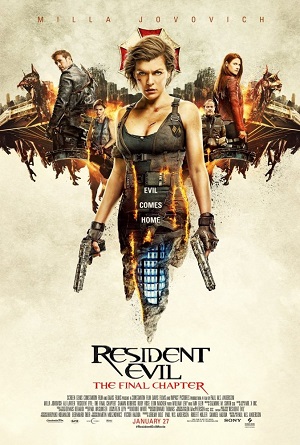
Resident Evil: The Final Chapter?

Yeah, right.

There’s a long tradition of venerable horror franchises claiming that their latest installment is “the final chapter.”  The Friday the 13th franchise declared that the fourth part would be the final chapter and then promptly announced that part five would be a new beginning.  As long as a franchise is still making a profit, nothing truly ends.  Resident Evil: The Final Chapter basically admits that at the end of its final chapter, when one of the surviving characters literally announces that the mission is not over.

Anyway, Resident Evil: The Not-So Final Chapter will probably seem totally incoherent to anyone who has not watched the previous film.  To be honest, even though I’ve seen the other Resident Evil films, I always have a hard time working my way through the franchise’s dense mythology.  There are times when I suspect that, much like the Underworld films, the Resident Evil films were specifically designed to mess with my ADD.  That said, the Resident Evil franchise has never made a secret about being more concerned with spectacle and action than with narrative coherence.  If you’re the type who obsesses of the lack of logic and plausibility in a horror-action film based on a video game, then you’re not the right audience for Resident Evil.

The Final Chapter finds Alice (Milla Jovovich) right where the previous Resident Evil film left her, in the ruins of the White House.  The world is still zombiefied and monsterfied, all as a result of the nefarious work of the Umbrella Corporation.  Alice is contacted by the Red Queen (Ever Gabo Anderson), who explains that Alice needs to return to Raccoon City and invade the Hive before Umbrella releases yet another virus.  Alice travels back the Hive, which leads to several of Resident Evil‘s trademark, over-the-top action sequences.  Along the way, a lot of familiar faces pop up.  Alice is reunited with Claire (Ali Larter).  Dr. Alexander Isaacs (Iain Glen) shows up, explaining that the Isaacs who Alice killed a few movies ago was actually just a clone.  (No one ever dies in Resident Evil.  Instead, they just get cloned.)

Of course, Albert Wesker returns as well.  Ever since Resident Evil: Afterlife, Wesker has been played by a Canadian actor named Shawn Roberts.  Watching The Final Chapter, it took me only a few seconds to realize that Shawn Roberts also played Dean the Rapist in five episodes of Degrassi: The Next Generation.  That storyline, in which Dean raped Paige and it then took two years (and two seasons) for the case to go to trial just to end with Dean getting acquitted and smirking at Paige as he left the courtroom, remains one of Degrassi‘s most powerful storylines.  Roberts uses that same smirk while playing Wesker.

Paul W. S. Anderson returns to direct The Final Chapter.  Though Anderson seems to be destined to be best known as “that other director named Paul Anderson,” he’s actually pretty good when it comes to directing nonstop action.  (For the record, I thought Anderson’s Pompeii was a sadly underrated film.)  The Final Chapter is fun and silly as long as you don’t waste any time to thinking about it and Anderson keeps the action coming so quickly that you literally don’t have time to worry about whether or not the movie makes any sense.  The film’s prologue, in which a boy gets zombiefied on a cable car, was actually pretty exciting and a reminder of the visceral horror that it is at the heart of all zombie films.

Resident Evil: The Final Chapter was released in January and, despite some decidedly mixed review, it became the highest grossing film in the franchise.  In other words, this is definitely not the final chapter…

Val’s Movie Roundup #4: Hallmark Edition


Recipe For Love

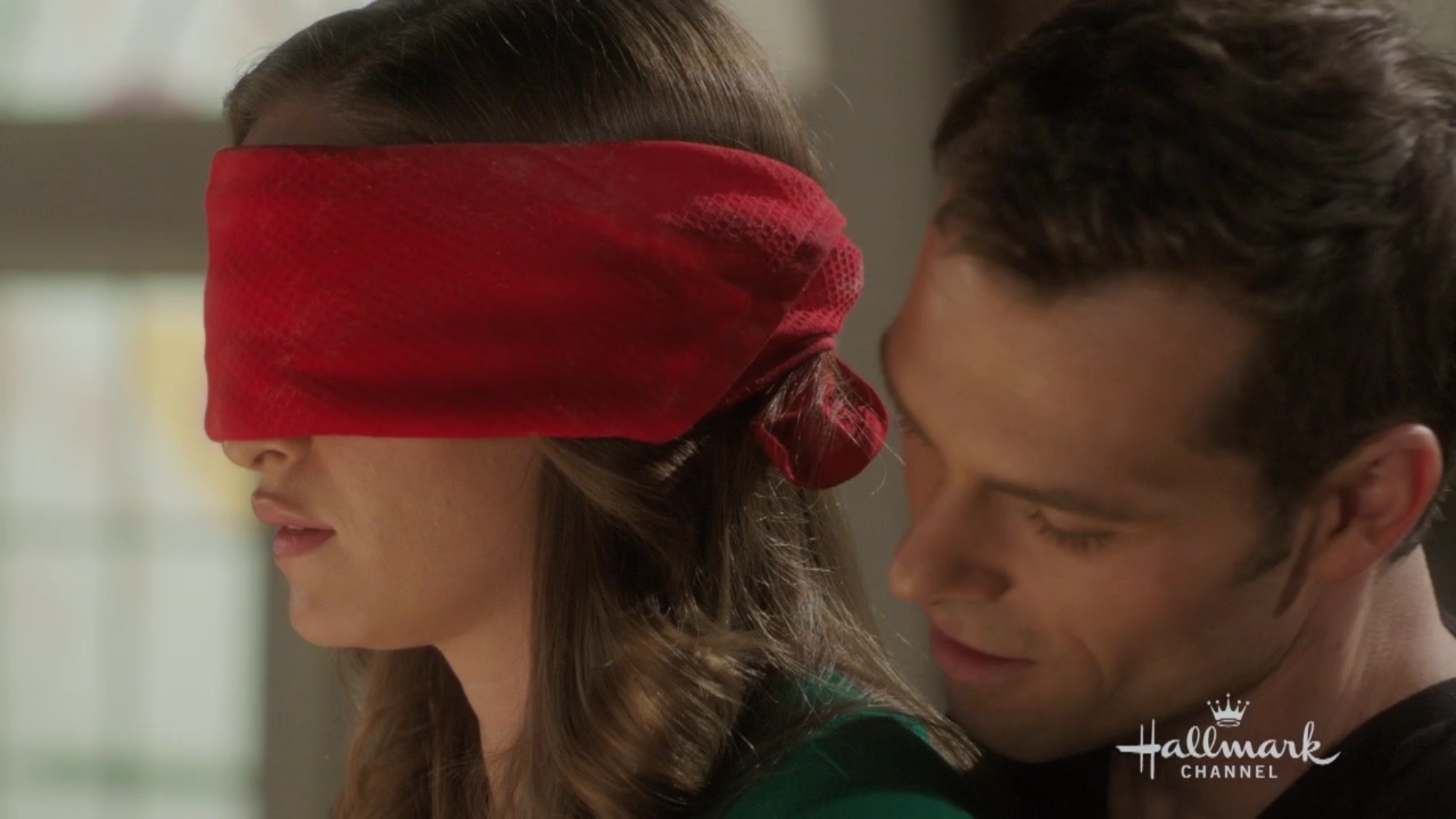
Recipe For Love (2014) – The movie begins with Lauren (Danielle Panabaker) as a kid writing a food blog about cafeteria food. She is told that’s a no no by the school. Then we jump ahead to when she’s an adult working in a kitchen. Suddenly, an opportunity falls into her lap. She is asked to ghostwrite a cook book for a television chef named Dexter Durant (Shawn Roberts). At first there is a little friction, but it doesn’t last long. The two open up to each other pretty quickly. We see behind the facade Dexter puts on for the audience and Lauren genuinely wants to make this cookbook happen. It’s not like this is a story about a woman whose voice is hidden behind a man’s. And it’s not about tearing down this fake personality to see Dexter fall from grace or watch him give up this thing he was only doing for fame. They work together, fall for each other, and both come out of the process better then when they began it. They both still love cooking and want to continue to do so with each other. I really liked that she wasn’t bashing against a wall that finally comes down in the end. Both of them begin to deal with each other as real people early on. I liked this Hallmark movie better than most I have seen.

Catch A Christmas Star

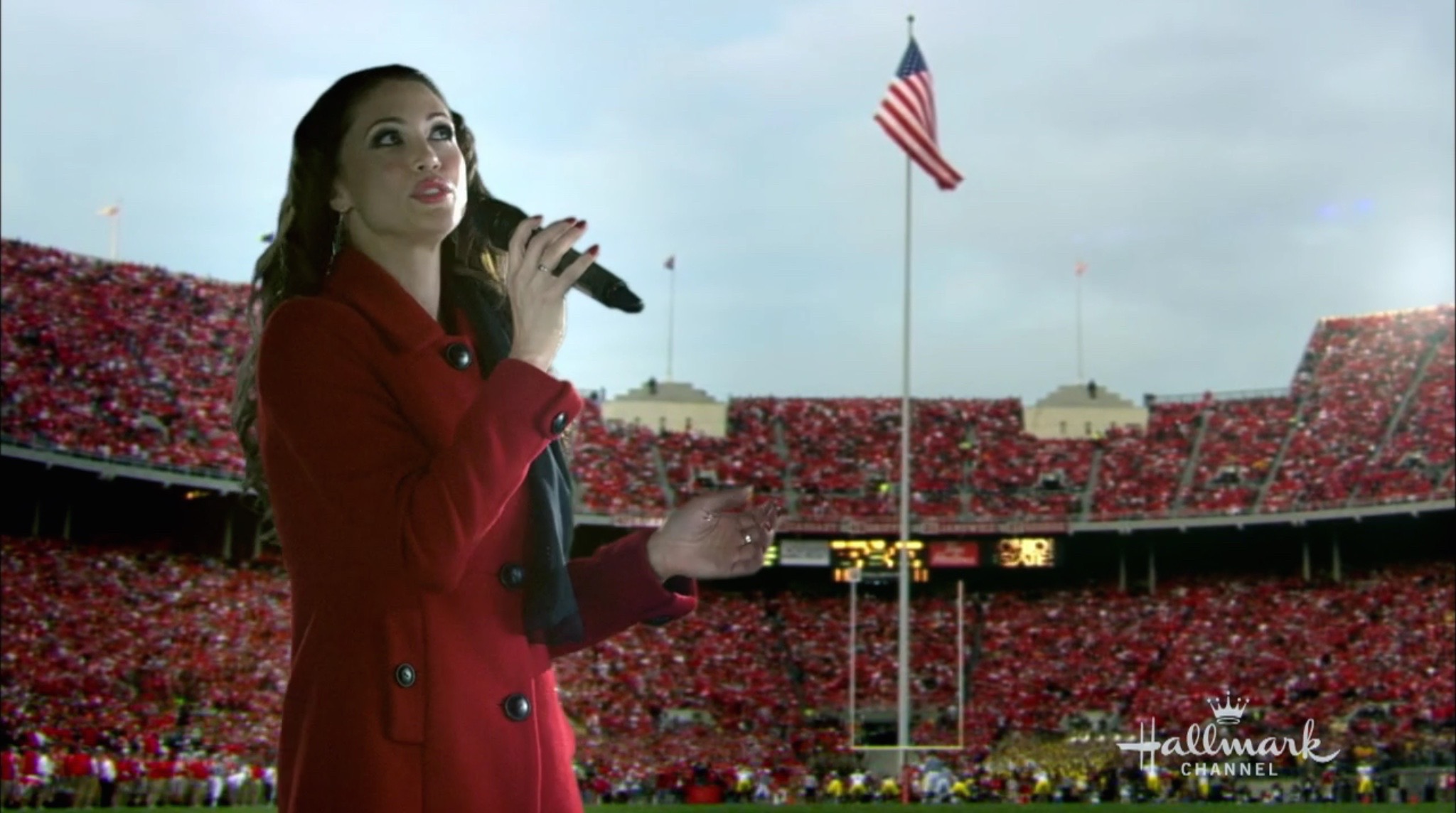
Catch A Christmas Star (2013) – I swear if it isn’t a dog movie, it’s a bible movie, otherwise it’s a Christmas movie. In fact, director John Bradshaw has made eight of them. This film introduces us to a family that has a little girl who likes a singer named Nikki (Shannon Elizabeth). She shows up at a record signing and wouldn’t you know it, turns out Nikki knows her Dad from the past. There’s no sense in spelling out the rest of the plot because you already know it. I didn’t like this one. I didn’t feel any chemistry. Shannon Elizabeth doesn’t act well. She certainly can’t sing. And while she is probably the nicest and sweetest person I could ever meet in real life, she looks like a plastic doll to me in this movie. I just couldn’t push past that. I’ve only seen four Hallmark Christmas movies, but I would go with A Royal Christmas (2014) instead.

My Boyfriends' Dogs

My Boyfriends’ Dogs (2014) – This year I replaced my desktop PC with a Mac. I kind of regret the choice of going with a Mac because the software is lousy. The hardware is giving me some problems too. But I’m going off on a tangent. My point is that while the computers have given out over the years, the monitors still work fine. As a result, I have the monitor that comes with the all in one Mac and two monitors from previous computers attached for a three monitor setup. This movie is like that. It follows Bailey (Erika Christensen) as she goes from one boyfriend to another, picking up their dogs along the way. It’s actually quite funny to see two of them show up on her doorstep with a dog for her to adopt. At the center of this series of dates is the guy at the pet shop cast because we can instantly tell he’s a good guy. Now all of this is told in flashback. At the beginning of the movie, Bailey wanders into a cafe wearing a wedding dress where she recounts her story to a some guy and Joyce Dewitt of Three’s Company fame. Turns out the final boyfriend almost became her husband before she ran out, dogs and all. I won’t spoil the ending, but it will have you yelling, “Oh, come on!” This one’s okay, but Recipe For Love is the best of the four in this roundup.

For Better Or For Worse

For Better or for Worse (2014) – This one is a Romeo and Juliet style story. You have the mother who does weddings. You have a father who does divorces. Their children decide to come together, become vegans, and organic farmers. Obviously, that doesn’t go to well with the parents. What follows is the parents getting closer while trying to drive the kids away, only to figure out that as weird as it seems, the kids are actually pretty happy together. The two parents also turn out to be happy as well with each other. Wait, I just realized something. I know it’s a little wishy washy, up for argument, and they did it in Clueless, but that smells a little like incest. A little weird for a Hallmark movie. Oh well, is it worth your time? You can do worse. It’s a decent 90 minutes or so without commercials. I wouldn’t seek it out, but if it’s on, then just enjoy it to pass the time.