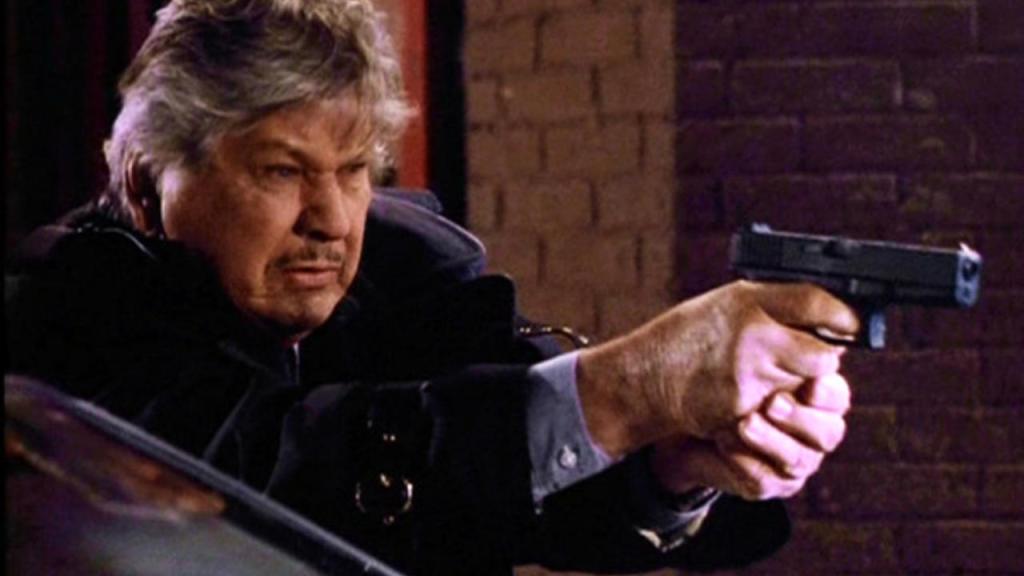
Brad reviews FAMILY OF COPS III: UNDER SUSPICION (1999) – Charles Bronson’s final film! 


Legendary actor Charles Bronson ended his five-decade career by starring in a series of made-for-TV movies, FAMILY OF COPS (1995), BREACH OF FAITH: A FAMILY OF COPS II (1997), and FAMILY OF COPS III: UNDER SUSPICION (1999). I was in my mid-twenties as this series played out, and I enjoyed each of the installments. Today, I’m going to take a look at the final film in the series, and the final film in Charles Bronson’s career.

FAMILY OF COPS III: UNDER SUSPICION opens with Milwaukee Police Inspector Paul Fein (Charles Bronson) and his detective son, Ben Fein (Joe Penny), investigating the double murder of a wealthy banker, Phillip Chandler, and his wife. Their initial suspect, the couple’s son Evan Chandler (Greg Spottiswood), is later found murdered, so they have to keep digging. They eventually uncover a money laundering scandal involving the current Chief of Police (Sean McCann) that may go all the way up to the Mayor (Art Hindle)! As usual, this series includes additional storylines involving other members of the family. One of the subplots involves Paul’s youngest son Eddie (Sebastian Spence), who’s racked with guilt over a S.W.A.T. raid gone wrong. Unable to open the warehouse door at the appropriate time, Eddie blames himself for the deaths of two cops. The other primary subplot involves Paul’s oldest daughter Kate (Barbara Williams), who finds herself pregnant with the child of her social worker boyfriend. Determined to have the baby whether her boyfriend hangs around or not, Kate must navigate their relationship and all the family drama while preparing for the possibility of being a single mother. 

As far as I’m concerned, the fact that this is Charles Bronson’s final film should make it a must watch for any person who considers themselves to be a fan of the icon. Making his debut in 1951 in the Gary Cooper film YOU’RE IN THE NAVY NOW, because he could “belch on cue,” Bronson’s final film would debut on CBS on January 10th, 1999, when he was 77 years old. At such an advanced age, Bronson still commanded the screen even though he was at the end of his career, and as time would tell, near the end of his life. He would be diagnosed in 2001 with Alzheimer’s disease and would pass away on August 30th, 2003. I savor every moment of this film, and while it makes me sad in some ways, in other ways I consider it my favorite of the series. Joe Penny steps up and takes a co-lead role in the film. He’s tough and sensitive, which adds another layer of depth to the foundation that Bronson had established in the first two movies. The series wouldn’t get another movie without Bronson, but I would have definitely been down for a Joe Penny led follow-up! This movie has a stronger sense of humor than we’ve seen in the earlier films, and I also like the main story as Paul Fein and his son take on systemic corruption in Milwaukee. While it’s still formulaic, I found the primary storyline to be more interesting than the generic crime stories in the first two installments. The subplots involving Eddie and Kate add some depth to the Fein family dynamics, but other than the fact that Kate is determined to keep her baby with or without her boyfriend’s help, the subplots didn’t make much of an impact for me. Also, there is one major departure in this installment, as Angela Featherstone does not return as the youngest daughter, Jackie Fein. Nicole de Boer steps into the role, and while she’s cute as a button, the character isn’t given much to do.

Overall, while FAMILY OF COPS III: UNDER SUSPICION is not in the same league as the great films made during Charles Bronson’s prime, it’s still a respectable close to his iconic career. It features good, committed performances, especially from Bronson and Joe Penny. The final shots of Charles Bronson looking over his movie family and smiling as they enjoy each other and share a meal together is a fitting end to his movie career, and one final celluloid glimpse into the man underneath the legendary facade.

Late Night Retro Television Review: Friday the 13th: The Series 3.6 “Bad Penny”


Welcome to Late Night Retro Television Reviews, a feature where we review some of our favorite and least favorite shows of the past! On Fridays, I will be reviewing Friday the 13th: The Series, a show which ran in syndication from 1987 to 1990. The entire series can be found on YouTube!

This week …. hey, it’s a good episode!

Episode 3.6 “Bad Penny”

(Dir by William Fruet, originally aired October 30th, 1989)

The Coin of Ziocles returns!  Last seen being used by a cult to raise the dead, the Coin is recovered from a construction site at the start of this episode.  This turned out to be the best episode of the third season so far.  Here’s a few reasons why:

  1. First off, with this episode, Friday the 13th finally showed that it still remembered its own history.  The last time Jack, Micki, and Ryan sought the coin, Micki was actually killed and remained dead until Ryan and Jack figured out how to use the coin to bring her back to life.  With this episode, we discover that Micki has some serious PTSD as a result of the experience which actually makes a lot of sense.  In the past, I’ve always felt this show tended to gloss over just how traumatizing it would be to deal with cursed antiques on a daily basis.  With this episode, we see that Micki can’t even look at the site where she was killed without starting to shake.  It was realistic and Robey did a great job portraying Micki’s emotions.
  2. In yet another nod to continuity, Johnny stole the coin and used it to bring back his dead father.  In the past, I’ve felt like Johnny was a bit too quick to accept the idea of the antiques being cursed.  With this episode, we saw that the inexperienced Johnny doesn’t quite understand that danger of the cured antiques.  Ryan, Micki, and Jack would never have made the mistake of using the antique or trusting anything that had once been owned by Uncle Lewis but Johnny is still learning.
  3. Steve Monarque and Sean McCann both did excellent work as Johnny and his father.  Needless to say, Johnny’s father is confused when he’s brought back from the dead.  His struggle to understand what was happening brought tears to my eyes.  It’s been less than a year since I lost my Dad.  I’d probably do the same thing Johnny did.  In the end, Johnny sent his father back into the afterlife.  It was so sad!
  4. Micki writes a letter to Ryan.  It’s probably one that she won’t ever send but it’s good to see that the show at least acknowledged how difficult it would have been for her to say goodbye to Ryan.
  5. By mentioning Ryan so much, this show actually made it easier for me to accept Johnny as his replacement.  Over the past few episodes, I kind of resented how quickly Johnny seemed to be stepping into replace him.  This episode showed me that Ryan is still loved.
  6. The villains — a corrupt cop and his zombified partner — were a bit over-the-top  but still entertaining.  For once, this episode focused on our heroes and I was glad it did.

This was an excellent episode of Friday the 13th!  I hope it’s a sign of things to come for the rest of the third season.

Late Night Retro Television Review: Friday the 13th: The Series 2.25 “The Prisoner”


Welcome to Late Night Retro Television Reviews, a feature where we review some of our favorite and least favorite shows of the past! On Fridays, I will be reviewing Friday the 13th: The Series, a show which ran in syndication from 1987 to 1990. The entire series can be found on YouTube!

This week, Johnny goes to prison!

Episode 2.25 “The Prisoner”

(Dir by Armand Mastroianni, originally aired on June 5th, 1989)

After Johnny Ventura’s father is killed by an invisible man….

Wait, what’s Johnny doing here?

No, don’t get me wrong.  I understand why Johnny’s there, mostly because I have the benefit of hindsight.  I know that Johnny is going to replace Ryan during the third season and this episode was obviously designed to get the audience used to the idea of Johnny being a part of the show.  The majority of the episode follows Johnny as he’s sent to prison, having been framed for murdering his own father.  The culprit is another prisoner, Dayton Railsback (Larry Joshua).  Dayton has a kamikaze pilot’s jacket that allows him to turn invisible whenever blood is spilled on it.  Whenever Dayton’s invisible, he sneaks out of the prison and searches for some money that he stole ten years earlier. Johnny is the only person in the prison who knows what Railsback is doing so soon, he’s being targeted by the invisible man.

While Johnny is dealing with life in prison, Micki, Ryan, and Jack are attempting to prove that Railsback is the murderer.  It’s a bit odd because the three of them — our stars! — are barely in the episode and, when they do appear, they’re just hanging out in the antique shop.  They talk about all of the investigating that they’ve been doing but we don’t actually see them doing it.  Watching the episode, one gets the feeling that John D. LeMay, Robey, and Chris Wiggins all shot their scenes in one day and then left on an extended vacation.  They showed up just long enough to establish this as being an episode of Friday the 13th, despite the fact that almost the entire episode is about Johnny.

Needless to say, it was a bit of a disjointed episode.  The show kept jumping from Johnny in prison to Railsback killing people outside of prison to everyone hanging out in the antique shop and it was a bit difficult to keep track of who was planning what.  Myself, I was surprised at how quickly the show went from Johnny’s father being murdered to Johnny getting tossed into prison.  We don’t even see Johnny’s trial.  Johnny was passed out when his father was shot and, quite frankly, it seems like he could have made a very credible argument that he was framed.  (The invisible Railsback puts the gun in Johnny’s hands but he doesn’t manipulate Johnny into pulling the trigger so it’s not like there would have been any powder residue on Johnny’s fingers.)  Johnny and his father appeared to have a pretty good relationship so you really have to wonder what type of case the prosecution made.  The episode ends with Johnny killing Railsback and then being released from prison.  So, is Johnny going to have to on trial again?  I mean, he just stood there while Railsback burned to death.

Weird episode.  It didn’t do too much for me.  I’m going to miss Ryan once season 3 starts.

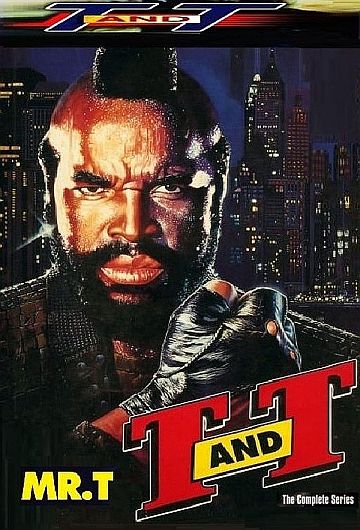
Retro Television Review: T and T 3.11 “A Place In History”


Welcome to Retro Television Reviews, a new feature where we review some of our favorite and least favorite shows of the past! On Fridays, I will be reviewing T. and T., a Canadian show which ran in syndication from 1987 to 1990.  The show can be found on Tubi!

Are you ready to get back into T and T?

Yeah, me neither.

But I made a commitment to review the show so here we go!

Episode 3.11 “A Place In History”

(Dir by Alan Simmonds, originally aired on March 17th, 1990)

Phil (Sean McCann), the new cut man at Decker’s gym, impresses everyone when he throws one solid punch that breaks the nose of a cocky boxer.  Phil tells them that he learned how to take care of himself back when he was better known as Lucky O’Mara.

OH MY GOD, everyone says, LUCKY O’MARA!

Apparently, in the 50s, Lucky O’Mara was a gangster who was famous for stealing from the rich and giving to the poor.  His picture was never taken and his mysterious disappearance led to a legend growing all over Canada about what happened to Lucky O’Mara.  (He was the Toronto version of D.B. Cooper, I suppose.)  After the local media gets wind of Phil’s story, he becomes a celebrity.  Everyone wants to interview Lucky O’Mara.  And at least one person — a veteran mafia hitman — wants to kill Lucky O’Mara.

Only Turner, Terri, and Detective Hargrove are skeptical of Phil’s story.  When Hargrove summons Phil to the police station and announces that he’s going to be arrested for a murder that Hargrove says Lucky committed, Phil comes clean and admits that he’s not Lucky.  And it all turns out that Phil wasn’t going to be arrested anyway.  It was just a clever ruse on the part of Hargrove and Terri.

At the end of the episode, Phil is back to working as a cut man and no one at the gym seems to be all that upset about him lying to them.  Phil tells Turner that he actually is Lucky O’Mara.  Turner shrugs.

Wow, what a nothing episode.  The idea was intriguing but the episode did little with it.  You kind of have to wonder how it is that a busy policeman like Hargrove and a busy attorney like Terri have time to fake arrest someone.  I mean, aren’t there real arrests that need to be made?  Worst of all, T.S. Turner spent most of this episode sitting in his office.  He didn’t growl at anyone.  He didn’t threaten anyone.  He didn’t get mad at anyone.  What’s the point of T and T if you’re not going to use the T that most people are probably watching for?

This episode was typical of the third season of T and T.  It didn’t add up too much and Mr. T really didn’t seem like he wanted to be there anymore.  I know how he feels but there’s only a few more episodes to go and I’m going to review everyone of them.

Retro Television Reviews: T and T 1.9 “On Ice” and 1.10 “The Latest Development”


Welcome to Retro Television Reviews, a new feature where we review some of our favorite and least favorite shows of the past! On Fridays, I will be reviewing T. and T., a Canadian show which ran in syndication from 1987 to 1990.  The show can be found on Tubi!

This week, T.S. insults the national sport of Canada and Amy battles city hall.

Episode 1.9 “On Ice”

(Dir by Alan Simmonds, originally aired on March 7th, 1988)

“In this episode,” Mr. T tells us, “Decker is forced to face the truth about a long-time friend.”

Though T and T took place in a generic city, the show itself was filmed in Canada, with a largely Canadian cast and crew.  Hence, it only makes sense that the show would eventually do an episode that centered around hockey.  This episode opens with Mr. T’s friend, Decker (David Nerman), coaching a junior hockey game.  While the players skate on the ice and chase the puck, Decker deals with fans like the loud Mrs. Mowby (Jayne Eastwood), who is apparently convinced that she knows better how to coach the team than the actual coach!  Unfortunately, Decker is yanked out of the game by two detectives who announce that he is under arrest for “theft of over $2,000.”

After T.S. Turner and Amy bails Decker out of jail, Amy explains that it appears that over $25,000 has been embezzled from the Junior Hockey Association.  Decker admits to being the association’s treasurer but he also admits to not being good at numbers.  He explains that his old friend, Goldie Stanski (played by Sean McCann), usually goes over the books for him.

“Goldie?”  T.S. growls, “You trusted a guy named Goldie!?”

Decker explains that Goldie has been his friend for years.  Goldie was his former coach!  And, indeed, when Mrs. Mowby demands that Decker be kicked out of the Junior Hockey League, Goldie argues that Decker has not been convicted of anything, not that it does Decker much good.  However, Detective Jones (Ken James) informs T.S. that “word on the street” is that Goldie has a gambling addiction.

Decker takes T.S. to his next practice and introduces T.S. to the team.  They ask T.S. if he’s going to join them on the ice.

“No thanks, brothers,” T.S. replies, “I don’t play no sport when you can get frostbitten indoors.  Besides, I think hockey’s an old ladies’ game …. Look at the ton of equipment you guys wear!”

After practice, Decker is arrested for a second time after the detectives, having gotten an anonymous tip, search his locker and just happen to find a bus ticket that leads to a bag full of money.  Fortunately, Amy is able to bail him out of jail again, much to the relief of her spacey administrative assistant, Sophie (Catherine Disher), who has a crush on Decker.

T.S. has decided that Goldie is setting up Decker.  Now, he just has to get Goldie to give himself away.

“I think with a little persuasion,” T.S. tells Amy, “he might do something foolish …. Friendly persuasion, of course!”

T.S.’s style of persuasion is to show up in Goldie’s apartment and tell him that everyone knows what Goldie’s done while drinking a glass of milk.  “Thanks for the milk,” T.S. growls before leaving.  When Goldie responds by going to the gym and pocketing more money from the hockey’s charity fund, Amy, T.S., and Decker are there to chase him out on the ice and catch him.  If you’ve ever wanted to see Mr. T drive a Zamboni, this is the episode for you.

Decker’s name is cleared and he’s re-instated as coach.  Yay!

This was a totally predictable episode but I kind of liked it.  Mr. T on a Zamboni was just a ludicrous enough image to make the entire show work.

Episode 1.10 “The Latest Development”

(Dir by George Mihalka, aired on March 14th, 1988)

“In this episode,” Mr. T tells us, “Amy and I fight City Hall …. and City Hall fights back!”

When a dumb, 13 year-old kid named Nick (Toby Proctor) breaks into a construction site and takes a bulldozer for a joyride, he accidentally destroys a truck.  The owner of the site, Enzo Malec (George Touliatos), is determined to throw the book at Nick because he’s an evil developer and he wants both Nick and his grandmother, Cora (Helen Hughes), out of their home.

It turns out that one of Amy’s former classmates, Brian Brack (Richard Comar), works in the city’s legal department so she heads down to City Hall in an attempt to guilt him into allowing Cora to stay in her home.  For once, we actually get to see Amy doing legal work, which basically amounts to wandering around with a file folder and rolling her eyes while having conversations with other people.

Meanwhile, T.S. takes Nick down to the construction site and convinces Malec to let Nick work off his debt as a construction worker.  T.S. arranges for Cora to move in with gospel-singing Aunt Martha (Jackie Richardson) while Nick moves in with Decker.

Suddenly, building inspectors show up at Amy’s office and start searching for violations.  “Brian Brack is responsible for this, isn’t he!?” Amy says, while the inspectors write her up for not having a window that opens quickly enough.  That’s a $2,000 fine!  Upon discovering that they are now going to war with city hall, T.S. tells Amy, “This could be a title bout!”

Amy confronts Brian at a fancy restaurant and tells him that she has discovered that he has invested in Enzo Malec’s development.  She demands to know who he and Malec paid off at city hall.  Brian tells Amy that she doesn’t know who she is missing with.  Amy responds by tossing a drink on him.  In a case of amazing timing, Alderman Kent (Mark Walker) shows up and asks if Amy is going to be joining him and Brian for lunch.  Hmmm …. I wonder who the corrupt politician could be.

Meanwhile, T.S. and Decker help Nick deal with his anger by training him to box.

“I know how to fight!” Nick says.

“To win, you need a strategy,” T.S. replies.

T.S. proceeds to knock down a 13 year-old.

While T.S. is teaching Nick how to fight, the city is threatening to shut down Aunt Jackie’s foster home!  When T.S. finds out, he puts on his dark jacket and starts to head off to City Hall so he can presumably beat up the mayor.  Instead, Amy convinces him to hold off by revealing that Brian and Alderman Kent have been taking bribes from Enzo Malec.  When T.S. heads down to the construction site, Malec panics and, later that night, he tries to burn a bunch of incriminating files.  However, it turns out that he’s being filmed by Amy and the local news.

And that apparently fixes the whole thing!

This episode felt rushed as it basically only had 30 minutes to deal with an hour’s worth of complications.  It only took one boxing lesson for Nick to let go of his anger and it only took one confrontation with T.S for Enzo Malec to make one sloppy mistake.  That said, I appreciate any episode that portrays municipal government as being thoroughly corrupt and irredeemable.  Fight the system!

Next week: Amy’s car gets stolen!

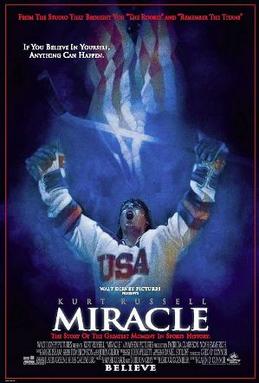
An Olympic Film Review: Miracle (dir by Gavin O’Connor)


(Back in 2011, Chris Mead — who wrote under the name Semtex Skittle — reviewed Miracle for this site.  At the that time, I had not seen the film.  Below are my thoughts but please, also be sure to read Chris’s review as well.)


Like all good people, I’m currently obsessed with the Winter Olympics.  Earlier this week I asked a couple of friends if they could recommend some good Winter Olympics movies.  A lot of movies were suggested but, without fail, everyone thought I should see Miracle.  (A lot of people also suggested Cool Runnings, which I’ll be watching next week.)  Having watched Miracle earlier today, I can see why everyone recommended it.

The year is 1980 and two hockey teams are about to face off at the Winter Olympics in upstate New York.  (The location, to be exact, is Lake Placid.  Fortunately, the giant alligators are nowhere to be seen.)

On one side you have the Russian team (or the Soviets as they were known back then).  They are widely considered to be one of the greatest hockey teams in history.  They are big, fierce, and determined.  Coming from a system that has declared individuality to be a crime against the state, the Soviet team plays like a machine.  The Soviets have won the gold in the last four Olympics.  As one American coach puts it, their greatest strength is that every other hockey team in the world is terrified of them.

On the other side, you have the American team.  However, this isn’t the type of American dream team that one would expect to see today.  In 1980, professional athletes were not allowed to compete on the U.S. Olympic team.  Instead, the 1980 hockey team is made up of amateurs and college players.  Unlike the Soviet teams, the American don’t have a government that grooms and supports them.  Instead, win or lose, they have to do it on their own.

Of course, it’s not just two hockey teams that are about to face off.  It’s also two super powers and two very different ways of life.  In 1980, the U.S. and the Soviet Union were the two most powerful rivals in the world.  The Soviets were trapped in an endless and unpopular war in Afghanistan.  Meanwhile, in the U.S., the economy was shaky, American citizens were being held hostage in Iran, and an ineffective President gave long-winded speeches about how unhappy everyone in the country appeared to be.  Both countries needed a victory but only one could win.

And it would take a miracle for that winning team to be American…

I don’t think it requires a spoiler alert to tell you that’s exactly what happens.  I mean, after all, I’m reviewing a film  called Miracle!  On top of that, it’s based on true events.  The U.S. hockey team — made up of college students and led by Coach Herb Brooks (played, in one of his best performance, by Kurt Russell) — not only managed to defeat the highly favored Soviet team but they went on to win the gold medal.

Even if you didn’t know that the Americans beat the Russians, you would never have any doubt about how Miracle is going to end.  Miracle is a film that utilizes almost every sports film cliché but it manages to do so with such sincerity and such style that you don’t mind the fact that the movie doesn’t exactly take you by surprise.  Is there any actor who is as good at project sincerity and human decency as Kurt Russell?  Whenever he says that he’s going to make his team into champions, you believe him.  When he says that he’s being hard on them because he wants them to be the best, you never doubt him or his techniques.  When he says that he’s proud of his team and his country, it brings tears to your eyes.  If there’s ever a movie that deserves a chant of “USA!  USA!  USA!,” it’s Miracle.