Days of Paranoia: The Anderson Tapes (by Sidney Lumet)


In 1971’s The Anderson Tapes, Sean Connery stars as Duke Anderson.

Duke is a career criminal, a safecracker who has just spent ten years in prison.  He’s released, alongside Pops (Stan Gottlieb), who spent so much time behind bars that he missed two wars and the Great Depression, and the quirky Kid (Christopher Walken, making his film debut).  Duke immediately hooks up with his former girlfriend, Ingrid (Dyan Cannon), and decides to rob the luxury apartment building where Ingrid is now living.

Of course, Duke will have to put together a crew.  It’s not a heist film without a quirky crew, is it?  Duke recruits the Kid and Pops.  (The Kid is happy to be in the game but he’s not a fan of violence.  Pops, meanwhile, has none of the skills necessary for living in the “modern” world and would much rather return to prison.)  Duke also brings in the flamboyant Tommy Haskins (an overacting Martin Balsam) and driver Edward Spencer (Dick Anthony Williams).  Duke goes to the mob for backing and Pat Angelo (Alan King) gives it to him on the condition that he take along a sociopathic racist named Socks (Val Avery) and that Duke kills Socks at some point.  Duke reluctantly agrees.

So far, this probably sounds like a conventional heist film.  Director Sidney Lumet mixes comedy and drama with uneven results but, overall, he does a good job of ratcheting up the tension and The Anderson Tapes is a good example of one of my favorite mini-genres, the “New Yorkers will be rude to anyone” genre.  At first glance, Sean Connery seems to be playing yet another super smooth operator, a confident criminal with a plan that cannot fail.  Duke seems like a criminal version of James Bond,  However, as the film progresses, we start to suspect that things might be getting away from Duke.  When Duke has to go the Mafia for support and is told that killing Socks is now a part of the job, we see that Duke isn’t as in-control of the situation as we originally assumed.  This is the rare Sean Connery film where he has someone pushing him around.

(Apparently, Connery took this role as a part of his effort to escape being typecast as Bond.  Perhaps that explains why Duke seems like almost a deconstruction of the James Bond archetype.)

Of course, what really lets us know that Duke isn’t as in-charge as he assumes is the fact that four different law enforcement agencies are following his every move.  From the minute he gets out of prison, Duke is being watched.  The apartment is bugged.  Security cameras records his every move.  Once the heist begins, we’re treated to flash forwards of breathless news reports.  The Anderson Tapes is less a heist film and more a portrait of the early days of the modern Surveillance State.  Of course, none of the agencies make any moves to stop Duke because doing so would reveal their own existence.  The film really does become a portrait of a government that has gotten so big and intrusive that it’s also lost the ability to actually do anything.

The Anderson Tapes is entertaining, even if it’s not really one of Lumet’s best.  Connery is, as always, a fascinating screen presence and it’s always entertaining to see a young Christopher Walken, showing early sings of the quirkiness that would become his signature style.  The Anderson Tapes is a portrait of a world where you never know who might be listening.
Horror Film Review: The Little Girl Who Lives Down The Lane (dir by Nicolas Gessner)


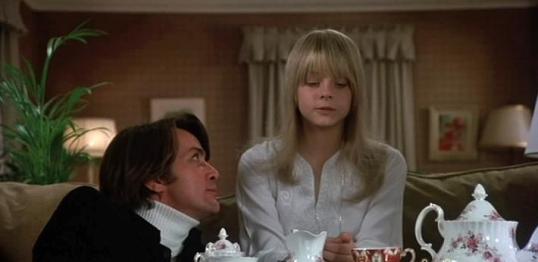
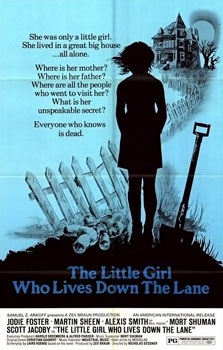
First released in 1976, The Little Girl Who Lives Down The Lane tells the story of Ryann Jacobs (played by Jodie Foster, who was thirteen years old when she made this film).

Rynn lives in a small New England town, in a house that her father has leased for three years.  It’s been a while since anyone has seen Rynn’s father.  Rynn always tells everyone that he’s either out of town or that he’s busy in his study and can’t be disturbed.  When the friendly local policeman (Mort Schuman) expresses some doubt about Rynn’s claim that her father is working, Rynn says that her father is a drug addict, like all of the great poets.

Rynn’s main problem is with the Halletts.  Cora Hallett (Alexis Smith) owns the house in which Rynn is living.  Cora drops by regularly, haughtily demanding to see Rynn’s father.  Her creepy son, Frank (Martin Sheen), also makes a habit of visiting.  He’s not interested in Cora’s father.  Instead, he’s interested in Cora.  Everyone in the town knows that Frank is a perv but no one is willing to do anything about it.  He’s protected by his mother’s money.

One day, when Cora drops by, she insists on going into the basement.  She says she has something down there that she needs to retrieve.  Rynn tells her not to go down there but Cora refuses to listen, which turns out to be a huge mistake.  Cora screams at what she sees down there and then falls to her death.  With the help of her only friend, Mario (Scott Jacoby) an aspiring magician who walks with a limp, Rynn covers up the murder.

Mario turns out to be a very good friend, indeed.  Not only does he tell people that he’s seen Rynn’s father but he even stands up to Frank when he shows up at the house, searching for his mother.  However, as it soon becomes clear, Frank isn’t one to give up so easily….

The Little Girl Who Lives Down The Lane is an interesting hybrid of a film.  It definitely does have elements of horror.  The running theme throughout the film is that Rynn might kill people but it’s all the adults in her life who are truly monstrous.  Frank is truly a monster and Martin Sheen gives a remarkably intense and creepy performance in the role.  Frank is the type who will say that worst things imaginable and then smirk afterward, confident that he’ll never have to face any sort of justice for his crimes.

At the same time, the film is also a coming-of-age-story and a teen romance.  Rynn and Mario are two outsiders who find each other.  You like both of them and you want things to work out for them, even though you spend almost the entire film worried that Rynn might end up poisoning Mario.  Foster and Jacoby share some genuinely sweet scenes.  Things would be just fine, the film seems to be saying, if all of these stupid adults would just mind their own business.

The Little Girl Who Lives Down The Lane is an effectively creepy and sometimes even sweet little film about a girl who occasionally has to kill people.  Keep an eye out for it!

Smash-Up On Interstate 5 (1976, directed by John Llewellyn Moxey)


Smash-Up On Interstate 5 begins with ominous shots of a crowded California interstate.  It’s the 4th of July weekend and old people are returning home, young people are looking for a party, and Sergeant Sam Marcum (Robert Conrad) of the California Highway Patrol is looking for a killer.  When one car swerves into the next lane and hits another, it leads to a chain reaction as hundreds of cars, trucks, and one motorcycle crash into each other.  While the vehicles crash, we see the people inside of them.  There’s Buddy Ebsen!  There’s Vera Miles!  There’s Sue Lyon (of Lolita fame) on the back of a motorcycle!  In a voice-over, Sam tells us that the accident will be classified as being due to “mechanical failure” and that 14 people are going to die as a result.  He might be one of them.

Smash-Up On Interstate 5 is a 70s disaster film so, after the pile-up, the movie flashed back 48 hours and we get to know everyone whose lives are going to eventually collide on Interstate 5.  Erica (Vera Miles) is recently divorced and trying to get back into the dating scene.  Albert (Buddy Ebsen) is trying to bring some joy to his terminally ill wife’s final days.  Lee (Scott Jacoby) and Penny (Bonnie Ebsen) are the hippies who are trying to get to Big Sur without getting arrested.  Burnsey (Sue Lyon) loves her biker boyfriend.  Some of them will survive the pile-up.  Some of them will not.

Smash-Up On Interstate 5 is an above average made-for-TV movie.  It’s got a notable cast and the movie does a good job of mixing together’s everyone’s subplots.  For instance, Burnsey and a group of bikers show up in the background of several scenes and harass Erica at one point long before the crash on the interstate.  It’s only a 100-minute film so the film doesn’t go into too much detail about everyone’s past but we learn just enough to make everyone stand out.  The crash itself is intense, even when seen today.  Made before the days of CGI, this is a film where the stunt crew definitely earned their paycheck.

Tommy Lee Jones plays a patrolman who is also Sam’s brother-in-law.  I was surprised when I first saw him but as soon as I saw the strained smile and heard the accent, I knew it was him.  Jones’s role is small and probably could have been played by anyone but the mere presence of Tommy Lee Jones definitely makes this film cooler than it would have been otherwise.

One final note: This film was directed by the made-for-TV horror specialist, John Llewellyn Moxey.  Be sure to read Gary Loggins’s tribute to this often underrated director.