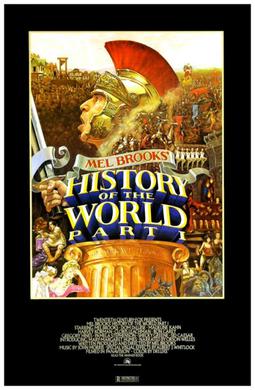
 Overlong, wildly uneven, gimmicky too a fault, and often laugh out loud funny with a mix of jokes that range from the crude to the sublimely clever to the surprisingly sentimental, The History of the World, Part I is the ultimate Mel Brooks films.
Narrated by Orson Welles and featuring five historical stories and a collection of coming attractions, The History of the World Part I follows man from his caveman origins to the French Revolution and the thread that ties it all together is that humanity always screws up but still finds a way to survive. Moses (Mel Brooks) might drop and break one of the three tablets listing the 15 Commandments but he’s still able to present the other ten. Stand-up philosopher Comicus (Mel Brooks) might make the mistake of poking fun at the weight of Emperor Nero (Dom DeLuise) but he still makes his escape with Josephus (Gregory Hines), Swiftus (Ron Carey), and Miriam the Vestal Virgin (Mary-Margaret Humes) and ends up serving as the waiter at the Last Supper. (“Jesus!”) The Spanish Inquisition may have been a catastrophe but it also gave Torquemada (Mel Brooks) a chance to show off his performance skills. The French Revolution may have been a bloodbath but the future still held promise. Ask for a miracle and he’ll show up as a white horse named Miracle, no matter what era of history you’re living in.
The humor is very Mel Brooks. During the Roman Empire sequence, Madeline Kahn plays Empress Nympho. Jackie Mason, Harvey Korman, Cloris Leachman, Spike Milligan, Jan Murray, Sammy Shores, Shecky Greene, Sid Caesar, Henny Youngman, and Hugh Hefner all make cameo appearances. Carl Reiner is the voice of God. John Hurt plays Jesus. The film ends with the promise of a sequel that will feature “Jews in Space.” Not every joke lands. The entire caveman sequence feels forced. But when the film works — like during The Inquisition production number — it’s hard not get caught up in its anything-goes style. The entire Roman Empire sequence is probably more historically accurate than the typical Hollywood Roman epic. That’s especially true of Dom DeLuise’s naughty performance as Emperor Nero.
Mel Brooks is 99 years old today and he says that he has at least one more film to give us, a sequel to Spaceballs. I’m looking forward to it! I’m also looking forward to rewatching and enjoying all of the films that he’s already given us. The History of the World, Part I may not have initially enjoyed the critical acclaim of his earlier films but, in all of its anarchistic glory, it’s still pure Mel Brooks.

 Through the Shattered Lens