Star Slammer (1986, directed by Fred Olen Ray)


On the planet of Arous, Taura (Sandy Brooke) leads a group of dwarf miners in rebellion against the international empire.  The empire sends Captain Bantor (Ross Hagen), Krago (Michael D. Sonye), and the Inquisitor (Aldo Ray) to capture Taura and put down the revolution.  When Bantor attempts to attack Taura, he sticks his hand in a volcanic acid plume and screams as it dissolves.  Taura is arrested.  Judge John Carradine sentences her to a term on Vehemence, a spaceship that serves as an intergalactic women’s prison.

Star Slammer is a Women In Prison film that happens to be set in space.  Taura makes an enemy of the sadistic warden (Marya Grant) and her henchwoman, Muffin (Dawn Wildsmith).  Taura also befriend Mike (Susan Stokey) and the two of them plot to overthrow the guards and make their escape.  When the now crazed Bantor boards the ship, Taura sees her chance.  Meanwhile, the prisoners have to deal not only with pervy guards but mutant rats.

Legend has it that Fred Olen Ray had rented Roger Corman’s New World Pictures studio for four days so that he could shoot some extra scenes for his film Biohazard.  Ray finished his Biohazard work in one day and then spent the other three days filming promotional footage for the film that would become Star Slammer.  He used props that were left over from Galaxy of Terror and was able to get Aldo Ray to come in for a day so that the footage would feature “a name.”  Producer Jack H. Harris looked at the footage and put up the money to shoot the rest of the film on the condition that Ray change the title from Prison Ship to Star Slammer.

Amazingly, the resulting film itself is not that bad.  Ray used the outer space setting as a way to both indulge in and poke fun at the common tropes of the Women In Prison genre and Sandy Brooke and Susan Stokey both turn in committed performances.  Ross Hagen laughs like a maniac and demands vengeance for his missing hand while trying to get his remaining hand on a mind control device.  The prisoners are kept in check by promises of prizes and free trips in return for good behavior.  A thoroughly deformed guard is promoted as a sex symbol and there’s a sharp wit to many of the scenes.  Star Slammer is much more clever and fun than anyone would have any right to expect it to be.

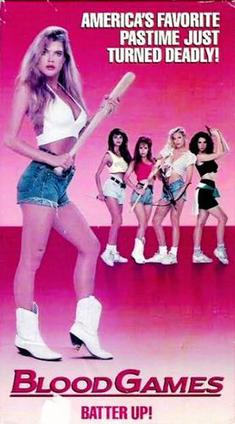
The TSL’s Grindhouse: Blood Games (dir by Tanya Rosenberg)


First released in 1990, Blood Games opens with a birthday celebration gone terribly wrong.

Somewhere in the rural South (at least, I assume it’s meant to be the South if just because of the big Confederate flag that appears in one scene), Roy Collins (Gregory Cummings) is celebrating his birthday.  Roy’s father, Mino (Ken Carpenter), has invited Babe and the Ball Girls, a women’s softball team, to come to town to play an exhibition game against Roy and the local boys.  When Babe (Laura Albert) and her team not only beat but also thoroughly humiliate the hometown team, Mino doesn’t take it well.  He yells at Roy and Roy and his idiot friend, Holt (Don Dowe), decide to get revenge.  After Roy is killed while trying to assault one of the girls, Mino gathers all of the rednecks together and declares, “I WANT JUSTICE!”  Everyone in town grabs a shotgun, jumps in a pickup truck, and heads off in pursuit of the Babe and the Ball Girls tour bus.

It shouldn’t come as a surprise to anyone that the bus itself breaks down in the middle of the woods and the team is forced to hike to safety while being pursued by Mino, Holt, and all of the rest of the shotgun toting locals.  It turns out that Mino is a deadly shot with a crossbow and Holt, at times, seems to be close to indestructible.  However, it also turns out that Babe and the Ball Girls are far tougher than any of the men expected.  The film reaches its bloody conclusion at a deserted farm, complete with a dramatically-scored flashback montage that reminds us of everyone whose life was lost during Roy’s birthday weekend.

Just to state the obvious, Blood Games is just as exploitive as it sounds.  This is the type of film where, early on, the action stops so the camera can linger on Babe and the Ball Girls in the locker room after they win their game.  (George “Buck” Flower shows up as the redneck who inevitably ends up peeking in at them.)  The team’s uniforms were probably popular with the film’s target audience but short shorts and crop tops don’t really seem practical for a game that would involve sliding through the dirt and the weeds on the way to home plate and, as a Southern girl who spent many a summer in the country while growing up, I cringed a bit when I thought about all the bugs that were probably in the grass and the dirt, waiting for a chance to hop onto a bare leg.  (It didn’t help that the game was apparently just being played in some random field.)

And yet, as exploitive as many viewers will undoubtedly find Blood Games to be, the film definitely works.  The rednecks are so loathsome and they overreact so severely to losing one game to a team of girls that it’s impossible not to cheer when Babe and the Ball Girls turn the tables on their pursuers.  “Batter up!” the film’s trailer announces and it is true that the Ball Girls use the same teamwork that won them the game to survive in the wilderness.  At the same time, they also use baseball bats, ropes, guns, and anything else they can get their hands on.

The acting is a bit inconsistent, though Don Dowe and Ken Carpenter are both well-cast as the main villains.  Dowe plays Holt as being someone who knows that he’s in over his head but who is too weak-willed to go against the mob.  The fact that he’s weak makes him all the more dangerous because a weak man will do anything to try to convince others that he’s strong.  Carpenter, meanwhile, is chillingly evil as Mino, who quickly goes from mourning his son to taking a sadistic pleasure out of hunting down human beings.  The film’s real strength is to be found in Tanya Rosenberg’s direction.  Along with keeping hte movie moving at a fairly steady pace, Rosenberg also captures the atmosphere of being lost in the country in the summer.  Watching the film, you can literally feel the heat rising from the ground and hear the cicadas in the distance.

Incidentally, I convinced my sister to watch this film with me because I assumed it was a baseball movie.  However, as Erin quickly pointed out to me, it instead turned out to be a softball movie.  I have no idea what exactly the difference is between baseball and softball but Erin assures me that there is one.  Well, no matter!  Whether it was softball or baseball, Babe and the Ball Girls did a good job striking out the hometown boys.

Batter up!

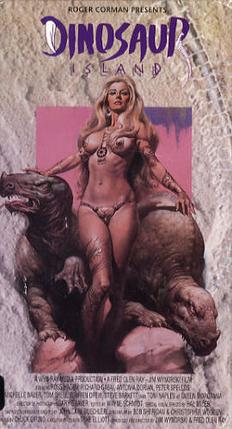
Dinosaur Island (1994, directed by Fred Olen Ray and Jim Wynorski)


What do you get when a producer like Roger Corman notices that Jurassic Park was the most financially successful film of 1993?

Dinosaur Island!

Directed by not just Fred Olen Ray but also Jim Wynorski (and if that combination isn’t enough to spark your interest, I don’t know what is), Dinosaur Island is about what happens when a cargo plane transporting three AWOL soldiers back to the United States crashes near an uncharted island. Led by no-nonsense Capt. Briggs (Ross Hagen), the soldiers make it to the island.

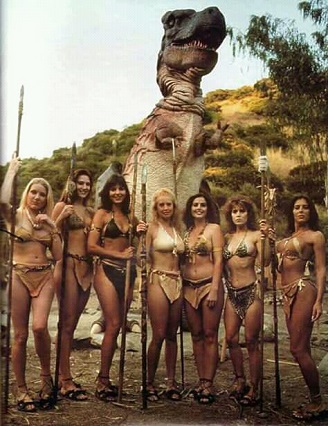
They discover that the island is full of beautiful cavewomen who spend much of their time topless. For the film’s intended audience of teenage boys, that’s good.

They discover that the women are ruled by a queen (Toni Naples) who hates men. That’s bad.

When the women notice that one of the men has a smiley face tattoo, they decide that he is the chosen one who has been prophesized about in the ancient scrolls. That’s good, I guess.

Chosen or not, the men still have to battle the Tyrannosaurs Rex that rules the island. That’s bad. Or is it good? I don’t know anymore.

To save money, Roger and the gang reused the dinosaur who appeared in Corman’s previous Jurassic hit, Carnosaur. They also reused a lot of stock footage from that film. The Carnosaur footage often doesn’t match with the footage that was shot for Dinosaur Island but I don’t know that anyone would expect anything less from Corman-produced rip-off of Jurassic Park. There are some films where the cheapness of it all become a selling point and this is one of them. The special effects are less important than marveling at how the movie got a dinosaur without spending any money.

Dinosaur Island is a bad movie with less than convincing special effects and a lot of overacting but it seems to be aware of its limitations so it’s hard not to like it. It’s obvious that Ray and Wynorski both understood that there was no way that they were gong to be able to make a serious film with the resources that they had available so instead, they shot a flat-out comedy that made fun of its own cheapness. It was the right approach to take, even though the film’s jokes are as often groan-worthy as they are funny. Among the cast, Ross Hagen seemed to have the best understanding of what was needed because he deadpans his way through the entire film, delivering his weird lines with a straight face and giving a performance that wouldn’t be out of place in Airplane! or one of the other ZAZ films.

Not surprisingly, this was a popular film on late night cable back on the day. It’s combination of boobs, jokes, and dinosaurs made it a Cinemax mainstay. Rewatching it, I knew how stupid it was but I couldn’t help but laugh at a few parts. I enjoyed viewing it again. Nostalgia is more powerful than any dinosaur.

Panther’s Revenge: Night Creature (1978, directed by Lee Madden)


Axel McGregor (Donald Pleasence) is a world-famous author and big game hunter who, while on a hunt in the steamy jungles of Thailand, is maimed by a ferocious panther.  With both his body and pride wounded, Axel posts a reward for the panther, demanding that it be captured and brought to his private island estate.  When the panther is delivered, Axel plans to set it free so that he can hunt and kill it and regain his lost virility.  Unfortunately, as soon as McGregor sets the panther free, unexpected guests show up at the island, Axel’s two daughters (Nancy Kwan and Jennifer Rhodes), his granddaughter (Lesly Fine), and an obnoxious tour guide named Ross (Ross Hagen).  The panther proves to be harder to hunt than Axel was expecting and soon, one daughter has been killed and another daughter suffers a fate worse than death when she becomes Ross’s default love interest.

Night Creature is a strange film.  It was obviously made as a part of the nature-gone-wild cycle that started in the wake of Jaws but, once the daughters arrive at the island, there are several lengthy stretches where the movie concentrates more on the love triangle between Ross and the daughters than on the panther.  When the panther does show up, the attack scenes are so confusingly shot that it is difficult to be sure what has really happened.  Director Lee Madden goes overboard with slow motion shots of the panther stalking its prey and an attempt to introduce some psychic bond between Axel and the panther largely falls flat.

At least we get Donald Pleasence, playing one of his twitchy roles and suffering another extended nervous breakdown.  Night Creature may not offer much but it does have one of the best Pleasence freakouts ever captured on film.  It’s always a pleasure to watch Pleasence chew the scenery, especially when he’s joined by panther.

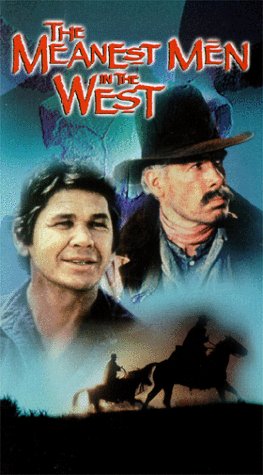
A Movie A Day #142: The Meanest Men In The West (1978, directed by Sam Fuller and Charles S. Dubin)


The Meanest Men In The West may “star” Charles Bronson and Lee Marvin and Sam Fuller may be credited as being one of the film’s two directors but don’t make the same mistake that I made.  Don’t get too excited.

There was once a TV western called The Virginian.  Starring James Drury as a ranch foreman, The Virginian ran for nine seasons on NBC.  A 1962 episode, which was written and directed by Sam Fuller, featured Lee Marvin as a sadistic outlaw who kidnapped The Virginian’s employer, a judge played by Lee J. Cobb.  Five years later, another episode features Charles Bronson as a less sadistic outlaw who kidnapped the Judge’s daughter.

The Meanest Men In The West mixes scenes from those two episode with western stock footage, a bank robbery that originally appeared in The Return of Frank James, an intrusive voice-over, and an almost incoherent prologue, all in order to tell an entirely new story.  Now, Charles Bronson and Lee Marvin are brothers and rivals.  After Marvin snitches on Bronson’s plan to rob a bank, Bronson blames his former friend, The Virginian.  In order to get the Virginian to come to his hideout, Bronson kidnaps Cobb’s daughter.  The Virginian manages to convince Bronson that he didn’t betray him, just to arrive back at the ranch and discover that Cobb has been kidnapped.  Meanwhile, Bronson and his gang set off after Marvin and his gang.  It ends with Charles Bronson, in 1967, shooting at Lee Marvin, who is still in 1962.

The Meanest Men In The West is so clumsily edited that the same shot of Charles Bronson holding a gun is spliced into a dozen different scenes.  Filmed on different film stocks, the Bronson scenes and the Marvin scenes look nothing alike and, since the two episodes were filmed five years apart, James Drury literally ages backwards over the course of the film.

The Meanest Men In The West is for Charles Bronson and Lee Marvin completists only.  I think Bronson and Marvin are two of the coolest individuals who ever existed and even I had a hard time making it through this one.  If you do watch it, keep an eye out for a young Charles Grodin, thoroughly miscast as a tough outlaw.

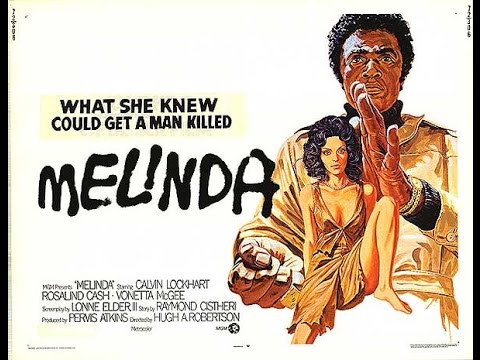
Cleaning Out The DVR Yet Again #40: Melinda (dir by Hugh A. Robertson)


(Lisa recently discovered that she only had about 8 hours of space left on her DVR!  It turns out that she’s been recording movies from July and she just hasn’t gotten around to watching and reviewing them yet.  So, once again, Lisa is cleaning out her DVR!  She is going to try to watch and review 52 movies by the end of 2017!  Will she make it?  Keep checking the site to find out!)

melinda

I recorded Melinda off of TCM on November 13th.

First released in 1972, Melinda is technically a murder mystery.  Frankie J. Parker (Calvin Lockhart, giving a brilliant performance) is a popular radio DJ in Los Angeles.  When we first see Frankie, he’s driving his expensive sportscar through a poor neighborhood.  It’s a neighborhood that he knows well but, as opposed to those around him, he’s made it out.  He’s handsome, slick, and more than a little arrogant.  When he arrives at a local gym, he looks at himself in a mirror and says, “I shouldn’t say it … but I am a pretty motherfucker.”  Frankie’s a student in a taekwondo class taught by Charles Atkins (Jim Kelly).  Charles gives Frankie a hard time about not giving back to the community.  Frankie blows off his concerns.  To be honest, we really should dislike Frankie but he’s so damn charming.  As played by Calvin Lockhart, Frankie has one of those irresistible smirks, the type of the lights up the screen.

One night, Frankie meets the mysterious Melinda (Vonetta McGee) and spends the night with her.  He thinks that it’s just going to be another one night stand but Melinda tells Frankie that he has the potential to be more than he realizes.  Touched, Frankie goes to work and resolves to be a better person.  Then he returns home and discovers that Melinda has been murdered!

The rest of the film deals with Frankie’s attempts to discover who murdered Melinda.  It turns out that Melinda had underworld connections and mob boss Mitch (Paul Stevens) is desperate to recover something that Melinda had in her possession when she died.  But honestly, the whole murder subplot is a MacGuffin (if you want to get all Hitchcockian about it).  Ultimately, Melinda is a character study of Frankie Parker and how, over the course of solving Melinda’s murder, he learns that there’s more to life than just looking out for himself.

Though Melinda was obviously made to capitalize on the blaxploitation craze of the early 70s, it’s actually far more low-key than most of the better known films in the genre.  (Or, at least it is until the karate-filled finale.)  Perhaps because it was directed by a black man and written by noted black playwright Lonne Elder III, Melinda is far more interested in exploring what makes its characters who they are, as opposed to just putting a gun in their hand and having them shoot up the screen.  Frankie Parker emerges as a fascinating character.

Mention should also be made of the performance of Rosalind Cash, who plays Terry, Frankie’s ex.  Cash gets an absolutely amazing scene where, while attempting to convince a bank employee that she’s Melinda so that she can get into Melinda’s safe deposit box, she tells off a rude teller.  It’s such a good scene and Cash delivers her lines with such fury that you find yourself forgetting that the teller was actually correct in her suspicion that Terry wasn’t actually who she said she was.

Melinda is probably one of the best films that hardly anyone has ever heard of.  Keep an eye out for it.

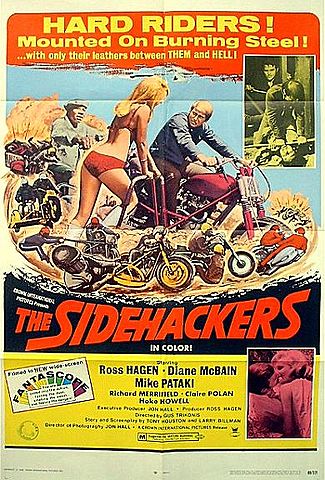
Embracing the Melodrama Part II #32: The Sidehackers (dir by Gus Trikonis)


Sidehackers

Why the Hell am I reviewing The Sidehackers, a rather terrible film from 1969?

A lot of it is because The Sidehackers is famous for being featured in an episode of Mystery Science Theater 3000 and my boyfriend absolutely loves that show.  And, after I watched The Sidehackers, I viewed the Mystery Science 3000 version of the film.  Seriously, if any film deserves to be mocked by two robots and a possibly stoned space traveler, it’s The Sidehackers.

Another reason that I agreed to watch The Sidehackers is that it’s included in one of my many Mill Creek box sets and, as I’ve stated in the past, I always enjoy seeing what I can find hiding in those compilations.  Sometimes, you find a surprisingly good film.  And sometimes, you find The Sidehackers.

Finally, The Sidehackers is a Crown International production and, as of late, I’ve become a bit obsessed with seeing as many Crown International films as possible.

CIP_Logo

Anyway, The Sidehackers is one of those films that’s built around a sport that was probably never popular with anyone other than the guy who produced the film.  No, I’m not talking soccer.  I’m talking about sidehacking!

Let’s see if I can explain this.  You’re going to have to forgive my limited knowledge of just what the Hell this sport was all about.  Basically, sidehacking is a former of motocross where all the motorcycles have a sidecar attached to them.  So, when racing, one person steers the motorcycle and then his teammate stands in the sidecar and spends the entire race adjusting his body and providing balance whenever the motorcycle has to make a sharp turn.

Or something.

All I know is that it looks extremely silly and kinda stupid but everyone in The Sidehackers is just fascinated by it.  The Sidehackers features two full races and I have to admit that, as hard as I tried, I could not keep up with who was on which motorcycle or how much help the guy in the sidecar really was.  I found myself wondering why someone would decide they wanted to race as a part of a team instead of as an individual.  At one point, the film’s main character says that sidehacking is all about “teamwork” but seriously, who needs that crap?  Individual glory all the way!

Anyway, surly Rommel (Ross Hagen) is the greatest sidehacker in the world.  However, he makes a mistake when he agree to show cult leader J.C. (Michael Pataki) how to sidehack.  J.C. loves the sport but he can’t handle the fact that he’s not very good at it.  He gets jealous of Rommel and his amazing sidehacking skills. J.C.’s girlfriend, Paisley (Claire Polan) is also impressed with Rommel’s sidehacking.  It looks like this sidehack might end in tragedy!

(To be honest, I just like using the word “sidehack” and I will probably use it a few more times before this review ends.)

When he’s not busy sidehacking, Rommel likes to go on picnics with his wife Rita (Diane McBain) and think about how happy they are and how much they both love sidehacking.  It’s a life so perfect that an American Idol style ballad is heard whenever Rommel and Rita are together.  However, then Paisley claims that Rommel assaulted her so J.C. briefly abandons his sidehacking obsession so that he and his gang can beat up Rommel and murder Rita.

Rommel handles the tragedy not by sidehacking but by walking along the highway.  Rommel no longer cares about sidehacking.  Sidehacking is J.C.’s thing now.  Rommel, instead, is out for revenge.  He recruits a few random people from around town and they go off to kill sidehacking J.C. and his gang.

And it should be easy enough to accomplish all of this because it’s not like J.C. is a particularly intelligent murderous cult leader but since this film was made in 1969, it has to end on a down note.  Let’s just say that the film ends with a close-up of a dead body while the Sidehackers love theme plays on the soundtrack.

The Sidehackers is incredibly bad and pretty boring.  Michael Pataki deserves some credit for giving a good performance as J.C. but Ross Hagen is amazingly surly.  Even before Rita dies, Hagen seems to be in a generally pissed off mood.  If anything, I doubt Ross Hagen’s performance did much to increase the popularity of sidehacking.

I searched YouTube and most of the clips of The Sidehackers was taken from the Mystery Science Theater episode.  Unfortunately, those clips tends to make The Sidehackers look more interesting than it actually is.  I really wanted to find some sidehacking footage so you could see how stupid it really does look but unfortunately, I couldn’t find any.  However, I did find this clip of one of Rommel’s men telling a stupid joke that has nothing to do with sidehacking.

Enjoy!

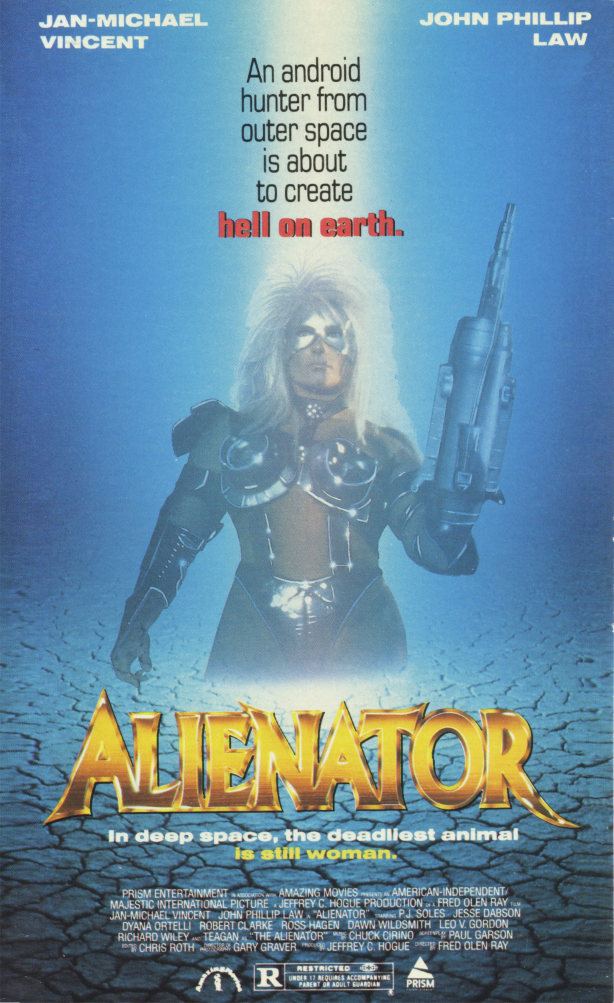
“Alienator” : Fred Olen Ray Gives “The Terminator” A Sex Change


Screen Shot 2012-10-19 at 4.59.15 PM

Give Fred Olen Ray credit — the guy’s a survivor. While his name has never been attached to a genuine B-movie classic — although Hollywood Chainsaw Hookers definitely has its fans — he’s found a way to remain, if not exactly relevant, at least employed for decades now and has , according to official IMDB totals, written 56 films, produced 80, starred in 143, and directed a staggering 128! Granted, directing 128 movies isn’t nearly as difficult as it sounds when most have two-or three-day production schedules, but still —

Anyway, Fred seems to be settling comfortably into the tail end of his career now helming SyFy network made-for-TV numbers and “Skinemax” fare such as Busty Housewives Of Beverly Hills, but back in the late ’80s/early ’90s the straight-to-video market was  wide open territory for low-budget mavens such as himself and he was more than willing to help blaze the  magnetic tape trail once the celluloid one he’d been treading previously dried and crinkled up with the demise of the drive-ins and downtown exploitation houses that had helped put food on his table (and we’ll get back to gastronomic analogies at the end of this review, just you wait and see!). A true visionary never gives up, he just gives it his best in another venue, right?

Unfortunately, even Fred’s best was never all that great, and the movie in our proverbial crosshairs today, 1990’s Alienator is far from his best indeed, although you’d never know it based on its drop-dead awesome premise, to wit : a supposedly evil intergalactic criminal genius/madman named Kol  (Ross Hagen) is about to be executed on a distant spaceship-prison thingie but , of course, manages to affect a semi-daring escape in a shuttle that  eventually crash-lands in a forest on Earth. There he makes friendly with a  park ranger (who’s got  the park ranger-iest name you’ll ever come across),  Ward Armstrong (John Phillip Law) and a bunch of annoying teenagers, but little do Kol and his new-found comrades suspect that the spaceship commander (named, simply, “Commander,” and played by Jan-Michael “anything for a buck” Vincent) from whose deadly clutches he managed to free himself has sent a Terminator-esque super-tracker after him, the ultra-deadly — and titular — Alienator herself!

alienator

Yes, I said herself — the Alienator, you see, is played by a female ( I think, at any rate, although it wouldn’t surprise me if she had some chromosomal issues going on, and I wouldn’t bet on her ability to pass an Olympic-style genetic screening test) bodybuilder who went by the snappy one-word name of Teagan at this, the apex (such as it was) of her career. She’s basically a cyborg — or maybe android, I never could tell the the difference — chick in a metal bikini who is damn hard to kill and displays, as you’d expect, the emotional range and affect of, say, a walnut. A single-minded killing machine with what appears for all intents and purposes to be a giant pair of binoculars on her boobs, arms that are thicker than my legs, and legs that are thicker than the trunk of the tree in my backyard. Are you afraid yet? You should be — but not so much of the Alienator her(him? it?)self as the unfortunate movie that bears her name.

I know, I know — you read about it on paper (or, as the case may be, your computer screen) and think to yourself “my God, how can you go wrong here?,” but trust me, friends, you can — this flick is a drag. All the actors play it disarmingly straight when by all rights they should be hamming things up, the pacing is dull as toasted rye, and the special effects aren’t good enough to be — well, good — but aren’t bad enough to be hysterical. In short, it’s all an exercise in sleepwalking, “get-it-in-the-can”-style movie-making, and can barely hold your interest despite the fact that by all rights it sure should given its appealingly blatant absurdity.

alienator-1

Still, if you’re in the (entirely advisable under most circumstances) habit of ignoring me, you can check it out for yourself as Alienator came out last week on DVD from Shout! Factory as part of their new “4 Action-Packed Movie Marathon” two-disc set where it shares billing with another early-90s DTV number from Ray, the Heather Thomas (yeah, I forgot about her, too) “starring” vehicle Cyclone, as well as the pretty-decent-all-things-considered Gary Busey revenge flick Eye Of The Tiger and fan favorite Cannon actioner Exterminator 2. The technical specs for Alienator are as follows : digitally remastered (and darn good) widescreen transfer, remastered mono sound, and no extras. Which is fine, really, especially since this package retails on Amazon for eight bucks.

51cAg+l+wbL._AA300_

Look, we might as well be honest here —odds are that if you’re gonna get this thing it’s for Exterminator 2 (I know that’s why I picked it up) so anything else is literally (okay, metaphorically — told you we’d get back to that)  just gravy, but ya know, sometimes turkey (or beef, or chicken, or whatever) tastes better plain, and Alienator is a cinematic condiment you can definitely skip and still get more than your money’s worth out of the main entree on offer here.

Which is kind of a  shame, really, because it sure sounded good on the menu.