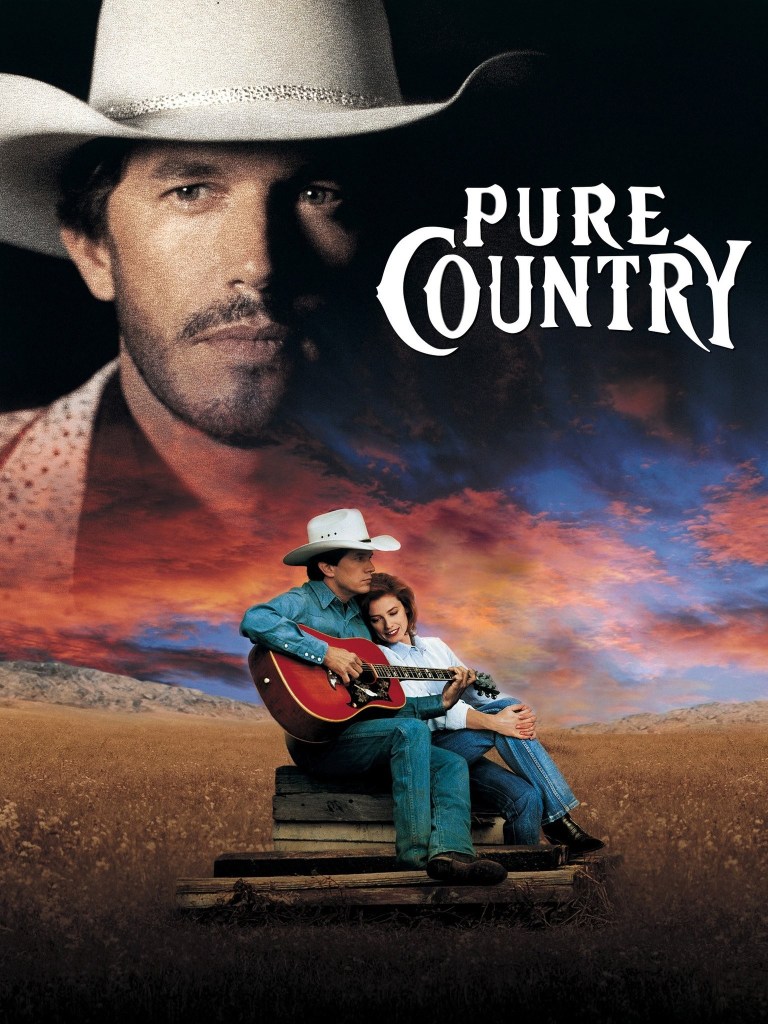
Rory Calhoun was a star of movies and TV going all the way back to the 40’s, but as a kid of the 80’s, the movies I most remember him for are not classics like HOW TO MARRY A MILLIONAIRE (1953) with Marilyn Monroe, or RIVER OF NO RETURN (1954) with Robert Mitchum. Rather, the movies I grew up watching Calhoun in have titles like ANGEL (1984), a B-movie crime thriller about a teenage hooker, and PURE COUNTRY (1992), the acting debut of country music superstar George Strait! One movie that I’ve always enjoyed, and even introduced my son to a decade or so ago, is the horror comedy MOTEL HELL (1980). My son loved it, and even though he’s married with children, whenever we’re together for the holidays he wants to know if I brought my blu ray of the film for us to watch. The amazing thing… I always have it!
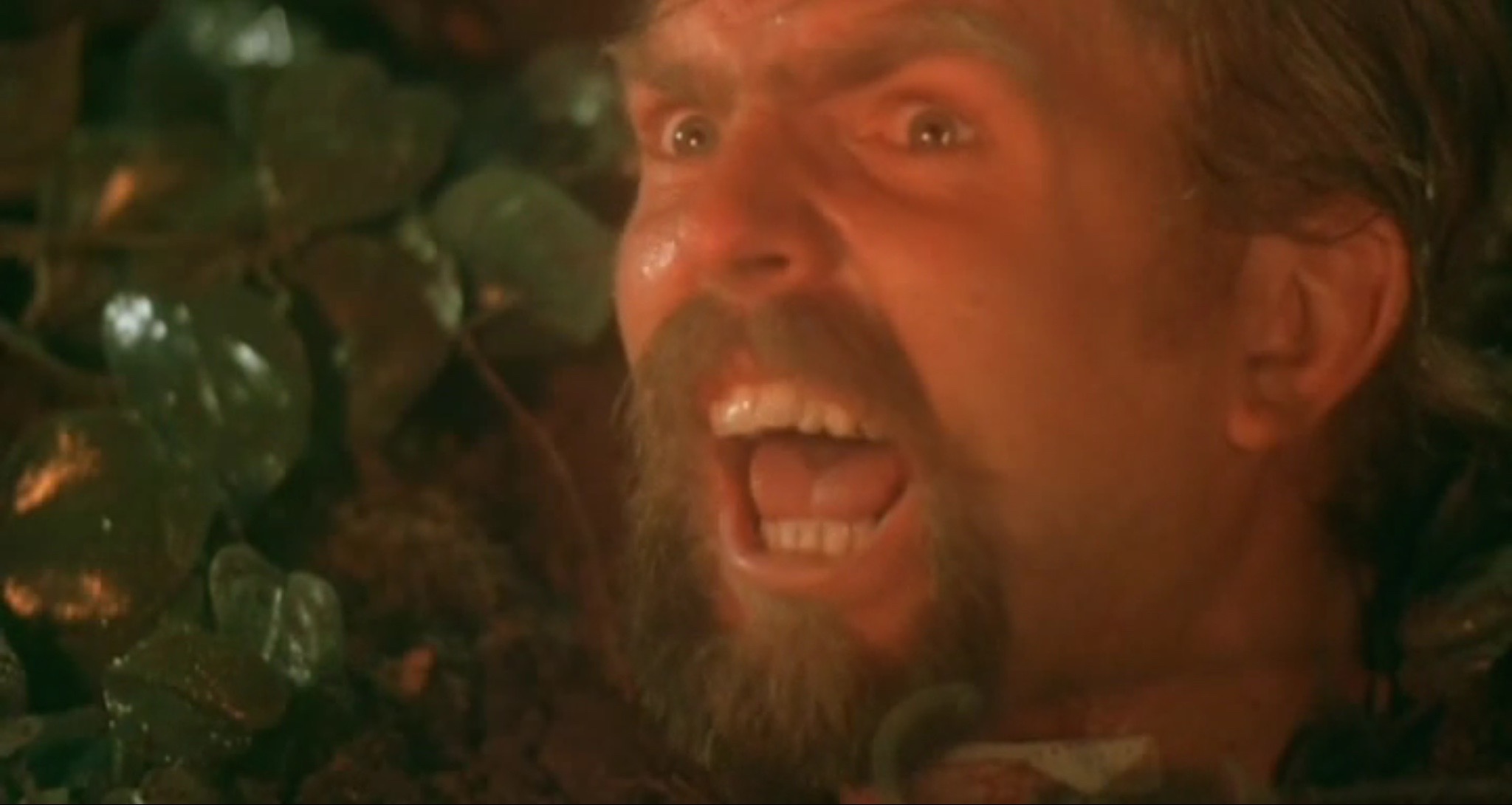
In celebration of Rory Calhoun’s 103rd birthday in cinema heaven, I present this scene of Calhoun tending to his human garden in MOTEL HELL! Enjoy, my friends.
There are certain movies I like that I don’t ever hear anyone else talk about. PURE COUNTRY, starring country music legend George Strait, is such a movie. As you might imagine, it has a great soundtrack. I remember singing one of its songs, “I Cross My Heart,” at a co-worker’s wedding in the summer of 1993. I butchered the hell out of it. It does make me wonder if they’re still married. I haven’t seen that person in close to 30 years, so I’d say it’s a 50/50 proposition. I also remember really liking a song called “Heartland,” another called “When Did You Stop Loving Me,” and another called “Where the Sidewalk Ends.”
I’m a sucker for romance movies, and one of my favorite types of romance movies is where a famous person falls in love with a regular person. In PURE COUNTRY, George Strait is Dusty, a huge country music star who’s tired of the loud music and the big special effects that have come to define his shows. He longs to get back to his roots and just grab his guitar and sing. Unfortunately, his longtime friend and manager Lula (Lesley Ann Warren) isn’t ready to scale down the show since they’re playing to 20,000 fans at every concert. So, after a show one night, Dusty heads out for a walk and doesn’t stop. He does stop by a barber shop where they cut his Steven Seagal ponytail and shave his scruffy beard. Then he heads to an old honkytonk he used to play at when he was in college and reminisces on the good old days. After having a few too many adult beverages, he starts smiling at the lovely Harley Tucker (Isabel Glasser) who doesn’t recognize him as the superstar Dusty. One thing leads to another and he ends up trying to defend her honor from this big obnoxious guy who won’t take no for an answer. A drunk Dusty is no match for the big jerk, and he ends up getting the crap beaten out of him. Thankful that he tried to defend her honor and that he’s cute, Harley takes him to her house to try to mend his wounds. Dusty’s not ready to resume his life as a megastar so he gives Harley his middle name, which is Wyatt. I really like Harley’s family. Her brothers are a couple of dorks, but they love their sister. Her grandpa is played by Rory Calhoun!!! I love Rory Calhoun going back to his westerns in the 40’s and 50’s. And thus begins a fun romance movie where he’s a huge star, and she thinks he’s a regular guy. Of course there will be complications along the way, and the truth will eventually be exposed, but the fun is seeing how it all plays out.
What about George Strait’s acting you might ask? Well, Strait isn’t a very good actor, but that doesn’t keep me from enjoying the film. I do like the way he tells the arrogant Buddy Jackson (Kyle Chandler), “Get your ass outta here!” in one of the scenes. He even repeats it just as well! It’s an important scene and he rises to the occasion. All in all, Strait’s good enough and he’s got the fact that he’s George Strait going in his favor. If you read this and like PURE COUNTRY, please take the time to leave me a comment. I’m looking for other fans. It gets lonely out here!
Welcome to Retro Television Reviews, a new feature where we review some of our favorite and least favorite shows of the past! On Fridays, I will be reviewing Half Nelson, which ran on NBC from March to May of 1985. Almost all nine of the show’s episodes can be found on YouTube!
The year was 1985 and actor/singer Joe Pesci was at an interesting place in his film career.
In 1980, Joe Pesci was nominated for Best Supporting Actor for his performance as Robert De Niro’s brother in Raging Bull. Raging Bull was Pesci’s second film and he earned critical acclaim for his performance as the second most angry member of the LaMotta family. In the years immediately following his first Oscar nomination, Pesci went on to play character roles in a handful of other films, including Dear Mr. Wonderful, Easy Money,Once Upon A Time In America, and Eureka. While no one could deny Pesci’s talent or his unique screen presence, it was also obvious that Hollywood wasn’t quite sure what to do with him. While Pesci was apparently high on everyone’s list when it came to playing gangsters with hair-trigger tempers, no one was willing to give Pesci a starring role.
Fortunately, television always has room for an Oscar nominee and, in 1985, Half Nelson came calling. Created by veteran television producers Glen A. Larson and Lou Shaw, Half Nelson was a detective show. Joe Pesci starred as Rocky Nelson, a tough New York cop who relocated to Los Angeles to pursue his acting career. While waiting for his big break, Rocky worked for Beverly Hills Security and lived in Dean Martin’s guest room. And when I say that Rocky was living in Dean Martin’s guest house, what I mean is that Dean Martin actually appeared on the show, playing himself.
NBC liked the idea enough to air the pilot film and then schedule the show as a mid-season replacement. Audiences were a bit less interested in the show and Half Nelson was canceled after only 8 weeks. Pesci went on to win an Oscar for Goodfellas and he never starred in another television show. Half Nelson would probably be forgotten if not for the fact that someone recently came across the opening credits on YouTube. When shared on Twitter, this video went viral as “the most 80s thing” ever created.
After I watched that video, I knew I simply had to review Half Nelson as soon as I finished up The Brady Bunch Hour. Fortunately, almost all of the episodes have been uploaded to YouTube so, for the next few weeks, I’ll be taking a look at HalfNelson, starring Joe Pesci!
Episodes 1 & 2 “The Pilot”
(Dir by Bruce Bilson, originally aired on March 24th, 1985)
Half Nelson begins in New York City, with NYPD’s finest, Detective Rocky Nelson (Joe Pesci), disguising himself as a waiter and sneaking into a mafia-owned restaurant. After punching out two guards, Rocky enters a backroom and discovers a group of guys with a lot of heroin. Rocky arrests them and becomes a hero. As Rocky explains in a voice-over, it’s the biggest drug bust in history. When Hollywood asks for the rights to the story, Rocky insists that he be allowed to audition for the lead role. Rocky quits the NYPD and heads out to Los Angeles. Rocky’s going to be a star!
And, at first, it seems like Rocky’s dream might actually come true. The film’s director (played by the veteran TV character actor, George Wyner) watches Rocky’s audition and announces that Rocky has the screen presence and talent of Al Pacino. Unfortunately, Rocky is also only 5’3. “You’re too short to play Rocky Nelson,” the director explains.
“But I am Rocky Nelson!” Rocky exclaims.
Despite the fact that Rocky’s telling the truth, it doesn’t matter. A tall British actor is cast in the film. As a dejected Rocky leaves the audition, he’s approached by a security guard who offers Rocky a job with Beverly Hills Patrol, a private security firm. Rocky’s skeptical until the security guard mentions that Rocky will get to live in Dean Martin’s guest house.
We jump forward six months. Rocky is now a trusted employee of Beverly Hills Patrol. When he’s not working as a bodyguard, he’s auditioning for roles. At the office, his boss is Chester (Fred Williamson) and the office manager is Annie O’Hara (Victoria Jackson). Chester is cool and all-business. Annie is flighty and has an obvious crush on Rocky. She also gives Rocky a pit bull named Hunk. Hunk is very loyal but also very quick to attack anyone who isn’t Rocky. I don’t know if a show could get away with a comic relief pit bull today but whatever. Hunk is a cute dog with a ferocious bark.
In just six months, Rocky has become surprisingly well-known in L.A. Some of that might be because he lives with Dean Martin. Martin appears in three scenes of the pilot and, to be honest, he definitely looks and sounds a bit worse for wear. Half Nelson was Dean’s final acting role. (He died ten years after the show was canceled.) But even though Dean was clearly not in the best shape when he appeared in the pilot, his natural charisma still shines through and there’s a lot of pleasure to be found in his scenes with Joe Pesci. For one thing, Pesci himself seems to be genuinely excited about acting opposite Martin.
Along with becoming friends with Dean Martin, Rocky has also befriended Parsons (George Kennedy), a Los Angeles police chief who is eager for Rocky to quit the Beverly Hills Patrol and to join the LAPD. Rocky turns down the offer, however. Rocky is done with police work. He’s going to be a star!
Of course, he’ll also find time to solve some crimes along the way.
For instance, in the pilot, Rocky investigates the death of his best friend and co-worker, Jerry (Nicholas Surovy). Parsons insists that all the evidence shows that Jerry murdered his girlfriend, Monika (Morgan Brittany), and then shot himself. However, Rocky doesn’t think Jerry would do something like that. When Jerry’s father (veteran screen actor Rory Calhoun) asks Rocky to find the people who killed his son, Rocky doesn’t have to be asked twice.
It turns out that Jerry and Monika were taking money from a tabloid magazine publisher (Terry Kiser). They had a video tape that would have been very embarrassing to some prominent Angelinos, including a businessman (Rod Taylor), a restauranter (Tony Curtis), a general (Mills Watson), an astronaut (Gary Lockwood), and a television executive (Bernie Kopell). Rocky assumes that the people on the tape ordered the murders but then he learns that, while the general did send two government agents to find the tape, he also made clear that no one was supposed to be killed. Instead, someone else who wanted the tapes committed the murders on his own.
Searching for the killer means that Rocky will have to assume many disguises and show off his acting skills. As an actor, he’s able to wander into the local movie studio and not only raid their wardrobe department but also borrow their cars. Over the course of the film, Rocky disguses himself as both a cowboy and a traffic cop. He also drives a Ferrari, a Cadillac, a jeep, a motorcycle, and KITT, the talking car from Knight Rider. (KITT, unfortunately, does not talk in Half Nelson.) On the one hand, the use of disguises is a little bit silly because Joe Pesci is always going to be Joe Pesci regardless of what costume he is wearing. The pilot’s silliest scene involves Rocky dressed up like a cop to confront two men who have been following him. Somehow, they fail to pick up on the fact that the 5’3 cop with the New York accent is the same 5’3 New Yorker who they’ve been tailing for the last few days. And yet, it’s one of those things that’s so ludicrous that you can’t help but think that the show was showing a bit of self-awareness and commenting on just how ludicrous most television shows tend to be.
Eventually, Rocky figures out that the killer is …. SPOILER ALERT …. Parsons! That’s right. The same police chief who kept offering Rocky a job with the LAPD turned out to be the murderer for whom Rocky was looking. What’s interesting is that, after realizing that Parsons is the killers, Rocky doesn’t arrest Parsons or attack him or do any of the other things that a typical TV detective might. And Parsons doesn’t try to flee or fight. Instead, the two men take a leisurely drive and talk about life, morality, and regret. Parsons talks about how he was once an honest cop but Los Angeles corrupted him. Rocky expresses some sympathy and says that he hates that he discovered that Parsons was the murderer. It’s a well-acted and surprisingly well-written scene. When Rocky asks Parsons about the murders, Parsons replies, “I had to empty my gun, just to drown out their screams.” (Yikes!) Parsons lets Rocky out of the car and tells him, “Don’t let them get to you, kid.” Parsons then drives the car over a cliff as Roberta and Chester (who have been tailing Parsons) run up to Rocky.
“Hard to believe that a man like that would kill himself!” Roberta says.
“That’s just the funeral,” Rocky replies as Parsons car explodes, “He died a long time ago.”
Wow, that’s dark! Fortunately, the mood is lightened during the show’s final scene, in which Rocky’s pit bull attacks boxer Larry Holmes.
The pilot for Half Nelson was nicely done. It set up the series and it gave us an introduction to the characters, which is exactly what a pilot is supposed to do. The cast showed off their chemistry and the final scene between Parsons and Rocky indicated that the show had the potential to be something more than just another mid-80s detective show. The pilot’s greatest strength, not surprisingly, was Joe Pesci. Pesci has played so many mobsters and crooked lawyers that it’s easy to forget what a likable actor he can be. The pilot featured Pesci at his most amiable and it also gave him a chance to show off his comedic timing. All-in-all, the pilot was a success and I could understand why NBC would have ordered more episodes after watching it.
But what about the series? Would the series live up to the promise of the pilot or would it just become another generic detective show? We’ll find out over the next 8 weeks!
Fear not, they’re the same show. Apparently, Ghost Story was struggling in the ratings so William Castle changed up both the show’s format and the title. Ghost Story became Circle of Fear and, sadly, Sebastian Cabot was dumped as the show’s host.
The first episode of the new Circle of Fear era featured Janet Leigh as the wife of a man who loves insects. Unfortunately for him, Leigh hates insects. This, along with an adulterous affair, can only lead to murder and that, of course, can only lead to the moths coming for revenge.
That may sounds silly but let me tell you, I totally agree with Janet Leigh when it comes to moths. If you want to see me run out of a room, just point out that there’s a moth flying around. Agck!
This episode originally aired on January 5th, 1973.
There’s really only one lesson to be learned from the 1972’s Night of the Lepus.
There is absolutely no way to make a rabbit look menacing.
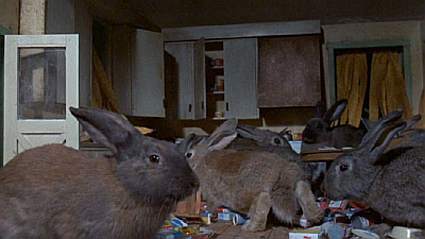
Oh sure, you can film them in slow motion. And you can add a lot of weird sound effects and you can do a lot of extreme close-ups to make them look bigger than they actually are. You can do a lot of stuff as a part of your effort to make a rabbit into a scary monster but you’ll pretty much be wasting you time. Rabbits are simply not intimidating. There’s a reason why the idea of a killer rabbit was so funny in Monty Python and The Holy Grail.
Now, don’t get me wrong. I’m enough of country girl that I know the damage that wild rabbits can do. They eat crops. They eat bark. They chew on irrigations lines. If you’re a farmer or even just someone who wants to maintain a nice garden, you know that rabbits can be a nuisance.
However, that doesn’t change the fact that there’s nothing really menacing rabbits. Rabbits are cute and, for the most part, they’re fairly timid. They’re aware that, in the brutal world of nature, they’re designated prey and, as a result, they try to stay out of the way. Rabbits are shy and they hop around and there’s absolutely nothing frightening about them.
(We actually have quite a few rabbits in my neighborhood. It’s not unusual for me to see one hopping through the front yard. Whenever I go for a run in the early evening hours, it’s not unusual for me to see several rabbits hopping through a nearby park.)
Night of the Lepus is a strange film that attempts to make rabbits frightening. It takes place in the southwest and it features a bunch of mutated, giant rabbits who hop around the desert in slow motion and who savagely kill everyone that they meet. The plot makes it sound like a spoof but Night of the Lepus takes itself very seriously, which needless to say is a mistake. It even opens with documentary footage that’s designed to make sure that we understand that rabbits are actually very dangerous. It’s all very odd and you have to wonder why, out of all the wild animals in the southwest, the filmmakers decided to go with the least intimidating creature possible. I mean, there are coyotes and Gila monsters in the desert. Imagine having a giant coyote coming at you. That would be scary!
Instead, we get giant rabbits, attacking a cast of actors who definitely deserved better. Stuart Whitman, Janet Leigh, Rory Calhoun, DeForest Kelly, they’re all talented actors and, in this film, they’re reduced to fighting a bunch of giant rabbits. No one comes across particularly well, though just about everyone in the cast does manage to keep a straight face. Still, the problem is that the rabbits are just too damn cute. Even after they’ve killed half the cast, you still don’t want anything to happen to them. When Whitman and Calhoun opened fire on a group of rabbits and killed a few of them, I actually found myself getting mad at the humans. Leave the rabbits alone! I thought. You humans have had your chance! This the land of rabbits now!
Anyway, Night of the Lepus is silly but it’s kind of fun, just because the giant rabbits are cute. They’re kind of like the giant guinea pigs that attacked South Park a few seasons ago. They’re murderous but they’re adorable!
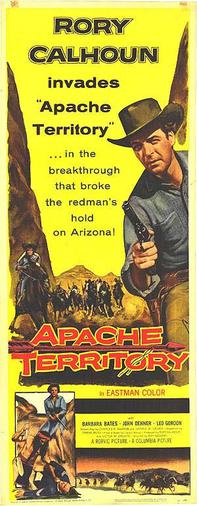
In this B-western, Rory Calhoun plays Logan Cates, an old west drifter, while traveling through the desert, comes across a young woman named Junie Hatchett (Carolyn Craig). Junie’s parents were settlers who were captured and killed by a group of Apaches. Knowing that the Apaches will still be looking Junie, Logan takes her to a nearby canyon where there’s water and shelter. Soon, other victims of the Apaches start to show up at the canyon. With their supplies dwindling and the Apaches surrounding them, Logan has to keep everyone alive and lead them to safety.
Complicating matters is that one of the people who shows up at the canyon is Logan’s ex-girlfriend, Jennifer (Barbara Bates). Jennifer is traveling with her new husband, the wealthy (and therefore cowardly) Grant Kimbrough (John Dehner). Also seeking shelter at the canyon are a group of Calvary officers, a Pima Indian named Lugo (Frank DeKova), and a naive teenage cowboy named Lonnie (Tom Pittman).
Based on a novel by Louis L’Amour, Apache Territory is a pretty standard western. Some of the battle scenes are surprisingly brutal — particularly when one of the Calvary officers gets hit by a flaming arrow — but otherwise, this is a typical B-western, the type of movie that would have been the second part of a double bill at a Saturday matinee. Logan Cates is able to survive because, unlike Grant Kimbrough, he knows and respects the land and, unlike the Calvary officers, he respects his enemy. He’s a typical western hero, though well-played by Rory Calhoun.
The main problem with the film is that, for a film about a group of people trapped in one location, it never achieves any sense of claustrophobia. The size of the canyon seems to change from shot to shot. The film’s finale involves a well-realized dust storm but it still never reaches the type of action-packed conclusion that most western fans will be hoping for. It ends with a whimper instead of a bang. It feels more like an extended episode of Gunsmoke or The Virginian than a feature film.
This one will be best appreciated by undemanding fans of the genre.
I recorded this 1961 Italian film off of TCM on June 14th!
From 280 BC to 226 BC, a 108 feet high statue of the sun-god Helios stood in the Greek city of Rhodes. It was reportedly built to celebrate a major military victory and it overlooked the harbor, serving to both welcome friends and intimidate enemies. No one’s quite sure what it actually looked like but we do know that it was considered, by its contemporaries, to be one of the Seven Wonders of the World. No trip to Greece was complete without a stopover in Rhodes so that the curious could feast their eyes upon the Colossus. Eventually, the statue was destroyed in an earthquake and it was never rebuilt.
The statue serves as the centerpiece for the aptly named 1961 film, The Colossus of Rhodes. The film opens with its dedication and ends with the earthquake that toppled it. (Of course, in the film, the earthquake occurs just a week or two after the dedication.) The film imagines that the Colossus was not just a monument to a God. No, instead, this film suggests that the Colossus was an elaborate torture chamber, one that could pour fire down on anyone trying to sail underneath it. Inside the Colossus is an elaborate labyrinth of dungeons, where anyone who has displeased the king is punished.
And, indeed, quite a few people have displeased the king. King Serse (Roberto Camardiel), it turns out, is a mad tyrant who spends all of his days eating grapes and having people executed in the coliseum. (He’s like Nero but without the artistic temperament.) Not only do the rebels want him dead but so does his evil second-in-command, Thar (Conrado San Martin). With the people angry that they’ve been forced to build a giant statue for no reason other than their king’s vanity, it seems like a perfect time for a revolution!
Caught in the middle of it all is Darios (Rory Calhoun). Darios is from Athens and the only reason he came to Rhodes was to visit his uncle and see the statue. At first, Darios is more interested in trying to get laid than the revolution. When that doesn’t quite work out, Darios tries to leave the island, just to discover that, thanks to the Colossus, escape is impossible. When Darios is accused of being a supporter of the revolution, he has no choice but to take up arms against Serse, which is exactly what Thar wants him to do…
The plot’s is more than a little convoluted and Darios is never the most sympathetic of heroes but The Colossus of Rhodes is still an enjoyable example of the peplum genre. Though the acting is frequently stiff, the film is visually impressive, with both the Colossus and ancient Rhodes brought to wonderfully decadent life. The idea that the Colossus was actually just an elaborate torture chamber is handled well and the frequent battle scenes are well-choreographed. (I was particularly impressed with a scene of Darios fighting off an army while also trying to maintain his balance on the Colossus’s arm.) And, of course, the climatic earthquake is as grandly operatic as you would hope. Say what you will about the Italian film industry, it always delivered what audiences wanted.
That said, the main reason that The Colossus of Rhodes is known today is because it was the Sergio Leone’s first directorial credit. (It was, however, the second film that he actually directed. Though uncredited, he previously replaced Mario Bonnard as the director of 1959’s The Last Days of Pompeii.) While The Colossus of Rhodes was obviously very different from the spaghetti westerns for which Leone is best known, there are some thematic similarities between the film and Leone’s future work:
For instance, much like Clint Eastwood in the Dollars Trilogy, Charles Bronson in Once Upon A Time In The West, and the gangsters in Once Upon A Time In America, Darios starts out as an amoral hero. When Darios does join the revolution, it’s reminiscent of James Coburn aiding Rod Steiger in Duck, You Sucker.
The corrupt and greedy Serse has much in common with the crooked land barons and businessmen who lurked behind-the-scenes in Once Upon A Time In The West.
Even the torture chamber in the Colossus brought to mind the grisly torments that both Clint Eastwood and Eli Wallach had to endure in The Good, The Bad, and The Ugly.
(Unfortunately, unlike other Leone films, Ennio Morricone did not provide the score for The Colossus of Rhodes. Instead, Angelo Francesco Lavagnino provided a rather standard “epic” orchestration.)
The Colossus of Rhodes may not be a great film but, as an early work of a great filmmaker, it’s definitely worth watching.
With the Trancers series done, I’ve decided to move onto the Angel series. I honestly had no idea what I was in for here. The box art appears to have a 12 year-old on the cover once as “High School Honor Student by day,” and then “Hollywood Hooker by night.” The DVD has the first three films on it. I’m quite sure that the girl on the cover is neither Donna Wilkes, Betsy Russell, or Mitzi Kapture.
Anyways, as I watched it, I knew this movie reminded me of a film I saw late last year. It took me some time because this movie is so subtle about it. Then it came to me. That movie of course being Crackdown Mission (1988).
Crackdown Mission (1988, dir. Godfrey Ho)
Why not? Might as well have been. That’s the Godfrey Ho movie where he spliced Pierre Kirby into the Taiwanese film Girl with a Gun (1982).
Girl with a Gun (1982, dir. Yao-Chi Chen)
Girl with a Gun was a Taiwanese remake of Ms. 45 (1981).
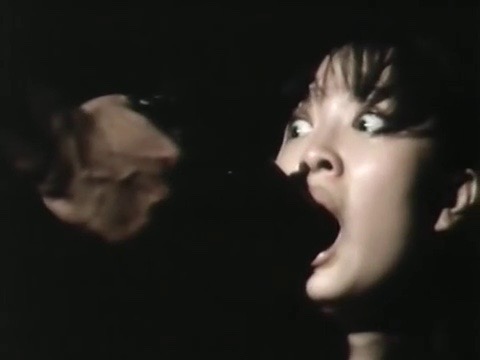
Ms. 45 (1981, dir. Abel Ferrara)
Ms. 45 being Abel Ferrara’s reworking of Death Wish (1974).
Death Wish (1974, dir. Michael Winner)
Death Wish arguably getting the pivotal opening rape from A Clockwork Orange (1971).
A Clockwork Orange (1971, dir. Stanley Kubrick)
You can go on and on with this. There’s also Rape Squad (1974), Fighting Back (1982), the Death Wish sequels, and so many more of these things. Heck, Death Wish even got a porno version called Sex Wish (1976). We even got the kiddie version, as I recall, of this same thing one year after Angel with The Legend of Billie Jean (1985).
If I got Gary on the line, he could probably take me back even further with movies like Something Wild (1961) or other films I don’t recall. Don’t need to though because this movie takes you back about as far as you can go anyways.
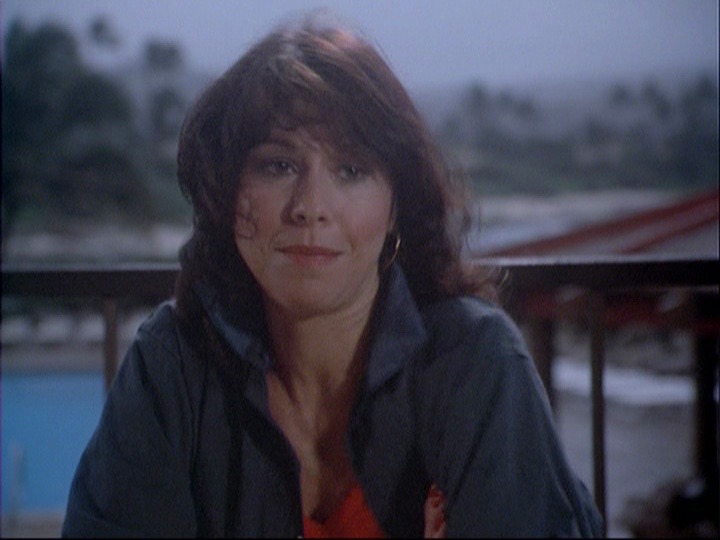
The movie opens up and we meet our lead character Angel, played by Donna Wilkes–and what the hell is that?
I would say that Donna Wilkes playing a 15 year-old at the age of 23 was a product of sleazy 80s movies, but I’d be lying through my teeth because of this.
The Poor Little Rich Girl (1917, dir. Maurice Tourneur)
Mary Pickford was 24 when she played the role of a little girl.
As for the child prostitute bit, let’s get that out of the way too because it goes back almost as far as well.
Baby Face (1933, dir. Alfred E. Green)
That’s the scene where we find out her father has been pimping her out since she was 14 years old. Barbara Stanwyck was 25 when she did Baby Face.
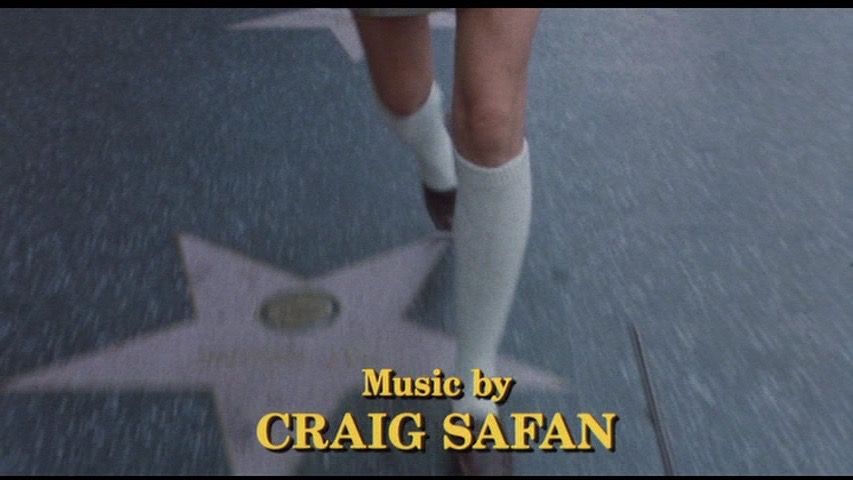
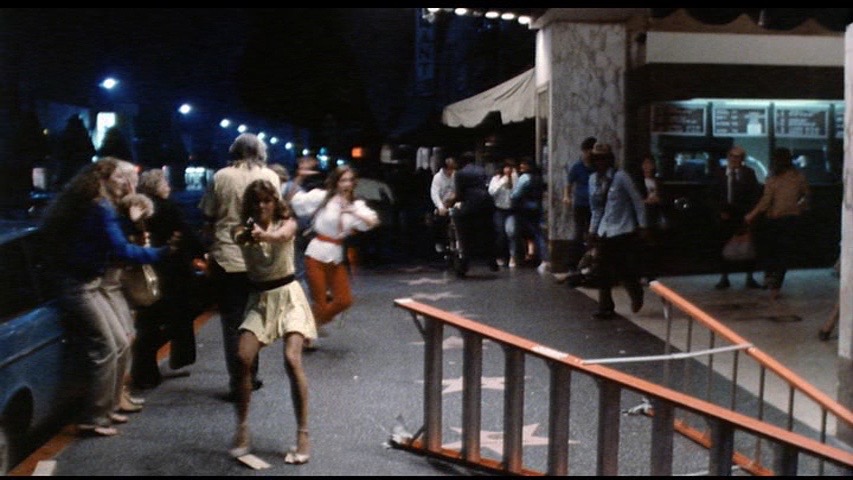
After seeing Angel come out of where she lives, we see her walk part of the Hollywood Walk of Fame.
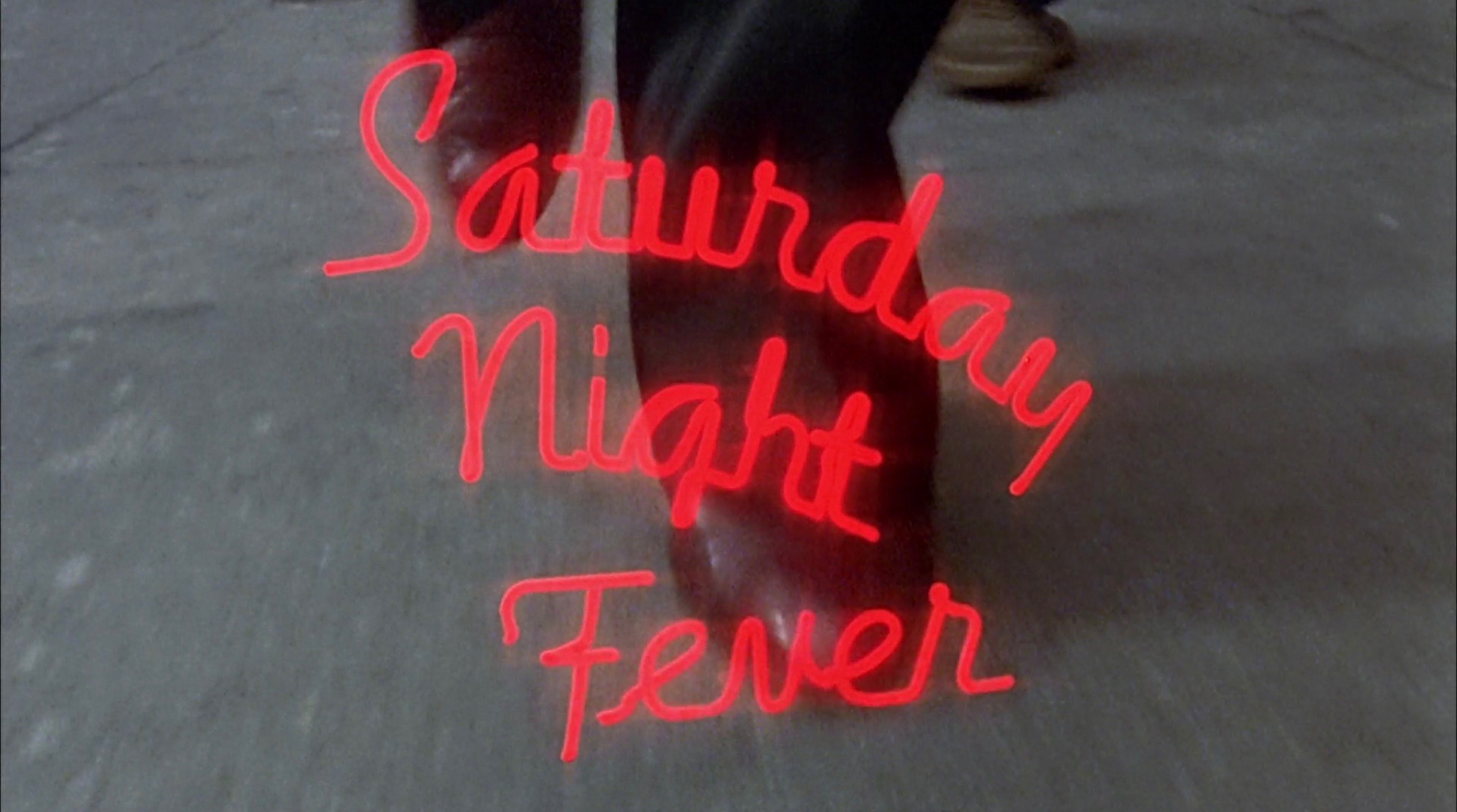
Along with these shots of her feet, we also see her say hi to some people cleaning Rex Allen’s star, fix her hair in a window, and then board a school bus. The music plays sad and tragic. It’s hardly upbeat, but was this meant to be a Saturday Night Fever reference? As I recall, Tony Manero is a similar character to Angel.
Saturday Night Fever (1977, dir. John Badham)
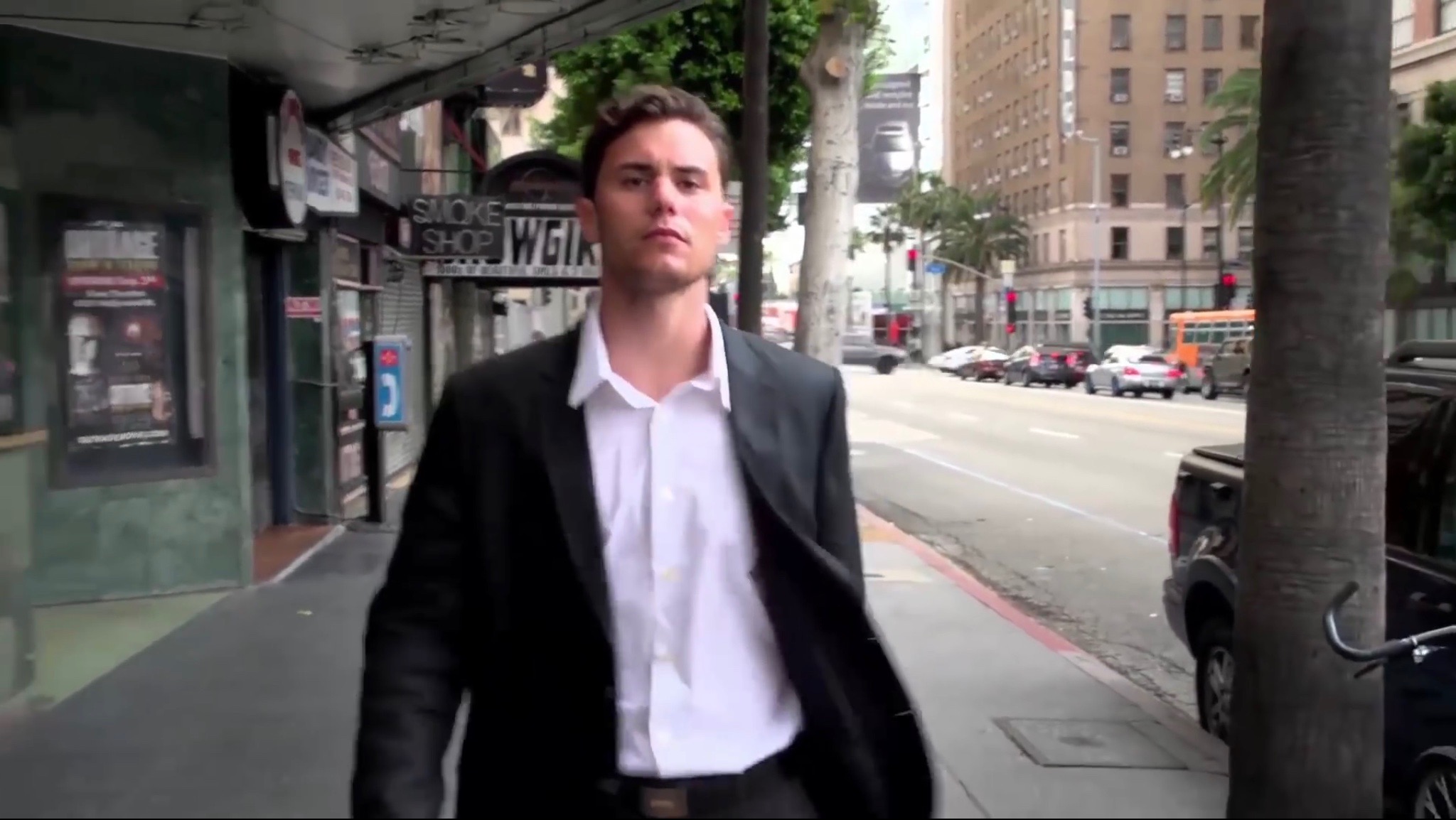
I would say that I wasn’t really sure, but considering the opening walk in Birdemic 2 was intended to be a Saturday Night Fever reference,…
Birdemic 2: The Resurrection (2013, dir. James Nguyen)
then I think I am safe saying it is a reference to that movie.
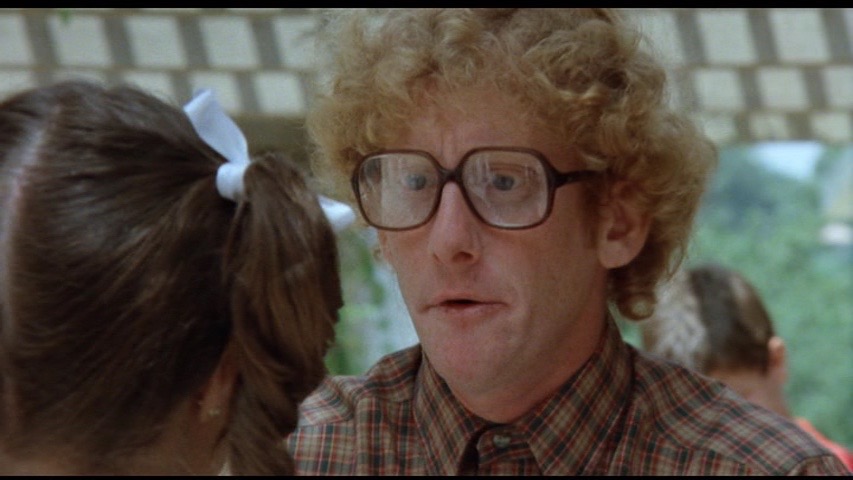
After getting her homework assignment, we meet this guy…
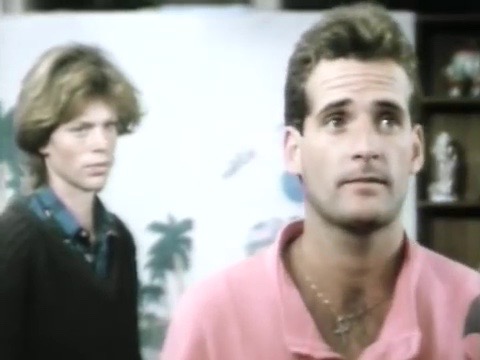
who looks like he got lost on his way to the Revenge of the Nerds (1984) set. He is here to make it clear that Angel is more mature than her age, but that she is keeping up the illusion that she is still very much a little girl. He tries to ask her out, but she turns him down saying her mother doesn’t like her dating. Now without any time wasted, we cut to home, she dolls up, and we’re out to the streets within the first 8 minutes of the movie.
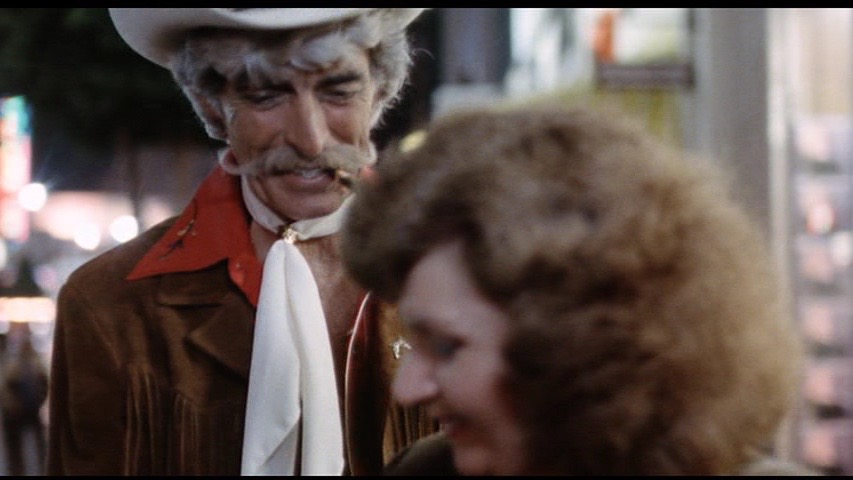
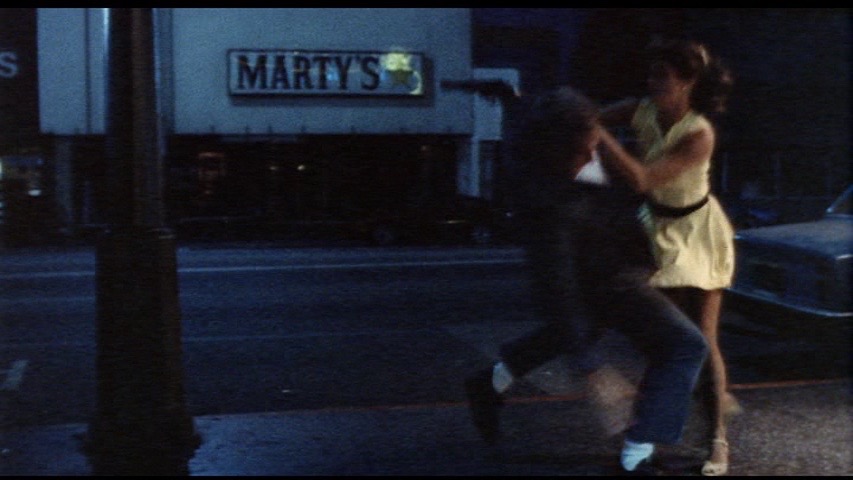
We immediately meet Kit Carson played by Rory Calhoun probably because Bill Williams, who played Kit Carson on TV, had stopped acting in 1981 after making Night of the Zombies (1981) and Goldie and the Boxer Go to Hollywood (1981). Given the titles, and that they starred porn star Jamie Gillis and O.J. Simpson respectively, I’m sure Bill would have done this movie if he could have. Rory Calhoun will be our reference to silent era cowboys for the movie. In particular, Tom Mix. Yes, he brings up Tom Mix so we are sure to get the reference. He also wears the white hat.
You got this so far? Donna Wilkes is Mary Pickford and Rory Calhoun is Tom Mix. Who’s next?
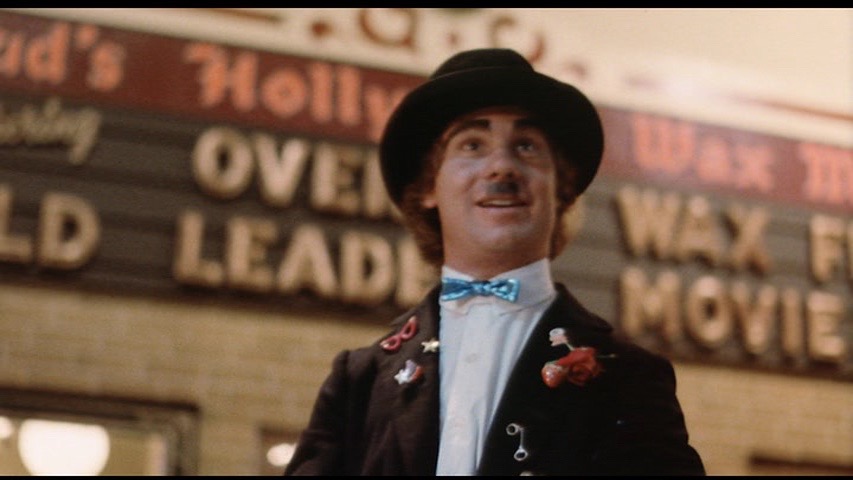
Charlie Chaplin of course!
I believe the movie wants these portions of the film to blur the lines between people peddling sex, and other people peddling Old Hollywood nostalgia. All of this going on while walking on stars for people who are dead, long forgotten, live far from this seedy place, or are going out on sad ends to their careers in their old age.
We see a variety of other colorful characters too. The movie makes sure we hear Kit tell the cops that he has fake bullets in his guns for foreshadowing purposes. A guy who looks like Jim Varney tries to hit on her. Then after turning down one guy, we see Angel riding with a much older guy. However, she sees right through him and figures out he’s a cop. That’s when we meet the another main character of the film named Mae played by Dick Shawn. How are we introduced to him?
He tells Angel not to let “fatso go yet”, sticks his head in the window, and tells him, “Why don’t you go home now and spank your monkey numb nuts!” That way know right off the bat that he is very protective of Angel.
Next we are introduced to Lt. Andrews…
played by none other than Cliff Gorman. Emory from The Boys in the Band (1970).
The Boys in the Band (1970, dir. William Friedkin)
It’s no coincidence that they introduce Mae back to back with Lt. Andrews seeing as Mae and Emory are similar characters.
You want to hear something really odd? Maud Adams’ first role listed on IMDb is an uncredited appearance in The Boys in the Band.
The Boys in the Band (1970, dir. William Friedkin)
The odd part is that Maud Adams is the villain in the third Angel movie.
Angel III: The Final Chapter (1988, dir. Tom DeSimone)
There’s one more connection here that’s worth mentioning. One of the movies Dick Shawn did in between It’s a Mad, Mad, Mad, Mad World (1963) and Penelope (1966) was a film called A Very Special Favor (1965). A Very Special Favor starring who else but Rock Hudson. The Rock Hudson movie where he actually says this.
A Very Special Favor (1965, dir. Michael Gordon)
Andrews is here to tell us about a killer on the loose who is murdering hookers. He gives us some info about him like he’s probably bisexual, a necrophiliac, and other things. Honestly, that stuff will barely play into this movie at all. It certainly won’t add anything material to the film. Now we cut to said killer played by John Diehl.
Most people probably remember him from Miami Vice. I’ve never watched the show though. I know, tsk tsk to me. He plays every serial killer from every 80s and early 90s movie ever made that had such a character in it. I’ll show you just how much of a stereotype he is later on. You’d think Mae was the major stereotype of the film, but it’s the killer.
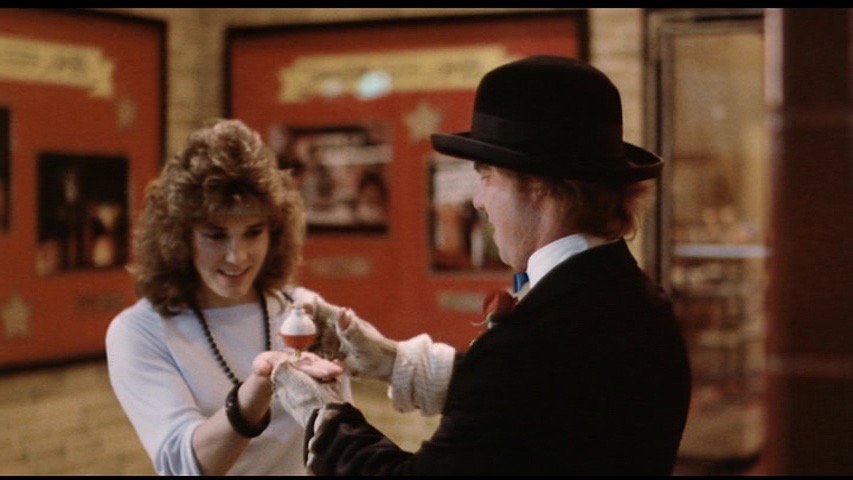
Now we get a tender moment between Chaplin, who is called Yo-Yo Charlie (Steven M. Porter), and the soon to be dead hooker named Crystal (Donna McDaniel). According to IMDb, Yo-Yo Charlie will make a return in the sequel. That’s not good. Anyways, he gives her a spinning top, she is soon picked up literally and figuratively by the killer, and then stabbed in the back. I actually like what they did here. In any other movie her death would have started the film to be the opening kill, which also would have established there’s a killer on the loose. Here her death has meaning, still kicks off the plot, and foreshadows a much more important death later in the film that bookends this opening kill. We also have warmed up to her in the short time we have known her so the silent stab in the back actually has some bite and we feel for Charlie when he finds out she’s dead. It helps to set a different tone for the movie than a slasher film.
Then we see the killer with her body.
That will be the last time you see any reference to the necrophilia thing. It’s one of those things in here that makes me feel the movie was rushed because it will suddenly have amnesia about something that seems like it would be pretty important.
Then we cut back to the streets so we can hear Rory Calhoun drop some more names. He mentions Ken Maynard, Buck Jones, and I believe he is about to say William S. Hart when Angel sticks her finger in his back so I can make a reference to Field of Dreams (1989).
Field of Dreams (1989, dir. Phil Alden Robinson)
Field of Dreams (1989, dir. Phil Alden Robinson)
We have one final major character to be introduced to at this point. That’s why Mae and Angel go back to where they live so we can meet the landlord named Solly played by Susan Tyrrell. Mae accuses her of making the movie Truth (2015), but…
it turns out she is simply doing foreshadowing by numbers. She calls it Fruit With Gun. Mae calls it “shit.” Solly also has a gun about half the size of Angel for later plot convenience.
Now we get a couple of short scenes of Angel at home to start to reveal her background that will explain why her mother and father aren’t around. It’s also there so that we know that both Angel and the killer have troubled backgrounds when it comes to their parents. Except they have dealt with it in completely different ways, but ways that have both lead them to the streets. That’s when we get this scene.
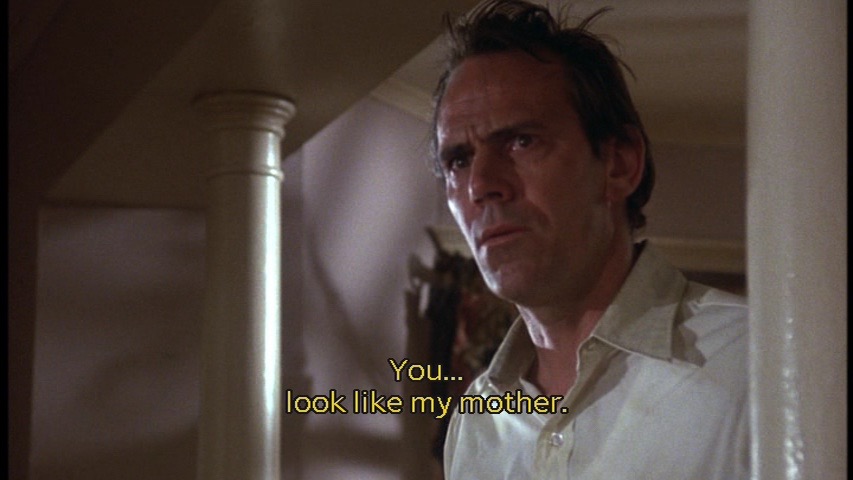
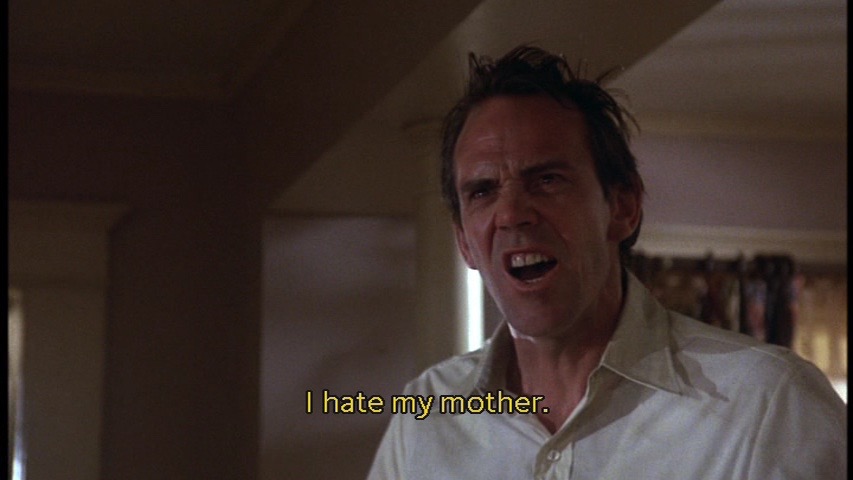
Yep, he makes out with an egg while a creepy picture of him and his mother hangs in the background till he crushes the egg, then kisses the picture. This movie came out in 1984. By 1986 they were already making fun of this exact kind of character.
Ruthless People (1986, dir. Jim Abrahams, David Zucker, & Jerry Zucker)
Ruthless People (1986, dir. Jim Abrahams, David Zucker, & Jerry Zucker)
Ruthless People (1986, dir. Jim Abrahams, David Zucker, & Jerry Zucker)
Ruthless People (1986, dir. Jim Abrahams, David Zucker, & Jerry Zucker)
Might as well be the Bedroom Killer from Ruthless People (1986).
At this point we are about 25 minutes into the movie so it’s like it all of a sudden wakes up and remembers she’s supposed to be a high school student so we better cut back there now. Sometimes there’s an actual reason, and other times it is just there to work naked ladies into the movie because they could have done the scene without having them there. This time around we meet Ric who will be our Biff Tannen for the movie except with little to no plot significance.
You might recognize actor David Underwood if you owned a Sega CD back in the day.
Sewer Shark (1992, dir. John Dykstra)
It’s a shame he didn’t overact this part like he did Ghost in Sewer Shark.
We also meet Patricia Allen played by Elaine Giftos who works for Angel’s school.
She’s here so that the film will have a way of having Angel’s secret about not having her parents around anymore come out and give the last kill an extra punch to the stomach. Throughout this movie I kept thinking I had seen her in something else. Apparently that place was a single episode of Magnum P.I.
Magnum P.I.
I’m not sure what that says about me other than I must like that show more than I thought I did.
Now we finally come around so that our characters can discover the hooker from the beginning has been murdered. Charlie is quite broken up about it. He’s even holding the top he gave her, which is now covered in blood. Mae, Angel, and Kit have a run in with Andrews about their friend being murdered. But with no wasted time at all, we are reintroduced to another unimportant hooker friend from the beginning who runs right over to the killer and leaves with him. In short order she’s dead.
We see Angel arrive with a client who has a Quebec license plate?
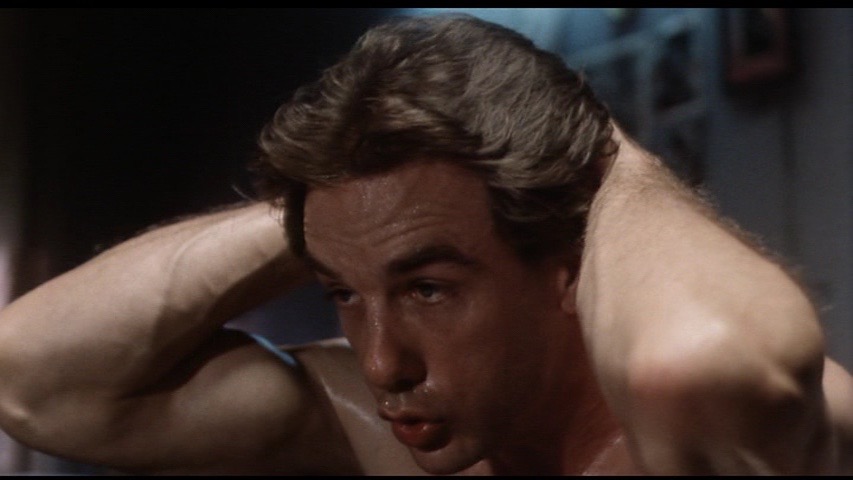
Your guess is as good as mine about that one. He finds the dead hooker, then Angel finds her too. The movie cuts to the killer bare ass naked scrubbing himself. The scene seems to go on forever. You’d think this is some sort of I need to wash myself clean thing, but just like the necrophilia bit, it doesn’t amount to anything. At times it feels like there was originally a script for this movie that didn’t include his character because he almost feels like an afterthought. That, or there was a script that did have more for his character, but was cut so this film would only get an R rating.
Now we get one of several scenes in this movie that seem to only exist to remind us that Cliff Gorman, Dick Shawn, Rory Calhoun, and Susan Tyrrell are good actors. Say what you will about the movie, Donna Wlikes, and the fact that Lisa hasn’t reviewed her comeback film 90210 Shark Attack (2014), but they surrounded her with quality.
After Angel gets harassed by Sewer Shark, we cut to the locker room to see cheerleaders getting dressed. It’s weird because it suddenly feels like you’ve slipped out of Angel and into Debbie Does Dallas (1978).
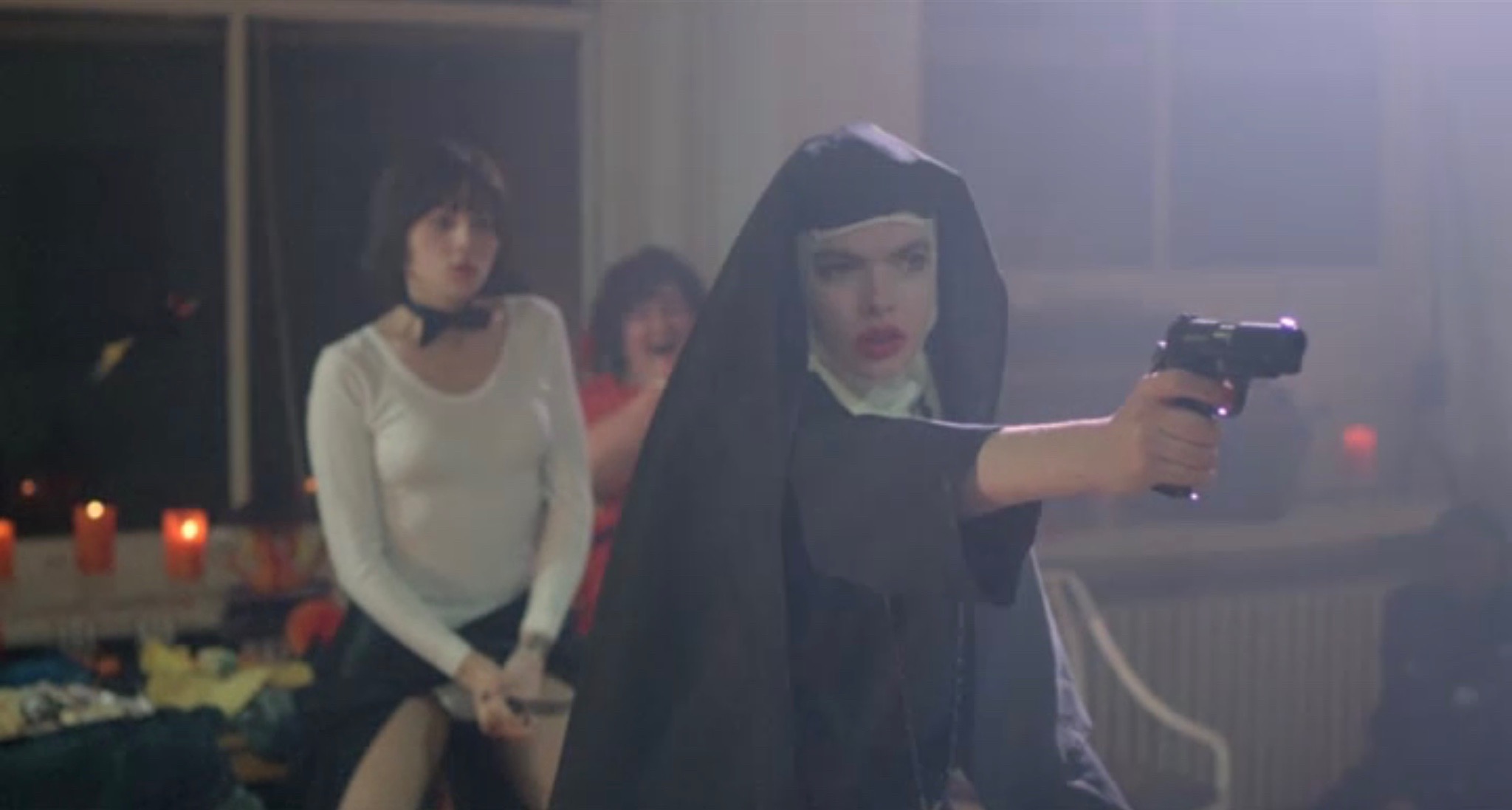
We get a scene of our killer at a porno theater to remind us that Taxi Driver (1976) exists. Would have made my day if he were watching Bat Pussy (1973). He’s arrested and brought in for a lineup so that he can break free to nearly kill Angel and Andrews. This is when the movie gets on the fast track to its conclusion. This is only at about the halfway point, but the remainder of the film will be everything unraveling till Angel is pushed past the tipping point and decides to go Ms. 45 on the streets to get the killer.
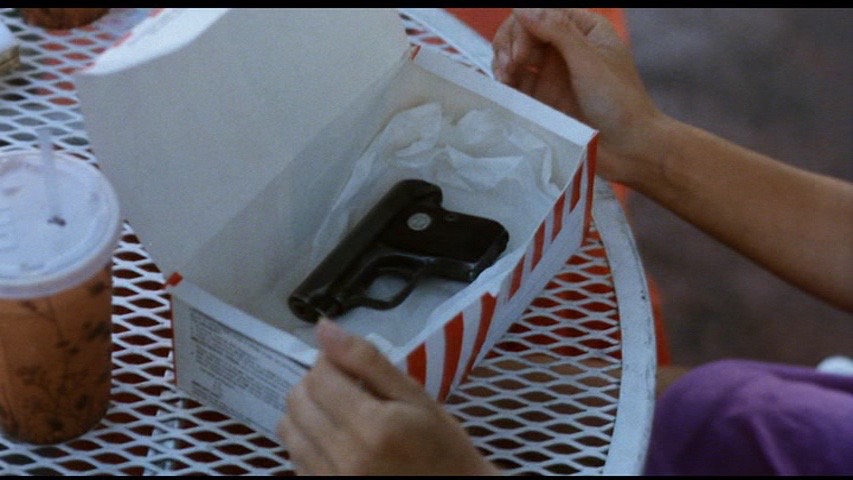
After we find out that Angel has been on the street since she was 12, the next important scene is between Mae and Angel. Angel buys a gun…
so that we can then see her visit a church and nearly drop it in the “Offerings” box. She comes close, but puts some money into it instead. Then empowering music plays as we get a long shot of her walking from the back to the front of the church.
Angel pays a visit to Kit’s place now. Not really so we can see her get a shooting lesson, but so that we can setup the ending by making us aware that Kit does indeed know how to shoot. He carries fake bullets when he works the streets, but the guns are real.
Now Angel gets kidnapped by Sewer Shark and his gang just so that we know that she not only has the gun and has been shown how to use that gun, but is willing to fire it if necessary. It’s a minor scene that doesn’t have much importance to the film in the end. Unlike the next scene when it cuts to naked women in the locker room showering. Actually this scene does serve a purpose beyond naked women. It’s there so that we can overhear that Sewer Shark has spread rumors about her, which ultimately leads Patricia to find Angel’s gun. To toss an extra cherry on top of her trauma, the Andy Dick looking guy from earlier actually tries to buy her services. It’s all enough that she now goes to Andrews to talk to him about what’s going on.
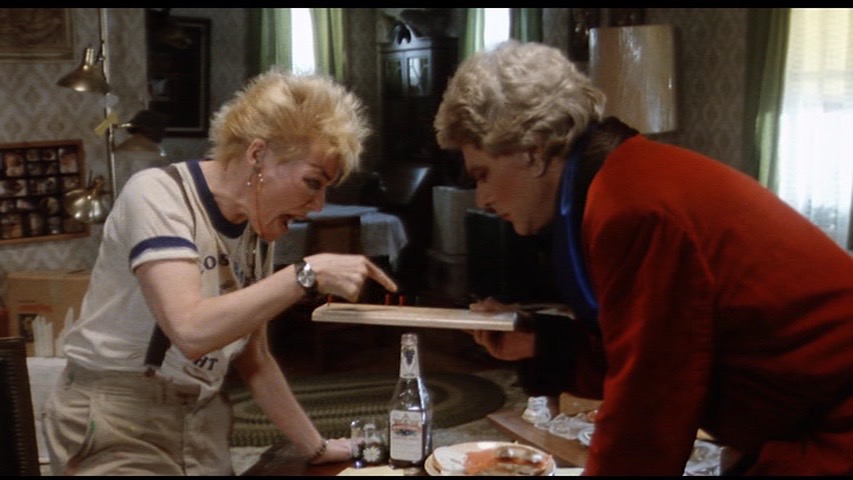
Now the film loops us back to the death of Crystal. It starts with Mae and Solly arguing over a game of cribbage like an old married couple. They are funny in this scene. Just like I could go for a TV Show made up of Bea Arthur tending bar from The Star Wars Holiday Special, I could also go for a whole movie with these two.
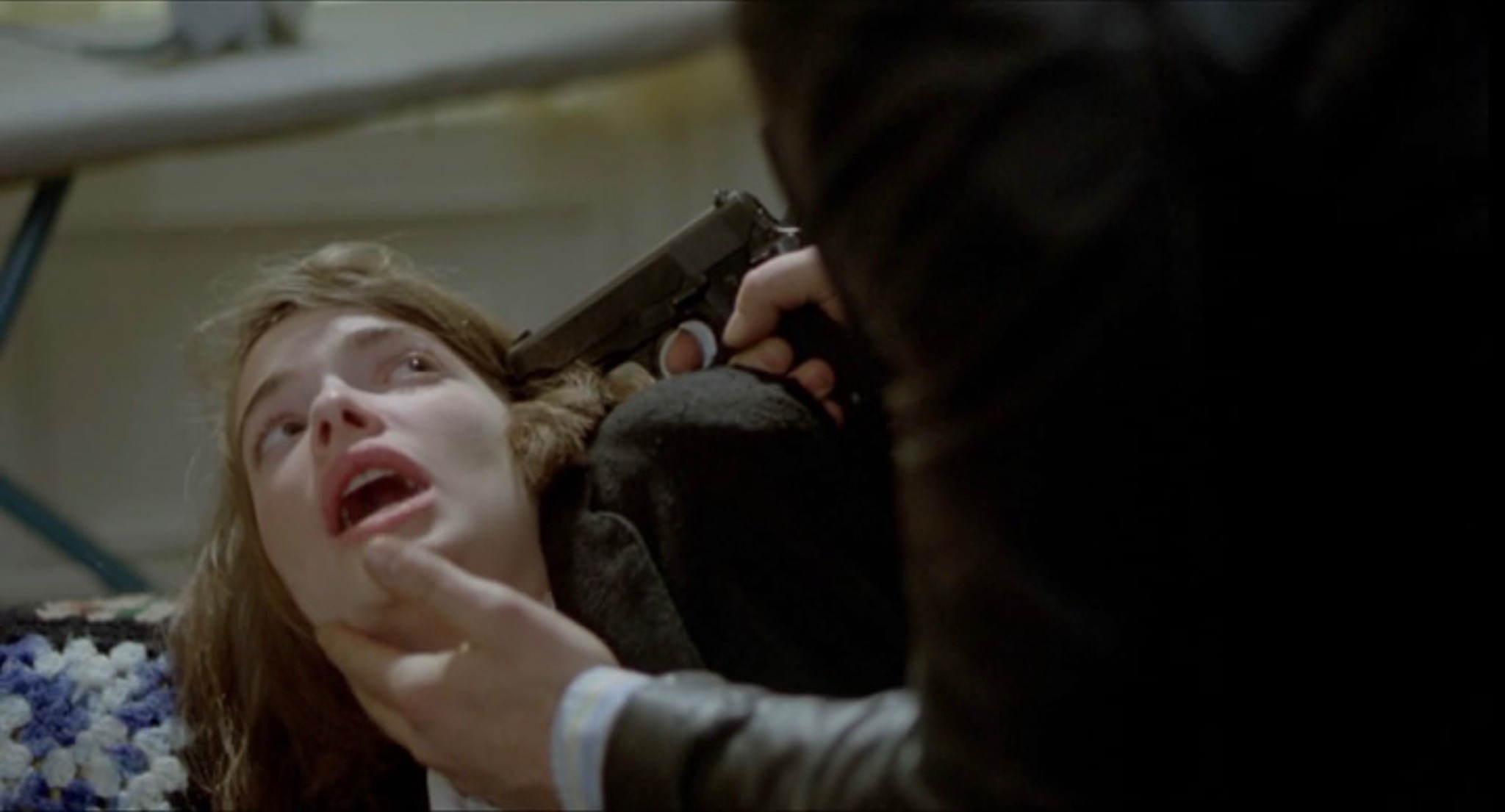
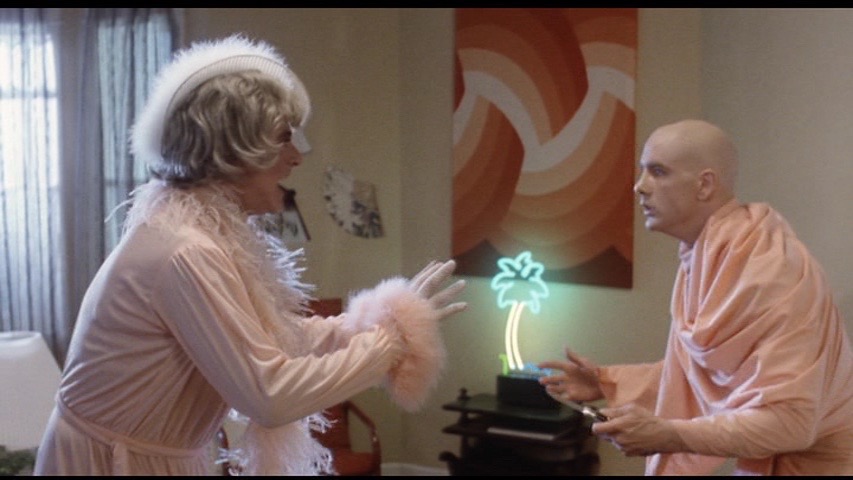
This scene is the equivalent of Charlie giving the girl his spinning top. We also get a scene where Mae tries to cover for Angel when Patricia comes to visit by pretending to be her mother. That works about as well as trying to convince the killer who now comes for Mae that it matters that he is a guy.
Look familiar?
Ms. 45 (1981, dir. Abel Ferrara)
Ms. 45 (1981, dir. Abel Ferrara)
They both die, but the difference is that they stuck in the conversation with Patricia here to remind us that Mae doesn’t deserve this whereas Ms. 45 edges in this one-sided conversation…
Ms. 45 (1981, dir. Abel Ferrara)
so that we know it’s okay that he was shot and killed. That’s most likely why we first met Mae looking like that guy in this movie.
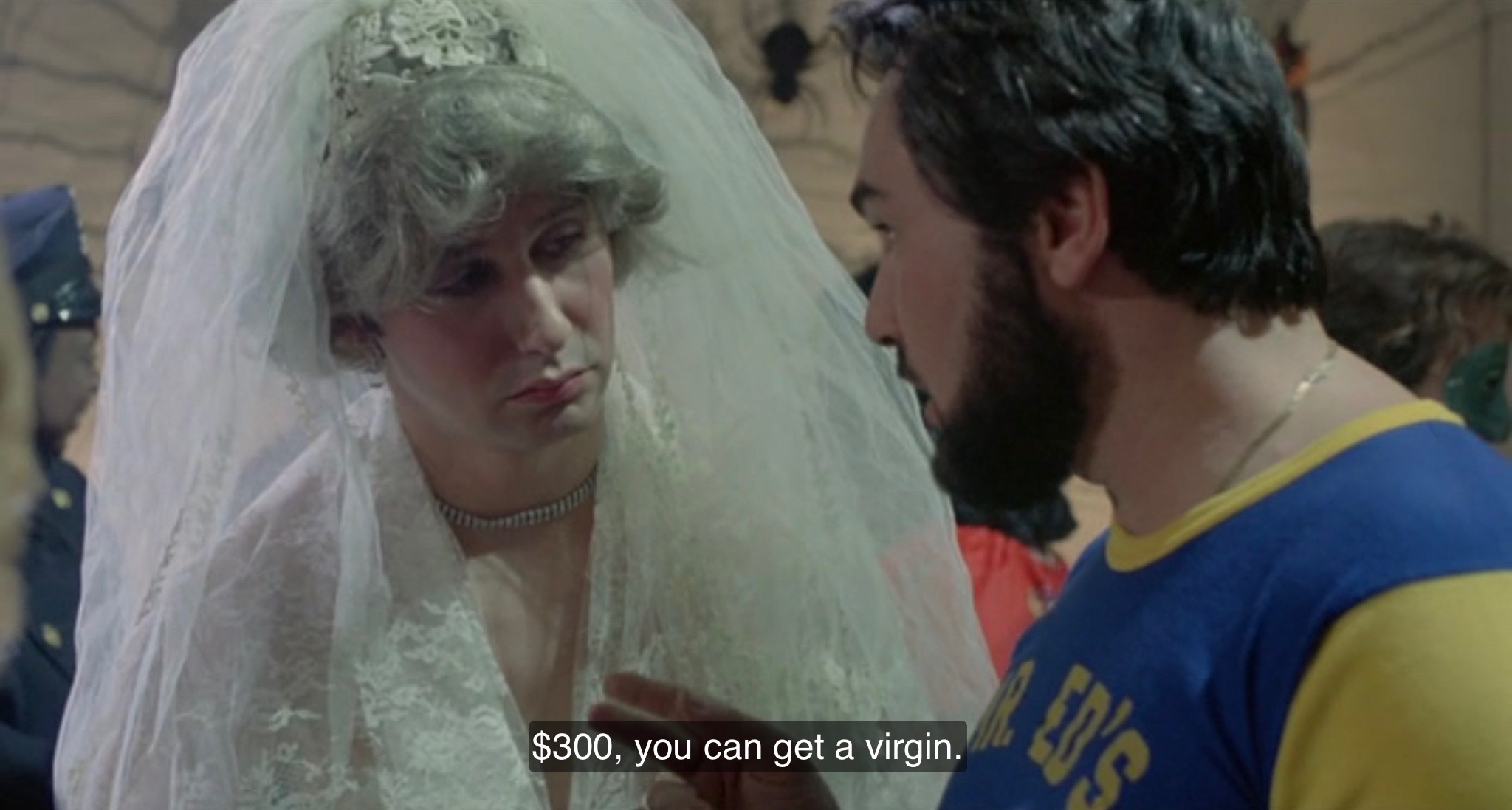
You could even make an argument that the character of Mae and the casting of Cliff Gorman is the LGBTIQ response to that final scene where she guns down the man dressed as a woman, then adds on that she is shocked when a genetic girl (a betrayer of the cause?) stabs her in the back. This movie even won Best Feature at the San Francisco International Lesbian & Gay Film Festival so it’s not reaching too much on my part.
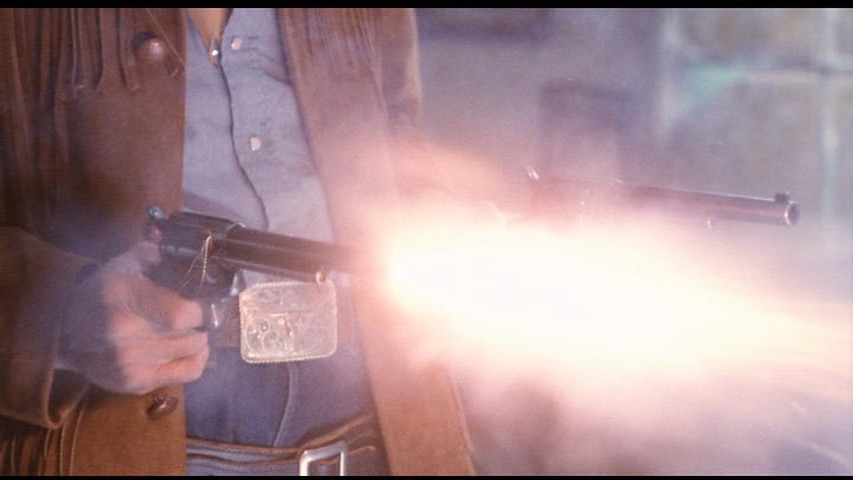
This is the last straw for Angel. She takes Solly’s giant gun to the streets in order to chase down the killer. They do it complete with repeating the opening scene, except with her walking us following her from behind, at night, in her night clothes, and armed.
Her already fractured innocence now gone.
He probably would have gotten away hiding amongst the Hare Krishnas, but he comes out and tries to attack her with his knife. All the while, Andrews chasing after both of them along with Kit. There is a goof during this chase. She shoots at him here.
However, when they cut to this shot, she appears to have teleported away.
Then they cut back there to show she is indeed still around.
This is one of those parts where the film again reminds you it was probably made quickly.
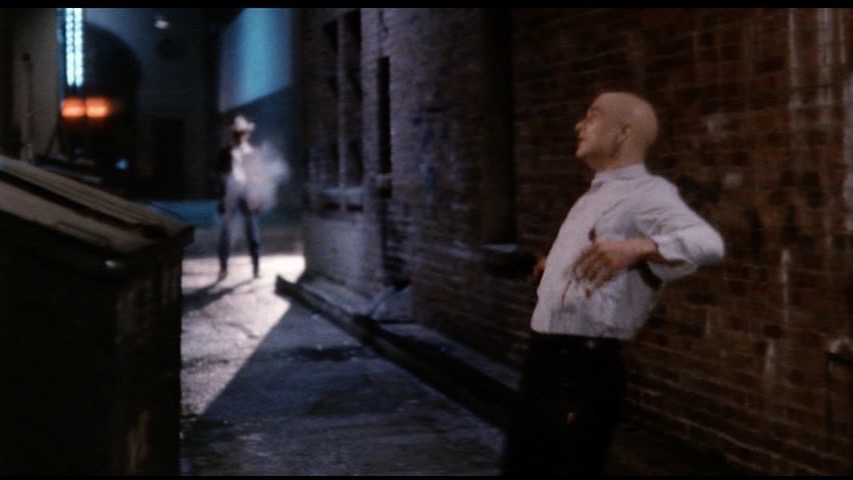
Seeing as it is the 80s, there is always a secluded alleyway or parking lot for the movie to go. We see Kit shot down before Andrews comes in to take shots at the bad guy and check on Kit. Kit tells him to go after Angel. The chase continues into another alleyway where the film comes its conclusion. Andrews calls to Angel, but she ignores him. The killer grabs Angel and shoots Andrews in the arm. She breaks free, causing Andrews to cover her to take any bullets, but doesn’t have to because Kit rises to the occasion to save both of them.
That’s when the movie essentially has its version of the ending of Targets (1968). Kit and Andrews look at him perplexed as the killer dies saying “It hurts. It hurts.”
With the plot finished, and a cowboy in the picture, they walk off into the not sunset of a neon lit alleyway end.
That’s the first Angel movie. Apparently, Ross Hagen was in here somewhere as “Urban Cowboy.” I have no idea where he was in this film.
The movie as a whole isn’t too bad. They certainly knew what they were doing when they picked the references, the shots they used, the casting, and surprisingly good main song for the movie. I also love the street life shots. I’m a sucker for movies that do that. I also liked the way they juxtaposed innocence in Angel with those who have lost theres to one degree or another while having Angel’s character make that journey herself walking down the Walk of Fame as a schoolgirl to a hooker with a gun. It seems that now days when I write one of these long looks at movies that probably don’t deserve this kind of attention, I either find they are much worse than I thought like Trancers 6 or much better than I thought like with this movie.
It is very much a movie of its time. The world had just come out of two decades of turmoil and was suddenly thrown into one that seemed to want to pretend the previous twenty years didn’t happen. It was also a time when you had a new breed of youth still co-existing with people who were from a time very far removed from the 80s as represented by Kit. To give you an example, Lillian Gish who was born in 1893, was not only alive when this came out, but made two more movies after it before dying in 1993. Mary Pickford had only died 3 years prior to this in 1979. Charlie Chaplin died 7 years prior in 1977.
Movies too had strayed for two decades into cinema the likes of which hadn’t been seen in the United States since movies like Baby Face an other pre-codes of the early 30s. However, after The Godfather and Star Wars films were so successful, the studios returned to the kind of films they made prior to the lifting of the production code. The difference being that they were no longer bound by such a code, but by the purse strings of whoever was funding the picture. That, and on occasion the clout of people working on the film, such as a directors like Tarantino.
Overall, I’d recommend seeing Angel. Especially as a counterpart to Ms. 45 (1981). Just fair warning again, it will feel rushed at times. I have a feeling that, just as with Trancers, this series will drop to watchable next, dreadful with the third film, and unbelievably bad with the fourth film which my “Angel Collection” triple feature doesn’t even acknowledge exists.
Last week, I started on my latest project — watching all 50 of the movies included in Mill Creek’s Fabulous Forties box set! I started things off with Port of New York and then I was lucky enough to discover two excellent low-budget gems: The Black Book and Trapped.
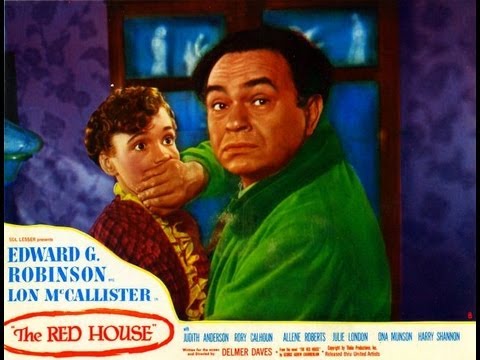
And now, we come the 7th film in the Fabulous Forties box set: 1947’s The Red House.
The Red House takes place is one of those small and seemingly idyllic country towns that always seem to harbor so many dark secrets and past crimes. Everyone in town is friendly, cheerful, and quick to greet the world with a smile.
Well, almost everyone.
Pete Morgan (Edward G. Robinson) is the exception to the rule. A farmer who moves with a pronounced limp, Pete lives on an isolated farm and refuses to have much to do with any of the other townspeople. He lives with his wife, Ellen (Judith Anderson), and his niece, 17 year-old Meg (Allene Roberts). Pete and Ellen are extremely overprotective of Meg. Pete, especially, is always quick to tell her not to associate with any of boys in the town and not to enter the dark woods that sit next to the farm. He tells her that there’s a red house hidden away in the woods and the house is haunted. Going into the red house can only lead to death.
Despite Pete’s eccentricities, Meg is finally able to convince him to hire one of her classmates to help do chores around the farm. Nath (Lon McAllister) is a good and hard worker and soon, even Pete starts to like him. Meg, meanwhile, is falling in love with Nath. However, Nath already has a girlfriend, the manipulative Tibby (Julie London), who cannot wait until they graduate high school so that she and Nath can leave town together. When Nath starts to also develop feelings for Meg, Tibby responds by flirting with the local criminal, Teller (Rory Calhoun).
Though things seem to be getting better on the Morgan Farm, Nath eventually makes the mistake of admitting that, when he goes home, he takes a short cut through the old woods. Pete angrily forbids Nath from entering the woods. Of course, this has the opposite effect. Soon, Nath and Meg are spending all day sneaking away into the woods so that they can look for the red house.
Once Pete learns of what they’re doing, he decides to hire Teller to keep them from even finding and entering the red house. Needless to say, love, melodrama, murder, and tragedy all follow…
Despite the fact that the DVD suffered from a typically murky Mill Creek transfer, I enjoyed The Red House. It’s one of those films that is just so over the top with all of the small town melodrama that you can’t help but enjoy it. (If M. Night Shyamalan had been a 1940s filmmaker, he probably would have ended up directing The Red House.) Nath and Meg were kind of boring but Julie London was a lot of fun as Tibby. If I had ever starred in production of The Red House, I would want to play Tibby.
Plus, the film’s got Edward G. Robinson doing what he does best! Robinson was an interesting actor, in that he could be both totally menacing and totally sympathetic at the same time. He has some scary scenes as Pete but they’re also poignant because Robinson suggests that Pete hates his behavior just as much as Ellen and Meg. Robimson was a powerhouse actor, the type who could elevate almost any film.
And that’s certainly what he does in The Red House!
You read the title of this post correctly. This is directed by Kevin Connor who has made numerous Hallmark films I’ve reviewed on this site. In addition, Bradford May was the camera operator on this film who also went on to direct numerous Hallmark movies I’ve reviewed. And it has one more connection to Hallmark because it has John Ratzenberger in it who went on to be in a few Hallmark movies.
So with all those connections to Hallmark in this 80s horror film, does it have any similarities to those films? Actually, it does in a way. In the case of Kevin Connor, it makes sense to hire a director who has proven themselves to be able to make a memorable movie with a small budget to make your small TV Movies.
Let’s talk about the movie now.
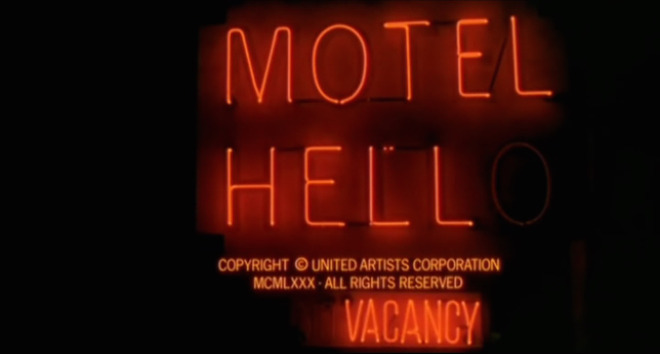
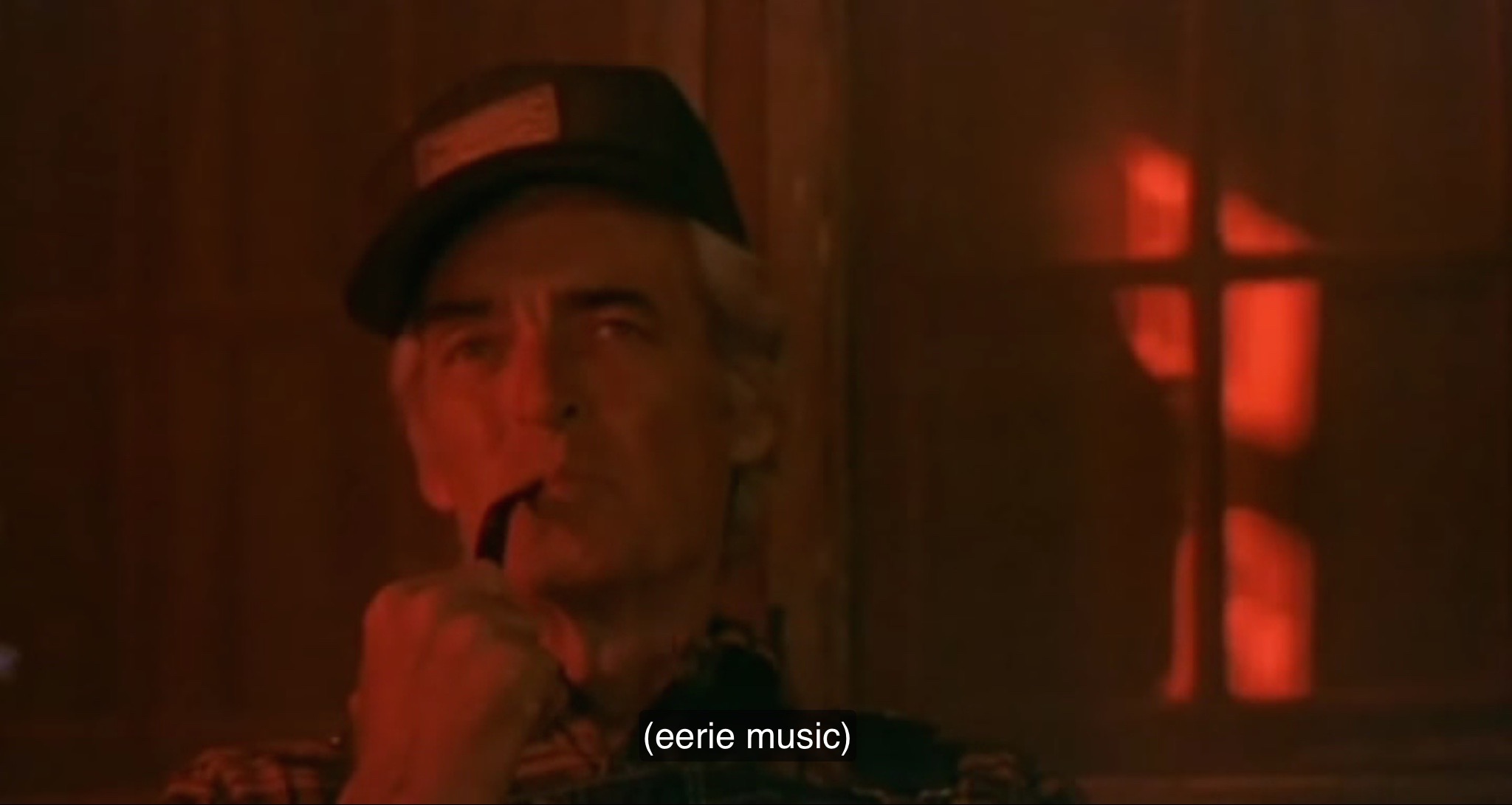
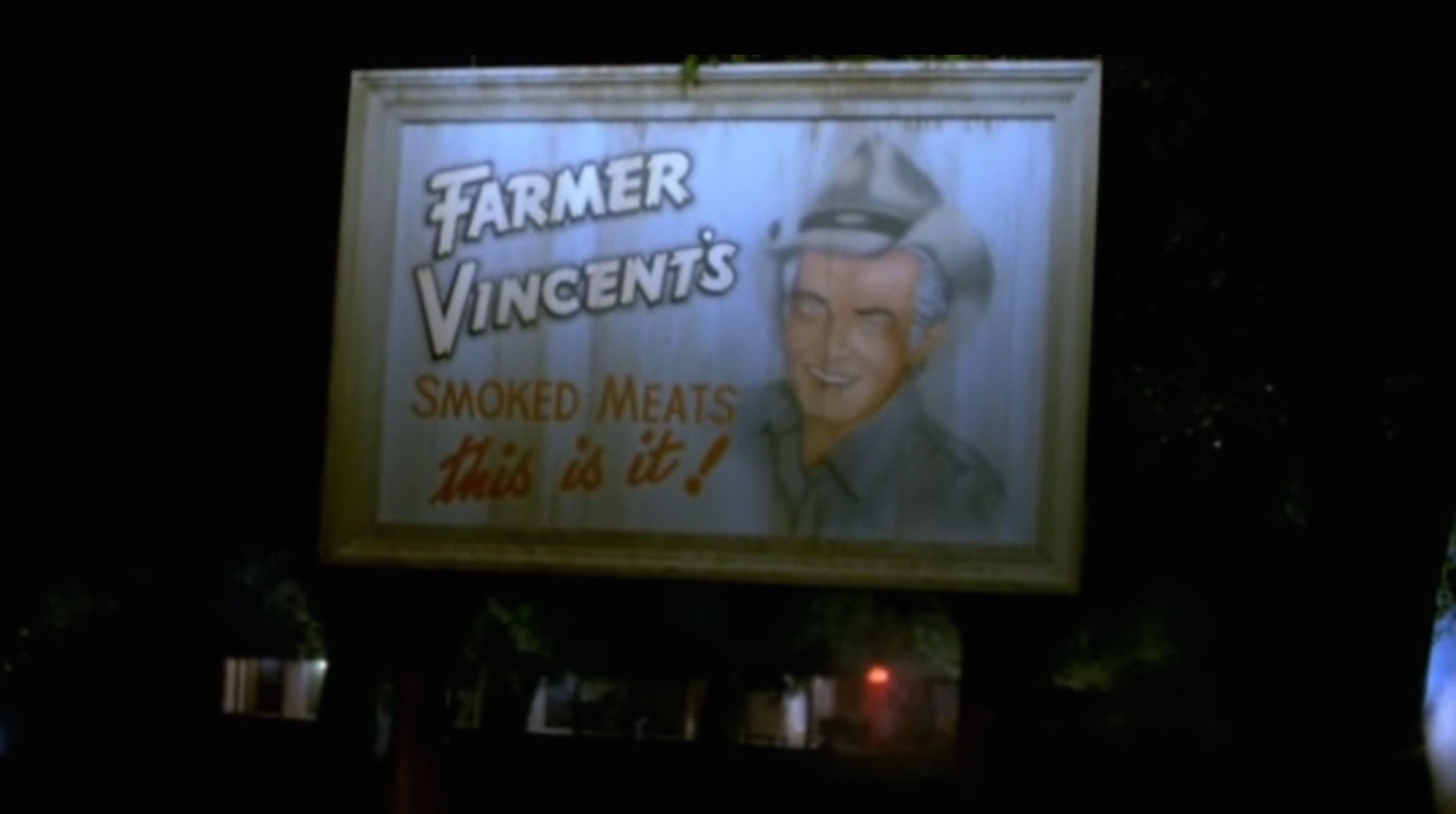
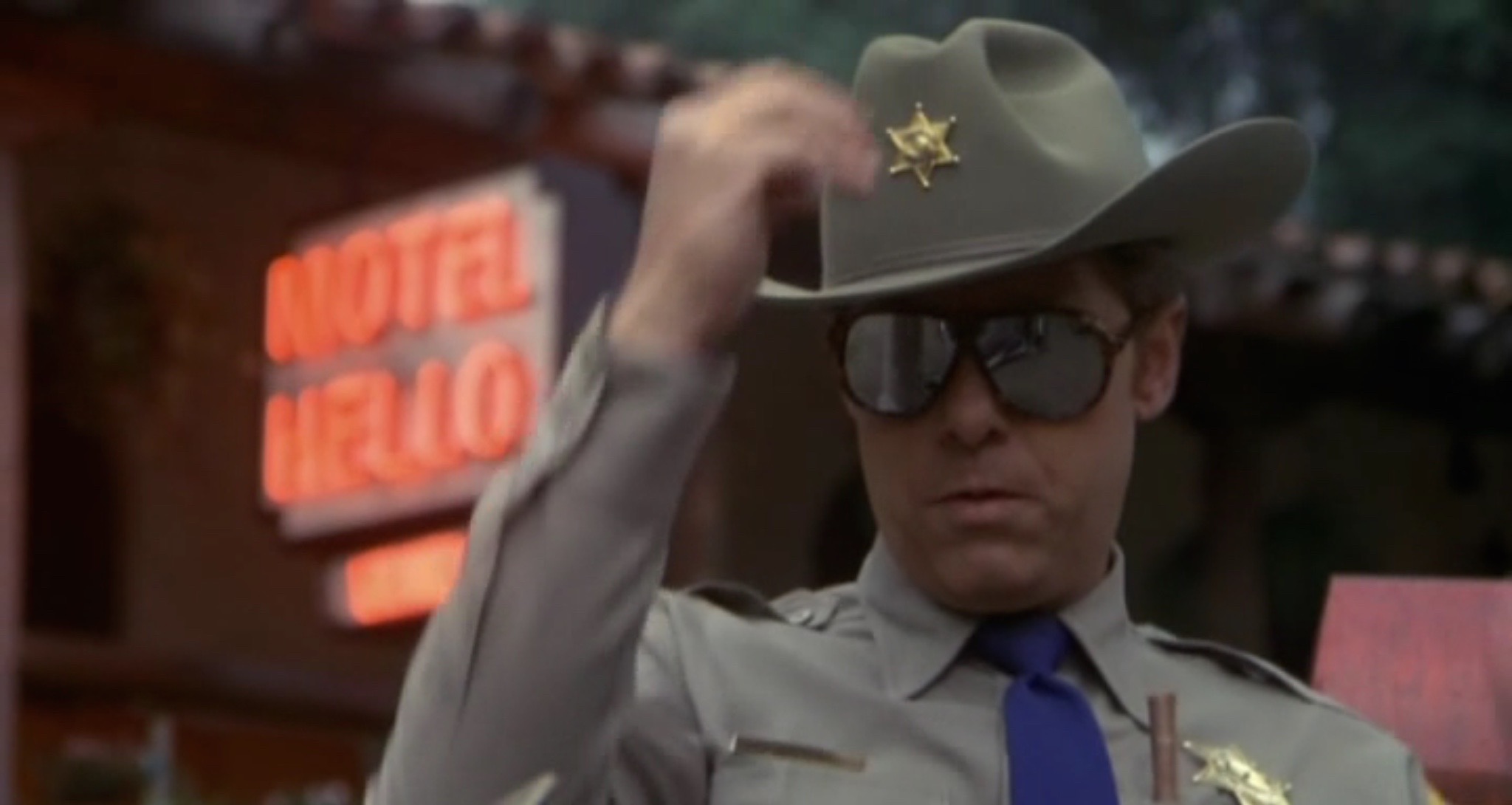
The film opens with Vincent Smith (Rory Calhoun) sitting on the porch of his Motel Hello. The ‘O’ being in need of replacing as it keeps going out. Thus changing the name of the place to Motel Hell. Smith drives out to the road and we see a motorcycle carrying a guy and a girl go past a sign.
Smith sells smoked meat out of his motel. He sees the motorcycle hit something then go down. The guy is dead, but the girl is still alive. He loads them up and brings them back home.
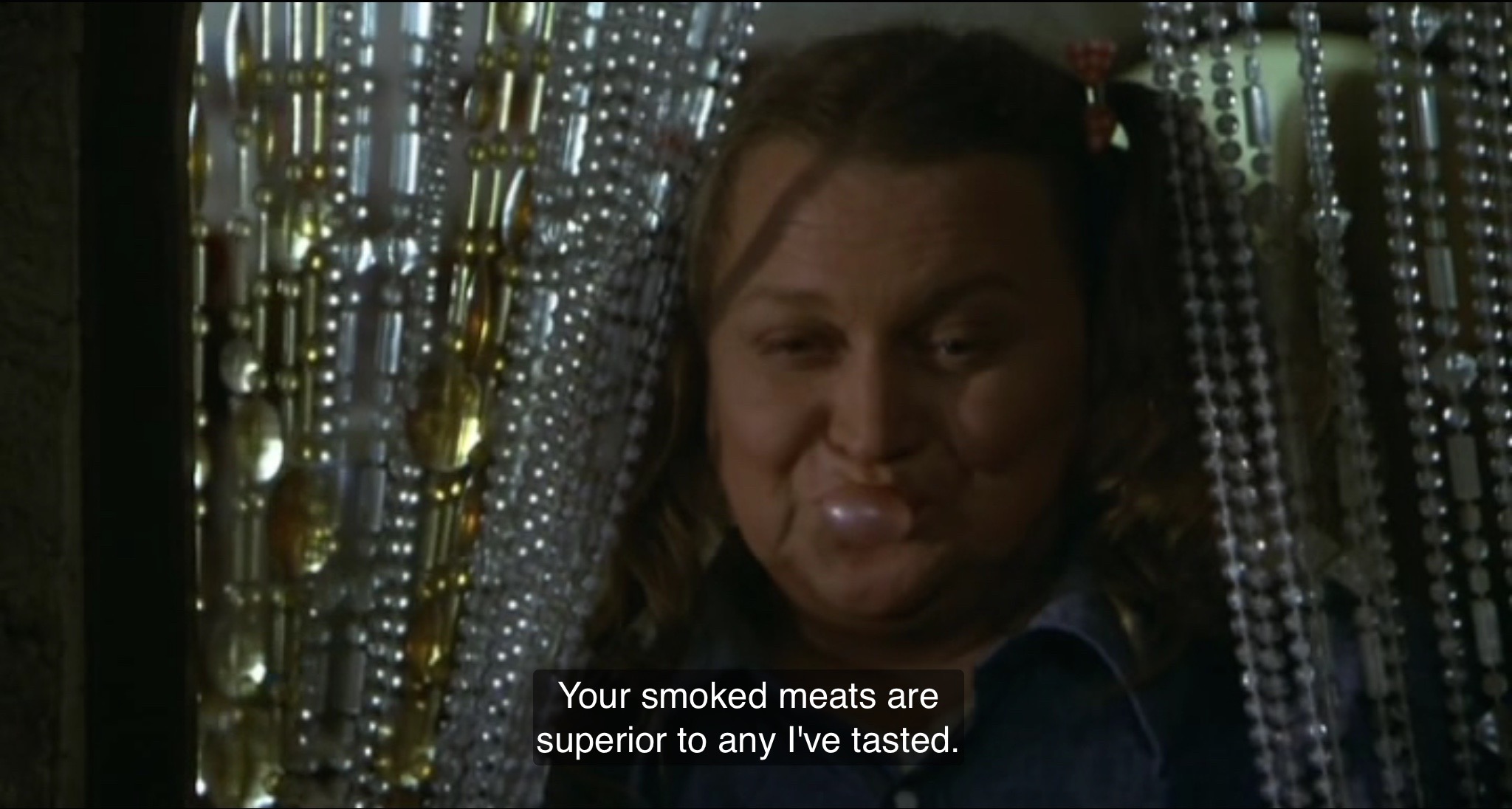
Smith doesn’t live alone. He lives with his sister Ida (Nancy Parsons). Look familiar?
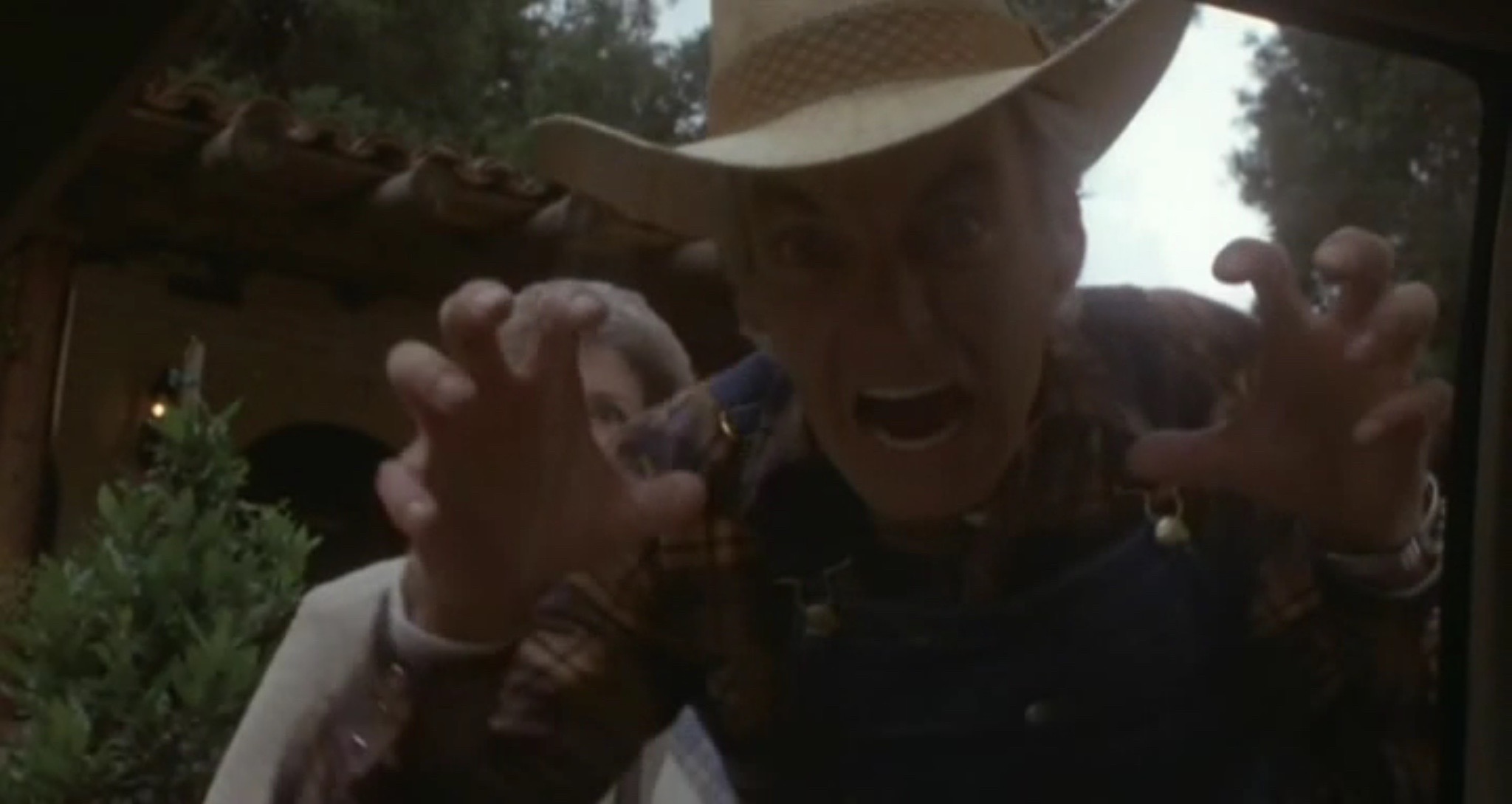
If a painful game of tug of war came to mind, then you do recognize her, because that’s Balbricker from Porky’s (1981). She grabs no dicks in this movie. This is Rory Calhoun’s film. And he makes it known with his time tested and approved way of calming kids down who just ran scared after wandering through a slaughterhouse.
We are now introduced to the three other characters who matter in this movie.
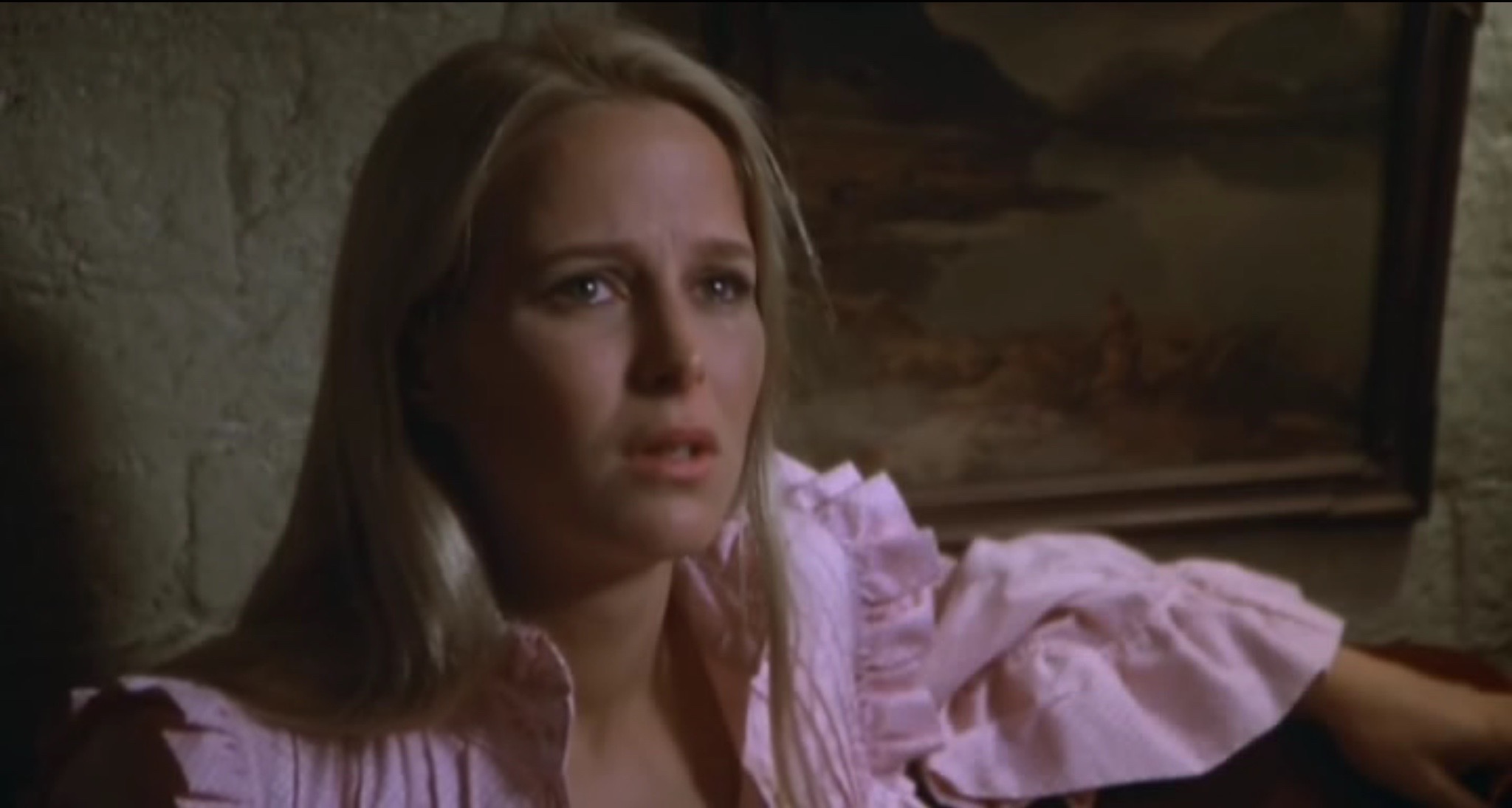
First, the girl who survived the crash. Her name is Terry (Nina Axelrod). She wakes up to find out that her boyfriend is long gone. Smith has already buried him.
Second, the 80s sheriff Bruce Smith (Paul Linke). He’s Vincent Smith’s kid brother.
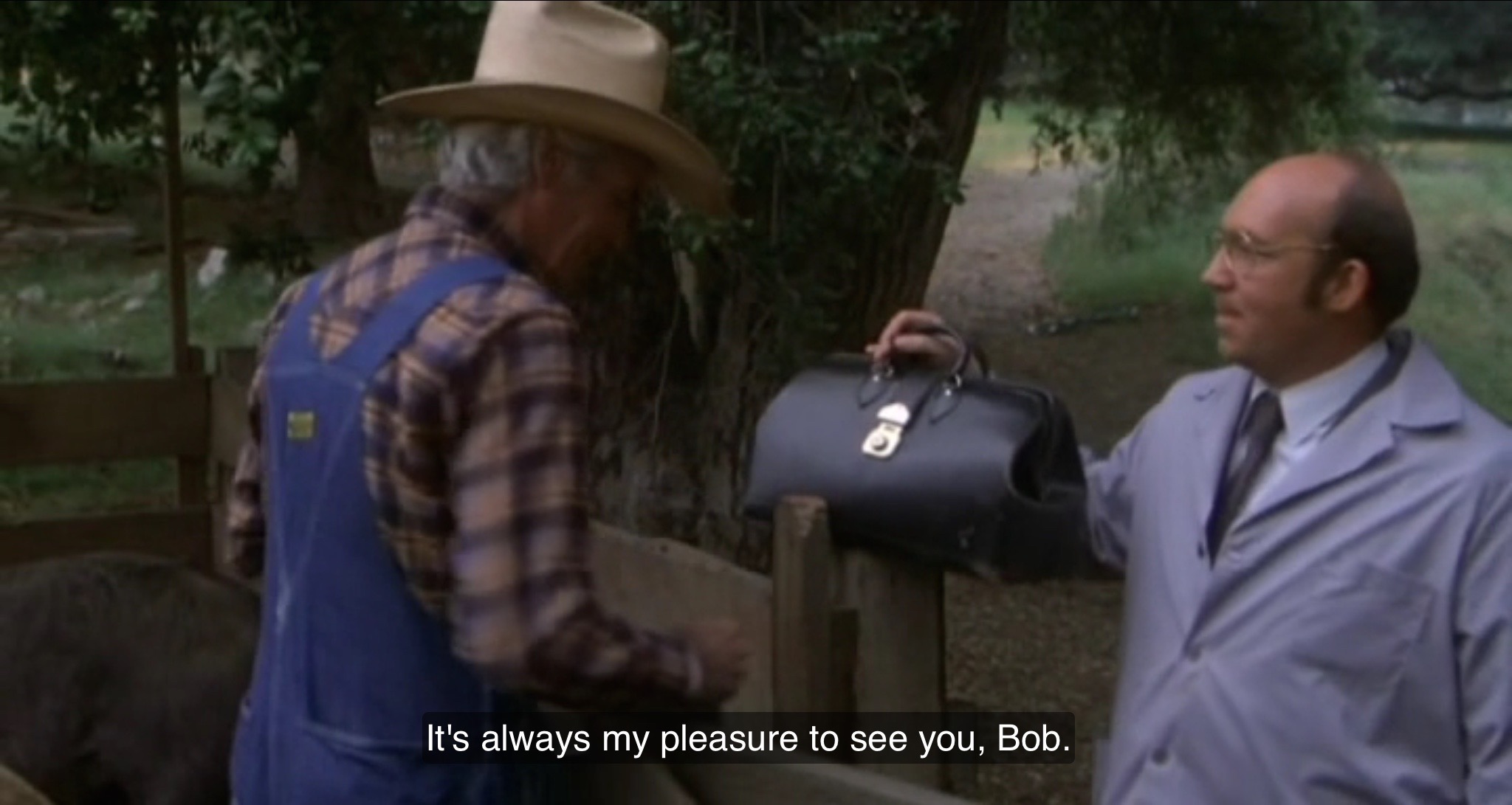
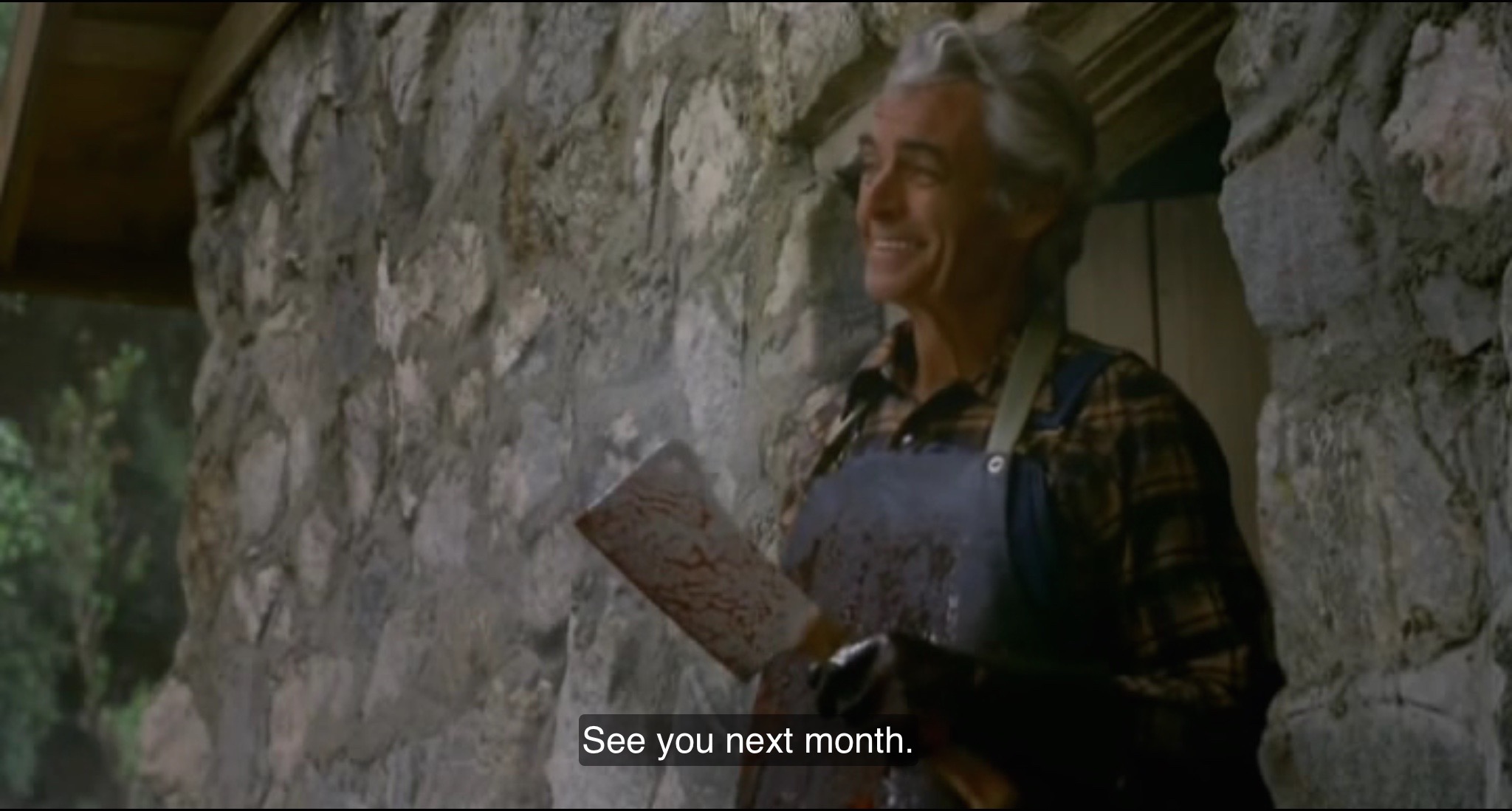
And inspector Bob Anderson (E. Hampton Beagle). Oh, poor poor Bob. Because after he gets this goodbye from Vincent.
Bob makes an unfortunate discovery about Vincent’s secret garden.
Yep, Vincent’s meat comes from people. Let me try and explain it the best I can. He sets traps on the nearby road so that people crash. He goes in and gasses them. He then takes them back to his secret garden and slits their vocal cords. He then plants them in the ground leaving just their head poking out. That’s why when the bag covering their heads are pulled off they just making groaning almost zombie like noises. Then he appears to hypnotize them using colorful pinwheels and hypnotic noise before he snaps their necks with a noose attached to a tractor trailer. They are then turned into the meat that he sells. Rather gruesome, but there honestly isn’t a whole lot to it. Here’s the scene that basically sums it all up.
Luckily, one of those heads is attached to John Ratzenberger. I say luckily because it means we finally all got our wish. Cliff Clavin has no way to tell his annoying stories anymore.
Oh, and Ratzenberger is captured after a van carrying himself and several bandmates hits a trap laid by Vincent. And you know what? More bands need to be named after Sergei Eisenstein movies.
That’s basically the film right there. Vincent and Ida collecting bodies, feeding the heads, and justifying it all to themselves with crazy talk. Then Bruce and Terry eventually figure things out and the net closes in on them.
There is one particular capturing scene that is worth watching. Here’s the capture of the kinky couple.
The other thing that is worth mentioning is that Wolfman Jack is in this. He plays a reverend.
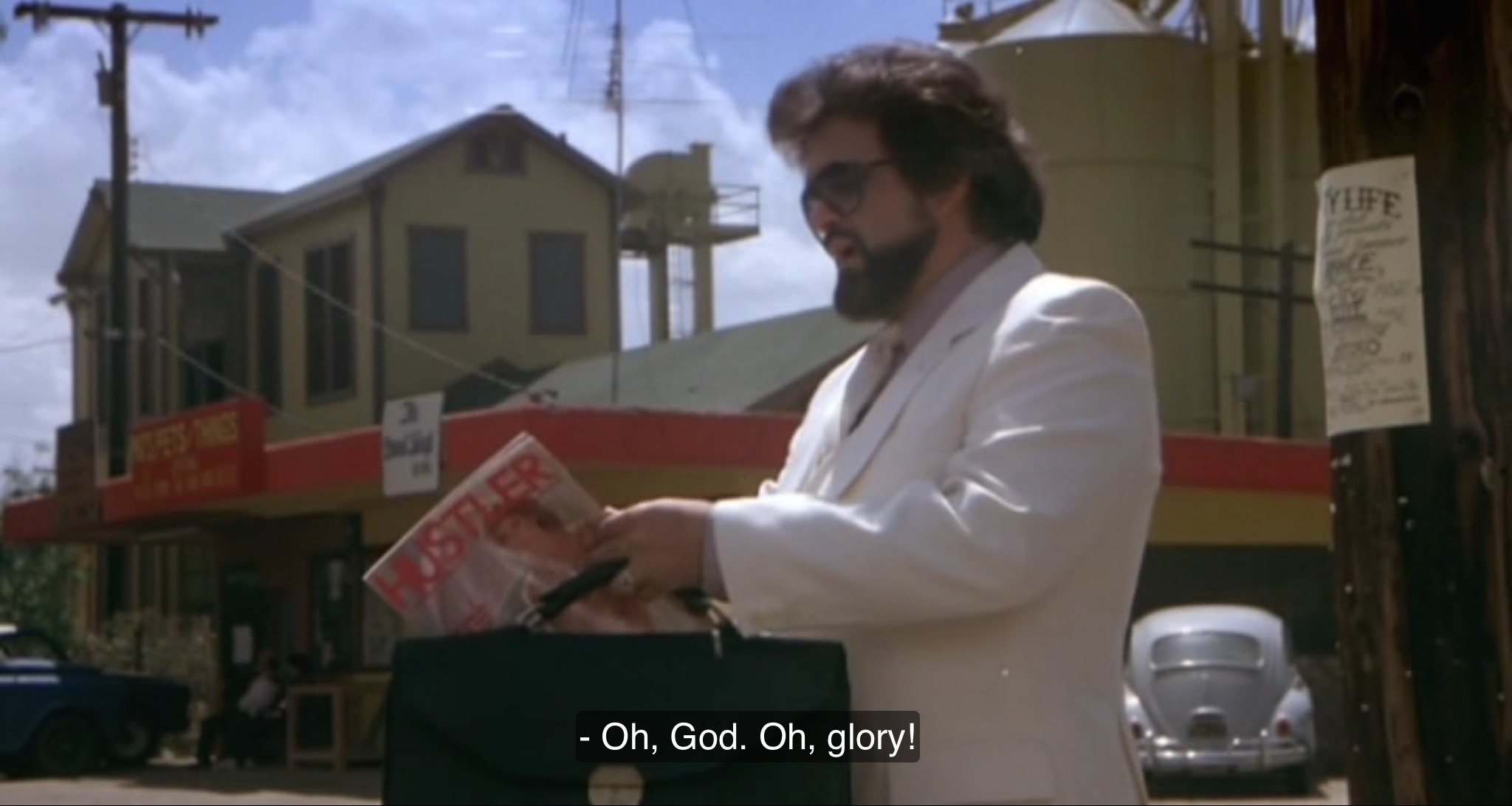
According to Motel Hell, the lord works in mysterious ways. Sometimes the lord provides you with an excuse to confiscate a copy of Hustler for your own personal collection.
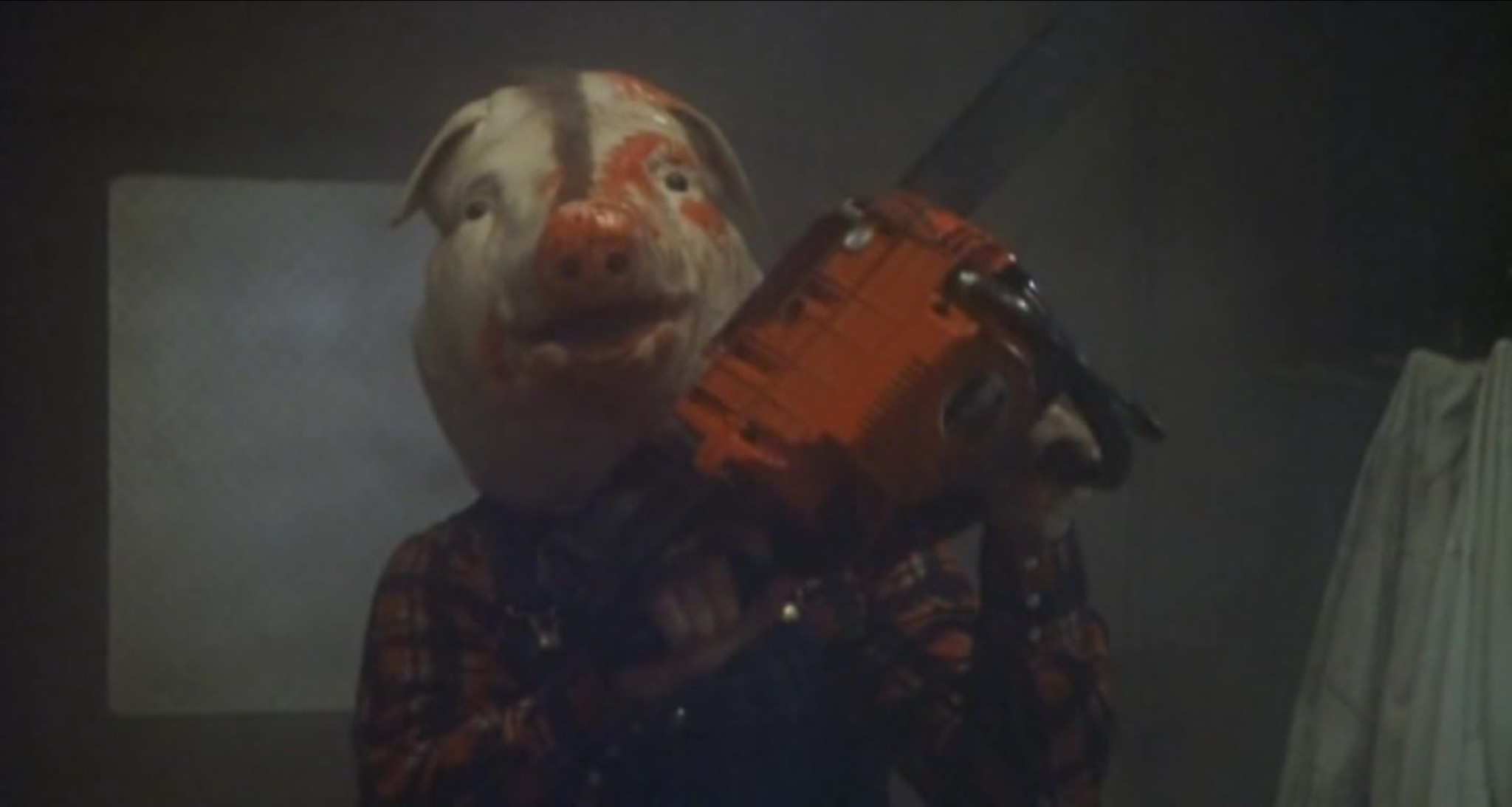
Horror really isn’t my thing and this film does begin to wear out it’s welcome at a certain point, but it’s Calhoun’s performance and the creepy atmosphere that makes it work. There are more clips up on YouTube if you want to see more in order to make your decision about watching this or not. I guess you have my recommendation.


















 Through the Shattered Lens