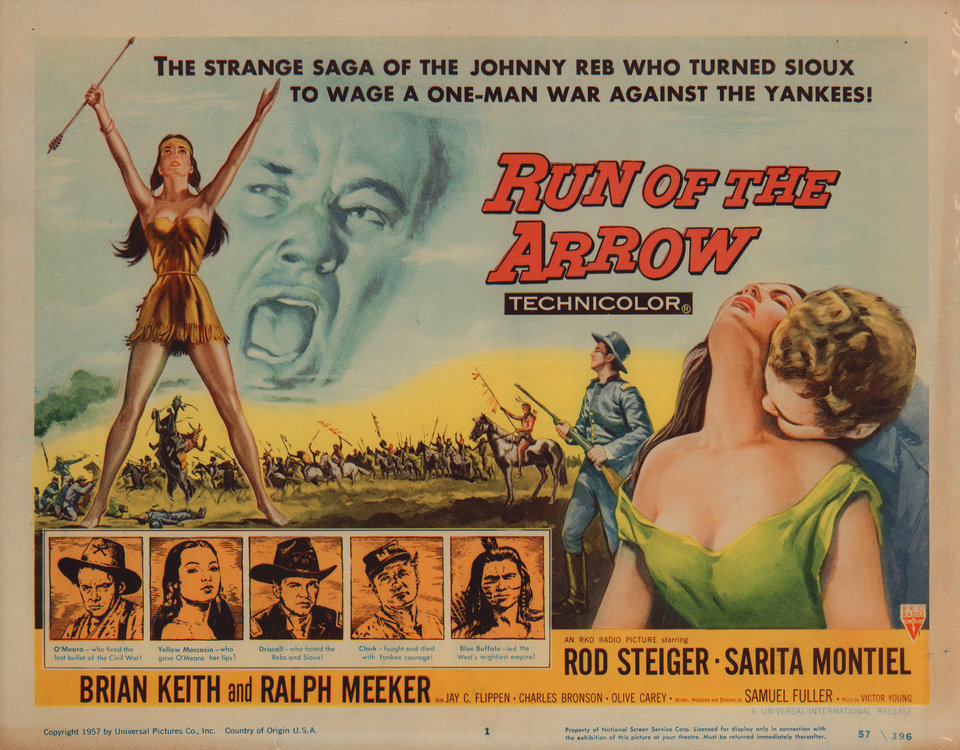
Brad reviews Samuel Fuller’s RUN OF THE ARROW (1957), starring Rod Steiger and Charles Bronson! 


RUN OF THE ARROW opens up on April 9th, 1963, with confederate sharpshooter O’Meara (Rod Steiger) shooting a Union lieutenant named Driscoll (Ralph Meeker). This turns out to be the final shot fired in the Civil War as General Lee is in the process of surrendering to General Grant. It also turns out to be Driscoll’s lucky day, as a slight warping of the bullet causes O’Meara’s aim to be off just enough for him to survive. With no more war to fight and with a heart full of hate for the Yankees, O’Meara declares himself to be a man without a country and decides to head out west towards the land of the Indians. As part of his travels he happens across Walking Coyote (Jay C. Flippen), an aging, renegade Sioux scout who’s headed back home to die. Walking Coyote takes O’Meara under his wing and teaches him the Sioux language, as well as many of their customs. When they’re captured by a band of Sioux warriors led by Crazy Wolf (H.M. Wynant), and are being prepared to be killed, Walking Coyote invokes the “run of the arrow”, a ritualistic game that could save their lives. Unfortunately, no one has ever survived the run of the arrow. But today, it seems there’s a first time for everything, as O’Meara survives just long enough to be found, hidden, and saved by the beautiful Indian squaw Yellow Moccasin (Sarita Montiel). Yellow Moccasin nurses him back to health and presents him to her tribal chief, Blue Buffalo (Charles Bronson), who spares his life since he survived the run. Blue Buffalo also welcomes O’Meara into their tribe and allows O’Meara and Yellow Moccasin, who have fallen in love, to get married and adopt the mute orphan boy, Silent Tongue, as their own son. Things seem to be going well until Sioux Leader Red Cloud (Frank DeKova) and Army General Allen (Tim McCoy) reach an agreement that allows for an Army Fort to be built in a narrowly defined area. While the construction of the fort is entrusted to an honest man of integrity named Captain Clark (Brian Keith), the agreement is ultimately sabotaged by the murderous Crazy Wolf, and then further by the Indian hating Captain Driscoll… yes, that same Union soldier that O’Meara shot on the last day of the war! When the fighting starts again, will O’Meara prove himself to truly be a Sioux warrior willing to kill American army soldiers, or is a part of his heart still with his country?

Director Samuel Fuller’s RUN OF THE ARROW is a movie about the damage that occurs when human beings allow their hearts to be so filled with bitterness and hate that they quit caring about other people. It’s also about what happens when those same people run into rational people of good will, and we find out if they’re still capable of even considering the possibility that their own hate has blinded them from the truth. In other words, it’s a film that’s possibly more relevant today than it was when it was made in 1957. Bitterness and hate is represented by the characters of O’Meara (Steiger), Crazy Wolf (Wynant), and Lieutenant Driscoll (Meeker). O’Meara hates Yankees, Crazy Wolf hates the white man, and Driscoll hates the Indians. The rational people of good will are the characters of Yellow Moccasin (Montiel), Blue Buffalo (Bronson), and Captain Clark (Keith). Yellow Moccasin saves O’Meara, when everyone else would have just let him die. Blue Buffalo engages in honest conversation with O’Meara and even welcomes him into their tribe. Captain Clark shows O’Meara an empathetic ear and kindness when so many others have told him to just get over himself. The actions and fates of the characters play out against this dynamic of hatred versus humanity, with the results underscoring just how tragic it is when people focus on the things that separate us rather than the things that unite us. It’s all so unnecessary, but it’s also a realistic vision of the world we live in. The film also struck me as particularly violent for a 50’s western, which also underscores that reality.

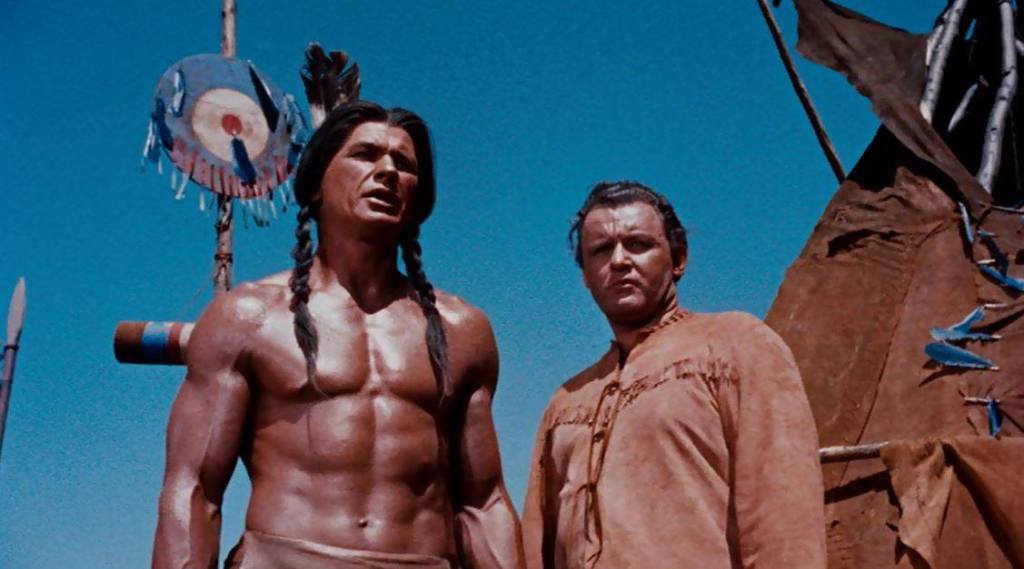
Some of the performances are very effective in the film. Rod Steiger’s Irish, confederate Sioux is an interesting character and the actor gives it his all as you’d expect. I’m a big fan of Steiger and his performance here only solidifies my respect for him. Brian Keith’s Captain Clark arrives fairly late in the proceedings and comes across as a tough, but honest man of integrity at a point when the movie really needs him. He has an excellent scene with Steiger where he debates the old confederate’s reasons for renouncing his citizenship with both sound logic, empathy, kindness and a hint of likable sarcasm all at the same time. It’s one of the best scenes in the film. And likewise, Charles Bronson, the most buff Hollywood Indian to ever strip down to a loincloth, comes across as a reasonable and kind tribal chief in his dealings. Bronson had played Indians before, but he was usually more of the renegade, warpath variety, so it was nice seeing him as a good guy here. H.M. Wynant took the renegade Indian role here which you might have expected for Bronson at the time. He’s suitably fierce but one-dimensional. The same can be said for Ralph Meeker as Lieutenant Driscoll. He’s pretty much just a stereotypical jerk. He’s good at being a jerk though! And Sarita Montiel, voiced by Angie Dickinson, is quite the beauty as Yellow Moccasin. We discussed H.M. Wynant and RUN OF THE ARROW with author Steven Peros on the “This Week in Charles Bronson Podcast.” Check out that interview below:

I’ve recently heard RUN OF THE ARROW compared to Kevin Costner’s DANCES WITH WOLVES, and there are definitely many similarities. I won’t go into all of those here, but one of the things I appreciated the most about RUN OF THE ARROW is the fact that the movie makes its feelings known about politics. In a movie filled with characters who have had their lives upended by the various decisions of political leaders, director Samuel Fuller has crafted a story that focuses most sharply on defining the quality of men based on what’s in their “hearts.” When it’s all said and done, oftentimes the only control we have is the way we respond to the events in our lives, and that’s not politics, it’s personal. To drive this home, in one of their conversations, Walking Coyote tells O’Meara that he could have been a chief if he had wanted to be. When O’Meara pushes the old scout on why he didn’t want the position, Walking Coyote responds with, “Because I hate politics!” On that point, I couldn’t agree more. 
Brad’s “mini-review” of LOVE AND BULLETS (1979), starring Charles Bronson! 


Charles Bronson is an Arizona cop who goes to Switzerland to bring back a gangster’s girlfriend (Jill Ireland). The gangster (Rod Steiger) sends a hitman (Henry Silva) to kill her so she can’t tell his crime secrets to the authorities.  

This isn’t one of Bronson’s best films, but it’s still a fun movie to watch on a chilly, rainy day. There are some good action scenes set in various cold & snowy European locations. This is Bronson in “Bond” mode which is kind of fun and different. And what can you say about a stuttering Rod Steiger screaming at his advisors about the meaning of “love.” It’s fun stuff when you like Steiger as much as I do. I do deduct half a star because Steiger gets so mad at one point that he turns over a table with some of the biggest, most scrumptious looking shrimp I’ve ever seen. That was completely uncalled for and wasteful, but not quite as wasteful as Bronson and Henry Silva in the same movie without an epic battle of some sort. The fact that they didn’t fight it out on the Matterhorn itself can only be described as a missed opportunity. 

Brad’s “scene of the day” – Glenn Ford, Charles Bronson, Rod Steiger & Ernest Borgnine!


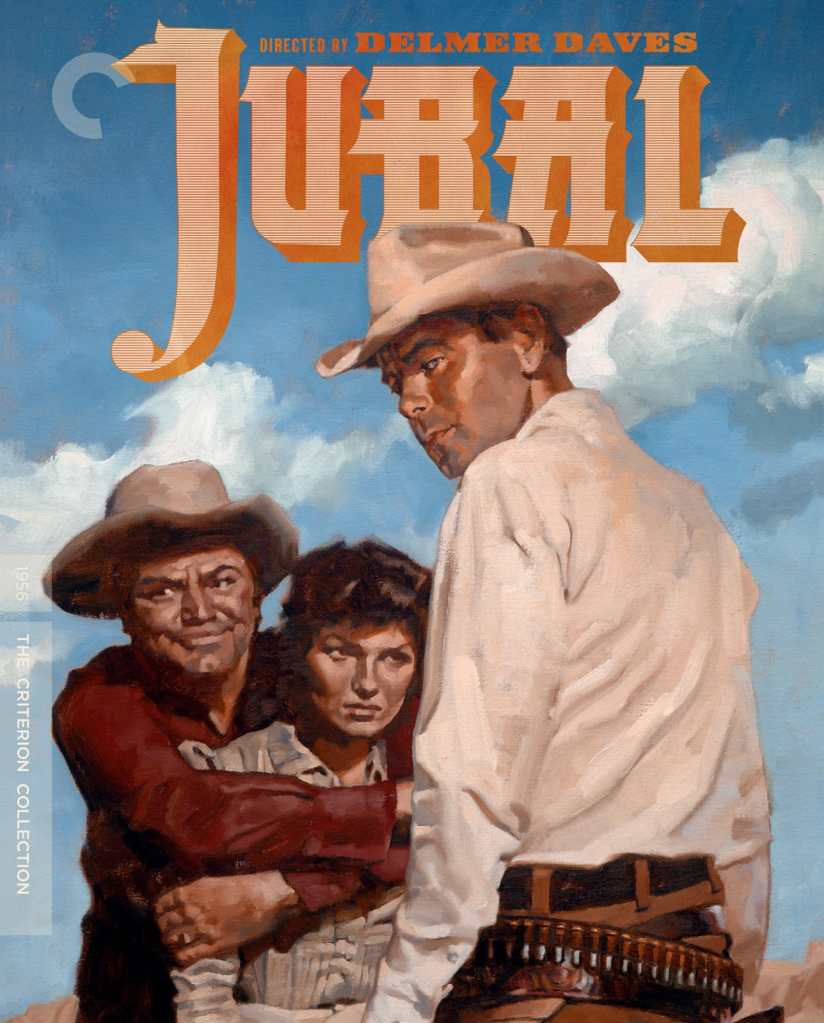
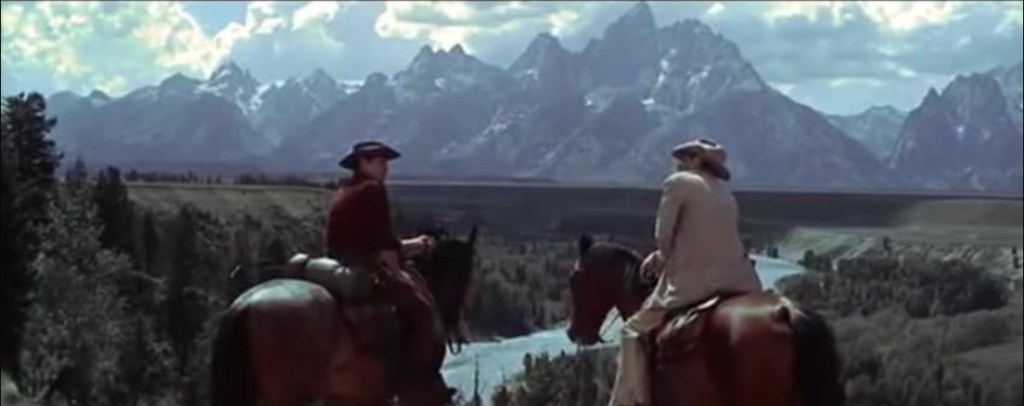
JUBAL (1956) is one of my favorite westerns. It’s set in the Grand Tetons and it stars some of my all time favorite actors, namely Bronson, Ford and Steiger. On what would have been his 109th birthday, I just wanted to take a moment to appreciate Glenn Ford. I visited the Tetons a couple of summers ago and I thought of these great actors often! Enjoy this scene from these icons of cinema!

Scenes I Love: James Woods and Eric Roberts In The Specialist


Since both Eric Roberts and James Woods are celebrating a birthday today, it seems only appropriate that today’s scene of the day should feature both of them.  In this scene from 1994’s The Specialist, Woods, Roberts, and Rod Steiger all compete to see who can steal a relatively simple conversational scene.

14 Days of Paranoia #6: The Player (dir by Robert Altman)


1992’s The Player tells the story of Griffin Mill (Tim Robbins).

It’s not easy being Griffin Mill.  From the outside, of course, it looks like he has the perfect life.  He’s a studio executive with a nice house in Hollywood.  He’s young.  He’s up-and-coming.  Some people, especially Griffin, suspect that he’ll be the president of the studio some day.  By day, he sits in his office and listens to pitches from respected screenwriters like Buck Henry.  (Henry has a great idea for The Graduate II!)  During the afternoon, he might attends dailies and watch endless takes of actors like Scott Glenn and Lily Tomlin arguing with each other.  Or he might go to lunch and take a minute to say hello to Burt Reynolds.  (“Asshole,” Burt says as Griffin walks away.)  At night, he might go to a nice party in a big mansion and mingle with actors who are both young and old.  He might even run into and share some sharp words with Malcolm McDowell.

But Griffin’s life isn’t as easy as it seems.  He’s constantly worried about his position in the studio, knowing that one box office failure could end his career.  He fears that a new executive named Larry Levy (Peter Gallagher) is after his job.  Two new screenwriters (Richard E. Grant and Dean Stockwell) keep bugging him to produce their downbeat, no-stars anti-capitol punishment film.  His girlfriend (Cynthia Stevenson) wants to make good movies that mean something.  Even worse, someone is sending Griffin threatening notes.

It doesn’t take long for Griffin to decide that the notes are coming from a screenwriter named Dave Kahane (Vincent D’Onofrio).  Griffin’s attempt to arrange a meeting with Dave at a bar so that Griffin can offer him a production deal instead leads to Griffin murdering Dave in a parking lot.  While the other writers in Hollywood mourn Dave’s death, Griffin starts a relationship with Dave’s artist girlfriend (Great Scacchi) and tried to hide his guilt from two investigating detectives (Whoopi Goldberg and Lyle Lovett).  Worst of all, the notes keep coming.  The writer, whomever they may be, is now not only threatening Griffin but also seems to know what Griffin did.

After spend more than a decade in the industry wilderness, Robert Altman made a critical and commercial comeback with The Player.  It’s a satire of Hollywood but it’s also a celebration of the film industry, featuring 60 celebrities cameoing as themselves.  Everyone, it seems, wanted to appear in a movie that portrayed studio execs as being sociopathic and screenwriters as being whiny and kind of annoying.  The Player both loves and ridicules Hollywood and the often anonymous men who run the industry.  Largely motivated by greed and self-preservation, Griffin may not love movies but he certainly loves controlling what the public sees.  In the end, only one character in The Player sticks to her values and her ideals and, by the end of the movie, she’s out of a job.  At the same time, Griffin has a social life that those in the audience can’t help but envy.  He can’t step out of his office without running into someone famous.

The Player is one Altman’s most entertaining films, with the camera continually tracking from one location to another and giving as a vision of Hollywood that feels very much alive.  Tim Robbins gives one of his best performances as Griffin Mill and Altman surrounds him with a great supporting cast.  I especially liked Fred Ward as the studio’s head of security.  With The Player, Altman mixes melodrama with a sharp and sometimes bizarre comedy, with dialogue so snappy that the film is as much a joy to listen to as to watch.  That said, the real attraction of the film is spotting all of the celebrity cameos.  (That and cheering when Bruce Willis saves Julia Roberts from certain death.)  Altman was a director who often used his films to explore eccentric communities.  With The Player, he opened up his own home.

Previous entries in 2025’s 14 Days Of Paranoia:

  1. The Fourth Wall (1969)
  2. Extreme Justice (1993)
  3. The Lincoln Conspiracy (1977)
  4. Conspiracy (2007)
  5. Bloodknot (1995)

JUBAL (1956) – Ford, Borgnine, Steiger, and Bronson star in a Shakespearean tragedy set in the old west!


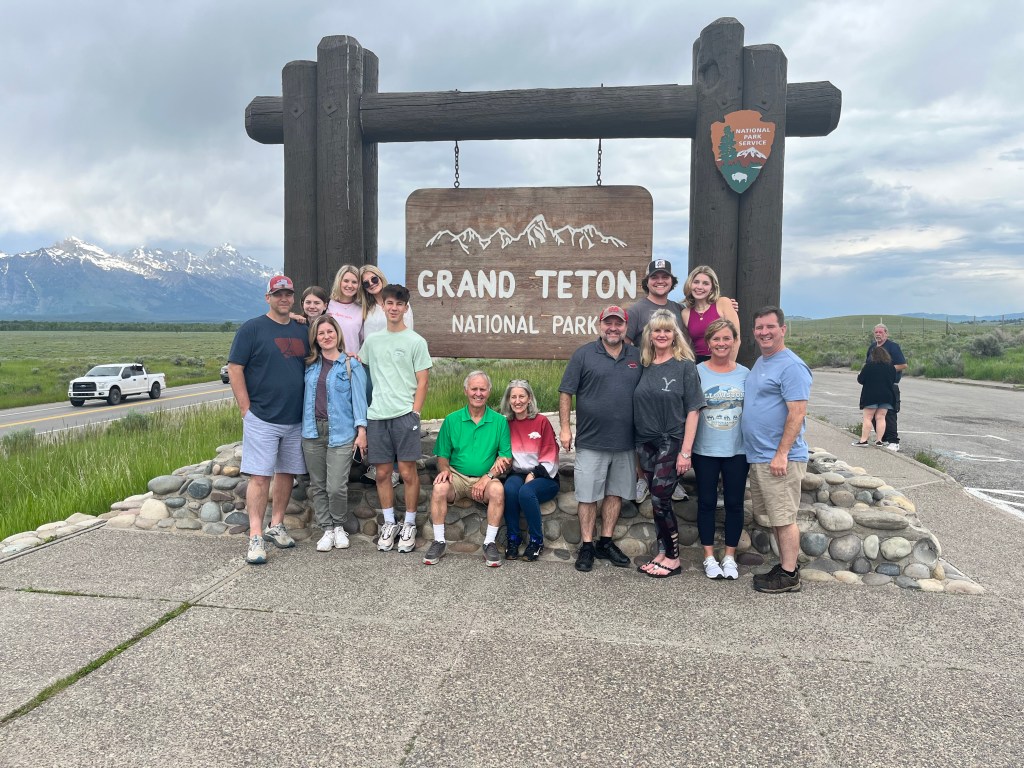
In 2023, our family (parents, siblings, kids, nieces & nephews, everybody) took a vacation to the Grand Teton National Park. It was one of the most enjoyable vacations I’ve ever been on. Of course, this dad got on his family’s nerves by continuously referencing the film JUBAL since it was filmed with the Grand Tetons in the background. I just kept thinking about the fact that we were hanging out near a place where Glenn Ford, Ernest Borgnine, Rod Steiger, and Charles Bronson worked on one of my favorite westerns. For good measure I mentioned SHANE a few times as well since it was also filmed there.

Nice guy rancher Shep Horgan (Ernest Borgnine) finds Jubal Troop (Glenn Ford) injured and at the point of death. He takes Jubal back to his ranch and they nurse him back to health. The two men hit it off and soon Shep asks Jubal to be his foreman. This doesn’t set well at all with the duplicitous Pinky (Rod Steiger) who’s used to being in charge.  It sets too well with Shep’s beautiful wife Mae (Valerie French) who takes the wrong kind of liking to Jubal, a habit that seems to keep rearing its head with the lonely lady. This eventually turns into a powder keg of betrayal, lies & misunderstandings. Charles Bronson has a small, but pivotal role as cowhand who’s there for Jubal when things get really rough.

I bought JUBAL on VHS early in my movie collecting days in the 80’s. Of course, they put Bronson’s face on the front of the box with the other stars, even though it was over-inflating the size of his role in the movie. But that’s okay because it was probably the first time a teenage Bradley ever watched a movie with old Hollywood stars like Ford, Borgnine & Steiger. I loved the movie, and I’ve since searched out each actor’s filmography to watch their best films. Steiger especially stands out as the evil Pinky. I’ve been a huge fan of his ever since.

JUBAL also turned me on to the director Delmer Daves. Daves is one of the great directors of that time period. It’s been nice seeing some of his work being released as part of the Criterion Collection. His other films include DARK PASSAGE with Humphrey Bogart, BROKEN ARROW with Jimmy Stewart, DRUM BEAT with Alan Ladd & Charles Bronson, THE LAST WAGON with Richard Widmark, and 3:10 TO YUMA again with Glenn Ford. Heck, the guy wrote the classic tearjerker AN AFFAIR TO REMEMBER. The guy was awesome!

Just to finish off a little personal history related to our family’s trip to the Grand Tetons in 2023…. I recently took my blu-ray of JUBAL to my parents’ cabin and watched it with my Dad and Mom. Me and Dad looked at each other and smiled every time a beautiful shot of the Tetons was in the background, and those majestic mountains are featured in almost every shot. It was marvelous.

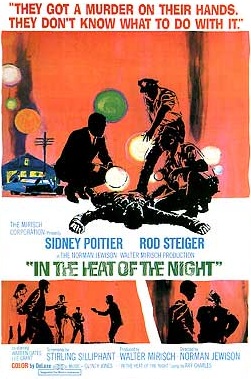
Scenes That I Love: Tibbs Meets Endicott in In The Heat Of The Night


Today, we observe what would have been Sidney Poitier’s 97th birthday.

Today’s scene that I love comes from the 1967 Best Picture winner, In The Heat of the Night.  In this film, Poitier plays Virgil Tibbs, a Northern cop who reluctantly finds himself helping a Southern sheriff (Rod Steiger) investigate a murder.  Tibbs’s number one suspect is Eric Endicott (Larry Gates), who owns what was then a modern-day plantation.

In this scene, Tibbs interrogates Endicott, a paternalistic racist who simply cannot believe or accept that he is being questioned by a black man.  When Endicott responds to one of Tibbs questions by slapping him, Tibbs slaps him right back.

While Endicott’s slap was in the original script, Tibbs’s response was not.  At first, Tibbs was meant to turn the other cheek and leave the plantation without saying a word.  Wisely, Poitier approached director Norman Jewison and objected to that, insisting that Tibbs would respond in kind.  The scene was rewritten and it became one of Poitier’s best moments in the film.

Horror Film Review: The Amityville Horror (dir by Stuart Rosenberg)


Based on a true story!

(Or maybe not. Actually, probably not…)

This 1979 film tells the story of George and Kathy Lutz (James Brolin and Margot Kidder), a young married couple who move into a big house in Amityville, New York. George and Kathy are having financial trouble so it’s good thing that they were able to find such a nice house at such a low price. Of course, it’s possible that the house was cheap because it was built on a native burial ground. Plus, the previous owners were murdered by their son, who later claimed that he was possessed by evil spirits. The house has a less than savory history but then again, what house doesn’t?

Anyway, strange things start to happen as soon as the Lutzes move in. Noxious black liquid floods the plumbing. Crosses are turned upside down. Their priest (Rod Steiger) gets violently ill when he attempts to bless the house. George starts to act weird, getting angry at strange moments and walking around with an ax. Kathy’s daughter from a previous marriage says that she’s made a new imaginary friend named Jodie and, apparently, Jodie doesn’t like George or her babysitter. Flies swarm through the house and weird noises are heard in the middle of the night. Kathy has nightmares. George screams, “I’m coming apart!” Even the family dog seems to be worried about the house, especially after a secret room is discovered in the basement.

Could the house be possessed!? Is a terrible, other worldly evil trying to destroy the George and Kathy? Will the Lutzes be able to escape and hopefully make a lot of money by selling their story? Watch the film and find out. And, if for some reason, you can’t watch this film, you can watch one of the dozen or sequels or maybe even the remake…

The original Amityville Horror was based on a book that claimed to tell the true story of the Lutzes. For the record, it is generally agreed that Ronald DeFeo murdered his family in Amityville, New York and that George and Kathy Lutz later moved into the DeFeo house. It’s also known that the Lutzes left the house after 30 days. The Lutzes claimed that the house was possessed. Others said that the Lutzes left because they couldn’t afford the house payments. Regardless of why the Lutzes actually left, the book that claimed to tell their story was a best seller.

As for the film adaptation, The Amityville Horror is frequently described as being a classic of horror cinema. However, I have to admit that, whenever I’ve tried to watch it, I’ve always ended up giggling after the first ten minutes or so. Some of that is because the film is such a blatant rip-off of The Exorcist, right down to including a bratty child with a invisible friend and a troubled priest who struggles with his faith. Just as The Exorcist featured Linda Blair throwing up on Max von Sydow and Jason Miller, The Amityville Horror seems to take a good deal of unsavory delight in tormenting Rod Steiger. From the minute he first shows up, the house really has it out for him. He gets swarmed by flies. He gets physically ill. His car stops working on him. It’s like, seriously, just leave Rod Steiger alone!

(Interestingly, Don Stroud plays Steiger’s protegee and their relationship is largely reminiscent of the relationship between Father Merrin and Father Karras in The Exorcist. Later, a police detective shows up and acts exactly like Lee J. Cobb’s Detective Kinderman. Val Avery, who plays the detective, even bears a resemblance to Lee J. Cobb. Considering just how successful The Exorcist was, it’s not surprising that the Amityville Horror would be influenced by it but, again, it’s still hard not to be a little bit amazed at just how blatant a rip-off Amityville really is.)

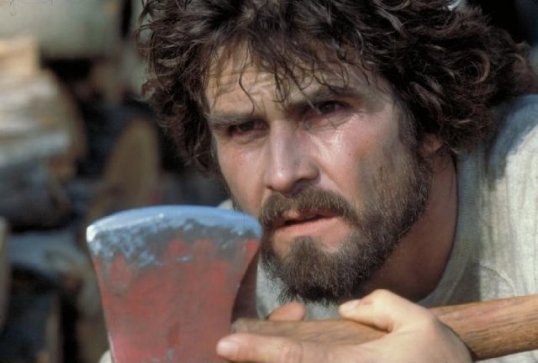
When the film isn’t tormenting Steiger, it’s concentrating on George going crazy. Unfortunately, as played by James Brolin, George seems to be in a permanently cranky mood even before he and Kathy move into their new home. Once the Lutzes movie into the house you find yourself wondering if George is possessed or if he’s just a jerk? Sometimes, it’s hard to tell. One thing is for sure: shortly after moving into the house, George becomes absolutely obsessed with chopping firewood and polishing his ax. I know the sight of Brolin with that axe is supposed to be ominous and scary but I have to admit that I started to laugh every time he started chopping away. Far more convincing was Margot Kidder in the role of Kathy but the film really didn’t give her much to do other than scream and worry about why her husband was always in such a sour mod.

Anyway, the most interesting thing about The Amityville Horror is that this rather slow and derivative film was such a box office success that it’s been followed by 20 sequels and one remake! Someday, when I’m feeling really, really brave, I’ll get around to reviewing all of the Amityville films. Until then, I leave you with George Lutz and his beloved ax.

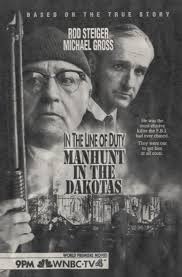
In The Line of Duty: Manhunt in the Dakotas (1991, directed by Dick Lowry)


On February 13th, 1983, a group of U.S. Marshals attempted to arrest a man named Gordon Kahl in North Dakota.  Kahl was an outspoken tax resistor.  He had already served time in Leavenworth for refusing to pay his taxes.  When he was released, he continued to refuse to pay and, in violation of his parole, started to attend meetings of the Posse Comitatus, an organization that refused to recognize the authority of any government above the county level.  Because Kahl was so prominent in anti-government circles, the plan was to make an example out of him by arresting him as he left a Posse Comitatus meeting.  Instead, Kahl,  his son, and an associate opened fire on the U.S. Marshals, killing two of them.  Kahl escaped and, for several months, was the subject of an FBI manhunt.

To make clear, Gordon Kahl was not a good man.  Gordon Kahl was a white supremacist and an anti-Semitic conspiracy theorist who was a follower of the Christian Identity movement.  While Kahl’s supporters claimed that Kahl originally fired on the marshals in self-defense, eyewitnesses testified that Kahl personally executed one marshal after he had already been wounded and was no longer a threat.  Gordon Kahl was no hero but, at a time when many farmers were struggling financially and felt helpless as they watched the banks and the government seize their land, many locals did sympathize with him.  The government’s attempt to publicly arrest Kahl and make an example out of him was seen as a classic example of government overreach.  The government was so eager to catch Kahl and Kahl was initially so successful in eluding them that Gordon Kahl became a folk hero.  When Kahl was discovered hiding out in an Arkansas farmhouse, it led to Kahl killing another deputy and the the government firing over a thousand rounds into the house before eventually setting it on fire.  In their effort to capture Gordon Kahl, the government behaved just as destructively as Kahl always said they would.

The hunt for Gordon Kahl served as the basis for the third of NBC’s In The Line of Duty films, Manhunt in the Dakotas.  Rod Steiger played Gordon Kahl.  Michael Gross, fresh off of playing a tax resistor in Tremors, played the FBI agent who headed up the manhunt.  Dick Lowry, director of the previous two installments of In The Line of Duty, returned to direct.

Manhunt in the Dakotas is a fair and even-handed look at the search for Gordon Kahl.  The film doesn’t shy away from Kahl’s racism and his paranoia but, at the same time, it also shows why many people instinctively distrust anyone who says that he’s from the government.  The film shows why so many supported Kahl without supporting Kahl itself.  Gross’s FBI agent may start out as rigid and by-the-book but he quickly learns that’s not the best way to get people to answer his questions.  Having come to understand why the people of the Dakotas don’t trust the government, he can only helplessly watch as the government does everything in its power to make Kahl’s paranoid claims seem plausible.  The FBI agent is determined to bring Gordon Kahl in alive but Kahl would rather be a martyr and it seems that the rest of law enforcement is all too happy to help Kahl achieve that.  Other than a few scenes were he indulges in his tendency to overact, Steiger gives a convincing performance as Kahl and he is well-matched by Michael Gross as the agent who comes to realize that there’s more to enforcing the law than giving orders and threatening to send people to prison.

Manhunt in the Dakotas would be followed by In The Line of Duty: Mob Justice, which I will review tomorrow.