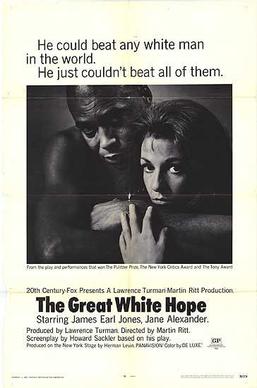
The Great White Hope (1970, directed by Martin Ritt)


The year is 1910 and the sports world is in a panic.  For the first time, a black man has won the title of the heavyweight champion of the world.  Jack Jefferson (James Earl Jones) had to go to Australia because no American city would agree to host the fight but he came out of it victorious.  The proud and outspoken Jefferson finds himself targeted by both the white establishment and black activists who claim that Jefferson has not done enough for his community.

It’s not just Jefferson’s success as a boxer that people find scandalous.  It’s also that the married Jefferson has a white mistress, a socialite named Eleanor Brachman (Jane Alexander, in her film debut).  While boxing promoters search for a “great white hope” who can take the title from Jefferson, the legal authorities attempt to arrest Jefferson for violating the Mann Act by supposedly taking Eleanor across state lines for “immoral purposes.”  Jefferson and Eleanor end up fleeing abroad but even then, their relationship is as doomed as Jefferson’s reign as the heavyweight champ.

Based on a Pulitzer-winning stage play by Howard Sackler, The Great White Hope features Jones and Alexander recreating the roles for which they both won Tonys.  Both Jones and Alexander would go on to receive Oscar nominations for their work in the film version.  It was the first nomination for Alexander and, amazingly, it was the only nomination that Jones would receive over the course of his career.  (It surprises me that he wasn’t even nominated for his work in Field Of Dreams.)  Both Jones and Alexander give powerful performances, with Jones dominating every scene as the proud, defiant, and often very funny Jack Jefferson.  Jones may not have had a boxer’s physique but he captured the attitude of a man who knew he was the best and who mistakenly believed that would be enough to overcome a racist culture.  (Speaking of racist, legendary recluse Howard Hughes reportedly caught the film on television and was so offended by the sight of Jones kissing Alexander that he thought about buying NBC to make sure that the movie would never be aired again.)  Hal Holbrook, Chester Morris, Moses Gunn, Marcel Dalio, and R.G. Armstrong all do good work in small roles.

Unfortunately, The Great White Hope still feels like a filmed stage play, despite the attempts made to open up the action.  Martin Ritt was a good director of actors but the boxing scenes are never feel authentic and the middle section of the film drags.  Jones and Alexander keep the film watchable but The Great White Hope is never packs as strong of a punch as its main character.
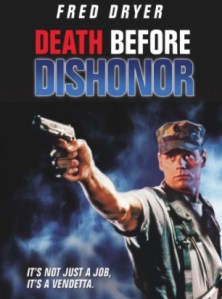
A Movie A Day #300: Death Before Dishonor (1987, directed by Terry Leonard)


In a fictional Middle Eastern country, tough-as-nails Col. Halloran (Brian Keith) has been kidnapped by terrorists.  The leader of the terrorists is named Jihad and he is played by the No Mercy Man himself, Rockne Tarkington.  The American ambassador (Paul Winfield) is a weak-willed Carter appointee who says, “We have to go through proper channels.”  Gunnery Sgt. Burns (Fred Dryer) ain’t got no time for the proper channels.  All of his men have been killed.  His mentor has been kidnapped and is being tortured with a power drill.  Even if it means breaking all the rules, Sgt. Burns is going to rescue Halloran, defeat Jihad, and kill anyone who has ever chanted “Death to the U.S.A.”
Totally a product of the 80s and about as politically incorrect as they come, Death Before Dishoner was an attempt to turn former football player-turned-TV star Fred Dryer into a movie star.  It did not work, though Fred does his best Clint Eastwood impersonation, chugging beer and speaking exclusively in tough one-liners.  Death Before Dishonor is dumb but entertaining.  (It may have been made for New World Pictures but it’s a Cannon Film at heart.)  The movie’s highlight if Fred Dryer chasing the bad guys in a jeep, keeping one hand on the steering wheel while using the other hand to fire a bazooka.  A close second is Brian Keith barely flinching while taking a power drill to the back of the hand.  No one’s tougher than an 80s action hero!

Cleaning Out The DVR: Women of San Quentin (dir by William A. Graham)


(Lisa is currently in the process of cleaning out her DVR!  She’s got over 170 films to watch before the end of 2017!  Will she make it?  Who knows?  She recorded 1983’s Women of San Quentin off of Retroplex on January 25th.)

For some reason, back in January, I felt the need to record several prison movies off of cable.  I’m not sure where my mind was at that I would see a title like Women of San Quentin listed in the guide and think to myself, “That’s something I definitely need to record.”  Maybe I was thinking of pursuing a career as a prison guard.  That seems to be the easiest way to get a show on A&E nowadays.

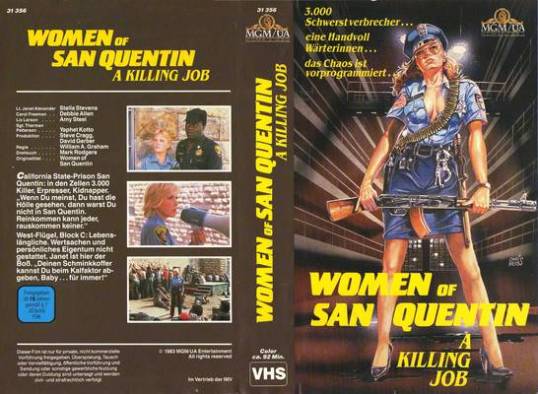
Anyway, I imagine that anyone reading this review is looking that title and considering the VHS cover art and they’re probably assuming that Women of San Quentin is some sort of Cirio Santiago-directed women in prison film.  And then consider the film’s cast: Amy Steel is best known for Friday the 13th Part II and April Fool’s Day.  Stella Stevens is an exploitation film vet.  One of the prisoners is played by Rockne Tarkington, who starred in a handful of blaxploitation films.  William Sanderson, star of the infamous Fight For Your Life, has a small role.  Yaphet Kotto plays a prison guard here but he’s best known for playing the villain in Live and Let Die.  Gregg Henry plays a sociopath.  Hector Elizondo and Debbie Allen play sympathetic guards.  Even Ernie Hudson, a now-respectable actor with several less-than-savory films on his resume, shows up.  Finally, consider this: Women of San Quentin was written by Larry Cohen, the man who directed both Black Caesar and It’s Alive.

However, despite all of that, Women of San Quentin is not an exploitation film.  Instead, it’s a made-for-TV movie.  (Director William A. Graham has over a hundred TV shows and made-for-TV movies to his credit.)  It follows several storylines.  Lt. Janet Alexander (Stella Stevens) is the tough-but-fair captain who is in charge of one of San Quentin’s most intimidating cell blocks.  She’s great at her job and she has a vaguely romantic relationship with Hector Elizondo but she’s also tempted to find a new career.  Charles Wilson (Ernie Hudson) steps up to lead the prison’s black inmates after another activist is assassinated.  Meanwhile, the leader of the Mexican Mafia plots a prison riot and Yaphet Kotto and Debbie Allen use any means necessary to discover what’s going to happen.

And then there’s Liz Larson (Amy Steel), the newest prison guard who struggles to prove that she belongs in San Quentin.  Sexist colleagues play cruel pranks on her.  The prisoners shout at her whenever she walks past their cells.  When she has to use a gun to break up a fight, she hesitates just a second too long.  Will she be able to step up when real trouble breaks out?  Among horror fans, Amy Steel is remembered for “surviving” several slasher films.  (Her performance as Ginny in Friday the 13th Part 2 largely set the standard for which all final girls are judged.)  Steel does a pretty good job as Liz but, actually, the entire movie is well-acted.  The script is frequently rudimentary but the cast is full of unique talent and it’s always fun to watch so many good actors playing opposite each other.

I assume that the Women of San Quentin was meant to be a pilot for a TV show or something.  It just has that feel to it.  If just for the cast alone, I would recommend watching Women of San Quentin if you get a chance.  I’m as surprised as anyone but, after all, where else are going to get a chance to watch Hector Elizondo, Yaphet Kotto, Stella Stevens, and Amy Steel all hanging out in a bar together?  There are certain opportunities that you just don’t miss.

Cleaning Out The DVR Yet Again #40: Melinda (dir by Hugh A. Robertson)


(Lisa recently discovered that she only had about 8 hours of space left on her DVR!  It turns out that she’s been recording movies from July and she just hasn’t gotten around to watching and reviewing them yet.  So, once again, Lisa is cleaning out her DVR!  She is going to try to watch and review 52 movies by the end of 2017!  Will she make it?  Keep checking the site to find out!)

melinda

I recorded Melinda off of TCM on November 13th.

First released in 1972, Melinda is technically a murder mystery.  Frankie J. Parker (Calvin Lockhart, giving a brilliant performance) is a popular radio DJ in Los Angeles.  When we first see Frankie, he’s driving his expensive sportscar through a poor neighborhood.  It’s a neighborhood that he knows well but, as opposed to those around him, he’s made it out.  He’s handsome, slick, and more than a little arrogant.  When he arrives at a local gym, he looks at himself in a mirror and says, “I shouldn’t say it … but I am a pretty motherfucker.”  Frankie’s a student in a taekwondo class taught by Charles Atkins (Jim Kelly).  Charles gives Frankie a hard time about not giving back to the community.  Frankie blows off his concerns.  To be honest, we really should dislike Frankie but he’s so damn charming.  As played by Calvin Lockhart, Frankie has one of those irresistible smirks, the type of the lights up the screen.

One night, Frankie meets the mysterious Melinda (Vonetta McGee) and spends the night with her.  He thinks that it’s just going to be another one night stand but Melinda tells Frankie that he has the potential to be more than he realizes.  Touched, Frankie goes to work and resolves to be a better person.  Then he returns home and discovers that Melinda has been murdered!

The rest of the film deals with Frankie’s attempts to discover who murdered Melinda.  It turns out that Melinda had underworld connections and mob boss Mitch (Paul Stevens) is desperate to recover something that Melinda had in her possession when she died.  But honestly, the whole murder subplot is a MacGuffin (if you want to get all Hitchcockian about it).  Ultimately, Melinda is a character study of Frankie Parker and how, over the course of solving Melinda’s murder, he learns that there’s more to life than just looking out for himself.

Though Melinda was obviously made to capitalize on the blaxploitation craze of the early 70s, it’s actually far more low-key than most of the better known films in the genre.  (Or, at least it is until the karate-filled finale.)  Perhaps because it was directed by a black man and written by noted black playwright Lonne Elder III, Melinda is far more interested in exploring what makes its characters who they are, as opposed to just putting a gun in their hand and having them shoot up the screen.  Frankie Parker emerges as a fascinating character.

Mention should also be made of the performance of Rosalind Cash, who plays Terry, Frankie’s ex.  Cash gets an absolutely amazing scene where, while attempting to convince a bank employee that she’s Melinda so that she can get into Melinda’s safe deposit box, she tells off a rude teller.  It’s such a good scene and Cash delivers her lines with such fury that you find yourself forgetting that the teller was actually correct in her suspicion that Terry wasn’t actually who she said she was.

Melinda is probably one of the best films that hardly anyone has ever heard of.  Keep an eye out for it.