Late Night Retro Television Review: Monsters 3.24 “The Moving Finger”


Welcome to Late Night Retro Television Reviews, a feature where we review some of our favorite and least favorite shows of the past! On Wednesdays, I will be reviewing Monsters, which aired in syndication from 1988 to 1991. The entire series is streaming on YouTube.
This week, Monsters comes to its conclusion.

Episode 3.24 “The Moving Finger”

(Dir by Kenny Myers, originally aired on April 26th, 1991)

Monsters comes to a close with an adaptation of a Stephen King short story.

Nerdy Howard (Tom Noonan) is shocked to discover that, every time he goes to any of the various drains in his house, a bony finger pokes out.  Howard’s wife can’t see the finger but Howard becomes obsessed with it, attacking it with a corrosive liquid and eventually a hedge trimmer.  No matter how much damage Howard does to it, the finger comes back, longer and stronger….

Despite the Stephen King pedigree and the presence of the usually reliable Tom Noonan, The Moving Finger makes for a disappointing conclusion to Monsters.  King’s style, and this is especially true of his short stories, often doesn’t translate well into visual adaptations.  The signature inner monologues and the building sense of dread can be difficult to recreate visually.  (One reason why The Shining is the best King adaptation is because Stanley Kubrick made the material his own and didn’t worry about trying to recreate all of King’s trademark  bullshit literary flourishes.)  Tom Noonan doesn’t have much of a character to play and the finger itself becomes less effective as the episode drags on.

Oh well!  Monsters was a generally uneven show so it’s perhaps appropriate that it ended on an unsteady note.  It’s the curse of the anthology format.  When Monsters was good, it was really, really good.  When it was bad, it was kind of boring.  There were a lot of good episodes that aired during the final season but, sadly, there were a few bad ones as well.  That said, the good Monsters episodes to outweigh the bad and forgettable ones.

That’s it for Monsters!  Next week, something new will premiere in this time slot.  What will it be?  I have no idea but I look forward to finding my next show!
Lisa Reviews An Oscar Nominee: Moonstruck (dir by Norman Jewison)


Nominated for Best Picture of 1987, Moonstruck is a film about love, romance, New York City, and being Italian.

Loretta Castorini (Cher) is a widow and a bookkeeper who lives with her parents, Cosmo (Vincent Gardenia) and Rose (Olympia Dukakis) in Brooklyn.  When her boyfriend, Johnny (Danny Aiello), asks Loretta to marry him, Loretta says yes even though she knows that, while she likes him, she’s not really in love with him.  After he proposes, Johnny reveals that he has to go to Sicily to see his “dying” mother.  He asks Loretta to pay a visit to his estranged brother, Ronny (Nicolas Cage), and invite him to the wedding.  Loretta, a strong believer in family and the importance of following tradition, agrees.

Loretta finds Ronny working in the bakery that he owns.  Ronny is not thrilled to learn that his brother has gotten engaged.  Ronny reveals that he has a wooden hand.  He lost his real hand when he accidentally placed it in a bread slicer while having a conversation with Johnny.  After he lost his hand, Ronny’s then-fiancée left him.  Ronny has never forgiven Johnny for the loss of his hand.  “I lost my hand!  I lost my bride!”  Ronny yells to the heavens.  Loretta, however, immediately understands that Johnny actually hurt his hand to get his fiancée to break up with him.  A conversation at Ronny’s apartment leads to the two of them impulsively sleeping with each other.  The next day, Ronny promises to never bother Loretta again if she agrees to go the opera with him.

What the guilt-stricken Loretta doesn’t know is that her father is having an affair himself and it turns out that Cosmo and Mona (Rose Gilette) enjoy the opera as well.  Meanwhile, Rose finds herself tempted by a lecherous college professor named Perry (John Mahoney).

There’s a lot of stereotypes to be found in Moonstruck.  Of course, passionate Ronny loves the opera.  Of course, the simple but well-intentioned Johnny abandons his fiancée so that he can rush to Sicily to be with his “dying” mother who, it turns out, isn’t dying at all.  Of course, Loretta slaps Ronny and tells him to snap out of it.  (I should note that I’m a fourth Italian myself so I could definitely relate to some of this film.  I’ve never liked opera, though.)  Fortunately, the film’s cast is so perfectly chosen and John Patrick Shanley’s script so adroitly maintains the balance between the broad comedy and the small dramatic moments that it doesn’t matter that all of the characters are a bit stereotypical.  The film comes to a wonderful life.  It’s impossible not love these characters, flaws and all.  Cher and Olympia Dukakis deserved the Oscars that they both won for this film.  Vincent Gardenia deserved the nomination that he received.  Nicolas Cage, Danny Aiello, and John Mahoney were not nominated but they should have been.  In particular, John Mahoney is heart-breaking in his small role, playing the type of lecherous character that most films would have just portrayed as being a cardboard buffoon.  As for Nicolas Cage, Moonstruck is a film that features both his trademark eccentricity and his ability to show the real and vulnerable human being underneath all of the bluster.  Moonstruck is a film about the search for love and the glory of finding it.  It’s a wonderfully romantic film, even if almost all of that love seems to involve infidelity.  As directed by Norman Jewison, Moonstruck not only celebrates falling in love but also celebrates being lucky enough to do so in New York City.  It’s a love letter not just to its characters but to the city as well.

Moonstruck was nominated for Best Picture but it lost to a far more epic production, The Last Emperor.


Embracing the Melodrama Part II #57: Saturday Night Fever (dir by John Badham)


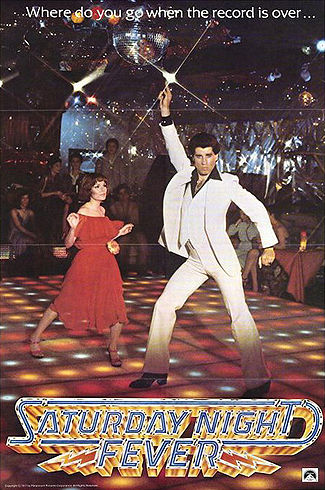
Saturday_night_fever_movie_posterHere’s a little bit of trivia about the iconic 1977 film Saturday Night Fever.

First off, according to the imdb, Saturday Night Fever was the first mainstream Hollywood film to ever use the term “blow job.”  That actually took me by surprise.  I mean, with all of the risks that the major studios took in the 70s, it still took them until 1977 to have someone say “blow job” in a movie?  But somehow, it seems appropriate that it would turn up in Saturday Night Fever.  We tend to think of Saturday Night Fever as being a movie where the soundtrack is nonstop disco and John Travolta dances in that iconic white suit.  But actually, Saturday Night Fever is a film about four guys who neither understand nor respect women.

When Tony (John Travolta), Joey (Joseph Cali), Double J (Paul Pape), and Bobby (Barry Miller) go down to that disco, it’s because they want to get laid.   Joey and Double J take turns having sex with insecure Annette (Donna Pescow) and, afterwards, Tony scornfully ask her if she‘s proud of herself.  When Bobby discovers that his girlfriend is pregnant, he is so terrified of having to be a father that he becomes suicidal.  As for Tony, he looks down on the women who are so eager to dance with him.  When he enters a dance contest with Stephanie (Karen Lynn Gorney), he can’t handle the fact that she wants more out of her life than just being his latest partner.

So, it makes sense that this would be the first mainstream movie to feature someone talking about a blow job because that’s what these boys are obsessed with.  Sexually primitive, hypocritically puritanical, and emotionally repressed, a blow job is all the intimacy that these boys can handle.

Another piece of trivia: while John Travolta was always the first choice for Tony Manero, several actors were seen for the roles of Joey and Double J.  At one point, both Ray Liotta and David Caruso were nearly cast in the role of Tony’s friends.  Imagine this: in some alternative universe, while white-suited John Travolta rules over the dance floor, Ray Liotta and David Caruso are standing in the background and cheering him on.

Of course, if Liotta and Caruso had been cast, it would be a totally different movie.  Whenever you watch Saturday Night Fever, you’re surprised by how much John Travolta totally dominates the film.  Even though the film devotes a good deal of time to Annette, Stephanie, Bobby and to Tony’s brother who has recently left the priesthood, Tony Manero is the only character that you remember.  That’s largely because Travolta is the only one of them who gives a truly memorable performance.

In theory, it’s easy to laugh at the thought of Travolta in that white suit, striking a dramatic pose on that cheap-looking dance floor.  But then you watch the film and you realize that Travolta truly did give a great performance.  And, to your surprise, you don’t laugh at Tony with his white suit because you know that the only time Tony has any control over his life is when he’s dancing.  He may work in a paint store.  He may regularly get slapped around by his family.  He may not be very smart or sensitive.  But when Tony’s dancing, he’s a king and you’re happy that he at least has one thing in his life that he can feel good about.

Even if he is kind of a jerk.

Of course, it helps that Tony is a really good dancer.  There’s actually a lot more going on in Saturday Night Fever than you might think but ultimately, it’s a dance movie and it’s one of the best.