The Asphyx, a 1972 horror film from the UK, opens in what would have been the film’s modern day. A horrific accident occurs when two cars collide. The drivers are both dead, with one of the them rather grotesquely hanging out of a shattered windshield. And yet somehow, an elderly pedestrian who was trapped underneath the two cars is still alive and able to shuffle away from the accident.
The film then jumps back to the Victorian-era. Sir Hugo Cunningham (Robert Stephens) is a scientist who is studying what happens at the exact moment of death. Taking a look of several pictures that were taken of people as they died, he spots a dark smudge that seems to be hovering near the subject of each photograph. Later, while making a home movie with an amazing new device called a motion picture camera, Sir Hugo can only watch in horror as his son Clive (Ralph Arliss) and Clive’s fiancee, Anna (Fiona Walker), both drown in a boating accident. When Sir Hugo later looks at the film, he notices a ghostly blue light that seems to be hovering over both his son and Anna.
Sir Hugo speculates that the light could be what the ancient Greek called the Asphyx, a force that comes for everyone’s life in the moment right before death. Hugo theorizes that everyone has their own individual Asphyx and he also comes to believe that if one were to capture their own Asphyx before it takes away their life, the result would be immortality. Working with his reluctant adopted son, Giles (Robert Powell), Hugo sets out to capture an Asphyx. Unfortunately, to do so means that someone has to be on the verge of death so that their Asphyx will show up. Giles is not happy about the idea of strapping Hugo into an electric chair or of sitting in a gas chamber himself but he agrees to do so in return for Hugo’s permission to marry Hugo’s daughter, Christina (Jane Lapotaire).
(Before we all say, “Ewwww!,” let us remember that Clive is only adopted. Still, it does feel a bit strange.)
The experiments lead to both tragedy and success. Heads roll, literally. And while Giles’s doubts continue to grow, Hugo finds himself more and more obsessed with the idea of living forever.
The Asphyx is a rather low-key horror film. No one is going to mistake this for one of Hammer’s bloody and flamboyant films. The horror is less in what is seen and more in what is implied. That said, the premise is an intriguing one, the film’s plot unfolds with a good deal of intelligence, and both Robert Powell and Robert Stephens overact so grandly during the film’s final few minutes that those who are just looking for a campy British horror film will be satisfied. Robert Stephens gives a very good performance as Sir Hugo, a scientist who claims that he’s just tying to make the world a better place but who is actually motivated by his own megalomania. (He reasons that he deserves to be immortal because he’s a scientist and his contributions are too important to be ended by a mere death.) Robert Powell’s somewhat wooden acting style actually makes him ideal for the role of Giles, who is written to be, at least in the beginning, a somewhat boring person. The film’s best performance comes from Jane Lapotaire, whose reaction to discovering how far her father is willing to go to capture an Asphyx is simply heart-breaking to watch.
The Asphyx is a great pick if you’re looking for an off-beat and intelligent horror film this scary season.
In 2021, I finally saw the infamous film, The Bonfire of the Vanities.
I saw it when it premiered on TCM. Now, I have to say that there were quite a few TCM fans who were not happy about The Bonfire of the Vanities showing up on TCM, feeling that the film had no place on a station that was supposed to be devoted to classic films. While it’s true that TCM has shown “bad” films before, they were usually films that, at the very least, had a cult reputation. And it is also true that TCM has frequently shown films that originally failed with audiences or critics or both. However, those films had almost all been subsequently rediscovered by new audiences and often reevaluated by new critics. The Bonfire of the Vanities is not a cult film. It’s not a film about which one can claim that it’s “so bad that it’s good.” As for the film being reevaluated, I’ll just say that there is no one more willing than me to embrace a film that was rejected by mainstream critics. But, as I watched The Bonfire of the Vanities, I saw that everything negative that I had previously read about the film was true.
Released in 1990 and based on a novel by Tom Wolfe, Bonfire of the Vanities stars Tom Hanks as Sherman McCoy, a superficial Wall Street trader who has the perfect penthouse and a painfully thin, status-obsessed wife (Kim Cattrall). Sherman also has a greedy mistress named Maria (Melanie Griffith). It’s while driving with Maria that Sherman takes a wrong turn and ends up in the South Bronx. When Sherman gets out of the car to move a tire that’s in the middle of the street, two black teenagers approach him. Maria panics and, after Sherman jumps back in the car, she runs over one of the teens. Maria talks Sherman into not calling the police. The police, however, figure out that Sherman’s car was the one who ran over the teen. Sherman is arrested and finds himself being prosecuted by a power-hungry district attorney (F. Murray Abraham). The trial becomes the center of all of New York City’s racial and economic strife, with Sherman becoming “the great white defendant,” upon whom blame for all of New York’s problems can be placed. Bruce Willis plays an alcoholic journalist who was British in the novel. Morgan Freeman plays the judge, who was Jewish in the novel. As well, in the novel, the judge was very much a New York character, profanely keeping order in the court and spitting at a criminal who spit at him first. In the movie, the judge delivers a speech ordering everyone to “be decent to each other” like their mothers taught them to be.
Having read Wolfe’s very novel before watching the film, I knew that there was no way that the adaptation would be able to remain a 100% faithful to Wolfe’s lacerating satire. Because the main character of Wolfe’s book was New York City, he was free to make almost all of the human characters as unlikable as possible. In the book, Peter Fallow is a perpetually soused opportunist who doesn’t worry about who he hurts with his inflammatory articles. Sherman McCoy is a haughty and out-of-touch WASP who never loses his elitist attitude. In the film, Bruce Willis smirks in his wiseguy manner and mocks the other reporters for being so eager to destroy Sherman. Hanks, meanwhile, attempts to play Sherman as an everyman who just happens to live in a luxury penthouse and spend his days on Wall Street. Hanks is so miscast and so clueless as how to play a character like this that Sherman actually comes across as if he’s suffering from some sort of brain damage. He feels less like a stockbroker and more like Forrest Gump without the Southern accent. There’s a scene, written specifically for the film, in which Fallow and Sherman ride the subway together and it literally feels like a parody of one of those sentimental buddy films where a cynic ends up having to take a road trip with someone who has been left innocent and naïve as result of spending the first half of their life locked in basement or a bomb shelter. It’s one thing to present Sherman as being wealthy and uncomfortable among those who are poor. It’s another thing to leave us wondering how he’s ever been able to successfully cross a street in New York City without getting run over by an angry cab driver.
Because the film can’t duplicate Wolfe’s unique prose, it instead resorts to mixing cartoonish comedy and overwrought melodrama. It doesn’t add up too much. At one point, Sherman ends a dinner party by firing a rifle in his apartment but, after it happens, the incident is never mentioned again. I mean, surely someone else in the apartment would have called the cops about someone firing a rifle in the building. Someone in the press would undoubtedly want to write a story about Sherman McCoy, the center of the city’s trial of the century, firing a rifle in his own apartment. If the novel ended with Sherman resigned to the fact that his legal problems are never going to end, the film ends with Sherman getting revenge on everyone who has persecuted him and he does so with a smirk that does not at all feel earned. After two hours of being an idiot, Sherman suddenly outthinks everyone else. Why? Because the film needed the happy ending that the book refused to offer up.
Of course, the film’s biggest sin is that it’s just boring. It’s a dull film, full of good actors who don’t really seem to care about the dialogue that they are reciting. Director Brian De Palma tries to give the film a certain visual flair, resorting to his usual collection of odd camera angles and split screens, none of which feel at all necessary to the story. In the end, De Palma is not at all the right director for the material. Perhaps Sidney Lumet could have done something with it, though he would have still had to deal with the less than impressive script. De Palma’s over-the-top, set piece-obsessed sensibilities just add to the film’s cartoonish feel.
The film flopped at the box office. De Palma’s career never recovered. Tom Hanks’s career as a leading man was momentarily derailed. Bruce Willis would have to wait a few more years to establish himself as a serious actor. Even the normally magnanimous Morgan Freeman has openly talked about how much he hated being involved with The Bonfire of the Vanities. That said, the film lives on because De Palma allowed journalist Julie Salomon to hang out on the set and the book she wrote about the production, The Devil’s Candy, is a classic of Hollywood non-fiction. (TCM adapted the book into a podcast, which is how The Bonfire of the Vanities came to be featured on the station.) Thanks to Salomon’s book, The Bonfire of the Vanities has gone to become the epitome of a certain type of flop, the literary adaptation that is fatally compromised by executives who don’t read.
Lucas (Ben Keyworth) is an 11-year-old boy who lives in London and who enjoys watching the neighborhood through his telescope. Because Lucas’s mother is blind, Lucas is concerned that there is a serial killer who is going around and attacking blind women. Lucas is determined to help his father (James Fox), an inspector with Scotland Yard, capture the killer. Lucas starts to sneak out of the house, visiting cemeteries and spying on the same blind women that the killer is stalking. Investigating on his own, Lucas discovers who the killer might be.
Or does he?
Outside of the imaginary world where he spends most of his time, Lucas is a shy boy and his father is not a detective but instead a florist. While Lucas’s mother actually is blind, Lucas himself is starting to lose his eyesight as well. Lucas is scheduled to undergo an experimental surgery. He’s due to go under the knife, just as surely as the victims of the serial killer that he thinks he’s hunting. Meanwhile, his mother is pregnant and the increasingly unstable Lucas is both obsessed with his older stepsister and jealous of all the attention that his new baby sister is already getting.
Afraid of the Dark is a British psychological thriller that deserves to be better known. Intelligently written and directed Mark Peploe, it’s both a poignant and a frightening look at a child who, due to being forced to deal with something that few others can understand, has retreated so far into his own imaginary world (where he can be the hero) that he can no longer tell what is real and what isn’t. Lucas is both frightening and sympathetic and the movie will keep viewers guessing as to what is real and what isn’t. James Fox and Fanny Ardant are perfectly cast as Lucas’s parents and David Thewlis, Paul McGann, and Robert Stephens all make an impression as the men who Lucas investigates in his search for the serial killer. Tense, intelligent, and surprising, Afraid of the Dark is a film that is worth discovering.
Now that the Oscars and the Sundance Film Festival are over with, it’s time to start a new series of reviews here on the Shattered Lens. For the rest of February, I will be looking at some films that deal with the universal topic of love. Some of these films will be romantic. Some of them will be sad. Some of them might be happy. Some of them might be scary. Some of them might be good. And some of them might be bad. In fact, to be honest, I haven’t really sat down and made out a definite list of which films I’ll be reviewing for Love On The Shattered Lens. Instead, I figure I’ll just pick whatever appeals to me at the moment and we’ll see what happens!
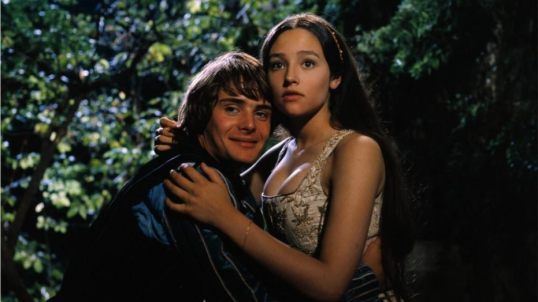
Let’s start things off with the 1968 film version of William Shakespeare’s Romeo and Juliet.
“Oh my God! Romeo and Juliet are hippies!”
Well, that’s not quite true. I mean, it is true that Romeo (played by Leonard Whitting) and Juliet (Olivia Hussey) are played by actual teenagers in this version of the classic play. It’s also true that, even though the film is set in a painstakingly recreated version of 15th century Verona, almost all of the actors have what would have then been contemporary haircuts. Romeo, Benvolio (Bruce Robinson), and Mercutio (John McEnery) all have longish hair, dress colorfully, and look like they could all be in the same band, covering the Beatles and writing songs about dodging the draft. Even Tybalt (Michael York) seems a bit counter-cultural in this version.
As played by Olivia Hussey, Juliet comes across as being far more rebellious in this version of Romeo and Juliet than in some of the others. It’s hard to imagine that Olivia Hussey’s Juliet would have much patience with Juliets played by Norma Shearer, Claire Danes, Hailee Steinfeld, or even the version of the character that Natalie Wood played in West Side Story. Olivia Hussey’s Juliet is always one step away from running away from home and hitch-hiking to the free Rolling Stones concert at the Altamont Speedway. Like the audience that the film was intended for, Romeo and Juliet both know that their parents are out-of-touch and that their friends are only temporary. Embracing love and pursuing all that life has to offer is what matters.
Was this the first film version of Romeo and Juliet to make explicit that the two characters had consummated their marriage? I imagine it was since it was apparently also the first version of Romeo and Juliet to feature on-screen nudity. That’s quite a contrast to the largely chaste 1936 version, in which Norma Shearer and Leslie Howard both seemed determined to keep a respectable distance from each other. Leonard Whiting and Olivia Hussey have an amazing chemistry together. They’re the two prettiest people in Verona and they just look like they belong together. From the minute they meet, you believe not only that they would be attracted to each other but that they’re also meant to be lovers.
Of course, we all know the story. The Capulets and the Montagues are rival families. Juliet is a Capulet. Romeo is a Montague. Juliet’s cousin, Tybalt, kills Romeo’s friend Mercutio. Romeo kills Tybalt. Juliet fakes her death. Romeo commits suicide. Juliet wakes up and does the same. The Prince shows up and yells at everyone. This film version moves around some of the events and it leaves out a few scenes but it actually improves on the play. For instance, poor Paris (Roberto Bissaco) doesn’t die in this version. Seriously, I always feel bad for Paris.
Throughout it all, director Franco Zeffirelli emphasizes the youth of the characters. It’s not just Romeo and Juliet who are presented as young. The entire Montague and Capulet feud is largely portrayed as being just a silly turf war between two competing high school cliques. When Tybalt and Mercutio have their fateful duel, it starts out largely as a joke and, when Tybalt kills Mercutio, it comes across as if it was an accident on Tybalt’s part. Tybalt appears to be just as shocked as anyone, like a scared kid holding a smoking gun and trying to explain that he didn’t know it was loaded when he pulled the trigger. When Mercutio curses both the Capulets and the Montagues, it’s all the more powerful because Mercutio is undoubtedly wondering how the duel could have so quickly gone from playful taunting to a fatal stabbing. The entire conflict between the Montague and the Capulets is a war that makes no sense, one in which the young are sacrificed while the old retreat to the safety of their homes.
Romeo and Juliet was a hit in 1968 and it’s still an achingly romantic film. Whiting and Hussey generate more chemistry in just the balcony scene than Leonardo Di Caprio and Claire Danes did in the entirety of Baz Luhrmann’s version of the tragic tale. Along with being a box office hit, it was also a critical hit. The Academy nominated it for best picture, though it lost to Oliver!


 Through the Shattered Lens