Horror Film Review: Empire of the Ants (dir by Bert I. Gordon)


Ants are interesting creatures.  On the one hand, they work hard and they can design and build a complex home in just a matter of hours.  They’re loyal to the other members of their tribe and they all happily do whatever needs to be done to keep their community healthy and moving forward.  They’re family-orientated.  They take care of their children.  They eat earth worms.  They fight other ants.  They can carry several pounds over their own weight.  They like to move in a single-file line.  These are all things that people, in general, admire.  If you had to hire someone to do some yardwork, you would want someone who had the attitude of an ant.

At the same time, ants also have no respect for privacy, they tend to get everywhere, and they bite you and leave behind those ugly red marks that take forever to go away and that can itch like heck.  I was once outside barefoot, helping someone wash his car, when I suddenly felt a really intense pain in my foot.  I looked down and saw that I had stepped straight into an ant hill.  It was not only an ant hill but it was a FIRE ANT HILL!  I grabbed a hose and I washed all of the ants off my foot but it was still one of the most painful experiences of my life.  Ants are hard-working and industrious but they’re also kind of mean and they really don’t like humans.  (Maybe they would like us more if people stopped kicking ant hills and using magnifying glasses to set them on fire.)  Ants will break into your house and then bite you when you tell them to go away.  My point is that you might like ants but ants do not like you and you better remember that!

The 1977 film, Empire of the Ants, is all about humanity’s mixed feelings towards ants.  Joan Collins plays a shady real estate agent who leads a group of potential home buyers into the bayou because she wants to trick them into buying some worthless property on a nearby island.   What Collins and her clients don’t know is that a barrel of radioactive waste was recently dumped off of a nearby boat and when the waste washed on shore, a bunch of ants got into it and it caused them to become giant ants!  The giant ants are industriously creating their own sugar-based society but they’re also attacking and brainwashing humans!

Needless to say, this is a Bert I. Gordon film.  Gordon took his “Mr. Big” nickname quite literally and, as a result, he spent almost his entire career making movies about animals and occasionally humans who were turned into giants by radiation.  Apparently, radiation can do anything!  Empire of the Ants is a typical Gordon film, in that the special effects are just bad enough to be kind of charming.  The ants are either awkwardly super-imposed into the scene or they are clearly made out of plastic.  There’s a scene where an ant grabs a man by his neck and it would be really terrifying if not for the fact that the ant’s head appears to have been made from Styrofoam.  Unfortunately, even though the special effects are bad in an amusing way, Empire of the Ants is still a pretty boring film.  Gordon devotes way too much time to the people heading out to look at Joan Collins’s beachfront property.  No one is watching a film like this for human drama.

This movie is based on a short story by H.G. Wells.  Wells, reportedly, considered it to be the worst thing he had ever written.

Late Night Retro Television Reviews: Monsters 1.4 “The Vampire Hunter”


Welcome to Late Night Retro Television Reviews, a feature where we review some of our favorite and least favorite shows of the past!  On Wednesdays, I will be reviewing Monsters, which aired in syndication from 1988 to 1991.  The entire show is streaming on Youtube.

This week, Monsters features a vampire!  Yay!  I usually love a good vampire story.

Episode 1.4 “The Vampire Hunter”

(Dir by Michael Gornick, originally aired on November 12th, 1988)

The fourth episode of Monsters opens in New England, towards the end of the 19th century.  Ernest Chariot (Robert Lansing) is a veteran vampire hunter who is planning on hanging up his crucifix and his stake so he can concentrate on flirting with the women who come to him searching for answers about the paranormal.  He even tells his young assistant, Jack (Jack Koening), that is planning on heading over to Austria so he can meet with Sigmund Freud and talk about dream interpretation with him.  Interestingly enough, it appears that Ernest doesn’t really believe in anything paranormal, outside of vampires.  Myself, I think if I ever saw proof that vampires existed, I would probably accept that anything could exist.  I mean, it’d be strange for it just be vampires.

Before he can retire, Ernest does have one last job to complete.  Ms. Warren (Page Hannah) claims that her brother has been acting strangely, as if he’s been bitten by a vampire.  Ernest is skeptical of Ms. Warren’s claims and decides to take a trip to Ms. Warren’s hometown so that he can investigate her background before he agrees to help her.  The far more naïve Jack, however, goes with Ms. Warren back to her home.

It turns out that Ernest was right to be suspicious because Ms. Warren is the reluctant servant of Charles Poole (John Bolger), a vampire who wears a blue mask because of a facial injury that was inflicted upon him by Ernest in the past.  Jack holds Ernest off with a crucifix but, after he loses that, he soon discovers that it’s not as easy to stake a vampire as he thought.

Ernest returns to his office from investigating Ms. Warren’s background, saying that it required him to work in cotton mill.  His housekeeper tells him that Jack left with Ms. Warren.  A panicked Ernest goes to Ms. Warren’s home where he finds Jack in a coffin and Charles Poole eager for a final battle….

And that’s pretty much it.  This was a really weird episode, largely because there wasn’t even an attempt at a clever twist at the end or anything like that.  Instead, it was just a straight-forward story of an old vampire hunter coming face-to-face with a vampire.  In the end, Ms. Warren chooses to help Ernest instead of Charles.  The good guys win and the final credits role.  It’s all very earnest and, again, straight-forward.  At the same time, it’s also not that interesting.  It feels like a scene from a bigger story and, when viewed outside of the context of that bigger story, it lacks the type of emotional depth necessary to really hold the viewer’s attention.

It’s a shame.  I usually love a good vampire story!  Unfortunately, this isn’t one.  Oh well.

Retro Television Review: The Astronaut (dir by Robert Michael Lewis)


Welcome to Retro Television Reviews, a feature where we review some of our favorite and least favorite shows of the past!  On Sundays, I will be reviewing the made-for-television movies that used to be a primetime mainstay.  Today’s film is 1972’s The Astronaut!  It  can be viewed on YouTube!

NASA has successfully landed a man on Mars!  The entire world watches as Col. Brice Randolph (Monte Markham) makes his way across the Martian surface.  However, suddenly, the signal goes out.  Viewers are assured that this is the sort of thing that happens all the time with interstellar travel.  What they don’t know is that the signal went down because Brice suddenly died.  While the surviving members of the mission return to Earth, NASA tries to figure out how to keep anyone from finding out what happened to Brice.  NASA director Kurt Anderson (Jackie Cooper) knows that the President wants to cut the budget and the death of an astronaut would probably provide the perfect excuse for taking money away from NASA and canceling the Mars program.

Anderson’s solution is to recruit a substitute.  Eddie Reese (Monte Markham) has a slight resemblance to Brice, one that can be perfected through plastic surgery.  While the mission returns from Mars, Eddie goes through a crash course to teach him how to talk, walk, and think like Col. Brice Randolph.  Eddie is told that he’ll have to be Brice until the NASA scientists can figure out what led to Brice’s death.  Once they do know what went wrong with the mission, Eddie will have to go into NASA’s version of the witness protection.

Eddie proves to be a quick learner and it helps that he, like so many others, looked up to Brice.  However, while Eddie can fool almost everyone else, he cannot fool Brice’s wife, Gail (Susan Clark).  When Eddie actually treats Gail with kindness and shows sympathy for her nervous condition, she realizes that there’s no way that Eddie is actually her husband.  Apparently, Brice was not quite the saintly figure that the public believed him to be.  Eddie and Gail soon fall in love for real but when NASA finally discovers what led to Brice’s death, it looks like their new life together might be over as abruptly as it begun.

The Astronaut is a low-key conspiracy …. well, I hesitate to call it a thriller.  There’s little of the things that one typically associated with a conspiracy thriller.  There’s no black helicopters.  There’s no shadowy assassins.  There’s no army of men walking around in black suits.  Instead, there’s just a bunch of nervous bureaucrats who are desperate to keep the rest of the world from discovering just how much they screwed up.  As played by Jackie Cooper, the head of NASA isn’t so much evil as he’s just way too devoted-to-his-job for his own good.  In many ways, this is probably one of the most realistic conspiracies ever portrayed on film.

In the end, The Astronaut is a portrait of two lonely people who find love in the strangest of circumstances.  Susan Clark and Monte Markham make for a likable couple and the viewer really does hope that things will work out for them.  What this film lack in conspiracy thrills, it makes up for in human drama.  It appealed to both my romantic and my rabid anti-government sides.  What more could one ask?

Film Review: Acapulco Gold (dir by Burt Brinckerhoff)


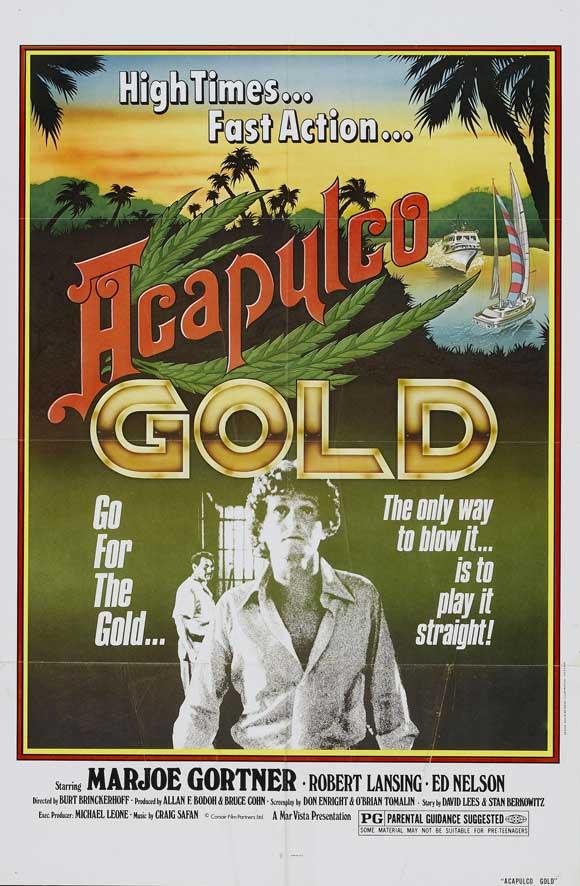
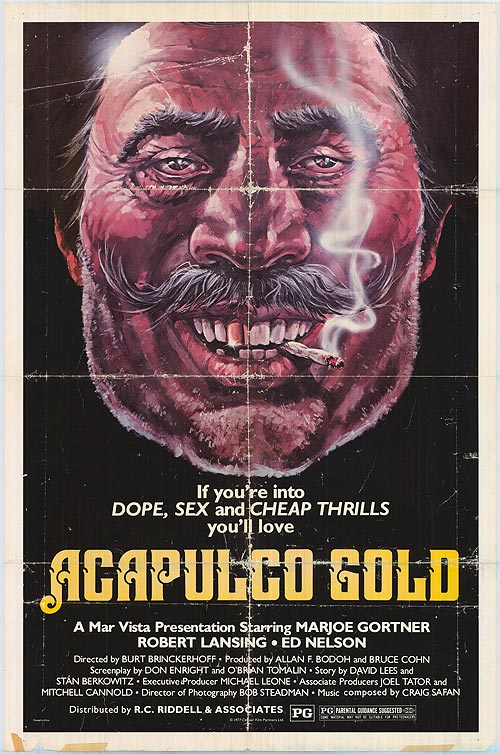
The poster is better than the film.

I just finished watching Acapulco Gold, a rather goofy 1976 film about …. well, who knows?

The film starts with some well-shot footage of marijuana farmers checking out their crop but then it abruptly abandons all of that to follow an American insurance salesman named Ralph Hollio (Marjoe Gortner). Ralph is at an airport in Acapulco, waiting to board a flight back to America. He’s approached by a nun who asks him to carry a piñata for her. Ralph says sure but — oh no! — that piñata is actually full of heroin! Ralph’s an unwitting drug mule and not a very good one because it doesn’t take long for him to get himself arrested and sentenced to 40 years in a Mexican prison.

Despite this run of bad luck, Ralph remains surprisingly cheerful. One is tempted to almost describe him as being a Candide-like figure but that would probably be giving this film too much credit. In prison, he meets another prisoner, a boat captain named Carl Solberg (Robert Lansing). Carl is sprung from jail by local businessman, Morgan Frye (John Harkins). Frye wants Carl to sail a boat from Mexico to Hawaii. Carl agrees but he insists that Morgan also pull some strings so that Ralph can serve as his first mate. Morgan, of course, agrees.

The film’s “action” shifts to Hawaii, where it turns out that Ralph and Carl are being used as a part of a much bigger plot. Or something. To be honest, it’s a bit difficult to figure out just what exactly is going on. Acapulco Gold has a make-it-up as you go along feel to it. Occasionally, it’s amusing. Often, it’s frustrating. As soon as you start to get in any way interested in one storyline, it gets abandoned. The film doesn’t have a plot as much as it has a bunch of scenes that we’re left to assume are meant to be somehow connected.

For instance, there’s an elderly couple who keep showing up at inopportune times, providing what I guess is meant to be comedic relief. At one point, it appears that the couple is surely doomed but, several scenes later, they show up at a golf course and they look none the worse for wear. There are lengthy sailing scenes, mixed in with lengthy helicopter scenes. None of them add much to the plot but the Hawaiian scenery is frequently nice to look at. Ralph falls for Morgan’s girlfriend (Randi Oakes) while a Congressman and a corrupt DEA agent use huge, oversized walkie-talkies to communicate with two people who we occasionally see wandering around in the jungle. There’s a golf cart chase, which ends with a labored joke about a two-strike penalty. And, since this is a low-budget 70s film, there’s a day-for-night sequence that is so ineptly lit that we can barely see anyone for several minutes of the movie. (Though his face may not be visible, one can always spot Marjoe Gortner by his hair. 70s Marjoe had a lot of hair.)

At its best, Acapulco Gold is a charmingly incoherent time capsule, a chance to hop in a time machine and go back to 1976. At its worse, it’s a total mess. That said, it’s short enough that it’s never exactly boring and the randomness of it all occasionally lends the film a dream-like atmosphere (albeit one of those dreams that you forget about after you’ve been awake for 87 minutes). As I previously stated the Hawaiian scenery is lovely and some members of the cast — Robert Lansing and Ed Nelson, in particular — do the best that they can with their inconsistently written characters. The whole thing is such a slapdash affair that it becomes oddly fascinating to watch.

As for the film’s star, Marjoe Gortner was a former child evangelist whose claim to fame was being the subject of Marjoe, a documentary in which he admitted that he didn’t believe in anything that he preached and that he was just scamming people out of their money. Perhaps not surprisingly, Gortner was usually best-cast as villains or unpredictable rogues. (His best performance was as a morally ambiguous space pirate in Starcrash.) In Acapulco Gold, Gortner is playing a normal, ordinary guy who finds himself caught up in the drug underworld. Gortner is miscast as a naive innocent and, instead of projecting any sort of shock over anything tht he experiences, Gortner’s laid back performance suggests that there were multiple reasons why this film was called Acapulco Gold.

Acapulco Gold is currently viewable on Prime. It’s not a particularly good film but Hawaii has always looked great.

After School (1988, directed by William Olsen)


After School is a strange “what were they thinking?” type of movie.  It’s also probably the only movie to end with a religious debate that’s moderated by Dick Cavett.

Cavett plays himself.  In this film, he still has a talk show and one of his guests is going to be C.A. Thomas (Robert Lansing), a former priest who has written a novel claiming that man created God and not the the other way around.  Cavett has reached out to the Catholic Church to ask them to send someone to represent their views on the show.

For reasons that are never clear, the Church selects Father Michael McClaren (Sam Bottoms), who teaches at a college in Florida.  Father McClaren is youngish and he rides a motorcycle, which the monsignor thinks will appeal to younger viewers of Cavett’s show.  (Did The Dick Cavett Show have younger viewers?)  Because Dick Cavett is legendary for investigating the pasts of all of his guests (that’s what they say in the movie, anyway), another priest is sent down to Florida to make sure that Father McClaren does not have any skeletons in his closet.

At first, Father McClaren seems to be perfect but it turns out that he’s having a crisis of faith.  It’s not just that the local bikers don’t have much respect for a priest, even when who does ride a bike.  It’s also that he’s become attracted to one of his students, the improbably-named September Lane (Renee Coleman).  It doesn’t take the movie long to settle into a familiar pattern of September coming on Father McClaren and then Father McClaren having to run off so that he can pray for strength.

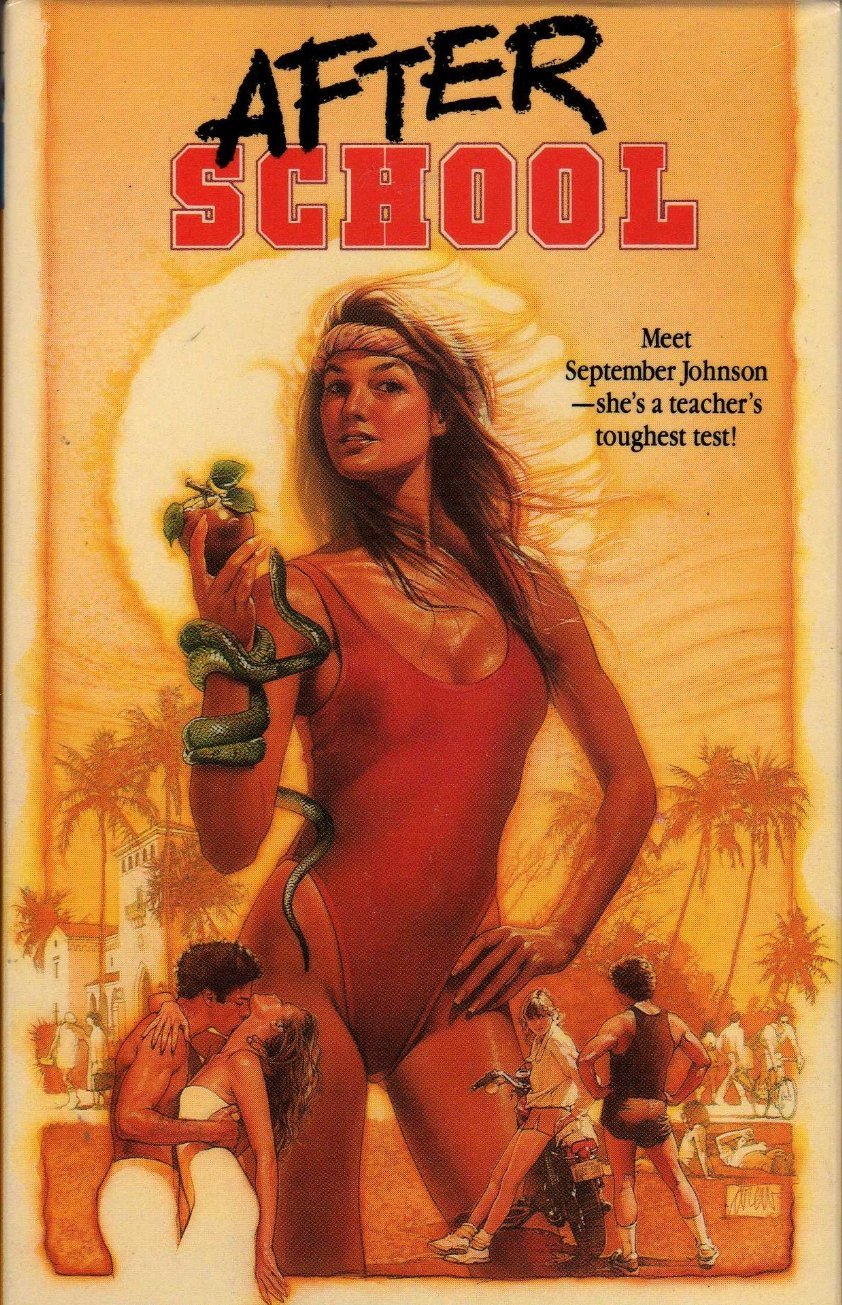
So far After School might sound like a typical movie about a priest being tempted to break his vows.  However, what sets After School apart from other films of its type is that there are frequent scenes featuring a group of cavemen living in prehistoric times.  It’s never really made clear why the cavemen are in the film.  The main caveman yells a lot and there’s a scene with a snake that suggests that he might live in the Garden of Eden.  (The movie was originally released under the title Return to Eden.)  There’s also several naked cavewomen who are in the film so that they can be ogled by the cavemen.  Oddly, the cavepeople scenes are full of broad comedy while the rest of the movie takes itself fairly seriously.

Why are the caveman there and what does it have to do with Dick Cavett?  Who knows?  That’s one of the many unanswered questions to be found in After School.  When C.A. Thomas and Father McClaren do finally meet on the Dick Cavett Show, they debate the origins of mankind.  Neither one has nothing new to say on the subject.  Even though everything that C.A. Thomas says sounds like New Age gobbledygook, Father McClaren proves himself to be incapable of countering him.

I don’t know what the point of After School was.  There were so any scenes, like one in which Father McClaren attends an aerobics class, that didn’t seem to have any purpose.  September’s lust for Father McClaren never makes any sense and his sudden declaration of love makes even less.  Even if you can make sense of all that, there’s still the cavemen and Dick Cavett to deal with.

After School thinks that it is about something but who knows what?